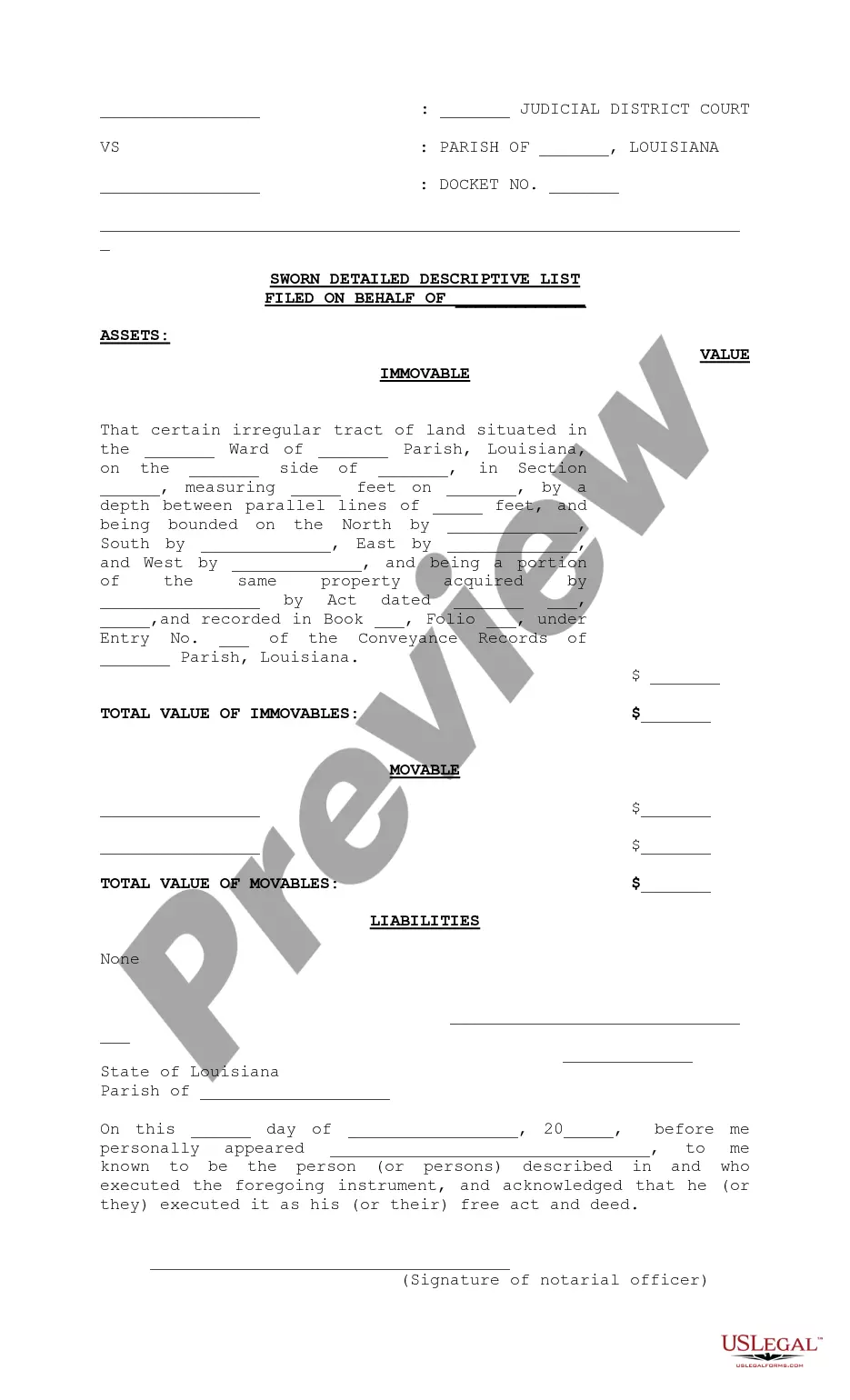
Louisiana Sworn Detailed Descriptive List of Immovable and Movable Property
What this document covers
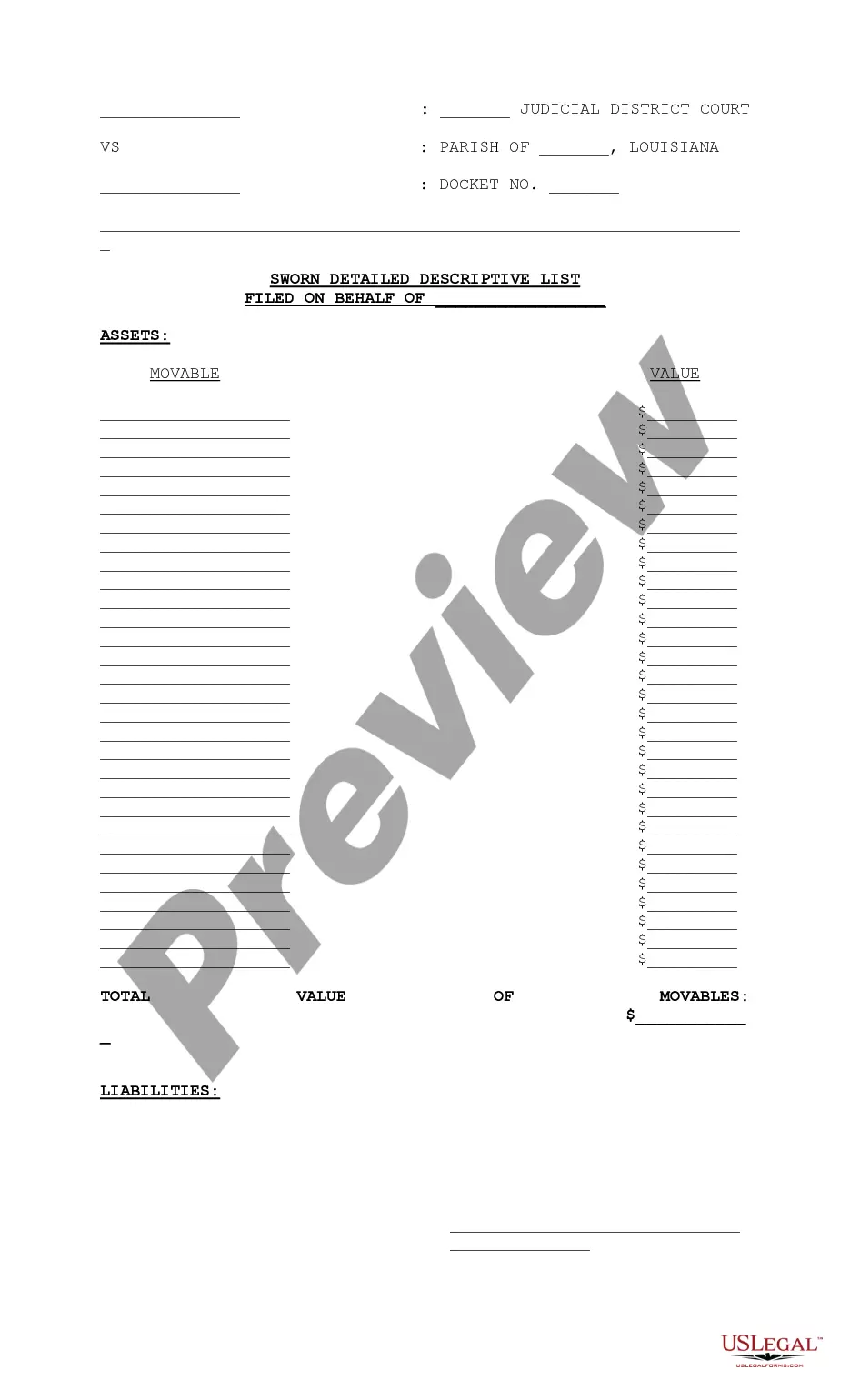
The Sworn Detailed Descriptive List of Immovable and Movable Property is a legal document that outlines both immovable and movable community property and liabilities in divorce proceedings. This form is filed with the court to provide a clear account of shared assets and debts when parties cannot reach a mutual agreement on property division, adhering to Louisiana law (LA.R.S. 9:2801). It serves a distinct purpose by formalizing asset documentation for judicial partitioning, differentiating it from other real estate or personal property forms.
Key parts of this document
- Identification of the court and docket number where the case is filed.
- Details of immovable property, including location, dimensions, and legal descriptions.
- Listing of movable property with its corresponding value.
- Declaration of any existing liabilities.
- Signature and notarization section to validate the document.
When to use this form
This form is essential in situations where spouses are undergoing divorce proceedings and cannot agree on how to amicably divide their community property. It is typically used when one party requests a judicial partition of the property through the court, ensuring that all assets and liabilities are clearly documented and apportioned according to legal standards.
Who needs this form
- Individuals involved in a divorce in Louisiana.
- Cplplaintiffs or defendants who are unable to agree on the division of property.
- Anyone needing to provide a detailed description of community property and liabilities to the court.
Completing this form step by step
- Identify the parish and court information on the form.
- Clearly describe each item of immovable property, including measurements and boundaries, as required.
- List movable property along with its estimated value.
- State any liabilities that apply to the community property.
- Sign the document in the presence of a notary public to ensure its validity.
Notarization requirements for this form
This form needs to be notarized to ensure legal validity. US Legal Forms provides secure online notarization powered by Notarize, allowing you to complete the process through a verified video call, available anytime.
Get your form ready online
Our built-in tools help you complete, sign, share, and store your documents in one place.
Make edits, fill in missing information, and update formatting in US Legal Forms—just like you would in MS Word.
Download a copy, print it, send it by email, or mail it via USPS—whatever works best for your next step.
Sign and collect signatures with our SignNow integration. Send to multiple recipients, set reminders, and more. Go Premium to unlock E-Sign.
If this form requires notarization, complete it online through a secure video call—no need to meet a notary in person or wait for an appointment.
We protect your documents and personal data by following strict security and privacy standards.

Make edits, fill in missing information, and update formatting in US Legal Forms—just like you would in MS Word.

Download a copy, print it, send it by email, or mail it via USPS—whatever works best for your next step.

Sign and collect signatures with our SignNow integration. Send to multiple recipients, set reminders, and more. Go Premium to unlock E-Sign.

If this form requires notarization, complete it online through a secure video call—no need to meet a notary in person or wait for an appointment.

We protect your documents and personal data by following strict security and privacy standards.
Mistakes to watch out for
- Failing to include all assets and liabilities, which can lead to future disputes.
- Inaccurate descriptions of property that do not match official records.
- Not having the form notarized, rendering it potentially invalid.
- Omitting signatures or dates required for legal endorsement.
Advantages of online completion
- Convenience of downloading and printing the form at home.
- Editability allows for customization to fit individual circumstances.
- Access to attorney-drafted templates ensures legal compliance and reduces errors.
- Streamlined process helps facilitate timely submissions to the court.
Key takeaways
- This form is essential in cases of contested property division during divorce in Louisiana.
- Accurate and complete information is crucial for fair judicial partitioning of property.
- Notarization is required for the form to be legally binding.
Looking for another form?
Form popularity
FAQ
The term movable property is commonly used to refer to tangible assets that are movable. For example, computers, paintings, jewellery, vehicles, etc. are all tangible assets that are characterised by their movability i.e. it can be moved around.
Example of movable property includes vehicles, timber, crops, home accessories like curtains, beds, almirah, etc. Immovable property examples will include land, building, trees attached to the land.
Immovable property, in the sense used, commonly refers to real estate (such as your house, factory, manufacturing plant, etc.) while movable property refers to movable assets (such as your computer, jewellery, vehicles, etc.).
Money is a movable property.
Movable property means property the location of which can be changed, including things growing on, affixed to, or found in land, and documents although the rights represented thereby have no physical location. "Immovable property" is all other property.
A movable property, as per many references and common understanding, refers to things like jewellery, watches, computers, money, etc.Section 22 of the Indian Penal Code (IPC) has provided the definition of movable property as any corporeal property except land and things permanently attached to the earth.
Section 2(9) of the same Act states that "'movable property' includes standing timber, growing crops and grass, fruit upon and juice in trees, and property of every other description, except immovable property."Under the General Clauses Act, all trees would be immovable property, as they are attached to the earth.
The term 'movable property' has been mentioned in Section 12(36) of the General Clause Act, 1847 and Transfer of Property Act, 1882. Section 22 of the Indian Penal Code (IPC) has provided the definition of movable property as any corporeal property except land and things permanently attached to the earth.