Louisiana Judgment for Child Support
About this form
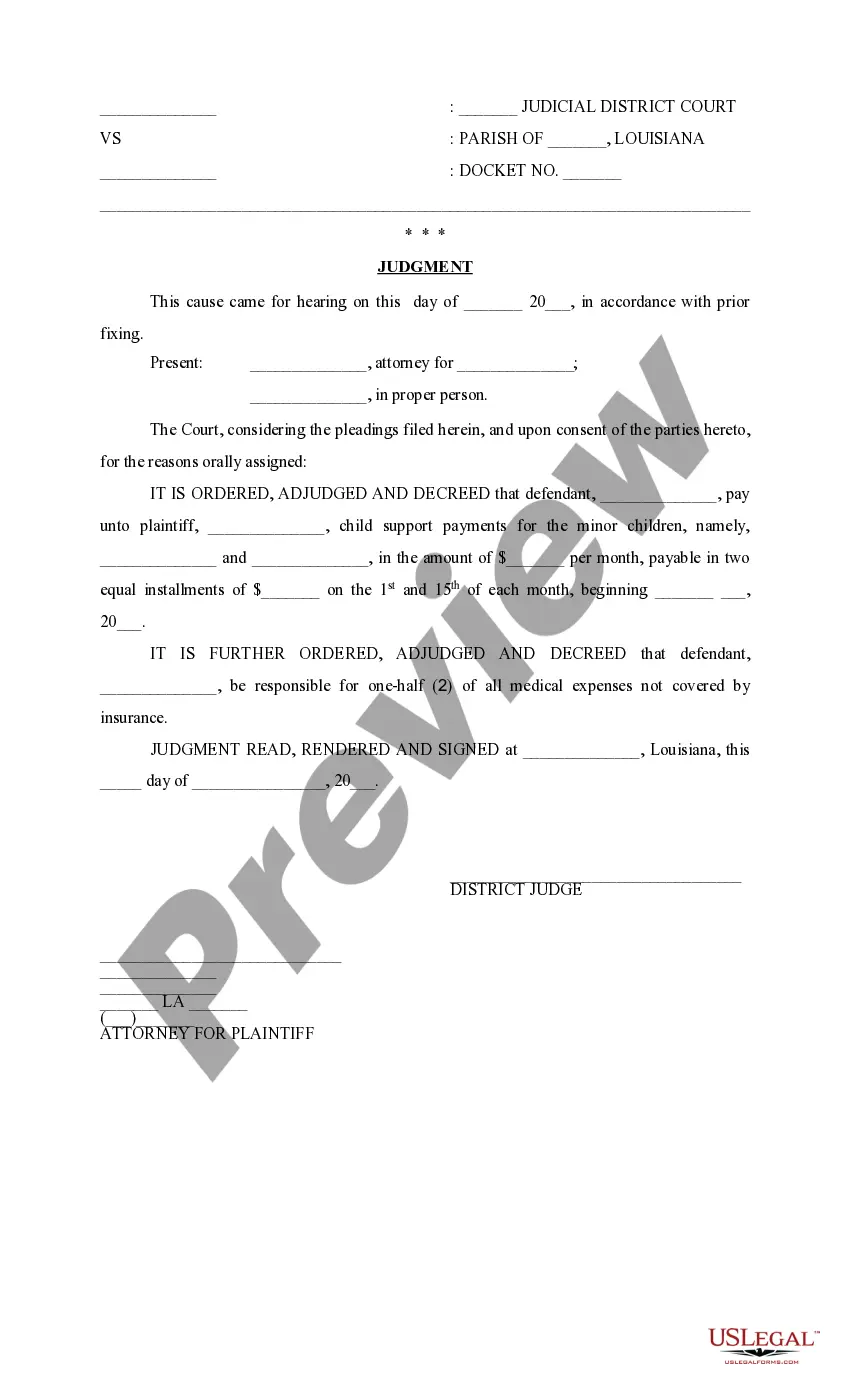
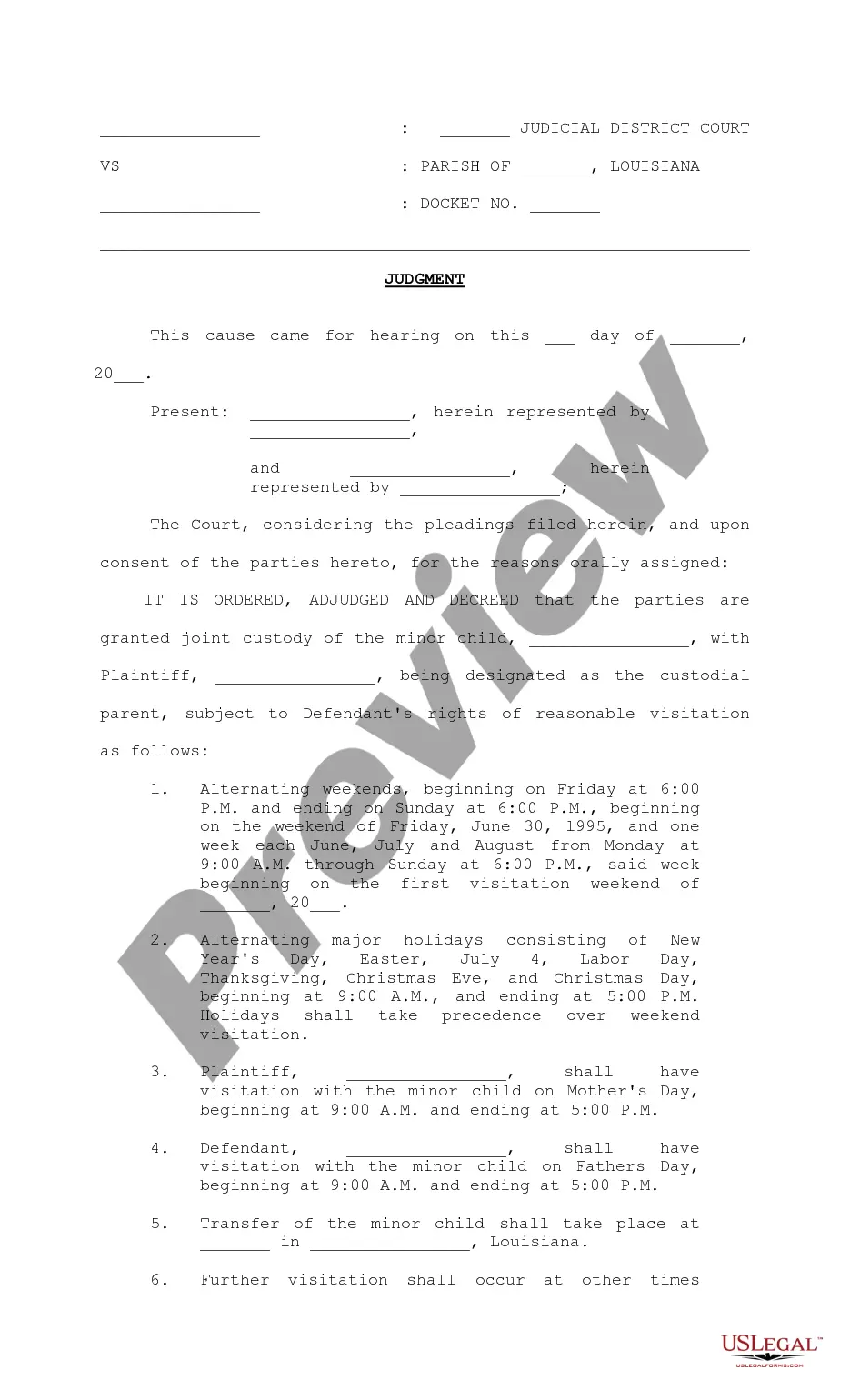
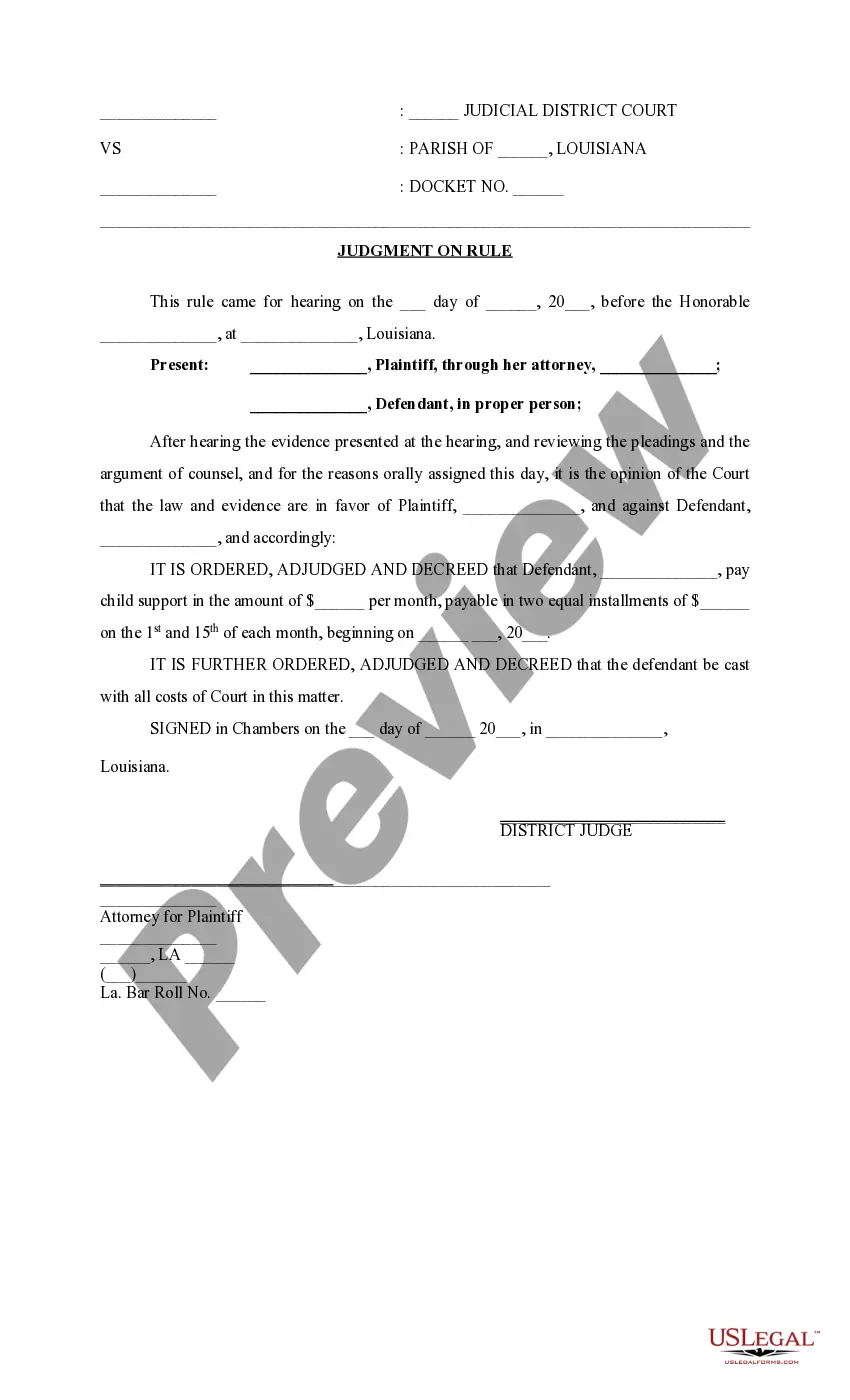
The Judgment for Child Support is a legal document issued by a court that determines the financial support one parent must pay to the other for the upbringing of their minor children. This form is specifically meant to establish the amount and payment schedule for child support, setting it apart from other custody or divorce agreements. It ensures that both parents contribute fairly to the costs of raising their children, including medical expenses not covered by insurance.
What’s included in this form
- Parties involved: Names of the plaintiff and defendant for clarity and legal identification.
- Amount of child support: Specifies the monthly payment amount and installment schedule.
- Payment schedule: Details the dates when payments are due each month.
- Medical expenses: Outlines the responsibility for covering half of the children's uninsured medical costs.
- Court details: Provides information about the court's jurisdiction and case number.
- Judge's signature: Confirms the judgment's validity with the district judge's signature and date.
Common use cases
This form is typically used in cases of divorce, legal separation, or paternity disputes when child support needs to be formally established by a court. It is essential when parents cannot come to an amicable agreement on child support payments and requires a judicial order for enforcement. The judgment ensures that the financial needs of the children are met consistently.
Who should use this form
- Parents involved in legal proceedings regarding child support obligations.
- Individuals seeking to formalize child support for the care of their minor children.
- Parties where one parent has filed a petition for child support in a family court.
- Individuals needing a legally binding agreement to address child support payments.
How to complete this form
- Identify the parties by entering the names of the plaintiff and defendant.
- Specify the amount of child support to be paid monthly and divide it into two equal installments.
- Set the payment dates for child support, typically scheduled for the 1st and 15th of each month.
- Indicate the childrenâs names for whom the child support is being provided.
- Include any obligations regarding medical expenses that are not covered by insurance.
- Obtain the signature of the district judge to finalize the judgment.
Does this form need to be notarized?
This form does not typically require notarization unless specified by local law. However, it is important to check specific state requirements to ensure compliance.
Get your form ready online
Our built-in tools help you complete, sign, share, and store your documents in one place.
Make edits, fill in missing information, and update formatting in US Legal Forms—just like you would in MS Word.
Download a copy, print it, send it by email, or mail it via USPS—whatever works best for your next step.
Sign and collect signatures with our SignNow integration. Send to multiple recipients, set reminders, and more. Go Premium to unlock E-Sign.
If this form requires notarization, complete it online through a secure video call—no need to meet a notary in person or wait for an appointment.
We protect your documents and personal data by following strict security and privacy standards.

Make edits, fill in missing information, and update formatting in US Legal Forms—just like you would in MS Word.

Download a copy, print it, send it by email, or mail it via USPS—whatever works best for your next step.

Sign and collect signatures with our SignNow integration. Send to multiple recipients, set reminders, and more. Go Premium to unlock E-Sign.

If this form requires notarization, complete it online through a secure video call—no need to meet a notary in person or wait for an appointment.

We protect your documents and personal data by following strict security and privacy standards.
Avoid these common issues
- Failing to correctly identify all parties involved, leading to enforceability issues.
- Leaving out details regarding medical expenses can result in unexpected costs later.
- Incorrectly calculating the support amount or payment schedule that does not comply with state laws.
Benefits of completing this form online
- Convenience: Access and complete the form from anywhere without the need for in-person visits to legal offices.
- Editability: Easily make changes or updates as circumstances change or if disputes arise.
- Reliability: Forms are drafted by licensed attorneys, ensuring they meet legal standards and requirements.
What to keep in mind
- Child support judgments establish clear financial responsibilities for both parents.
- Using the form correctly helps to avoid future legal disputes regarding payments.
- The form is state-specific and designed to meet Louisiana's legal standards for child support.
Looking for another form?
Form popularity
FAQ
The court estimates that the cost of raising one child is $1,000 a month. The non-custodial parent's income is 66.6% of the parent's total combined income. Therefore, the non-custodial parent pays $666 per month in child support, or 66.6% of the total child support obligation.
Child support back pay cannot be totally forgiven or waived, but there are a few situations that can help you handle it. Double-check the amount the court states you are in arrears. You can always ask the court to recalculate this amount to make sure it is correct.You can request a manageable payment schedule.
As with other types of government debt, the consequences can be severe if you don't pay. The Child Support Agency (CSA) or Child Maintenance Service (CMS) have the powers to deduct arrears and ongoing payments straight from your earnings or bank account.
Yes, because the law requires a non-custodial parent (that is, a parent who does not live with the child) pay a minimum amount of child support. That minimum amount is $100.00 a month for any number of children.
Louisiana law requires both parents to pay child support based on the needs of the child and the ability of the parents to provide support. Both parents are expected to provide basic financial support for things like food, housing, and clothing.
The court estimates that the cost of raising one child is $1,000 a month. The non-custodial parent's income is 66.6% of the parent's total combined income. Therefore, the non-custodial parent pays $666 per month in child support, or 66.6% of the total child support obligation.
For certain outstanding debts -- including past-due child support and unpaid student loans -- the IRS can withhold some or all of your unpaid stimulus payment issued as a Recovery Rebate Credit when you file your taxes.
The statute of limitations for child support enforcement in Louisiana is 10 years.
A custodial parent can waive or forgive all arrears owed to him or her directly. Use the Account Summary from the SCU to determine what arrears are owed to the parent, and what arrears are owed to the state (if the custodial parent ever received Public Assistance).