Louisiana Judgment of Divorce with community property, no children
What this document covers
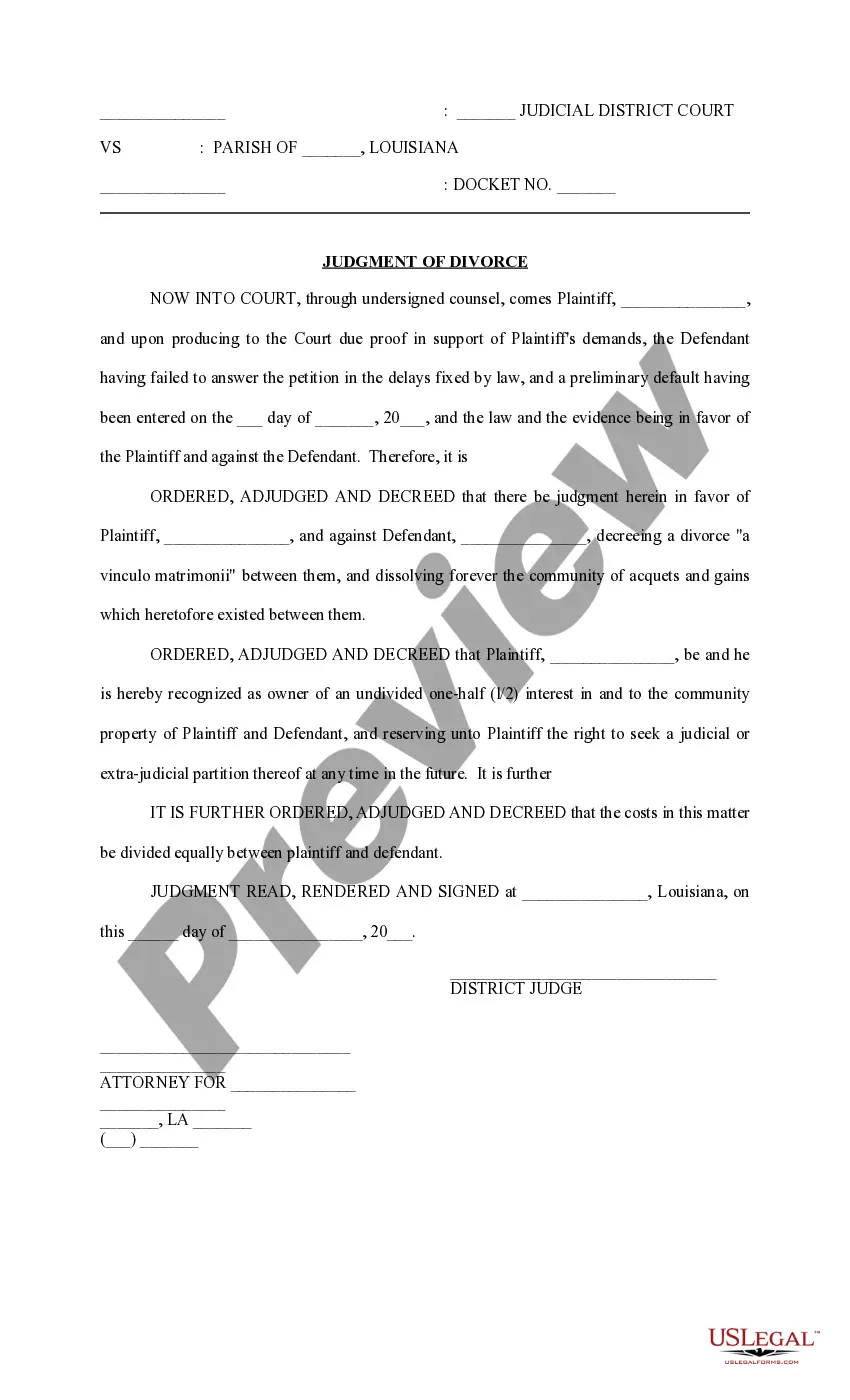
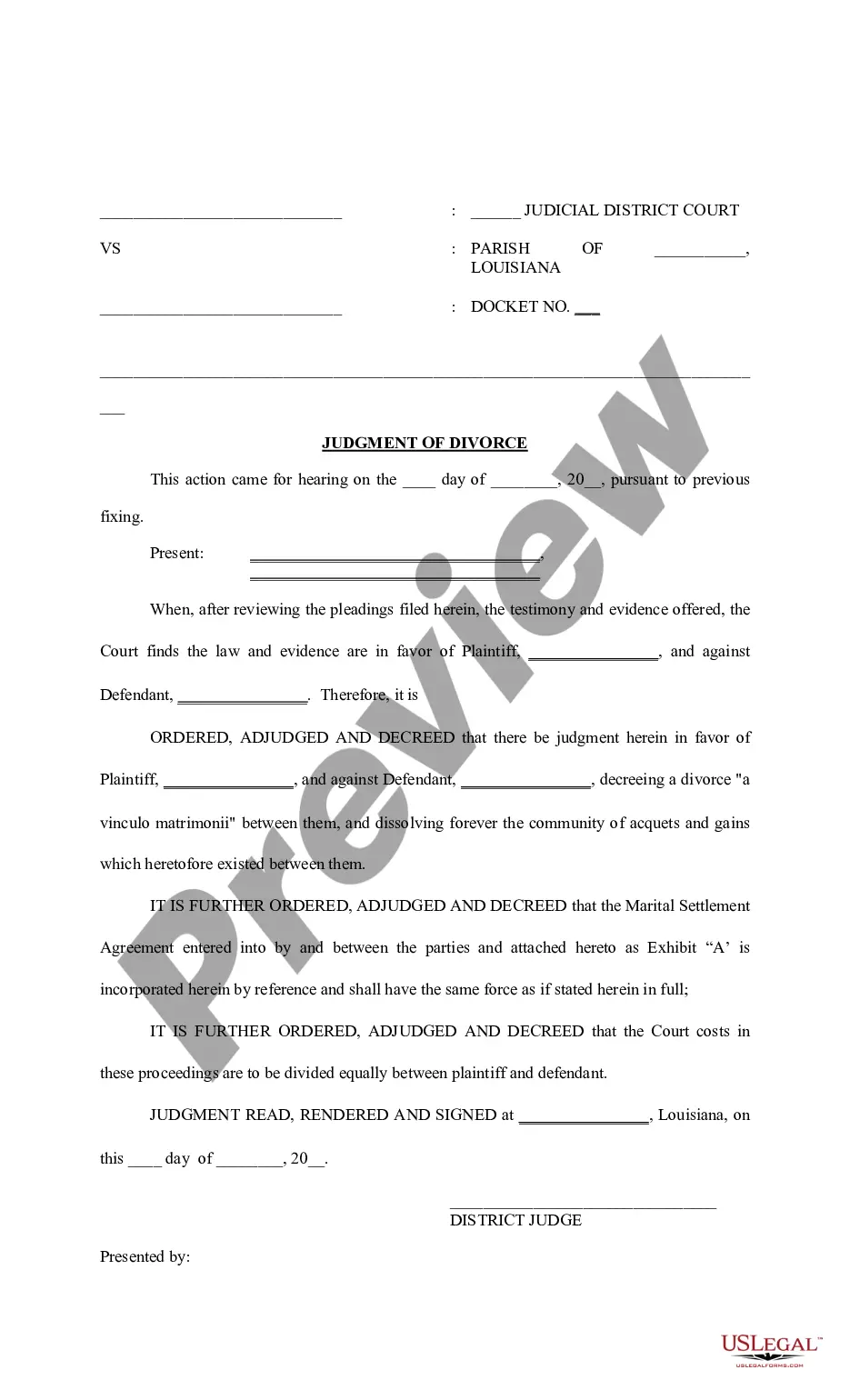
The Judgment of Divorce with community property, no children is a legal document that officially dissolves a marriage between two parties. This form is specifically designed for cases where there are no children involved and the divorce is granted in favor of the plaintiff, often due to the defendant's failure to respond within the designated timeframe. This form also includes provisions regarding the division of community property, granting the plaintiff ownership of a half interest and allowing future partitioning.
Key parts of this document
- The court orders a divorce "a vinculo matrimonii" between the parties.
- The plaintiff is granted a one-half interest in the community property.
- Provisions for future partitioning of the property are included.
- Court costs are shared equally between the parties.

When this form is needed
This form should be used when one spouse (the plaintiff) is seeking a divorce from the other spouse (the defendant), with mutual agreement on the absence of children. It is applicable when the defendant does not respond to divorce proceedings in the prescribed time frame, allowing the court to proceed with a default judgment.
Who this form is for
- Individuals in Louisiana looking to finalize a divorce without children.
- Parties where one spouse has not responded to divorce proceedings.
- Those seeking a clear division of community property following the divorce.
How to prepare this document
- Identify the names of the plaintiff and the defendant.
- Enter the relevant docket number as issued by the court.
- Fill in the dates for the court proceedings and judgment signing.
- Specify the community property interests clearly.
- Include any additional signatures required from legal representatives.
Notarization requirements for this form
In most cases, this form does not require notarization. However, some jurisdictions or signing circumstances might. US Legal Forms offers online notarization powered by Notarize, accessible 24/7 for a quick, remote process.
Get your form ready online
Our built-in tools help you complete, sign, share, and store your documents in one place.
Make edits, fill in missing information, and update formatting in US Legal Forms—just like you would in MS Word.
Download a copy, print it, send it by email, or mail it via USPS—whatever works best for your next step.
Sign and collect signatures with our SignNow integration. Send to multiple recipients, set reminders, and more. Go Premium to unlock E-Sign.
If this form requires notarization, complete it online through a secure video call—no need to meet a notary in person or wait for an appointment.
We protect your documents and personal data by following strict security and privacy standards.

Make edits, fill in missing information, and update formatting in US Legal Forms—just like you would in MS Word.

Download a copy, print it, send it by email, or mail it via USPS—whatever works best for your next step.

Sign and collect signatures with our SignNow integration. Send to multiple recipients, set reminders, and more. Go Premium to unlock E-Sign.

If this form requires notarization, complete it online through a secure video call—no need to meet a notary in person or wait for an appointment.

We protect your documents and personal data by following strict security and privacy standards.
Avoid these common issues
- Failing to properly fill in court and party names, which can delay processing.
- Omitting the date of judgment or other critical information.
- Not addressing property division clearly, leading to potential disputes later.
Advantages of online completion
- Immediate access to the form for efficient processing.
- The ability to customize the document to fit specific circumstances.
- Provides a straightforward and reliable way to obtain legal forms drafted by attorneys.
Looking for another form?
Form popularity
FAQ
Separate property is property belongs exclusively to one of two spouses. Under Louisiana law, assets acquired by a deceased person while unmarried, or acquired during the marriage by gift, is considered to be separate property.
In order to start the divorce process without a lawyer, you'll need to complete some forms. The forms are not readily available from the Louisiana Judicial Branch website, but you can go to your local parish courthouse and request a complete packet of divorce papers.
Generally, the divorce papers do not need signatures from both parties to move forward. There is little need to ensure that the other spouse is in agreement to end the marriage legally. However, if both spouses are amenable to the process, it can permit both to progress through the divorce amicably.
Under Louisiana law, marital property, or property acquired during the marriage, is distributed equally (50-50) to each party unless the court finds such a division to be inequitable or parties agree to a different formula under which to divide property.
Filing a divorce using abandonment as the ground for your request, you'll first need to file a petition for divorce with your local court. It's important to review your state's residency requirements, which often require you or your spouse to live in the state for a specific period of time before you file.
Infidelity or other bad behaviors do not affect the amount of community property one is entitled to. Also, one is not entitled to more spousal support, child support, or custody rights even if they can prove their spouse had an affair. Today in Louisiana, adultery actually plays a very minor role in a divorce.
Yes, Louisiana is in the minority of states that follows community property laws. Most states adhere to equitable distribution principles, but Louisiana isn't one of them. Louisiana community property laws seek to divide a couple's property equally in a Louisiana divorce.
One such fault ground is willful desertion and abandonment. In order for a party to prove willful desertion or abandonment he/she must prove (1) that the deserting spouse intended to end the marriage; (2) that the deserted spouse did nothing to justify the desertion; and (3) the desertion was against the wishes of
Louisiana is a community property state. This means that spouses generally share equally in the assets, income and debt acquired by either spouse during the marriage. However, some income and some property may be separate income or separate property.