Louisiana Final Decree of Adoption
What this document covers
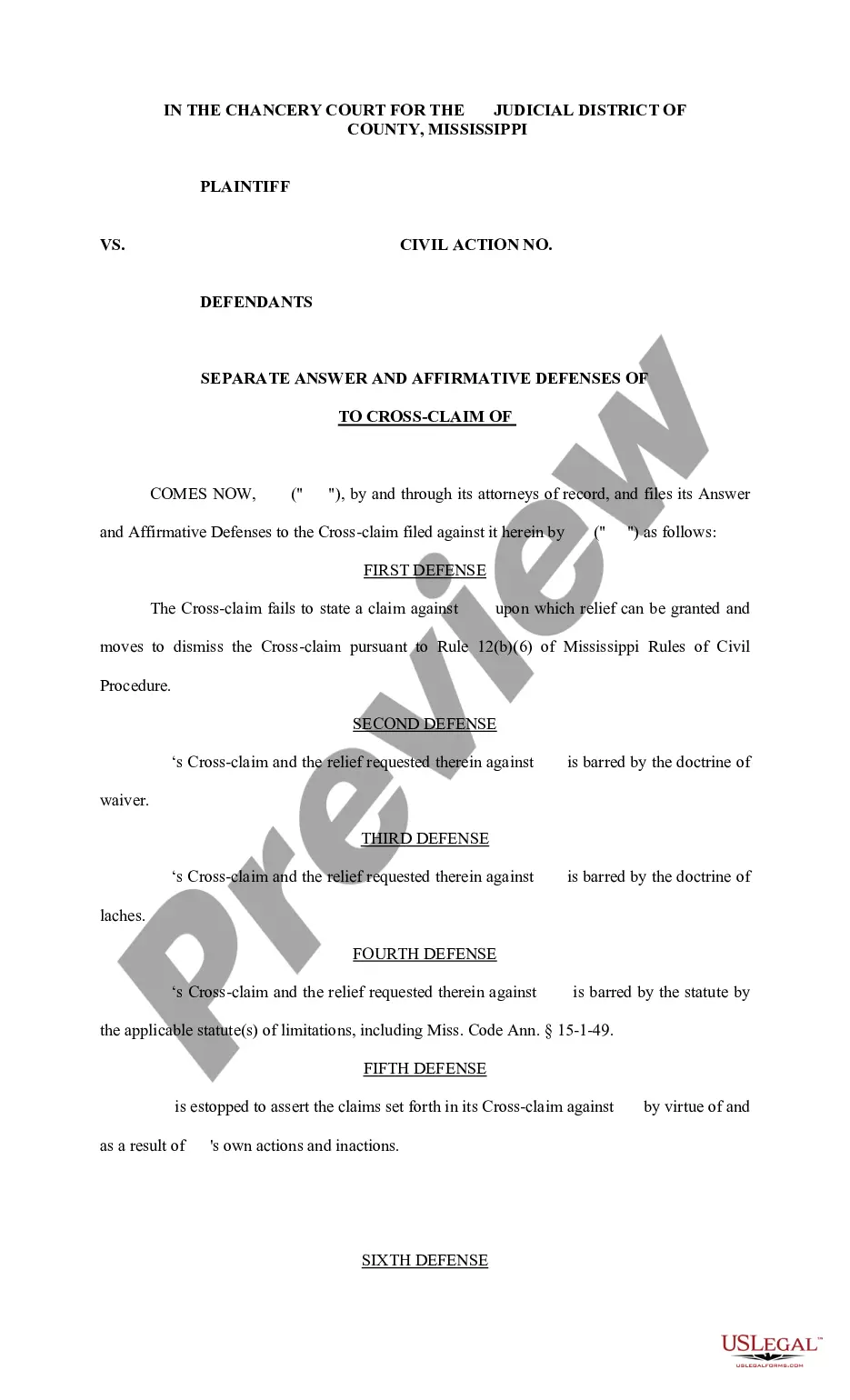
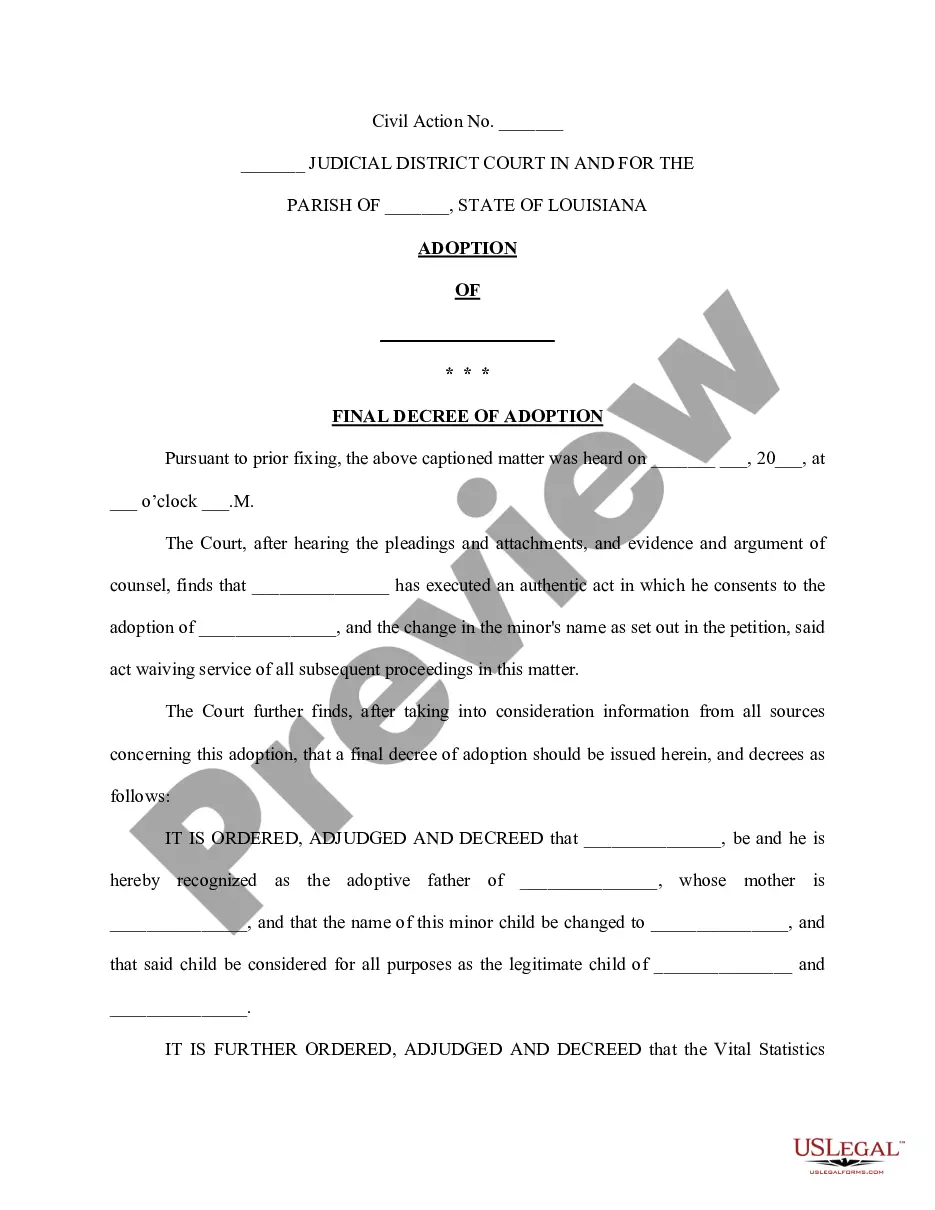
The Final Decree of Adoption is a legal document issued by a judge that finalizes an adoption, establishing a permanent and legal parent-child relationship. It confirms the adoptive parent's rights and responsibilities and often includes a change in the child's name. This form is essential for anyone looking to formalize an adoption in a legal context.
Key parts of this document
- Court information, including judicial district and parish.
- Details of the child being adopted, including their current and new name.
- Consent of the biological parent(s) to the adoption.
- Judgment details, including the date and location of the hearing.
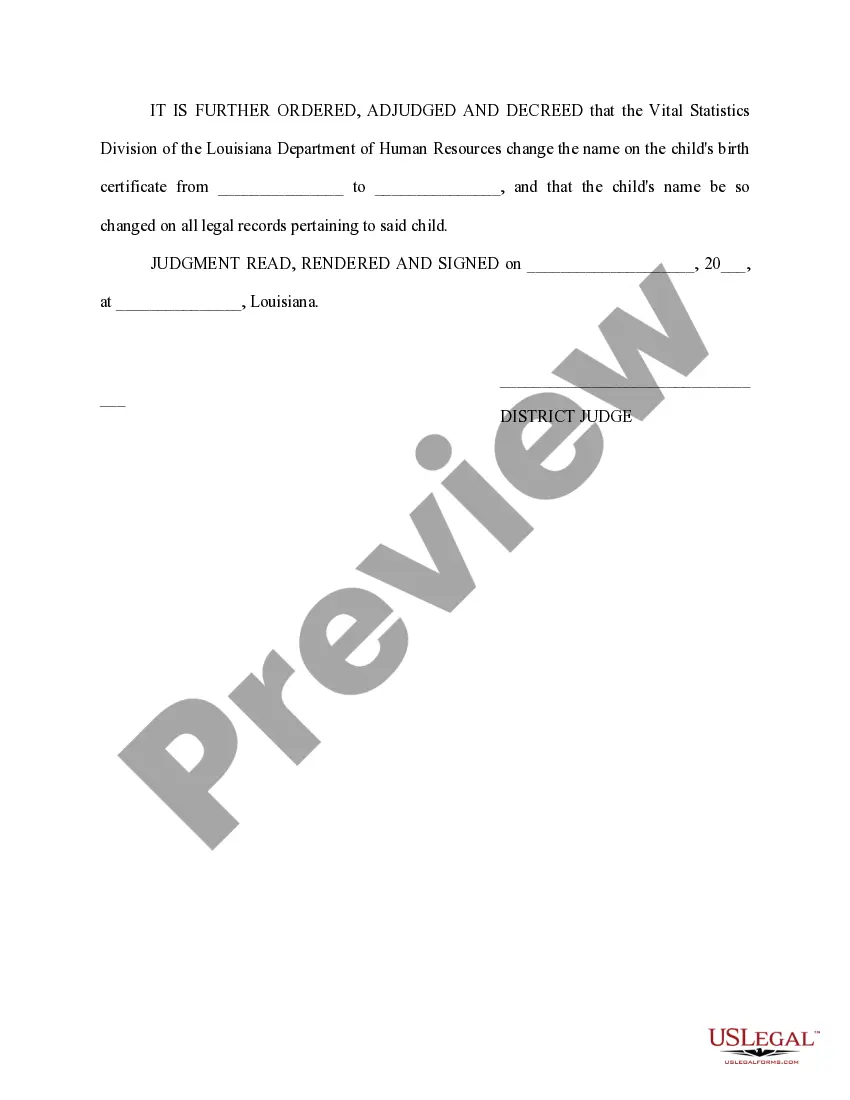
- Order of name change to be reflected in legal documents.

Situations where this form applies
This form should be used when a legal adoption has been completed and needs to be formalized by a court order. It is necessary when a parent wishes to adopt a child without the involvement of both biological parents, or when a stepparent is adopting the child of their spouse. The Final Decree of Adoption provides the legal recognition needed for the new parent-child relationship.
Who needs this form
- Individuals seeking to adopt a child in a legal capacity.
- Stepparents looking to officially adopt their spouse's child.
- Biological parents consenting to the adoption of their child.
Instructions for completing this form
- Fill in the names of the adoptive parent(s) and the child being adopted.
- Specify the current and new name of the child, if applicable.
- Include the date and time of the court hearing.
- Provide any necessary consents from biological parents.
- Sign the document in front of a notary if required.
Does this form need to be notarized?
This form does not typically require notarization unless specified by local law. However, it's advisable to verify local requirements to ensure compliance.
Get your form ready online
Our built-in tools help you complete, sign, share, and store your documents in one place.
Make edits, fill in missing information, and update formatting in US Legal Forms—just like you would in MS Word.
Download a copy, print it, send it by email, or mail it via USPS—whatever works best for your next step.
Sign and collect signatures with our SignNow integration. Send to multiple recipients, set reminders, and more. Go Premium to unlock E-Sign.
If this form requires notarization, complete it online through a secure video call—no need to meet a notary in person or wait for an appointment.
We protect your documents and personal data by following strict security and privacy standards.

Make edits, fill in missing information, and update formatting in US Legal Forms—just like you would in MS Word.

Download a copy, print it, send it by email, or mail it via USPS—whatever works best for your next step.

Sign and collect signatures with our SignNow integration. Send to multiple recipients, set reminders, and more. Go Premium to unlock E-Sign.

If this form requires notarization, complete it online through a secure video call—no need to meet a notary in person or wait for an appointment.

We protect your documents and personal data by following strict security and privacy standards.
Common mistakes
- Failing to obtain necessary consents from all parties involved.
- Forgetting to include the correct court information.
- Not entering the child's new name correctly, especially if a name change is desired.
Benefits of completing this form online
- Convenience of downloading and completing the form at your own pace.
- Editability allows customization to fit specific circumstances.
- Reliability from forms crafted by licensed attorneys.
Key takeaways
- The Final Decree of Adoption is essential for finalizing the legal parent-child relationship.
- It must be signed by a district judge to be valid.
- Adoptive parents should ensure accurate information is provided to avoid delays.
Looking for another form?
Form popularity
FAQ
A parent can voluntarily place a child into foster care or voluntarily surrender his/her parental rights so that the child can be adopted by another person, but there is no such thing as un-adopting a child.
Therefore, the only way a birth parent could reclaim custody of an adopted child is by proving to a court that the decision to sign the relinquishment document was done under fraud or duress. In most cases a court will automatically deny custody to a birth parent when their parental rights have been terminated.
After your adoption finalization is complete, your adoption attorney will help you apply for a new birth certificate and social security card. At this point, your legal adoption process will be complete but your lifelong adoption journey is just beginning.
In most adoptions, the final adoption hearing occurs around six months after placement, although some hearings can happen as little as three months or up to a year after placement.
You may be able to obtain a copy of the adoption record that is maintained by the superior court by filing a petition, under California Family Code 9200, in the clerk's office of the county superior court where the adoption was finalized.
At the conclusion of the hearing, the judge signs the decree of adoption, and any other orders related to the adoption, such as an order approving a payment of living expenses to the birth mother, or terminating an alleged father's parental rights.
Decree of Adoption is the document that a judge signs to finalize an adoption. It formally creates the parent-child relationship between the adoptive parents and the adopted child, as though the child were born as the biological child of its new parents.
Parties who can reverse an adoption usually include the birth parents, adoptive parents and the child being adopted. In order for an adoption to be reversed, a petition must usually be filed by one of these parties and the court must be convinced of a compelling reason to reverse or annul the adoption.
Louisiana's adoption records are confidential and are sealed.If Vital Records receives a court order annulling an adoption, Vital Records will unseal the original birth certificate and return the original birth certificate to the "active" birth registry.