Louisiana Motion for Preliminary Examination
About this form
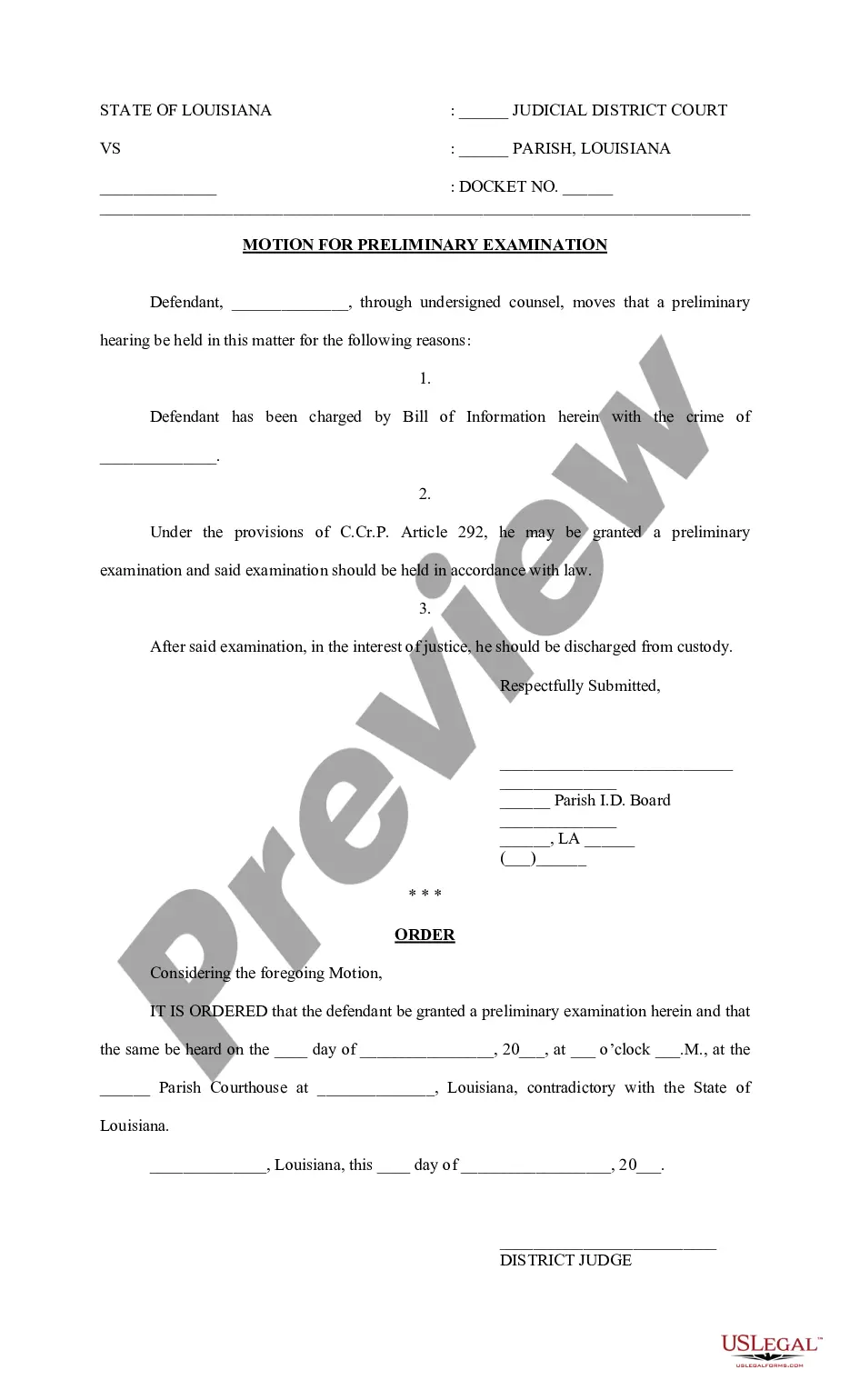
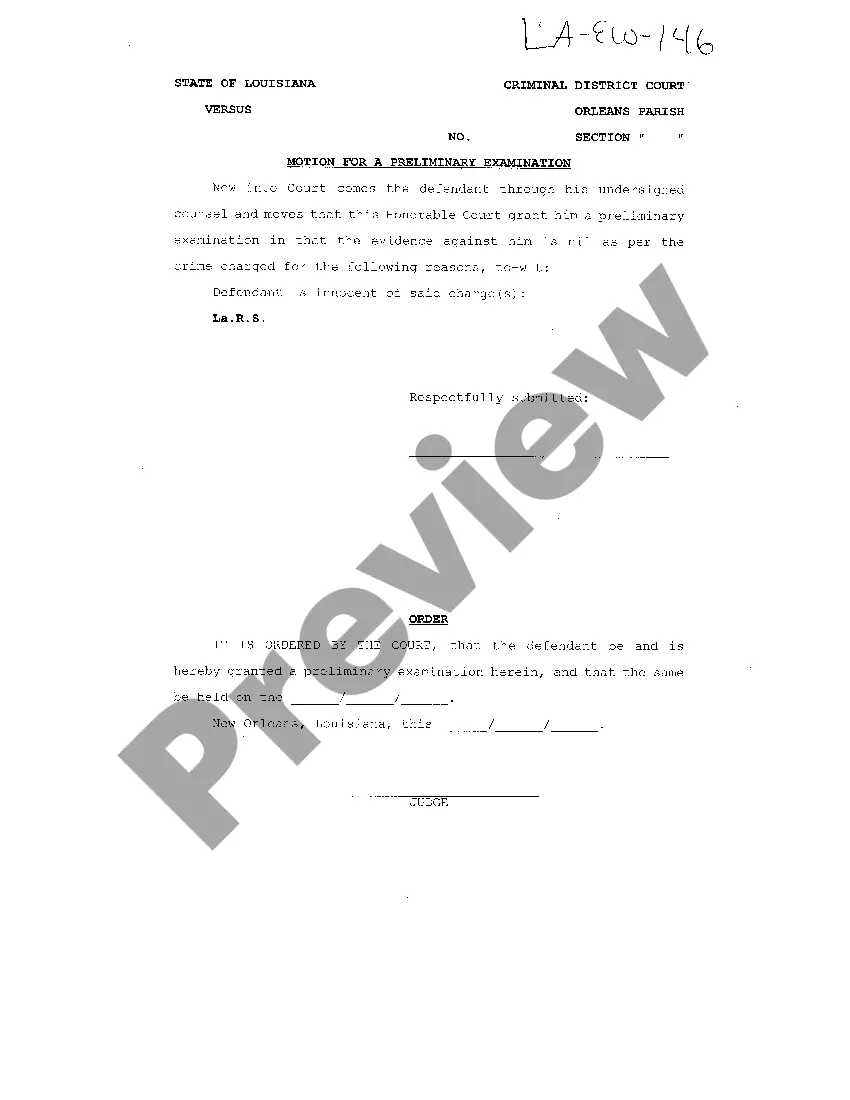
The Motion for Preliminary Examination is a legal document filed by a defendant in a criminal case, requesting the court to conduct a preliminary examination to assess whether there is enough evidence to proceed. This form differs from other motions as it specifically aims to evaluate the validity of charges against the defendant and can lead to their release from custody if the evidence is insufficient after the examination.
Key components of this form
- Defendant's name and case details.
- Charges outlined in the Bill of Information.
- Request for a preliminary examination based on legal grounds.
- Statement justifying the request for discharge from custody.
- Order section scheduling the examination date.
Common use cases
Use this Motion for Preliminary Examination when you are a defendant facing criminal charges and believe that there is insufficient evidence against you. This form allows you to formally request a hearing where the prosecution must prove that there is enough evidence to justify continuing with the case. If the court finds the evidence lacking, it may result in your release from custody.
Intended users of this form
- Defendants in criminal cases who are seeking to challenge the legality of the charges against them.
- Individuals who wish to assert their rights to a preliminary examination under Louisiana law.
- Lawyers representing clients in criminal defense matters.
How to prepare this document
- Enter the defendant's personal information and case details at the top of the form.
- Specify the charges as identified in the Bill of Information.
- Clearly articulate the reasons for requesting the preliminary examination, citing relevant legal statutes.
- Fill out the order section with the date and time for the preliminary examination hearing.
- Have your attorney sign and date the motion before submitting it to the court.
Does this document require notarization?
Notarization is generally not required for this form. However, certain states or situations might demand it. You can complete notarization online through US Legal Forms, powered by Notarize, using a verified video call available anytime.
Get your form ready online
Our built-in tools help you complete, sign, share, and store your documents in one place.
Make edits, fill in missing information, and update formatting in US Legal Forms—just like you would in MS Word.
Download a copy, print it, send it by email, or mail it via USPS—whatever works best for your next step.
Sign and collect signatures with our SignNow integration. Send to multiple recipients, set reminders, and more. Go Premium to unlock E-Sign.
If this form requires notarization, complete it online through a secure video call—no need to meet a notary in person or wait for an appointment.
We protect your documents and personal data by following strict security and privacy standards.

Make edits, fill in missing information, and update formatting in US Legal Forms—just like you would in MS Word.

Download a copy, print it, send it by email, or mail it via USPS—whatever works best for your next step.

Sign and collect signatures with our SignNow integration. Send to multiple recipients, set reminders, and more. Go Premium to unlock E-Sign.

If this form requires notarization, complete it online through a secure video call—no need to meet a notary in person or wait for an appointment.

We protect your documents and personal data by following strict security and privacy standards.
Typical mistakes to avoid
- Failing to provide accurate case details, which can delay processing.
- Not specifying the charges adequately, leading to confusion.
- Omitting to sign the motion, making it invalid.
Why use this form online
- Convenience of downloading the form at any time.
- Easy to edit and customize according to your specific case needs.
- Reliably drafted by licensed attorneys to ensure compliance with legal standards.
What to keep in mind
- The Motion for Preliminary Examination is essential for defendants wishing to challenge charges pre-trial in Louisiana.
- Properly completing the form can lead to a preliminary hearing and potential discharge from custody.
- Understanding state-specific legal terminology and procedures is crucial for successful use of this form.
Looking for another form?
Form popularity
FAQ
Article 292 of the Louisiana Code of Criminal Procedure defines the framework for pleadings in criminal cases, including the handling of motions like the Louisiana Motion for Preliminary Examination. This article ensures that defendants have the opportunity to challenge the evidence presented against them before trial. By applying its provisions, defendants can safeguard their rights and prepare for a robust defense. Utilizing a platform like uslegalforms can facilitate understanding and navigating these complex legal processes.
Rule 9.9 in Louisiana is part of the local rules governing how attorneys and parties should handle certain procedural aspects in court. It emphasizes the need for specific documentation and timely submissions, ensuring a smoother court process. Knowing these rules can significantly impact the effectiveness of your motions, including a Louisiana Motion for Preliminary Examination.
The purpose of the preliminary hearing is to determine if there is enough evidence to justify holding the defendant to answer for the alleged charge(s), which includes any misdemeanors that are charged along with the felonies. It's our job to try to convince the judge that there is not.
A preliminary examination is conducted in a similar fashion to a trial. Witnesses and evidence are put forth by the district attorney. The defense counsel is able to question the witnesses and argue the weaknesses of the case presented by the district attorney. Unlike a trial, however, no jury is present.
The burden of proof at these hearings is on the prosecutor and he/she must show that: there is enough probable cause to show that a crime was committed, and. there is enough probable cause to believe that the defendant is the person who committed that crime.
An arraignment is a pre-trial proceeding, sometimes called an initial appearance. The criminal defendant is brought in front of a judge at a lower court.
Investigation. Charging. Initial Hearing/Arraignment. Discovery. Plea Bargaining. Preliminary Hearing. Pre-Trial Motions. Trial.
Is there probable cause to believe the alleged crime occurred and did it occur within the court's jurisdiction? Is there probable cause to believe that the defendant committed the crime?
A motion is an application to the court made by the prosecutor or defense attorney, requesting that the court make a decision on a certain issue before the trial begins.The motion can affect the trial, courtroom, defendants, evidence, or testimony. Only judges decide the outcome of motions.
Finding by a grand jury that there is probable cause to believe a crime occurred and the defendant is the person who committed it.Preliminary hearing is a screening device to determine whether there is probable cause to believe that the defendant committed the crime charged.