Louisiana Accounts Receivable Monthly Customer Statement
Description


How to fill out Accounts Receivable Monthly Customer Statement?
Are you currently in a situation where you frequently require documents for either business or personal reasons? There are numerous legal document templates accessible online, but finding ones you can trust is not easy. US Legal Forms offers a vast collection of form templates, such as the Louisiana Accounts Receivable Monthly Customer Statement, designed to comply with federal and state regulations.
If you are already familiar with the US Legal Forms website and have an account, simply Log In. After that, you can download the Louisiana Accounts Receivable Monthly Customer Statement template.
If you do not have an account and wish to start using US Legal Forms, follow these steps: Get the form you require and ensure it is for your specific city/county. Utilize the Preview button to review the form. Check the description to ensure you have selected the correct form. If the form is not what you are looking for, use the Search field to find the form that suits your needs. Once you locate the appropriate form, click Buy now. Choose the pricing plan you prefer, fill in the required details to create your account, and complete the purchase using your PayPal or Visa or Mastercard. Select a convenient document format and obtain your copy.
- Access all the document templates you have purchased in the My documents section. You can download an additional copy of the Louisiana Accounts Receivable Monthly Customer Statement at any time. Just follow the required form to download or print the document template.
- Utilize US Legal Forms, the largest collection of legal forms, to save time and avoid mistakes. The service provides properly crafted legal document templates that can be used for various purposes. Create your account on US Legal Forms and start simplifying your life.
Form popularity
FAQ
The balance sheet typically shows accounts receivable as an asset. It represents the total amount owed to your business by customers who have purchased on credit. Additionally, a Louisiana Accounts Receivable Monthly Customer Statement can provide detailed insights into each customer's outstanding balance, enhancing your financial management.
Accounts receivable (AR) represent the amount of money that customers owe your company for products or services that have been delivered. AR are listed on the balance sheet as current assets and also refer to invoices that clients owe for items or work performed for them on credit.
Accounts receivable (AR) is an item in the general ledger (GL) that shows money owed to a business by customers who have purchased goods or services on credit. AR is the opposite of accounts payable, which are the bills a company needs to pay for the goods and services it buys from a vendor.
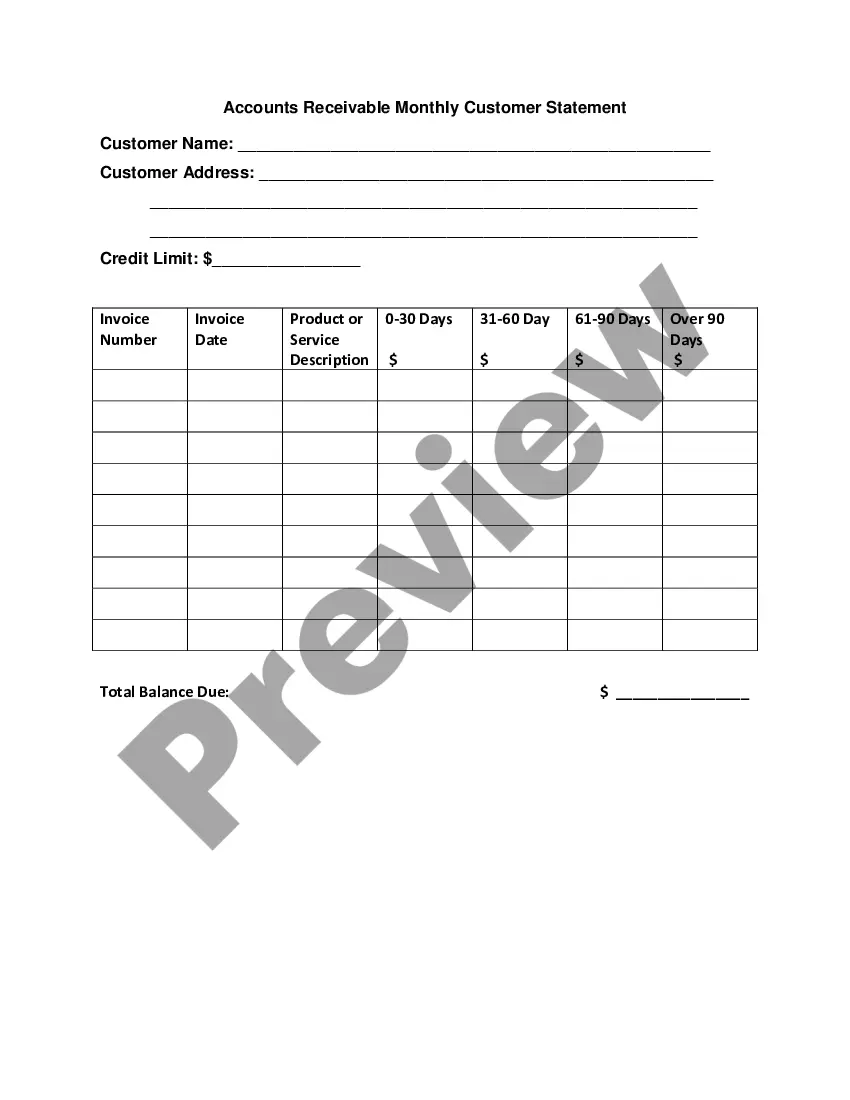
The Accounts Receivables Statements are documents that itemize all invoices, payments, and credits created during a specific time period, and whose intention is to remind the account holder of their account status. Statements can be mailed, emailed, faxed, or previewed.
Accounts receivable (AR) are funds the company expects to receive from customers and partners. AR is listed as a current asset on the balance sheet. Lenders and potential investors look at AP and AR to gauge a company's financial health.
Accounts Receivable Statements. Accounts receivable statements are print, file, email, or fax reports showing amounts owed by AR account holders. They are typically prepared for billing purposes.