Massachusetts Decree - Minor, Family Name Change
About this form
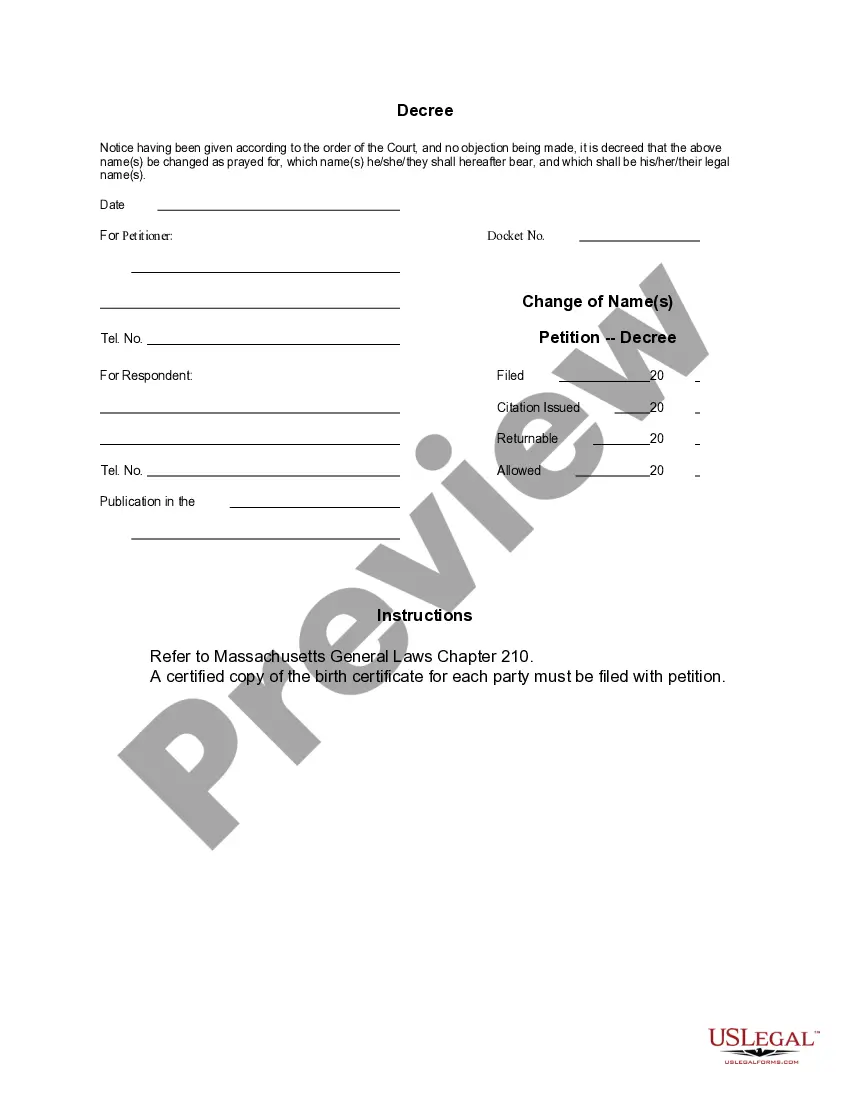
The family name change decree for minors is a legal document that finalizes the change of a minor's name. This form is distinct from other name change documents as it represents the court's official decision on the change, making it legally binding once signed by a judge and filed with the court. It ensures that the minor's new name is recognized in official records and documents.
Key components of this form
- Notice of the court order indicating that no objections were made to the name change.
- Details of the name(s) being changed as requested in the application.
- Legal affirmation that the new name(s) will be recognized as the minor's official name(s).
- Signature line for the judge to finalize the decree.
Situations where this form applies
You should use the family name change decree when you have obtained court approval for a minor's name change and are ready to finalize the legal process. This typically occurs after a name change petition has been filed, and you have notified all relevant parties, ensuring there are no objections. The decree is essential for updating legal documents like birth certificates and school records.
Who this form is for
- Parents or legal guardians seeking to change the name of their minor child.
- Individuals who have completed the necessary legal petition for a minorâs name change.
- Persons involved in custody or adoption processes where a name change is required.
Completing this form step by step
- Fill in the minor's current legal name and the proposed new name.
- Ensure that the court order has been issued and is referenced in the form.
- Have the form reviewed for accuracy before submission.
- File the completed decree with the appropriate court for the judgeâs signature.
- Obtain a copy of the signed decree for your records and for required updates to legal documents.
Notarization guidance
This form does not typically require notarization unless specified by local law. However, having it notarized can provide an additional layer of verification when submitting it to the court.
Get your form ready online
Our built-in tools help you complete, sign, share, and store your documents in one place.
Make edits, fill in missing information, and update formatting in US Legal Forms—just like you would in MS Word.
Download a copy, print it, send it by email, or mail it via USPS—whatever works best for your next step.
Sign and collect signatures with our SignNow integration. Send to multiple recipients, set reminders, and more. Go Premium to unlock E-Sign.
If this form requires notarization, complete it online through a secure video call—no need to meet a notary in person or wait for an appointment.
We protect your documents and personal data by following strict security and privacy standards.

Make edits, fill in missing information, and update formatting in US Legal Forms—just like you would in MS Word.

Download a copy, print it, send it by email, or mail it via USPS—whatever works best for your next step.

Sign and collect signatures with our SignNow integration. Send to multiple recipients, set reminders, and more. Go Premium to unlock E-Sign.

If this form requires notarization, complete it online through a secure video call—no need to meet a notary in person or wait for an appointment.

We protect your documents and personal data by following strict security and privacy standards.
Common mistakes
- Failing to notify all required parties before seeking the decree.
- Submitting the form without the necessary court order.
- Omitting the minor's full current name or the new name.
- Not following your state's specific filing procedures.
Why use this form online
- Convenience of downloading the form anytime, eliminating the need for physical paperwork.
- Editable format allows you to customize the form easily.
- Reliable access to attorney-drafted templates ensures compliance with legal standards.
What to keep in mind
- The family name change decree is crucial for finalizing a minor's name change after court approval.
- Ensure that all required notifications are made prior to submission.
- Follow your specific state's guidelines for filing the decree with the court.
- Accessing and completing the form online can streamline the process.
Looking for another form?
Form popularity
FAQ
If you live in Massachusetts and are 18 or older, you can file a Petition for Change of Name. Parents may file to change their child's name if the child is a minor. You can file your name change forms at the Probate and Family Court in the county you live in.
To change your name legally as an adult in Massachusetts, you need to go through a court name change proceeding. Names can also be changed as part of an adoption, divorce, or sometimes a parentage judgment. If you get married, Massachusetts law allows you to adopt any surname (last name).
If one parent is out of the picture, you don't need consent to change your child's last name. You do need to serve him or her with a conformed copy of the Order to Show Cause form. The other parent still does not have to consent or agree, just get served. Once served, a Proof of Service form must be filed.
Generally, you will not be able to change your child's surname without the permission of the other parent if: the other parent is listed on the Child's Birth Certificate, and.
Parents in Massachusetts are permitted to change the name of their child as long as the minor is in their legal custody. Anyone under the age of eighteen (18) is considered a minor. In order to legally change their child's name, the parent or legal guardian must file a petition with their county court.
Marriage or Divorce Sometimes, when parents divorce, if one parent is awarded the majority of custody, they may choose to change the child's last name.This could be the last name of one of the parents, a hyphenated last name, or even a name that represents the combining of the two last names.
A child age 14 or older must consent to their own name change. If any of the children are 14 or older, each child must complete a consent. This is the form the judge signs to grant the child's name change.Make sure to indicate whether or not a new birth certificate should be issued for the child with the new name.
Both legal parents have the right to name a child or to request a name change. However, one parent can't change a child's name without the approval of the other parent. Thus, if the mother doesn't approve, then the father requesting the name change must file a petition with the court for a decision.