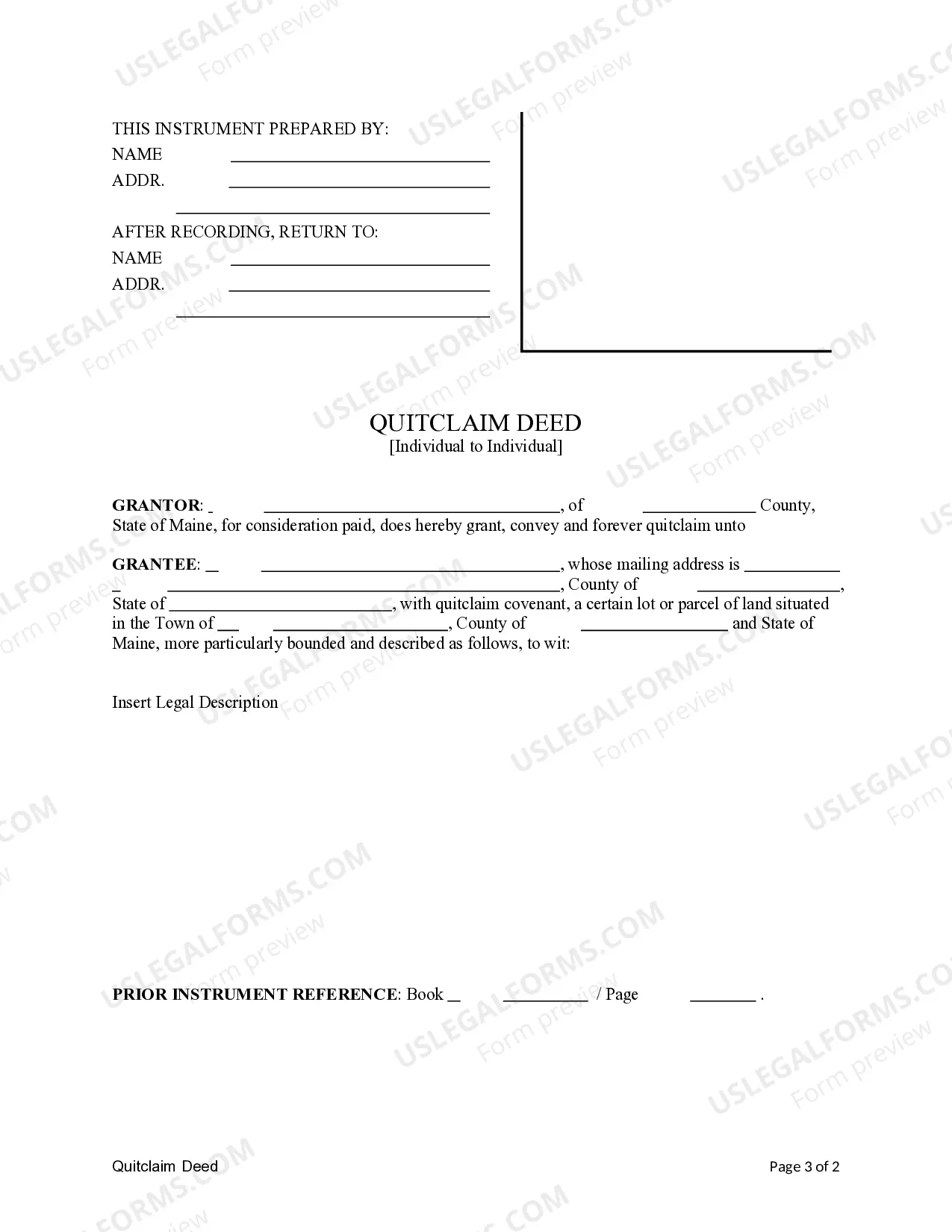
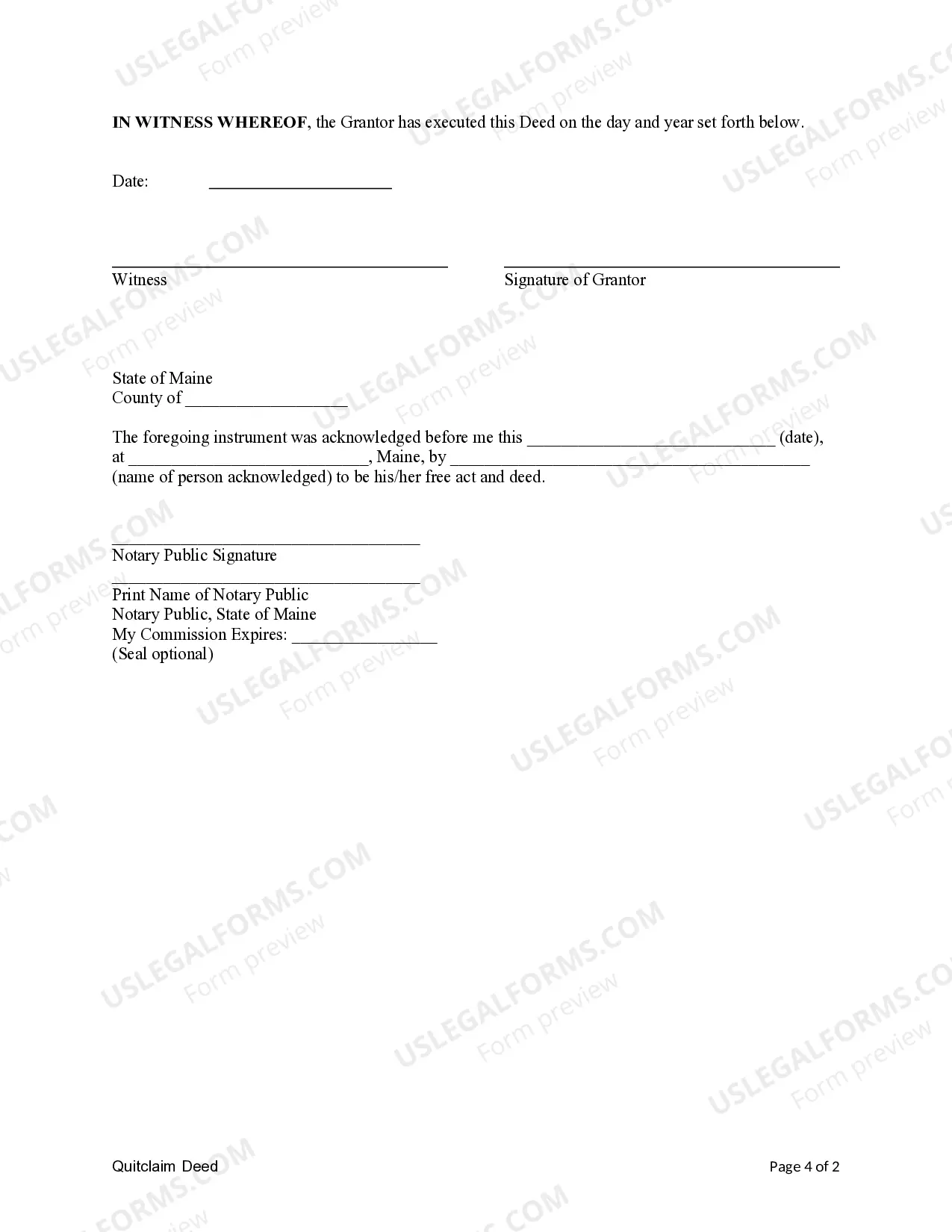
This form is a Quitclaim Deed where the Grantor is an individual and the Grantee is an individual. Grantor conveys and quitclaims the described property to Grantee. This deed complies with all state statutory laws.
Maine Quitclaim Deed from Individual to Individual
Instant download
Description
Free preview








How to fill out Maine Quitclaim Deed From Individual To Individual?
Greetings to the most important legal documents library, US Legal Forms.
Here you will discover any template including Maine Quitclaim Deed from Individual to Individual forms and save them (as many as you choose/require).
Create official documents within a few hours, instead of days or even weeks, without spending a fortune on a lawyer or attorney.
If the template meets all your requirements, click Buy Now. To create an account, choose a subscription plan. Use a credit card or PayPal account for registration. Download the document in the format you need (Word or PDF). Print the document and complete it with your or your business’s details. Once you’ve filled out the Maine Quitclaim Deed from Individual to Individual, send it to your attorney for confirmation. It’s an additional step but a crucial one to ensure you’re fully protected. Sign up for US Legal Forms now and gain access to a vast amount of reusable templates.
- Obtain your state-specific template with just a few clicks and rest assured knowing it was prepared by our state-certified legal experts.
- If you are already a registered user, simply Log In to your account and then click Download next to the Maine Quitclaim Deed from Individual to Individual you desire.
- Given that US Legal Forms is web-based, you will always have access to your saved documents, regardless of the device you are using.
- View them in the My documents section.
- If you don't have an account yet, what are you waiting for.
- Follow our instructions below to get started.
- If this is a state-specific document, verify its validity in your state.
- Review the description (if available) to determine if it’s the right template.
Form popularity
FAQ
A person who signs a quitclaim deed to transfer property they do not own results in no title at all being transferred since there is no actual ownership interest. The quitclaim deed only transfers the type of title you own.
Yes, you can use a Quitclaim Deed to transfer a gift of property to someone. You must still include consideration when filing your Quitclaim Deed with the County Recorder's Office to show that title has been transferred, so you would use $10.00 as the consideration for the property.
The only way to forcibly change the ownership status is through a legal action and the resultant court order. However, if an owner chooses to be removed from the deed, it is simply a matter of preparing a new deed transferring that owner's interest in the property.
Fill out the quit claim deed form, which can be obtained online, or write your own using the form as a guide. The person giving up the interest in the property is the grantor, and the person receiving the interest is the grantee.
Once you sign a quitclaim deed and it has been filed and recorded with the County Clerks Office, the title has been officially transferred and cannot be easily reversed. In order to reverse this type of transfer, it would require your spouse to cooperate and assist in adding your name back to the title.
If you own your own home, you are free to gift or sell an interest in the real property to someone else.You'll need to transfer an interest by writing up another deed with the person's name on it. In California, you can use either a grant deed, a quitclaim deed or an interspousal deed, depending on your circumstances.
But you might be wondering if an owner can transfer a deed to another person without a real estate lawyer. The answer is yes. Parties to a transaction are always free to prepare their own deeds.A quitclaim deed, for example, is far simpler than a warranty deed.
The drawback, quite simply, is that quitclaim deeds offer the grantee/recipient no protection or guarantees whatsoever about the property or their ownership of it. Maybe the grantor did not own the property at all, or maybe they only had partial ownership.
Quitclaim deeds are most often used to transfer property between family members. Examples include when an owner gets married and wants to add a spouse's name to the title or deed, or when the owners get divorced and one spouse's name is removed from the title or deed.