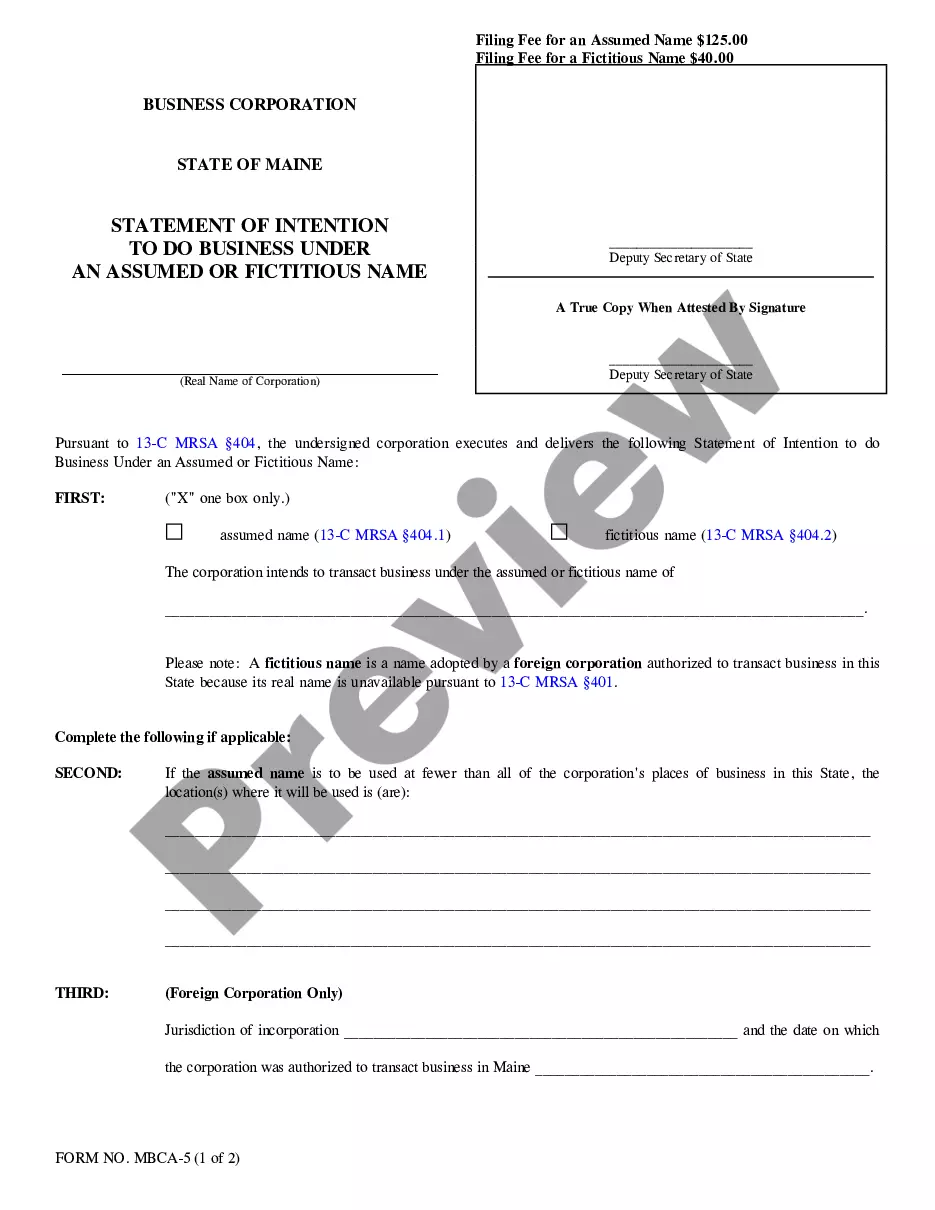
Maine Statement of Intention to Do Business Under an Assumed or Fictitious Name by a Corporation
What this document covers
The Statement of Intention to Do Business Under an Assumed or Fictitious Name by a Corporation is a legal document required by corporations wishing to conduct business in a state using a name other than their registered corporate name. This form serves to notify the Secretary of State about the assumed or fictitious name being utilized, which helps in maintaining transparency and protecting the public from misleading business practices.
Form components explained
- The real name of the corporation.
- Selection between an assumed name or a fictitious name.
- The specific name under which the corporation intends to do business.
- Location(s) where the assumed name will be used, if applicable.
- Jurisdiction of incorporation and authorization date for foreign corporations.
- Signature of a duly authorized person from the corporation.

Situations where this form applies
This form should be used when a corporation plans to do business under a name that is different from its official registered name. This situation typically arises when the chosen name is more marketable or descriptive of the business activities. Filing this document is necessary to meet state requirements and protect your legal interests.
Who this form is for
- Corporations operating in the state that wish to conduct business under an assumed or fictitious name.
- Foreign corporations authorized to transact business in the state seeking to adopt a name different from their registered name.
How to complete this form
- Identify and write the real name of the corporation at the top of the form.
- Select either the "assumed name" or "fictitious name" option by marking the appropriate box.
- Enter the assumed or fictitious name that the corporation will use in business.
- If the name is to be used at specific locations, list those addresses in the provided space.
- For foreign corporations, provide the jurisdiction of incorporation and the date when authorized to operate in Maine.
- Sign the document with the name and capacity of the person completing the form, ensuring it is from an authorized officer or the clerk.
Does this form need to be notarized?
This form does not typically require notarization unless specified by local law. However, it must be signed by an authorized officer or the clerk of the corporation to be legally valid.
Get your form ready online
Our built-in tools help you complete, sign, share, and store your documents in one place.
Make edits, fill in missing information, and update formatting in US Legal Forms—just like you would in MS Word.
Download a copy, print it, send it by email, or mail it via USPS—whatever works best for your next step.
Sign and collect signatures with our SignNow integration. Send to multiple recipients, set reminders, and more. Go Premium to unlock E-Sign.
If this form requires notarization, complete it online through a secure video call—no need to meet a notary in person or wait for an appointment.
We protect your documents and personal data by following strict security and privacy standards.

Make edits, fill in missing information, and update formatting in US Legal Forms—just like you would in MS Word.

Download a copy, print it, send it by email, or mail it via USPS—whatever works best for your next step.

Sign and collect signatures with our SignNow integration. Send to multiple recipients, set reminders, and more. Go Premium to unlock E-Sign.

If this form requires notarization, complete it online through a secure video call—no need to meet a notary in person or wait for an appointment.

We protect your documents and personal data by following strict security and privacy standards.
Common mistakes to avoid
- Failing to identify the real name of the corporation correctly.
- Not marking the box for the type of name being registered (assumed vs. fictitious).
- Omitting the necessary information about locations if the name is used in some but not all business venues.
- Not obtaining the proper signature from an authorized individual.
Advantages of online completion
- Convenience of downloading and completing the form at your own pace.
- Ability to edit the form as needed before final submission.
- Accessing reliable templates drafted by licensed attorneys to ensure compliance.
Looking for another form?
Form popularity
FAQ
You can only file your personal and business taxes separately if your company it is a corporation, according to the IRS.Corporations file their taxes using Form 1120. Limited liability companies (LLCs) can also choose to be treated as a corporation by the IRS, whether they have one or multiple owners.
To do business under a DBA, you must complete and file the appropriate DBA forms and pay a filing fee, after which point you receive a DBA certificate. Depending on the state you may be able to file with a local or county clerk's office, with a state agency, or both.
The DBA has to be filled out and notarized with no errors due to the fact that it is recorded with the County. Filing for a DBA allows you to do business under a different name.The name of your business is up to you, but it needs to be properly registered with the state of California.
Regarding doing business as form concerns, as a self-employed individual listed as doing business as (DBA), you only have to file these forms if appropriate to your self-employment business: Form 1040. Schedule C.
A DBA Is Reported on Schedule C The DBA is reported on your personal 1040 tax return. The business income and expenses will be entered in Schedule C. All profits from the DBA are subject to self-employment tax.
1Step 1 Obtain the Form. Get the Assumed Business Name registration form from the Municipal or Town Clerk.2Step 2 Fill out the Form.3Step 3 Notarize the Form.4Step 4 Submit the Form.
It is NOT a separate entity. A Sole Proprietor fills out Schedule C as part of your Form 1040. You will also fill out Schedule SE for your employment taxes on your net profit.
Depending on the jurisdiction, most DBA filings take 1-4 weeks with some exceptions. Is filing a DBA the same thing as filing for a Trademark? many jurisdictions, more than one applicant can file the exact same DBA. The only way to legally ensure exclusive rights to the use of a name is to register a trademark.
No Special Tax Benefits: Unlike a corporation, filing a DBA that is not part of an LLC or another 'corporate umbrella' will not give you any special tax benefits. Your business' revenues will be passed on to your individual tax return and taxed accordingly.