Maine Testimony by Defendant
What this document covers
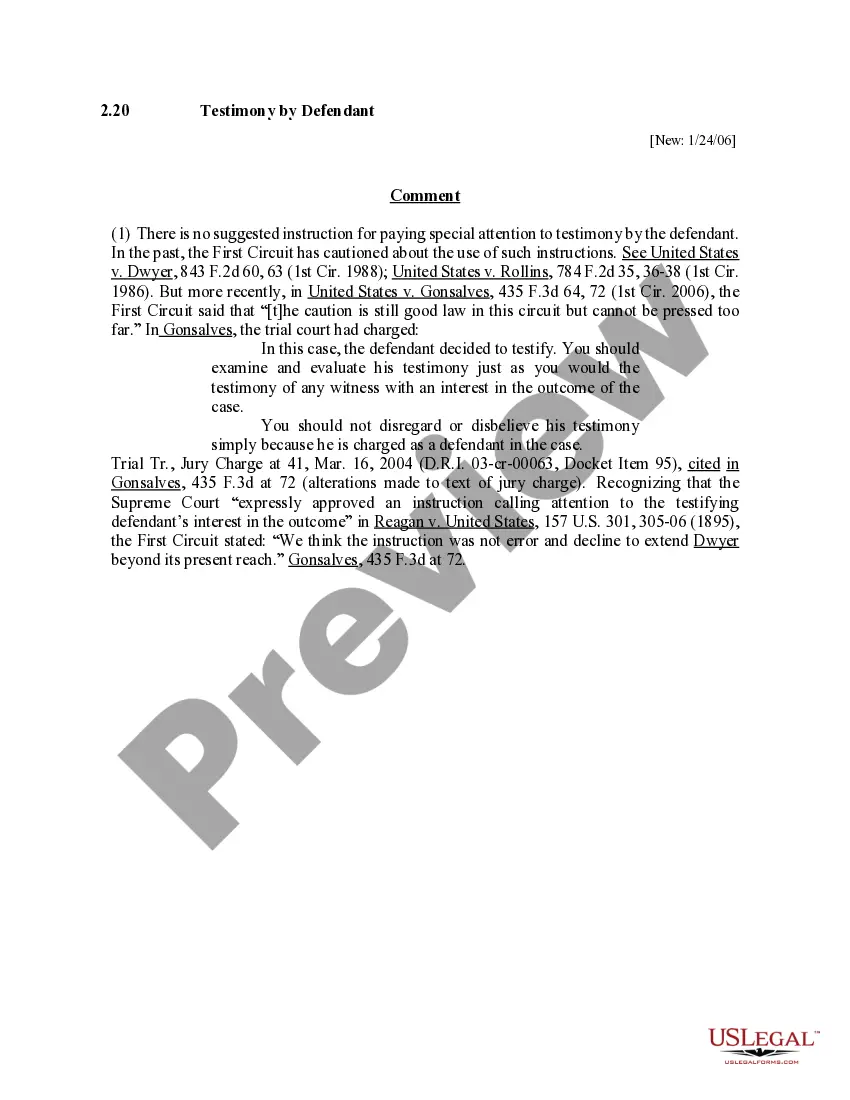
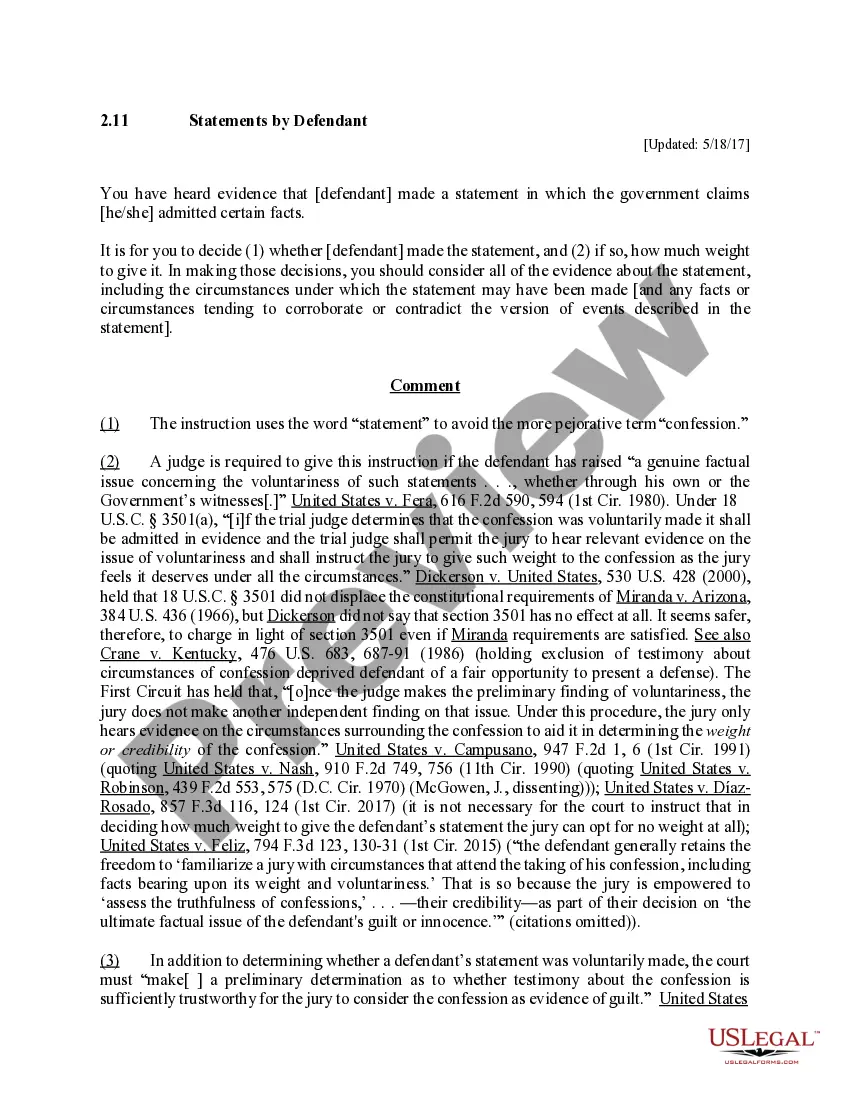
The Testimony by Defendant form is part of the official pattern jury instructions used in federal criminal cases in Maine. It provides guidance on how jurors should evaluate the testimony of a defendant who has chosen to take the stand. This form ensures that jurors treat the defendant's testimony equally to that of other witnesses, emphasizing the importance of impartiality in their assessments. It is essential for maintaining fairness in trial proceedings.
Key components of this form
- The introductory statement that addresses the defendant's choice to testify.
- Guidelines for assessing the defendant's credibility, similar to that of any other witness.
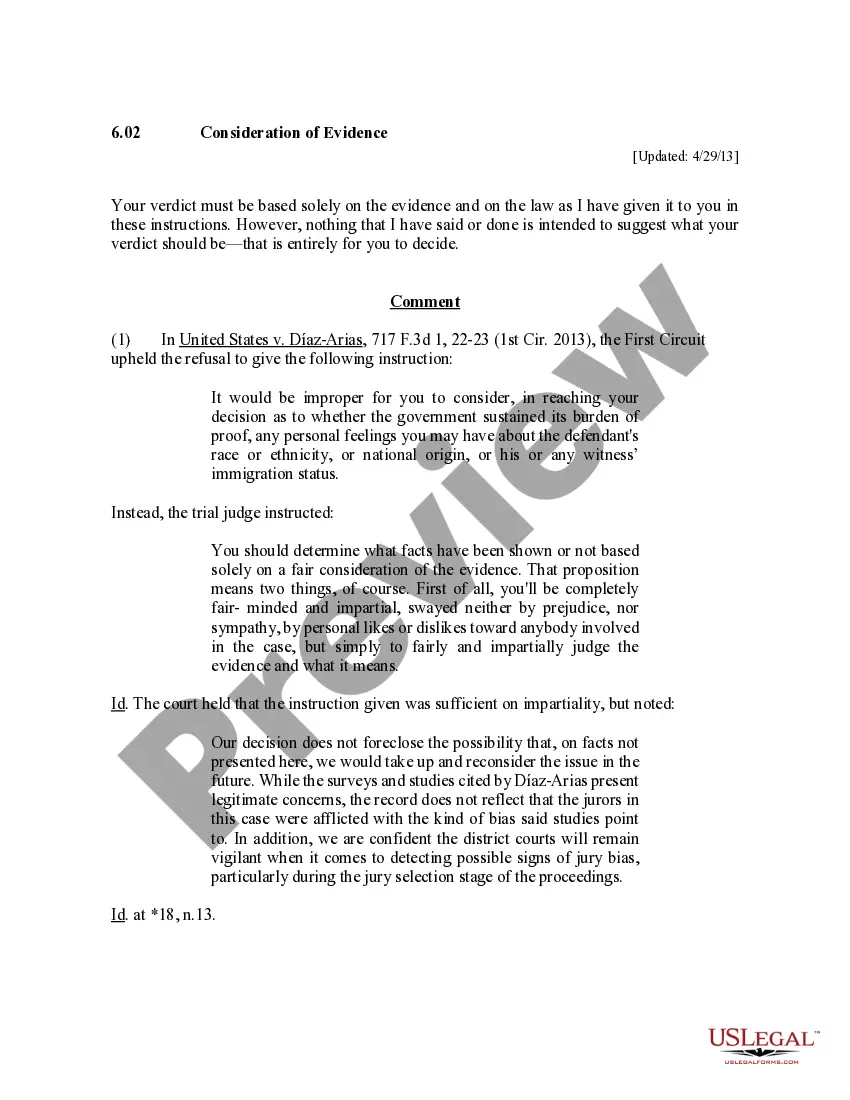
- Instructions to avoid bias against the defendant simply because they are charged with a crime.
- Citations to relevant case law that supports the instructions provided.
Common use cases
This form should be used in criminal trials where the defendant has chosen to testify in their own defense. It is applicable in cases where the jury needs clear instructions on how to weigh the defendant's testimony against the backdrop of the charges they face. The instructions help to provide a balanced and fair evaluation of the evidence presented in court.
Who needs this form
- Judges presiding over federal criminal trials in Maine.
- Legal counsel representing defendants in such trials.
- Members of juries needing guidance on how to approach a defendant's testimony.
Steps to complete this form
- Read the introductory section that outlines the defendant's decision to testify.
- Include the context of the case as it applies to the defendant's testimony.
- Incorporate relevant case law citations that bolster the validity of the instructions.
- Detail the guidelines for jurors on how to fairly assess the credibility of the defendant's testimony.
Notarization guidance
This form usually doesn’t need to be notarized. However, local laws or specific transactions may require it. Our online notarization service, powered by Notarize, lets you complete it remotely through a secure video session, available 24/7.
Get your form ready online
Our built-in tools help you complete, sign, share, and store your documents in one place.
Make edits, fill in missing information, and update formatting in US Legal Forms—just like you would in MS Word.
Download a copy, print it, send it by email, or mail it via USPS—whatever works best for your next step.
Sign and collect signatures with our SignNow integration. Send to multiple recipients, set reminders, and more. Go Premium to unlock E-Sign.
If this form requires notarization, complete it online through a secure video call—no need to meet a notary in person or wait for an appointment.
We protect your documents and personal data by following strict security and privacy standards.

Make edits, fill in missing information, and update formatting in US Legal Forms—just like you would in MS Word.

Download a copy, print it, send it by email, or mail it via USPS—whatever works best for your next step.

Sign and collect signatures with our SignNow integration. Send to multiple recipients, set reminders, and more. Go Premium to unlock E-Sign.

If this form requires notarization, complete it online through a secure video call—no need to meet a notary in person or wait for an appointment.

We protect your documents and personal data by following strict security and privacy standards.
Common mistakes
- Ignoring the requirement to treat the defendant's testimony with impartiality.
- Failing to cite necessary legal precedents that support the instructions.
- Overly emphasizing the defendant's status, which can lead to biased jury evaluations.
Why complete this form online
- Convenience of immediate access to essential legal documents.
- Editability to tailor instructions as necessary for individual cases.
- Reliability of well-drafted forms created by licensed attorneys.
Legal use & context
- This form is recognized within the jurisdiction of Maine's federal courts for guiding jury deliberations.
- Its instructions are grounded in established legal standards and case law, reinforcing its enforceability.
What to keep in mind
- The Testimony by Defendant form is crucial in ensuring fair treatment of defendants in criminal trials.
- Jurors must be instructed to evaluate testimony without bias.
- Legal precedents cited in the form guide the interpretation and application of the jury instructions.
Looking for another form?
Form popularity
FAQ
Rule 45 in Maine pertains to the issuance of subpoenas, allowing a court to compel a witness to testify or produce evidence. This rule is significant in ensuring that necessary testimony is provided during a trial. If you are dealing with Maine testimony by defendant, understanding how to navigate subpoenas can facilitate smoother courtroom proceedings.
The following evidence is not admissible in a civil or criminal proceeding involving alleged sexual misconduct: (1) Evidence offered to prove that an alleged victim engaged in other sexual behavior; or (2) Evidence offered to prove an alleged victim's sexual predisposition.
Maine Rule 609 requires all convictions to pass a "reverse Rule 403 " test, i.e. they can be admitted only if their probative value as to credibility outweighs any danger of unfair prejudice to a criminal defendant or any civil party.
RULE 402. Irrelevant evidence is not admissible.
Rule 11 - Pleas; Special Circumstances As to Acceptance of Certain Pleas; Notice to Noncitizens of Potential Adverse Immigration Consequences of a Plea (a) Pleas for any Crime. (1)In General. A defendant may plead not guilty, not criminally responsible by reason of insanity, guilty, or nolo contendere.
Evidence is relevant if: (a) It has any tendency to make a fact more or less probable than it would be without the evidence; and (b) The fact is of consequence in determining the action.
Rule 404 - Character Evidence; Crimes or Other Acts (a) Character evidence. (1)Prohibited uses. Evidence of a person's character or character trait is not admissible to prove that on a particular occasion the person acted in ance with the character or trait. (2)Exception for a defendant in a criminal case.
(1) A mediator has a privilege to refuse to testify in any proceeding concerning a mediation or any communication between the mediator and a participant in the mediation that was made during the course of, or that related to the subject matter of, any mediation.