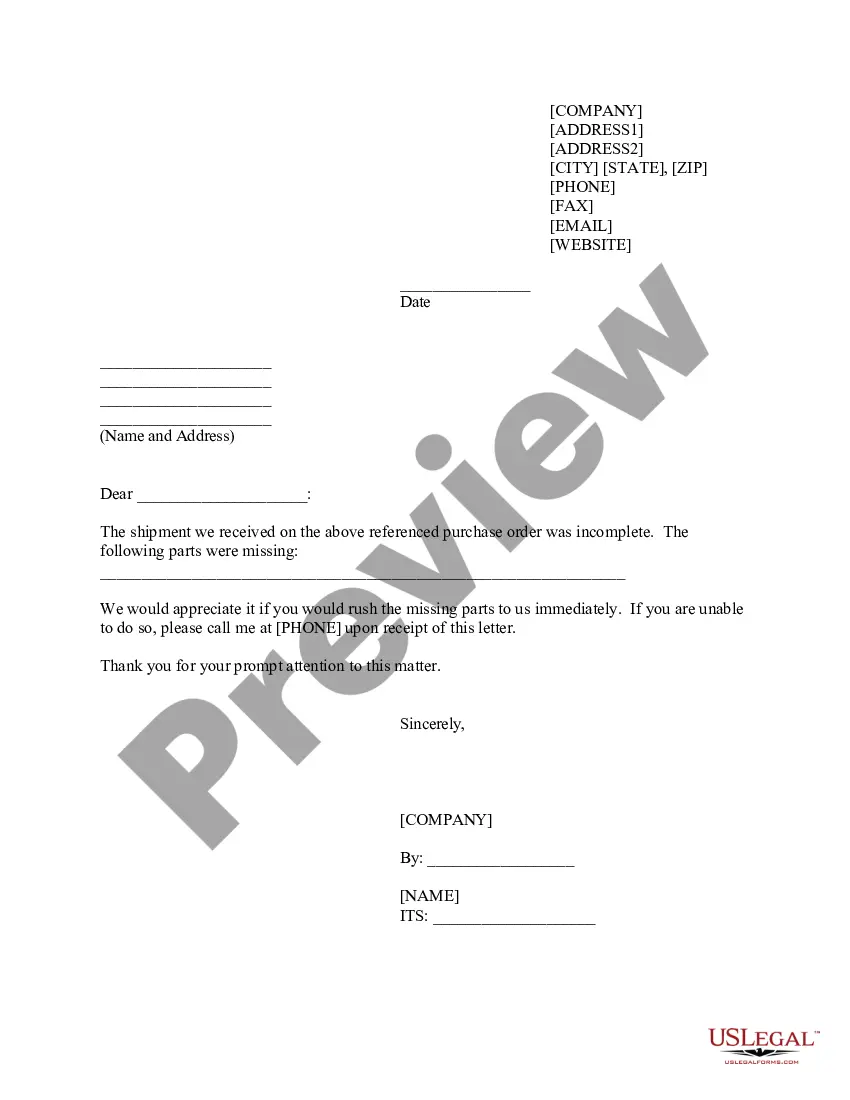
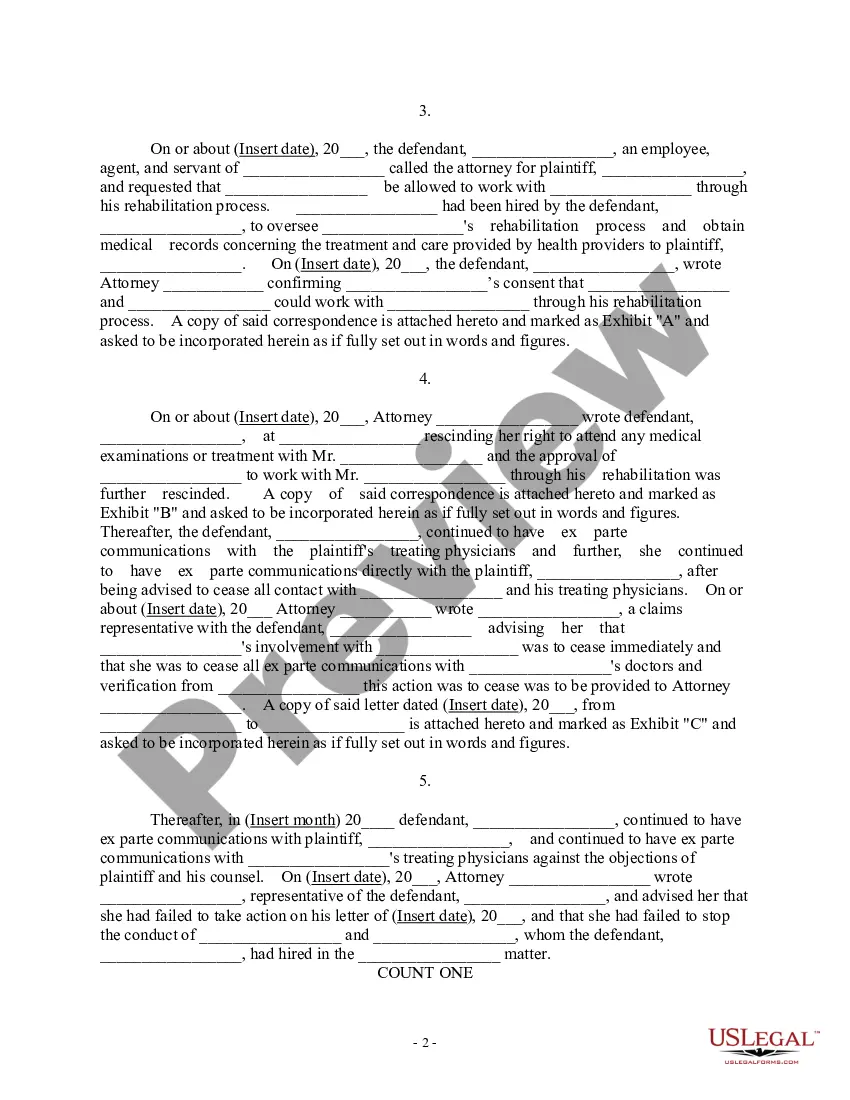
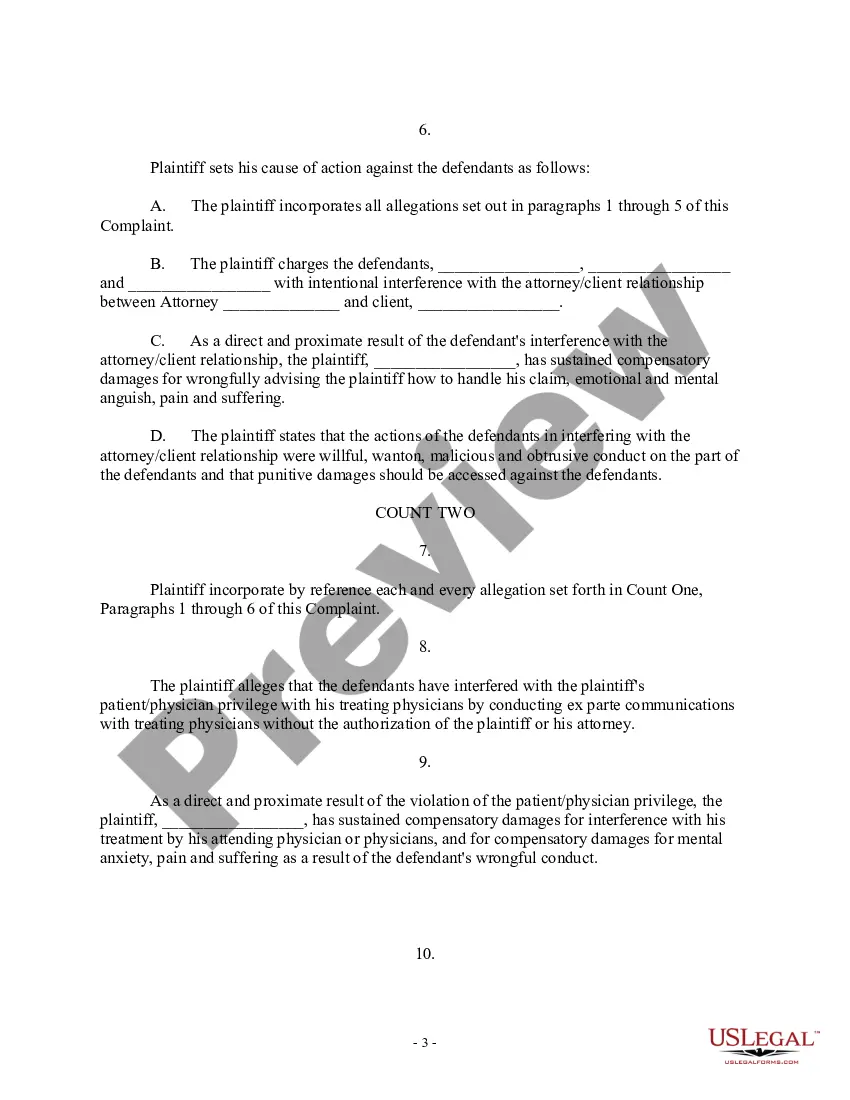
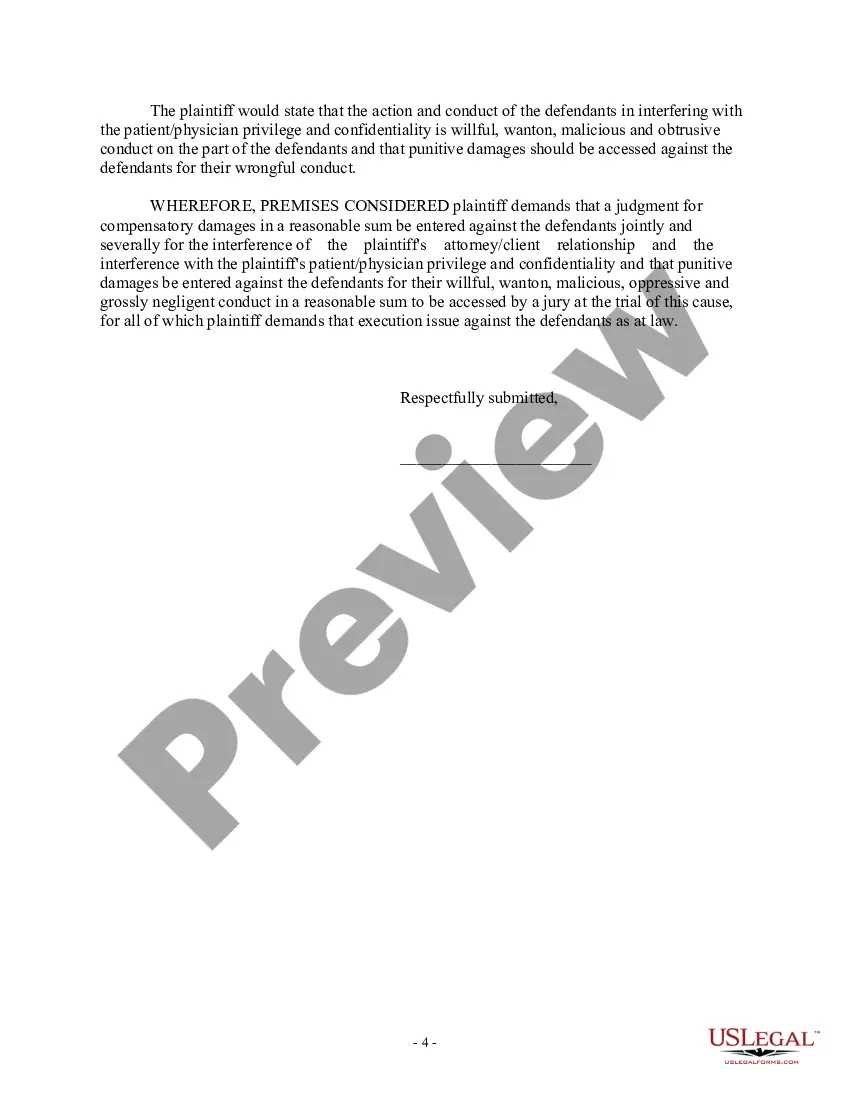
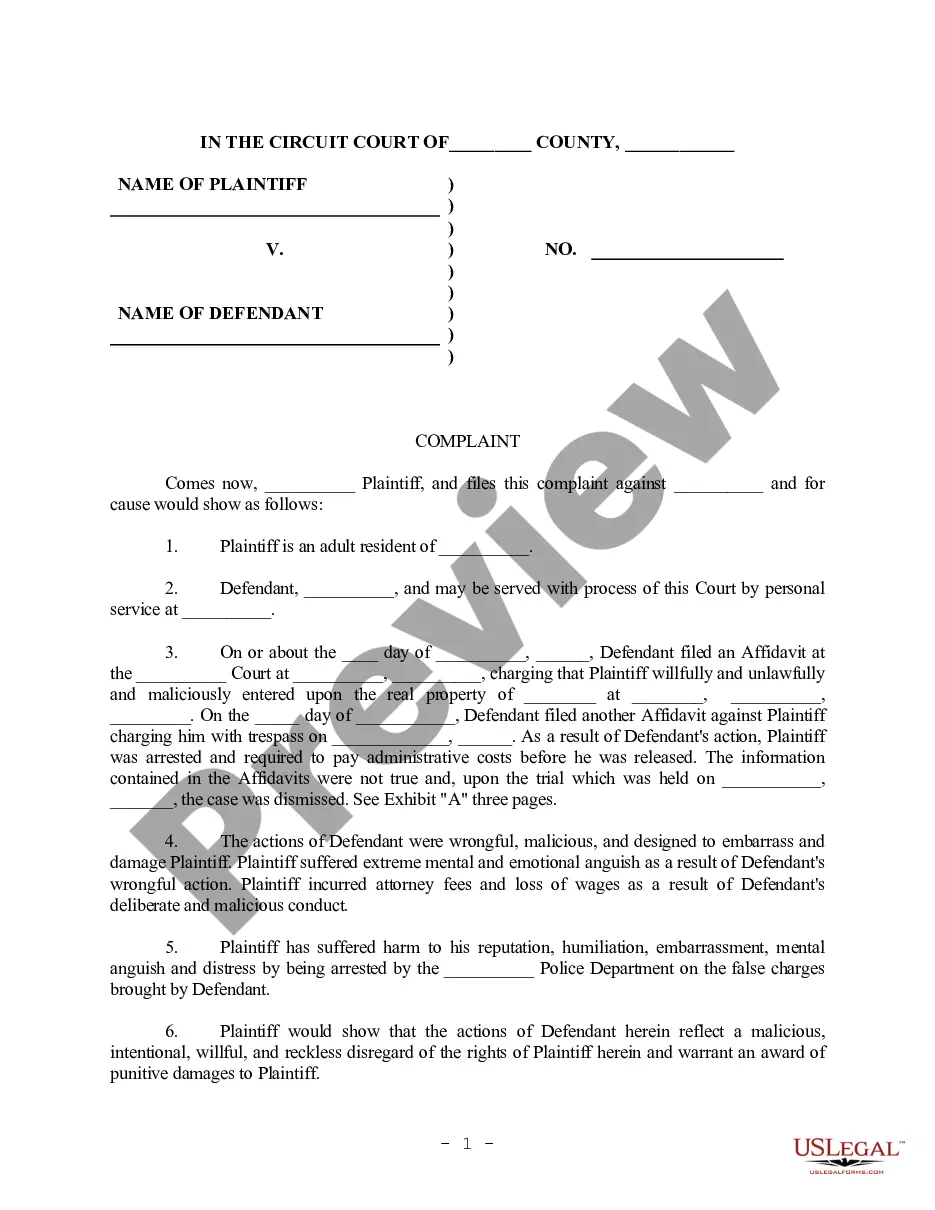
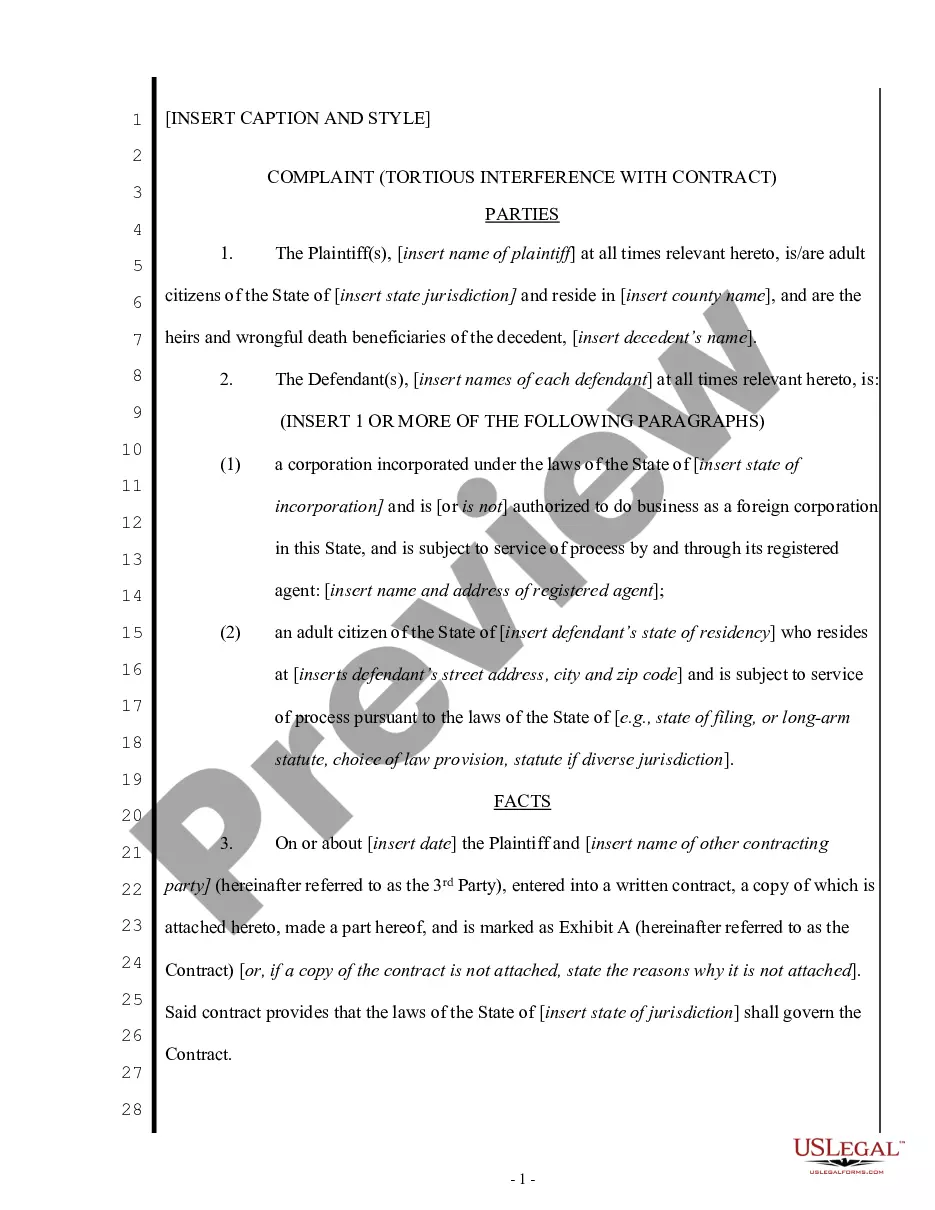
In this complaint, plaintiff charges defendants with intentional interference with the attorney/client relationship. The plaintiff states that the actions of the defendants in interfering with the attorney/client relationship were willful, wanton, malicious and obtrusive and that punitive damages should be accessed against the defendants.
Maine Complaint For Intentional Interference With Attorney-Client Relationship
Category:
State:
Multi-State
Control #:
US-000295
Format:
Word;
Rich Text
Instant download
Description
Free preview





How to fill out Complaint For Intentional Interference With Attorney-Client Relationship?
If you need to compile, download, or print sanctioned document templates, utilize US Legal Forms, the largest assortment of legal forms available online.
Make use of the site’s straightforward and user-friendly search feature to locate the documents you require.
Various templates for business and personal purposes are categorized by type and jurisdiction, or keywords. Access US Legal Forms to find the Maine Complaint For Intentional Interference With Attorney-Client Relationship in just a few clicks.
Every legal document format you download is yours permanently. You will have access to every form you downloaded in your account. Click on the My documents section and select a form to print or download again.
Complete and download, and print the Maine Complaint For Intentional Interference With Attorney-Client Relationship with US Legal Forms. There are numerous professional and state-specific forms you can utilize for your business or personal needs.
- If you are already a US Legal Forms user, Log In to your account and click the Acquire button to download the Maine Complaint For Intentional Interference With Attorney-Client Relationship.
- You can also find forms you previously downloaded in the My documents section of your account.
- If you are using US Legal Forms for the first time, follow the instructions below.
- Step 1. Ensure you have selected the form for your correct city/state.
- Step 2. Use the Review option to examine the form’s content. Remember to read the details.
- Step 3. If you are not satisfied with the form, use the Search field at the top of the page to find other versions of the legal form format.
- Step 4. Once you have found the form you need, click on the Get now button. Choose the payment plan you prefer and enter your information to create an account.
- Step 5. Complete the transaction. You can use your credit card or PayPal account to finalize the payment.
- Step 6. Select the format of the legal form and download it to your device.
- Step 7. Complete, modify, and print or sign the Maine Complaint For Intentional Interference With Attorney-Client Relationship.
Form popularity
FAQ
The 4.4 rules of professional conduct address the respect lawyers must show for the rights of others when representing clients. Specifically, these rules prohibit lawyers from using methods that serve to embarrass, delay, or burden a third party. If you believe that an attorney has violated these principles, and it has affected your attorney-client relationship, you can consider a Maine Complaint For Intentional Interference With Attorney-Client Relationship. It's beneficial to seek guidance on how these rules apply to your specific situation.
Rule 4.2 of the professional conduct guidelines emphasizes that lawyers must not communicate with individuals who are represented by another lawyer regarding the legal matter in question. This rule exists to protect the integrity of the attorney-client relationship and prevent undue influence. Violations of this rule can lead to serious repercussions and may be grounds for a Maine Complaint For Intentional Interference With Attorney-Client Relationship. Understanding this rule is vital for maintaining ethical legal practices.
Yes, you can sue for emotional distress in Maine, especially if you can prove that someone else's actions caused you significant emotional harm. This type of lawsuit often requires demonstrating that the behavior was extreme and outrageous. If your emotional distress stems from interference in your attorney-client relationship, you might consider filing a Maine Complaint For Intentional Interference With Attorney-Client Relationship. Consulting a legal professional can guide you through this process.
Rule 4.2 of the Maine Rules of Professional Conduct prohibits attorneys from communicating with a person known to be represented by another lawyer regarding the subject of the representation. This rule helps protect the sanctity of the attorney-client relationship. If an attorney violates this rule, it could form the basis for a Maine Complaint For Intentional Interference With Attorney-Client Relationship. Understanding this rule is crucial for both clients and lawyers.
Yes, you can sue an attorney for tortious interference under certain conditions. If you believe an attorney intentionally interfered with your attorney-client relationship, you may file a Maine Complaint For Intentional Interference With Attorney-Client Relationship. It's essential to gather evidence and understand your rights before taking legal action. Consulting a legal expert can help clarify your options.
In order to state a claim for tortious interference with a prospective economic advantage, a plaintiff must allege: "(1) that a valid contract or prospective economic advantage existed; (2) that the defendant interfered with that contract or advantage through fraud or intimidation; and (3) that such interference ...
Tortious interference, also known as intentional interference with contractual relations, in the common law of torts, occurs when one person intentionally damages someone else's contractual or business relationships with a third party, causing economic harm.
Under California law, to establish interference with contractual relations, a plaintiff must show that: (1) a valid contract exists between plaintiff and a third party; (2) defendant knew of the existence of this contract; (3) defendant took intentional steps to interrupt the contractual relation; (4) defendant's ...
The requisite elements of tortious interference with contract claim are: (1) the existence of a valid and enforceable contract between plaintiff and another; (2) defendant's awareness of the contractual relationship; (3) defendant's intentional and unjustified inducement of a breach of the contract; (4) a subsequent ...
Primary tabs The existence of a valid contract between the plaintiff and a third party; The defendant having knowledge of the contract; The defendant intentionally and unjustifiably inducing the third party to breach the contract; The occurrence of the breach resulting from the defendant's conduct; and. Damages.