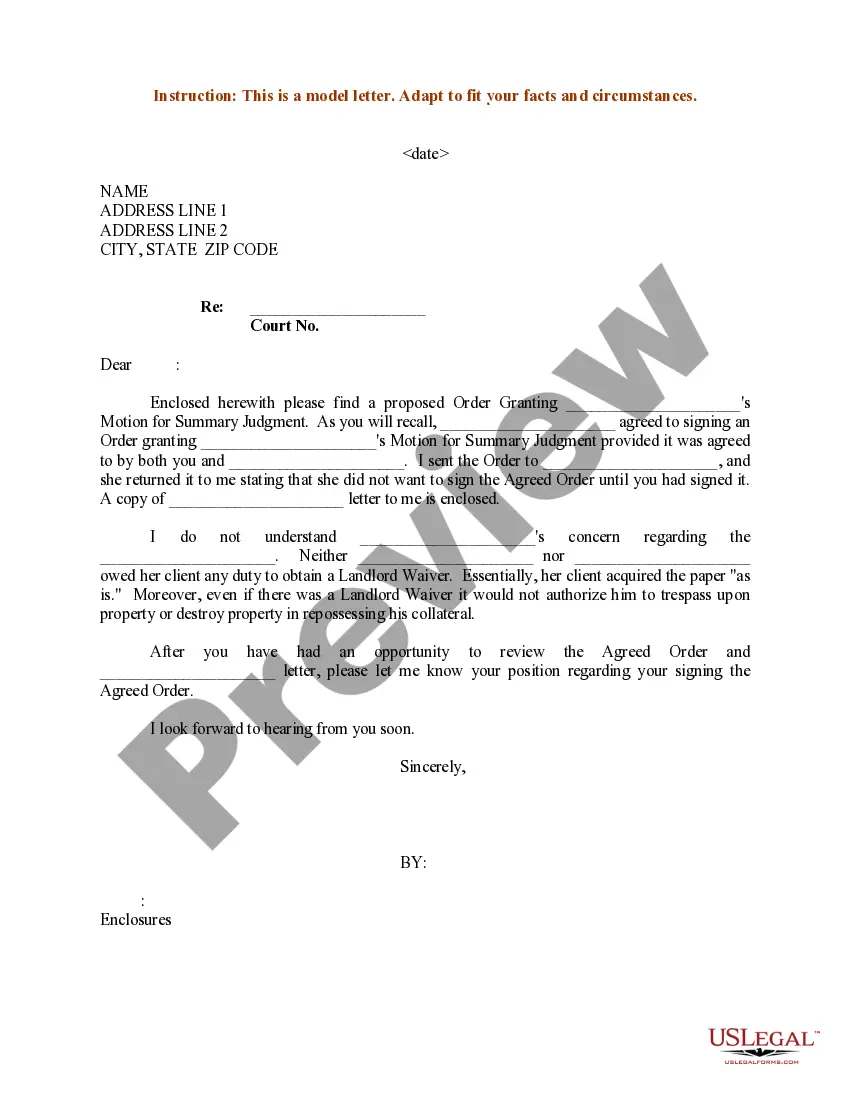
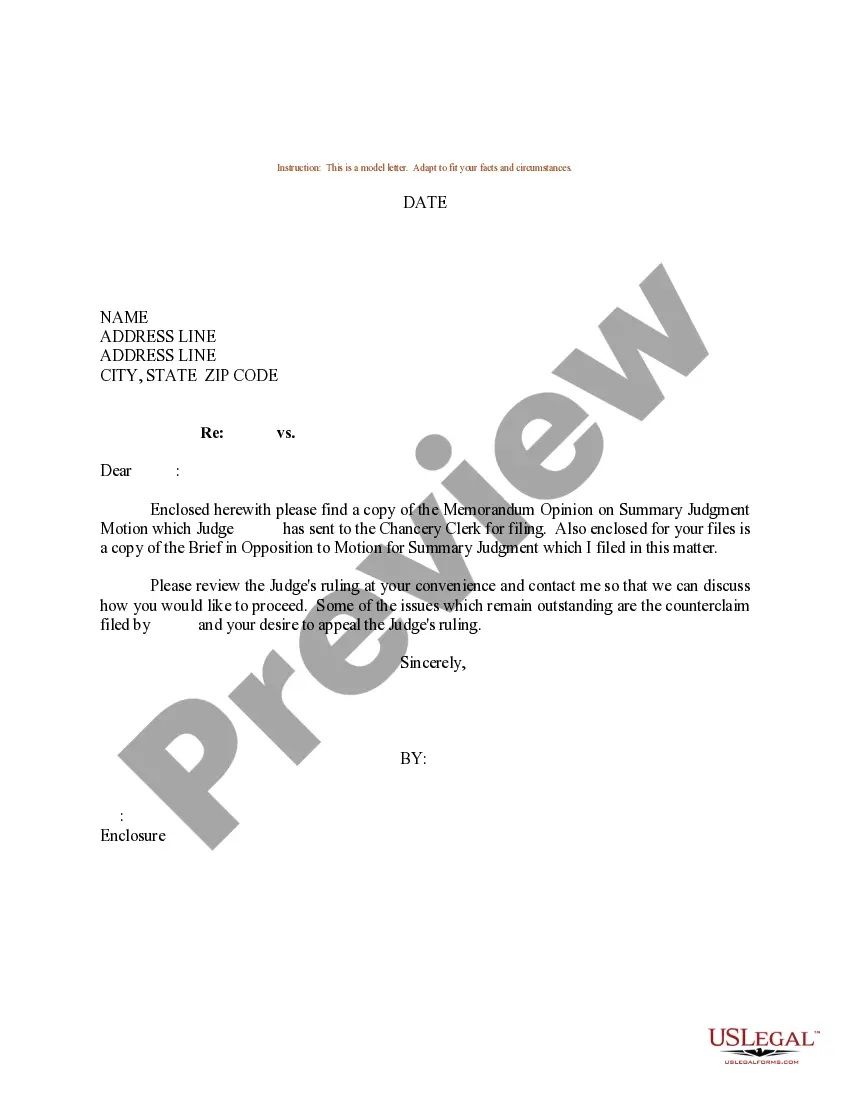
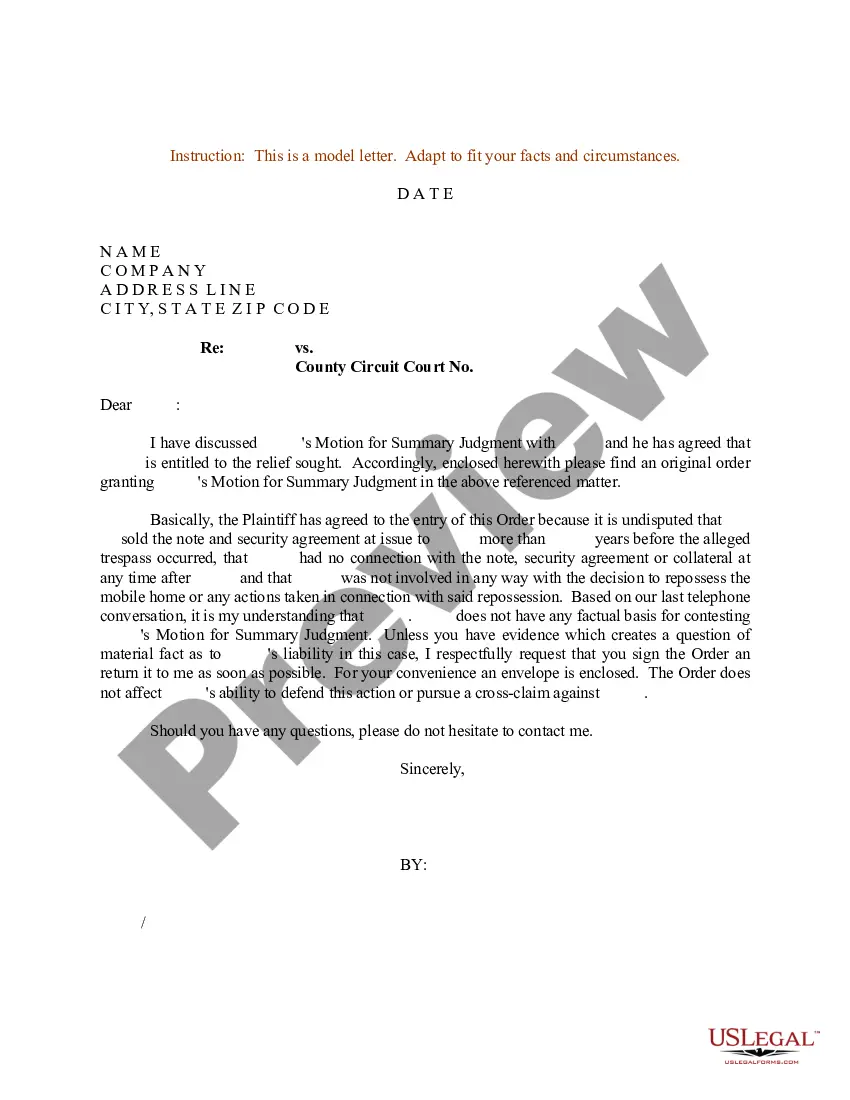
Maine Sample Letter for Proposed Order Granting Summary Judgment
Description
Get your form ready online
Our built-in tools help you complete, sign, share, and store your documents in one place.
Make edits, fill in missing information, and update formatting in US Legal Forms—just like you would in MS Word.
Download a copy, print it, send it by email, or mail it via USPS—whatever works best for your next step.
Sign and collect signatures with our SignNow integration. Send to multiple recipients, set reminders, and more. Go Premium to unlock E-Sign.
If this form requires notarization, complete it online through a secure video call—no need to meet a notary in person or wait for an appointment.
We protect your documents and personal data by following strict security and privacy standards.

Make edits, fill in missing information, and update formatting in US Legal Forms—just like you would in MS Word.

Download a copy, print it, send it by email, or mail it via USPS—whatever works best for your next step.

Sign and collect signatures with our SignNow integration. Send to multiple recipients, set reminders, and more. Go Premium to unlock E-Sign.

If this form requires notarization, complete it online through a secure video call—no need to meet a notary in person or wait for an appointment.

We protect your documents and personal data by following strict security and privacy standards.
Looking for another form?





How to fill out Sample Letter For Proposed Order Granting Summary Judgment?
If you need to aggregate, download, or generate sanctioned document templates, utilize US Legal Forms, the largest collection of legal forms available online.
Take advantage of the site’s straightforward and user-friendly search function to locate the documents you need.
Various templates for commercial and personal uses are categorized by categories and states, or keywords. Use US Legal Forms to locate the Maine Sample Letter for Proposed Order Granting Summary Judgment in just a few clicks.
Each legal document template you purchase is yours for years. You will have access to every form you saved in your account. Click the My documents section and select a form to print or download again.
Complete and download, and print the Maine Sample Letter for Proposed Order Granting Summary Judgment with US Legal Forms. There are millions of professional and state-specific forms available for your business or personal needs.
- If you are already a US Legal Forms customer, Log In to your account and click on the Download button to retrieve the Maine Sample Letter for Proposed Order Granting Summary Judgment.
- You can also access forms you previously stored in the My documents section of your account.
- If you are using US Legal Forms for the first time, follow the instructions below.
- Step 1. Ensure you have selected the form for the correct state/region.
- Step 2. Utilize the Review option to examine the form's details. Don’t forget to check the description.
- Step 3. If you are dissatisfied with the form, use the Search field at the top of the screen to find alternative types of the legal form format.
- Step 4. Once you have located the form you need, select the Buy now button. Choose the payment plan you prefer and enter your details to register for an account.
- Step 5. Process the transaction. You can use your credit card or PayPal account to complete the purchase.
- Step 6. Choose the format of the legal form and download it to your device.
- Step 7. Fill out, modify, and print or sign the Maine Sample Letter for Proposed Order Granting Summary Judgment.
Form popularity
FAQ
Rule 41A - Motion to Suppress Evidence (a) Grounds of Motion. A defendant may move to suppress as evidence any of the following, on the ground that it was illegally obtained: (1) property; (2) statements of the defendant; (3) test results; (4) out-of-court or in-court eyewitness identifications of the defendant.
Where there is n genuine issue of material fact, the court will Page 2 Appendix 5 grant summary judgment in favor of one of the parties. For example, if all the evidence shows that the light was green, the court does not need to hold a trial to determine whether the light was red or green.
A motion is an application to the court made by the prosecutor or defense attorney, requesting that the court make a decision on a certain issue before the trial begins. The motion can affect the trial, courtroom, defendants, evidence, or testimony. Only judges decide the outcome of motions.
Therefore, to win on summary judgment you have to convince a judge that it is a good use of his or her very limited time and resources to write the decision. This means that your written material has to demonstrate that the law and facts support summary judgment, and contain no misstatements of law or fact.
What are the three basic items all motions must include? All motions must include (1) the motion, (2) the notice of hearing and the memorandum of points and (3) authorities.
A motion to the court must include the legal authority that supports the motion request. The moving party must explain how and why the law, case law, and/or court rule supports the request.
The most common post-trial motions include: Motion to set aside the verdict. Motion for a new trial. Motion to dismiss.
A motion is the method used to speak to the judge about a matter in your case. For example, a motion may be brought to ask the court to set aside a default or vacate a default judgment, or it may be brought to ask the court to order a judgment to be paid in installments.