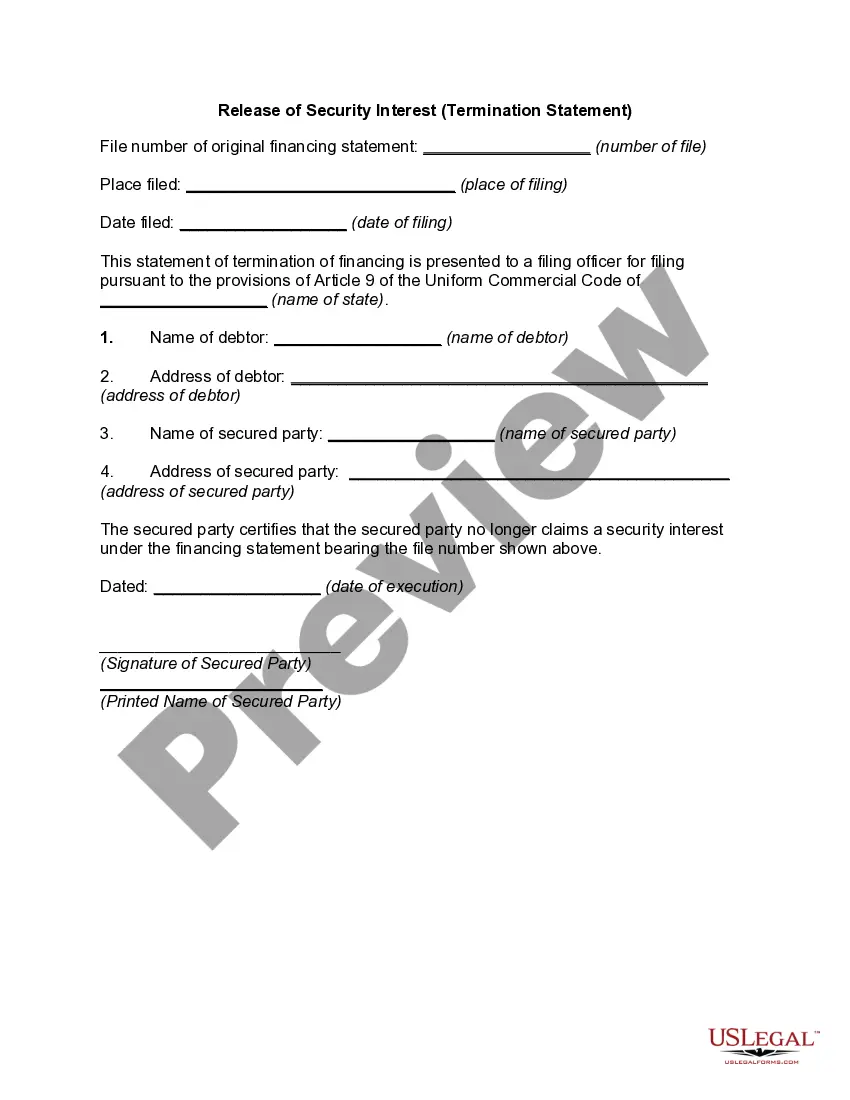
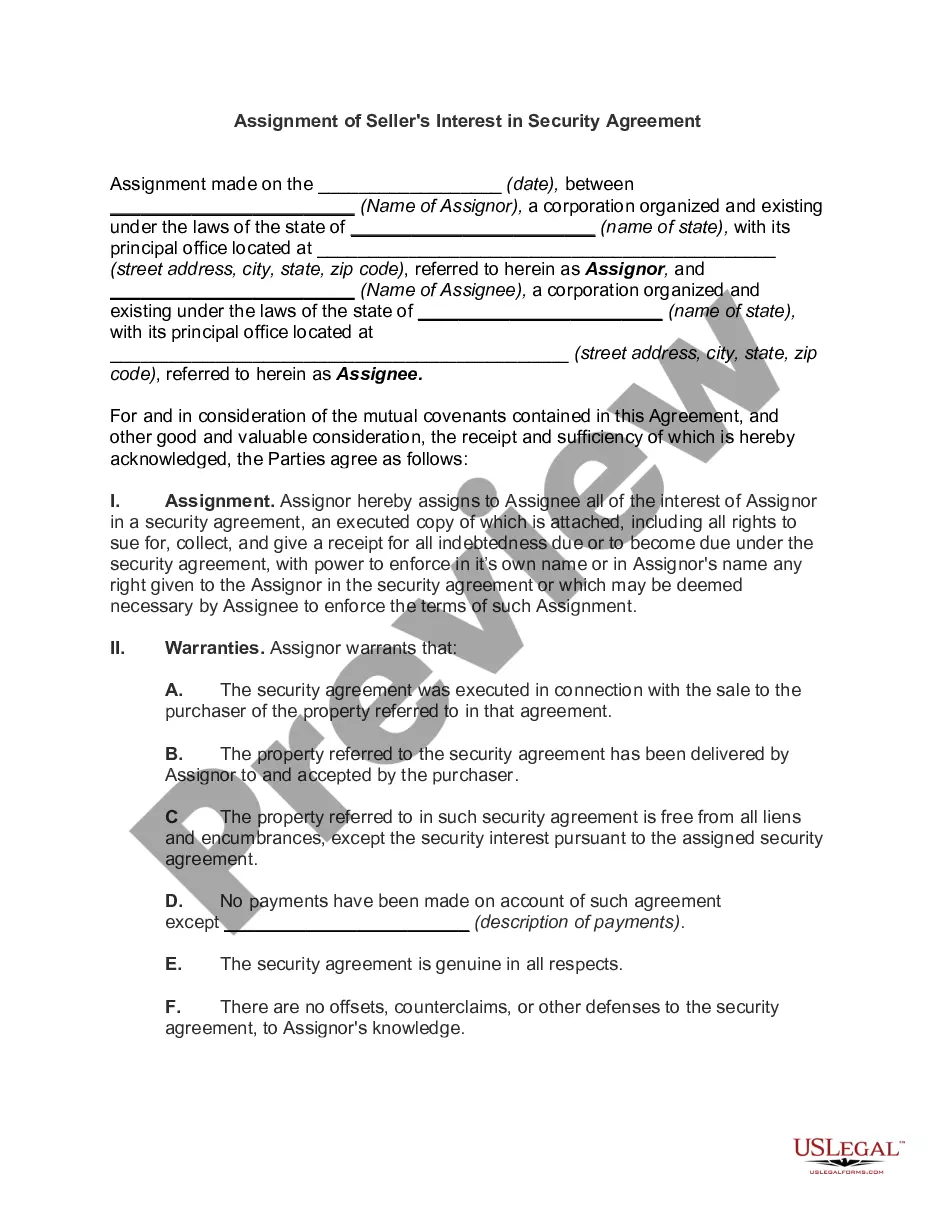
Maine Release of Security Interest - Termination Statement
Description
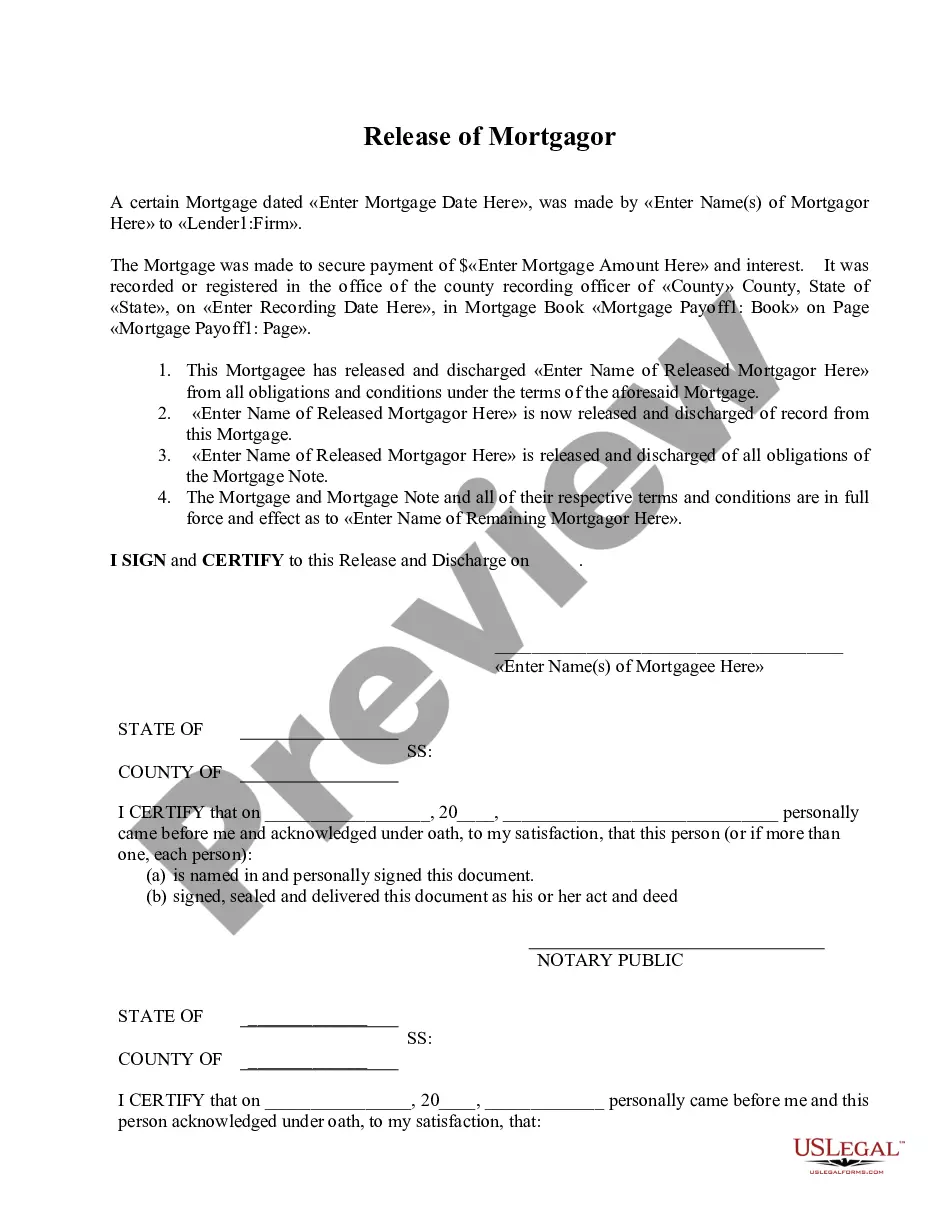
Get your form ready online
Our built-in tools help you complete, sign, share, and store your documents in one place.
Make edits, fill in missing information, and update formatting in US Legal Forms—just like you would in MS Word.
Download a copy, print it, send it by email, or mail it via USPS—whatever works best for your next step.
Sign and collect signatures with our SignNow integration. Send to multiple recipients, set reminders, and more. Go Premium to unlock E-Sign.
If this form requires notarization, complete it online through a secure video call—no need to meet a notary in person or wait for an appointment.
We protect your documents and personal data by following strict security and privacy standards.

Make edits, fill in missing information, and update formatting in US Legal Forms—just like you would in MS Word.

Download a copy, print it, send it by email, or mail it via USPS—whatever works best for your next step.

Sign and collect signatures with our SignNow integration. Send to multiple recipients, set reminders, and more. Go Premium to unlock E-Sign.

If this form requires notarization, complete it online through a secure video call—no need to meet a notary in person or wait for an appointment.

We protect your documents and personal data by following strict security and privacy standards.
Looking for another form?
How to fill out Release Of Security Interest - Termination Statement?
If you have to complete, acquire, or print out legal record layouts, use US Legal Forms, the largest assortment of legal types, which can be found on the web. Use the site`s easy and convenient research to obtain the papers you need. Various layouts for organization and specific purposes are categorized by types and claims, or keywords. Use US Legal Forms to obtain the Maine Release of Security Interest - Termination Statement with a number of mouse clicks.
Should you be currently a US Legal Forms client, log in to the bank account and click on the Download switch to obtain the Maine Release of Security Interest - Termination Statement. Also you can access types you in the past downloaded in the My Forms tab of your bank account.
If you are using US Legal Forms initially, follow the instructions below:
- Step 1. Ensure you have selected the form for your right metropolis/nation.
- Step 2. Make use of the Review solution to check out the form`s content material. Don`t forget to learn the outline.
- Step 3. Should you be unhappy with all the type, utilize the Lookup field on top of the screen to discover other versions of the legal type web template.
- Step 4. When you have located the form you need, go through the Get now switch. Select the prices prepare you choose and include your credentials to sign up to have an bank account.
- Step 5. Approach the financial transaction. You can use your Мisa or Ьastercard or PayPal bank account to complete the financial transaction.
- Step 6. Choose the formatting of the legal type and acquire it on your device.
- Step 7. Comprehensive, edit and print out or indication the Maine Release of Security Interest - Termination Statement.
Every legal record web template you buy is your own property eternally. You possess acces to each and every type you downloaded within your acccount. Go through the My Forms area and decide on a type to print out or acquire again.
Compete and acquire, and print out the Maine Release of Security Interest - Termination Statement with US Legal Forms. There are thousands of professional and status-specific types you can use to your organization or specific requirements.
Form popularity
FAQ
What makes someone a secured party? To put it in simple terms, the secured party is the creditor on the UCC loan. The creditor is the secured party because they have a financial interest in the collateral which the lien is on.
?UCC? stands for Uniform Commercial Code. The Uniform Commercial Code is a uniform law that governs commercial transactions, including sales of goods, secured transactions and negotiable instruments. The Uniform Commercial Code is a comprehensive set of statutes created to provide consistency among the states.
Uniform Commercial Code (UCC) filings allow creditors to notify other creditors about a debtor's assets used as collateral for a secured transaction. UCC liens filed with Secretary of State offices act as a public notice by the "creditor" of the creditor's interest in the property.
A creditor files a UCC-1 to provide notice to interested parties that he or she has a security interest in a debtor's personal property. This personal property is being used as collateral in some type of secured transaction, usually a loan or a lease.
Ask the lender to terminate the lien upon payoff. When you pay off a loan, a good rule of thumb is to immediately submit a request with the lender to file a UCC-3 form with your secretary of state. The UCC-3 will terminate the lien on your company's asset (or assets) and remove the UCC-1 filing.
A UCC filing is the official notice lenders use to indicate that they have a security interest in a borrower's assets or property. The UCC filing establishes a lien against the collateral the borrower uses to secure the loan ? giving the lender the right to claim that collateral as repayment in the case of default.