Michigan Personal Representative's Deed of Distribution to an Individual
What is this form?
The Personal Representative's Deed of Distribution to an Individual is a legal document used to transfer real property from a deceased estate to a named individual beneficiary or heir. This deed serves as proof that the personal representative has the authority granted by the court to distribute the property, highlighting their lack of obligation to defend against claims outside of their authority. Unlike a traditional deed, this document specifically addresses the distribution of estate property after an individual's passing.
Main sections of this form
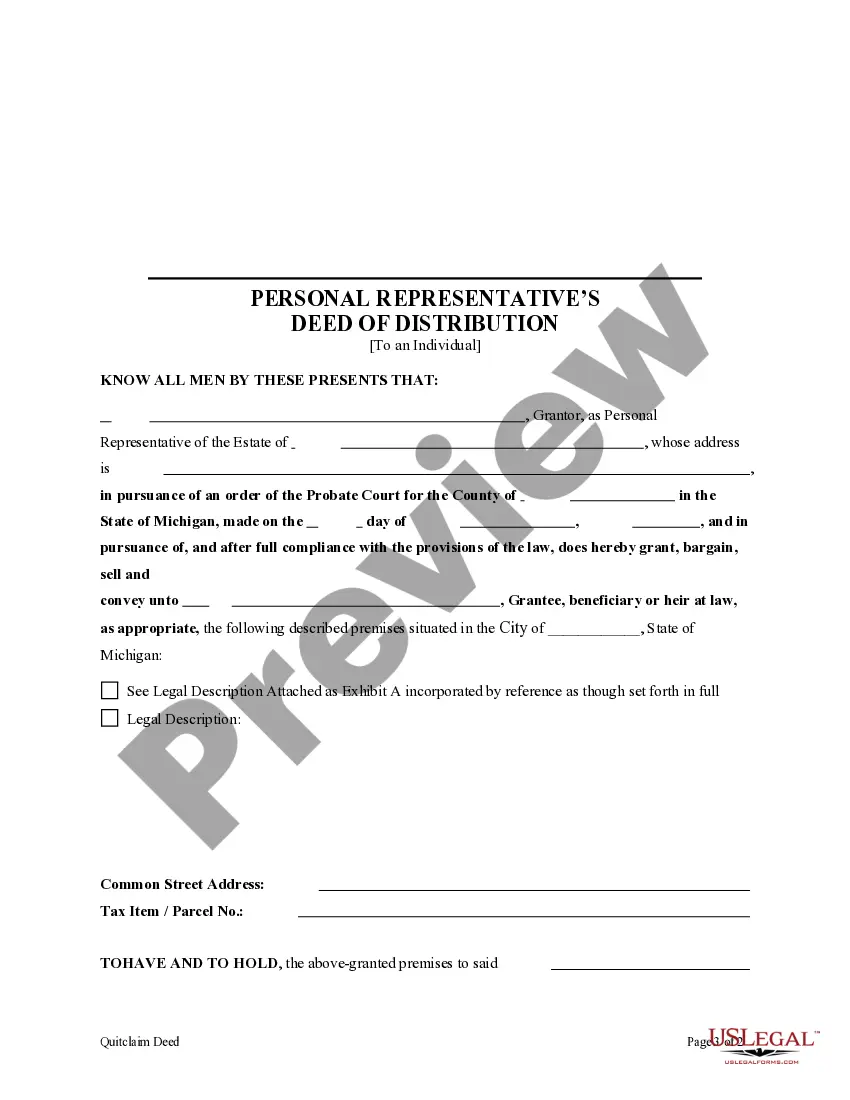
- Identification of the grantor (personal representative) and grantee (beneficiary).
- Legal description of the property being transferred.
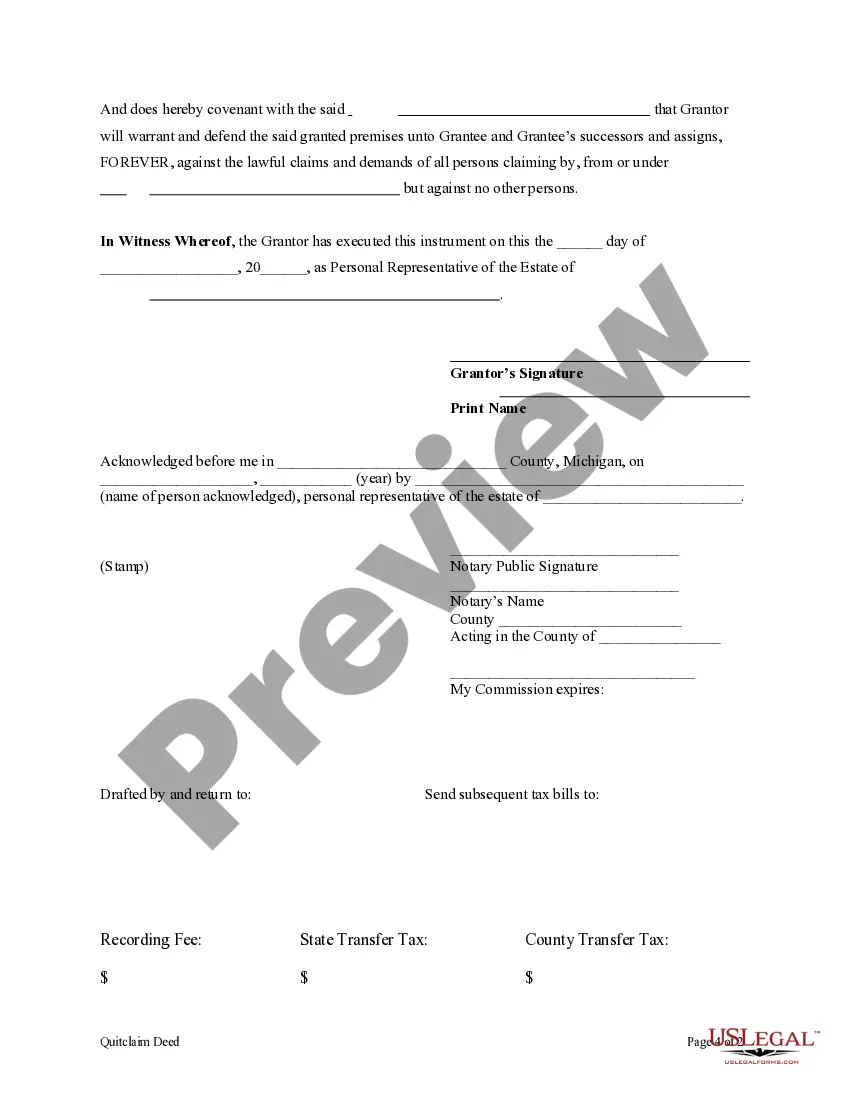
- Covenants regarding the authority of the grantor and encumbrances on the property.
- Signature area for the grantor to formally execute the deed.
- Reference to court authorization for the personal representative's actions.




When to use this form
This form is typically used when a personal representative is ready to distribute property to an heir or beneficiary as part of the estate settlement process. It is essential for ensuring that the property title is legally and properly transferred in compliance with state laws following a person's death.
Intended users of this form
- Personal representatives handling an estate after someone's death.
- Beneficiaries or heirs looking to receive their share of the estate's real property.
- Individuals involved in the estate administration process seeking to maintain proper legal documentation.
Steps to complete this form
- Identify the parties: Enter the names and information of both the grantor (personal representative) and grantee (beneficiary).
- Specify the property: Provide a detailed legal description of the real property being transferred.
- Obtain court approval: Ensure you reference the court order that grants the personal representative the authority to distribute the property.
- Sign the deed: The personal representative must sign the deed in accordance with state laws requiring the execution of legal documents.
- Record the deed: After completion, ensure the deed is filed with the appropriate local government office to officially document the transfer.
Does this document require notarization?
This form does not typically require notarization unless specified by local law. However, having the deed notarized can provide an additional layer of legal assurance and may be needed for recording purposes in some jurisdictions.
Get your form ready online
Our built-in tools help you complete, sign, share, and store your documents in one place.
Make edits, fill in missing information, and update formatting in US Legal Forms—just like you would in MS Word.
Download a copy, print it, send it by email, or mail it via USPS—whatever works best for your next step.
Sign and collect signatures with our SignNow integration. Send to multiple recipients, set reminders, and more. Go Premium to unlock E-Sign.
If this form requires notarization, complete it online through a secure video call—no need to meet a notary in person or wait for an appointment.
We protect your documents and personal data by following strict security and privacy standards.

Make edits, fill in missing information, and update formatting in US Legal Forms—just like you would in MS Word.

Download a copy, print it, send it by email, or mail it via USPS—whatever works best for your next step.

Sign and collect signatures with our SignNow integration. Send to multiple recipients, set reminders, and more. Go Premium to unlock E-Sign.

If this form requires notarization, complete it online through a secure video call—no need to meet a notary in person or wait for an appointment.

We protect your documents and personal data by following strict security and privacy standards.
Common mistakes to avoid
- Failing to include the correct legal description of the property.
- Not referencing the court's authorization in the deed.
- Omitting the necessary signatures or failing to sign the form properly.
- Not filing the deed with the local government office, which can delay property transfer.
Benefits of using this form online
- Convenient access to legal forms that can be completed and printed from the comfort of your home.
- Editability allows for customization to fit individual circumstances without starting from scratch.
- Reliability, with forms drafted by licensed attorneys to ensure compliance with state laws.
Looking for another form?
Form popularity
FAQ
Used to transfer real property from a deceased person’s estate to a named individual, the Michigan Personal Representative's Deed of Distribution to an Individual shows the personal representative has court-approved authority to distribute the property. It records the distribution after death and flags that the representative’s authority is limited to matters within the court’s order.
To fill it out, identify the grantor (the personal representative) and the grantee (the beneficiary), then enter the property’s legal description and the deed’s covenants about authority and encumbrances. The grantor signs in the designated area and the document references the court authorization that permits the distribution.
To obtain it, prepare the form with the grantor and grantee identified, verify the property description, and ensure the deed includes the court authorization. After signing, the document is typically filed or recorded with the appropriate county clerk to effect the transfer of title from the estate to the named individual.
The owner of the property after execution is the grantee named in the deed—the individual beneficiary or heir receiving the property. The form transfers title from the estate to that person, subject to the authority and encumbrance language and the court authorization referenced in the deed.
Use this form when a personal representative is ready to distribute property to a named individual. Ensure the legal description and encumbrance details are accurate, and that the deed clearly references the court authorization. A properly signed deed is typically recorded with the county recorder to effect the transfer.
This form is specifically used to transfer title to a single named individual beneficiary or heir and includes a reference to court authorization, along with the required grantor/grantee identification, property description, and covenants about authority and encumbrances. It focuses on distribution to one person rather than multiple recipients.