Michigan Order of Adjournment
Overview of this form
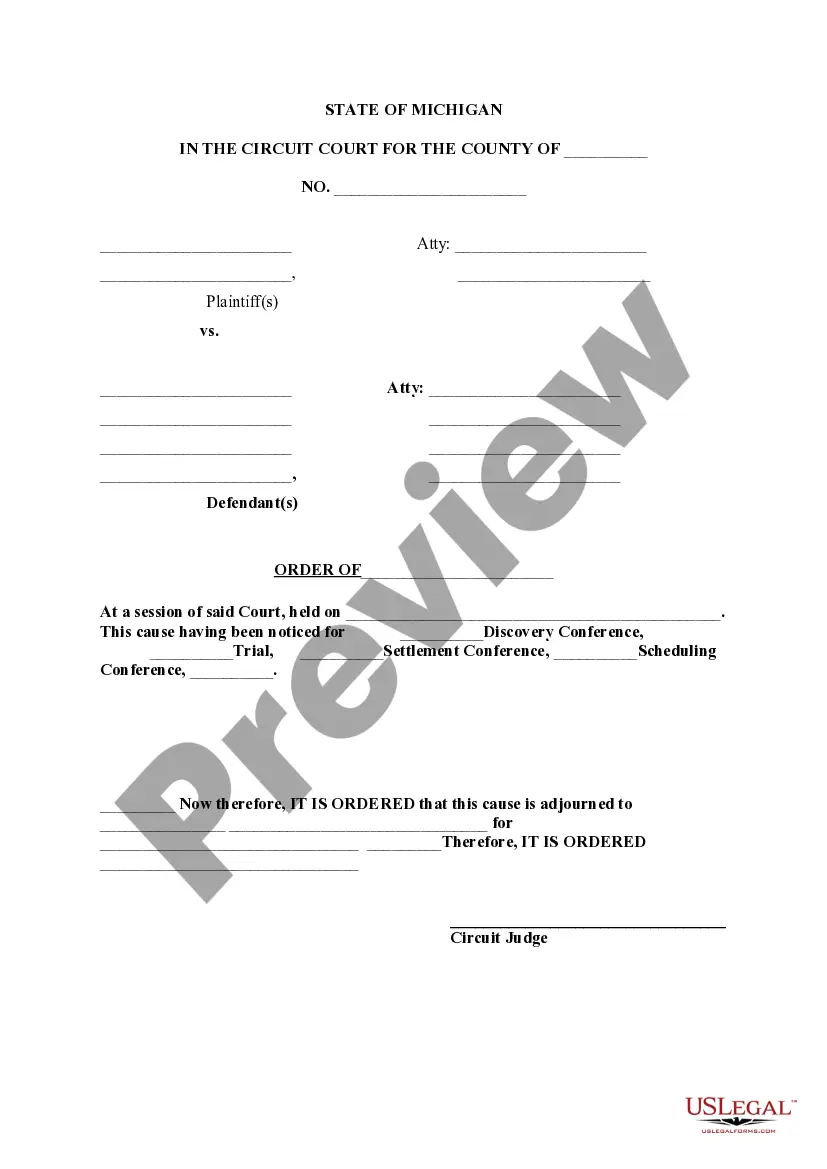
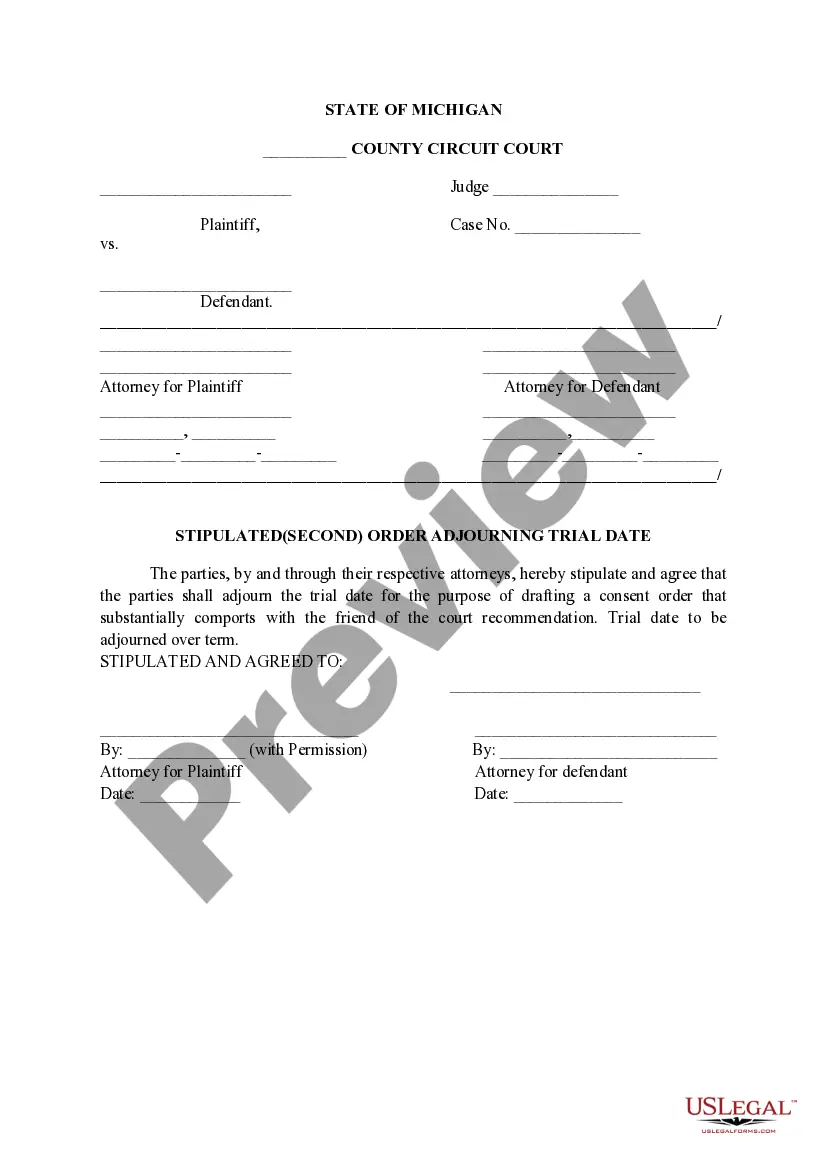
The Order of Adjournment is a legal document used in court proceedings to officially postpone a scheduled court date to a later time. This form is essential for maintaining proper legal protocol when a party involved in a case needs additional time or specific conditions are required before continuing with the proceedings. Unlike other court documents, the Order of Adjournment specifically addresses the rescheduling aspect of court activities.
Main sections of this form
- Case title, including names of plaintiffs and defendants.
- Court name and number.
- Date and type of the originally scheduled court event.
- New date and reason for adjournment.
- Signature of the Circuit Judge.
When to use this document
This form is used when a court hearing or trial needs to be postponed for various reasons, such as the unavailability of a party, the need for further legal preparation, or other exigent circumstances. It ensures that all parties are informed of the postponement and the new court date.
Intended users of this form
- Parties involved in a civil lawsuit who need to reschedule their court date.
- Lawyers representing clients who require an adjournment in their case.
- Individuals seeking to manage their court schedule responsibly and lawfully.
How to prepare this document
- Identify and fill in the names of the plaintiffs and defendants.
- Enter the specific court name and case number.
- Indicate the original date and type of conference or trial that is being adjourned.
- Provide the new date for the court event and the reason for the adjournment.
- Obtain the signature of the Circuit Judge to validate the adjournment.
Does this document require notarization?
This form does not typically require notarization unless specified by local law. Ensure you check any specific requirements related to your case to maintain compliance.
Get your form ready online
Our built-in tools help you complete, sign, share, and store your documents in one place.
Make edits, fill in missing information, and update formatting in US Legal Forms—just like you would in MS Word.
Download a copy, print it, send it by email, or mail it via USPS—whatever works best for your next step.
Sign and collect signatures with our SignNow integration. Send to multiple recipients, set reminders, and more. Go Premium to unlock E-Sign.
If this form requires notarization, complete it online through a secure video call—no need to meet a notary in person or wait for an appointment.
We protect your documents and personal data by following strict security and privacy standards.

Make edits, fill in missing information, and update formatting in US Legal Forms—just like you would in MS Word.

Download a copy, print it, send it by email, or mail it via USPS—whatever works best for your next step.

Sign and collect signatures with our SignNow integration. Send to multiple recipients, set reminders, and more. Go Premium to unlock E-Sign.

If this form requires notarization, complete it online through a secure video call—no need to meet a notary in person or wait for an appointment.

We protect your documents and personal data by following strict security and privacy standards.
Common mistakes
- Failing to specify the new date and reason for adjournment.
- Not obtaining the required signature from the Circuit Judge.
- Incorrectly identifying the parties involved in the case.
Advantages of online completion
- Fast and easy access to the legal template you need.
- Edit the document to suit your specific case requirements.
- Assurance that the form meets the legal standards required by Michigan courts.
Looking for another form?
Form popularity
FAQ
To make an adjournment application in Michigan, start by identifying the reason for your request. You will need to complete the necessary forms accurately, making sure to include details about your case and the specific circumstances for the adjournment. Next, file the application with the court and serve it to all relevant parties. Utilizing a platform like US Legal Forms can simplify this process by providing pre-filled templates designed specifically for a Michigan Order of Adjournment.
Reasons for requesting an adjournment can include the need for more time to gather evidence, witness availability, or unforeseen personal circumstances. By referring to the Michigan Order of Adjournment, you highlight the legal basis for your request, making it more compelling. Gathering any supporting documentation can also strengthen your case.
A sample sentence for adjournment might read: 'I respectfully request a Michigan Order of Adjournment to allow additional time for case preparation and ensure all parties are adequately represented.' This sentence succinctly conveys your intent while referencing the related legal term, making it clear and professional.
The procedure for adjournment typically requires you to file a formal request with the court, citing the Michigan Order of Adjournment. You may need to notify the opposing party and potentially attend a hearing. Each jurisdiction may have specific rules, so it’s wise to check local court procedures or consult with a legal professional for guidance.
The best excuse for adjournment can vary, but health issues, travel emergencies, or the need for additional legal representation are often accepted. Make sure to mention the Michigan Order of Adjournment in your request, as this terminology clarifies your intentions. Being honest and providing documentation can make your excuse more credible.
The best reason for filing for an adjournment often includes unavoidable circumstances such as a scheduling conflict or needing more time to prepare. When referencing the Michigan Order of Adjournment, emphasize the importance of ensuring fairness and adequate preparation for all parties involved. A well-founded reason can significantly enhance the chances of approval.
To write a letter of adjournment, start by clearly stating the case number and the reason for your request. Use a polite and formal tone, and mention the Michigan Order of Adjournment to describe the specific action you are seeking. Be sure to include relevant dates and any supporting information that strengthens your request.
The 77-day rule in Michigan refers to a specific guideline regarding the time frame in which a case must be resolved or heard after an adjournment is granted. This rule is crucial for ensuring that legal proceedings move forward in a timely manner. Being aware of the 77-day rule and incorporating the Michigan Order of Adjournment into your strategy can help maintain order and efficiency in court processes.
The meaning of an order of adjournment specifically relates to the formal act of delaying legal proceedings. In Michigan, this order is typically issued by a judge upon request from one of the parties involved. Understanding this concept is essential for any individual or entity engaged in legal matters, particularly when navigating processes like the Michigan Order of Adjournment.
The primary purpose of an adjournment is to provide parties with necessary time to prepare thoroughly for a case or to gather additional evidence. It also allows time for negotiations and additional discussions that may benefit the resolution of a legal matter. Utilizing an adjournment effectively can significantly impact the outcome of a case under the Michigan Order of Adjournment framework.