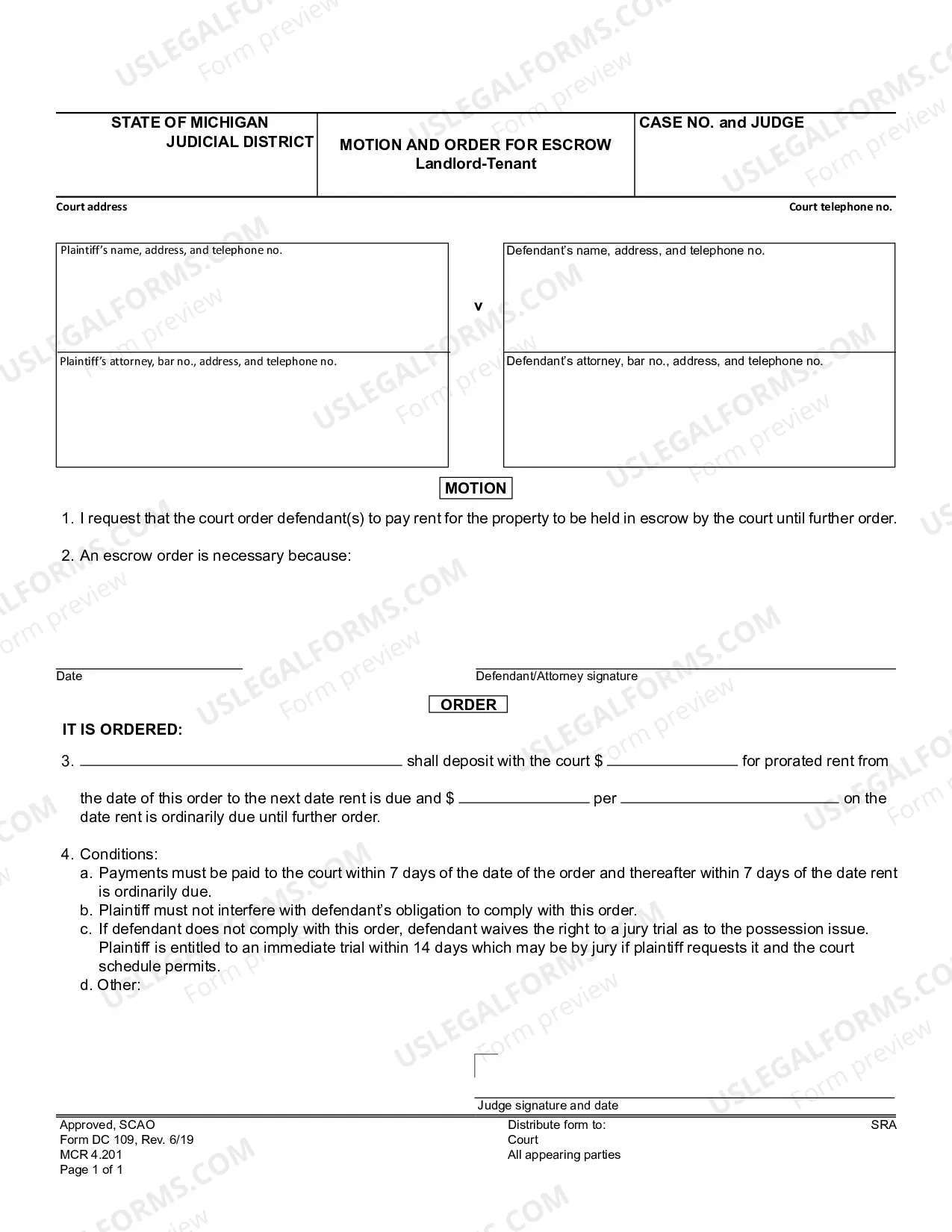
Michigan Motion and Order for Escrow, Landlord-Tenant/Land Contract is a court document used in the state of Michigan to set up an escrow agreement between a landlord and tenant. This document is used to specify the terms of the agreement, including the amount of money to be held in escrow, the date on which it should be deposited, and the purpose for which the funds will be used. This document is also used to determine who is responsible for any costs associated with the escrow agreement. Additionally, the document may outline the rights and responsibilities of both parties in the event of a breach of agreement. There are two different types of Michigan Motion and Order for Escrow, Landlord-Tenant/Land Contract. The first type is used when a tenant is making a large down payment on a property, and the landlord wants to protect their interests by having the tenant put the money into an escrow account. The second type is used when a land contract is in place between a landlord and tenant. This document outlines the rights and responsibilities of both parties, and specifies the amount of money that should be held in escrow.
Michigan Motion and Order for Escrow, Landlord-Tenant/Land Contract
Description
Get your form ready online
Our built-in tools help you complete, sign, share, and store your documents in one place.
Make edits, fill in missing information, and update formatting in US Legal Forms—just like you would in MS Word.
Download a copy, print it, send it by email, or mail it via USPS—whatever works best for your next step.
Sign and collect signatures with our SignNow integration. Send to multiple recipients, set reminders, and more. Go Premium to unlock E-Sign.
If this form requires notarization, complete it online through a secure video call—no need to meet a notary in person or wait for an appointment.
We protect your documents and personal data by following strict security and privacy standards.

Make edits, fill in missing information, and update formatting in US Legal Forms—just like you would in MS Word.

Download a copy, print it, send it by email, or mail it via USPS—whatever works best for your next step.

Sign and collect signatures with our SignNow integration. Send to multiple recipients, set reminders, and more. Go Premium to unlock E-Sign.

If this form requires notarization, complete it online through a secure video call—no need to meet a notary in person or wait for an appointment.

We protect your documents and personal data by following strict security and privacy standards.
Looking for another form?
Key Concepts & Definitions
Understanding the terms related to motion and order for escrow in landlord-tenant land disputes involves several key concepts:
- Motion Order: A legal request filed by a party in a lawsuit asking the court for a specific ruling.
- Landlord Tenant: Refers to the legal relationship between a property owner and the occupant renting the property.
- Termination of Tenancy: The process of legally ending a rental agreement.
- Land Contract: An agreement wherein the buyer makes payments to the seller for possession of a property, without receiving title until the full sale price is paid.
- Court Garnishment: A court order directing a third party to withhold funds, typically from the tenant's wages, to satisfy a debt or judgment.
- Default Judgment: A judgment in favor of the plaintiff when the defendant fails to contest the case or fails to appear.
Step-by-Step Guide to Filing a Motion for Escrow Order
To file a motion for an escrow order in a landlord-tenant dispute involving land, follow these steps:
- Determine the Need: Assess whether a motion for escrow is necessary to resolve any disputes regarding property possession or payments.
- Prepare the Documentation: Gather all necessary documents such as lease agreements, payment records, and any prior court orders or communications.
- Filing the Complaint: File a complaint with the court outlining the issues and request for escrow of funds.
- Serve the Motion: Legally serve the motion to all involved parties.
- Court Hearing: Attend the hearing, presenting your case and evidence for why an escrow order should be granted.
- Comply with Court Order: If the motion is approved, comply strictly with the courts escrow order and ensure all payments are made accordingly.
Risk Analysis
Filing a motion for escrow in landlord-tenant disputes carries various risks:
- Legal Costs: Both sides may incur significant legal fees, particularly if the dispute escalates to prolonged litigation.
- Delayed Resolutions: Court procedures can be lengthy, potentially delaying conflict resolution and extending the period in which property or funds are in limbo.
- Unfavorable Judgments: There is always a risk that the court may not rule in your favor, which could complicate your property possession or financial recovery efforts.
Comparison Table: Legal Processes in Landlord-Tenant Disputes
| Process | Description | Typical Duration |
|---|---|---|
| Motion for Escrow Order | Legal request to place funds or property under a third-party control during a dispute. | 3-6 months |
| Termination of Tenancy | Legally ending a rental agreement. | 1-3 months |
| Default Judgment | A ruling granted when a party fails to fight a claim legally. | 1-2 months |
How to fill out Michigan Motion And Order For Escrow, Landlord-Tenant/Land Contract?
How much time and effort do you typically allocate to drafting official documentation.
There’s a more advantageous option to obtain such forms than employing legal professionals or spending hours looking online for a suitable template.
Another advantage of our service is that you can access previously downloaded documents that are safely stored in your profile under the My documents tab. Retrieve them anytime and redo your paperwork as often as necessary.
Conserve time and labor preparing formal documents with US Legal Forms, one of the most reliable online solutions. Sign up with us today!
- Verify the form details to confirm it adheres to your state criteria. To do this, review the form description or utilize the Preview option.
- If your legal template does not fulfill your requirements, find an alternative using the search feature at the top of the page.
- If you already possess an account with us, Log In and download the Michigan Motion and Order for Escrow, Landlord-Tenant/Land Contract. Otherwise, move on to the subsequent steps.
- Click Buy now when you locate the appropriate document. Select the subscription plan that best fits your needs to gain full access to our library’s services.
- Register for an account and complete your subscription payment. You can pay with your credit card or via PayPal - our service is fully secure for those transactions.
- Download your Michigan Motion and Order for Escrow, Landlord-Tenant/Land Contract onto your device and complete it either by hand on a printed copy or electronically.
Form popularity
FAQ
Typically, the seller holds the title to the property until the buyer fulfills their obligations under the land contract. However, the buyer has equitable interest in the property and gains certain rights, like occupancy. Once the buyer pays off the contract, the title transfers to them. For clarity on rights and titles, reference the Michigan Motion and Order for Escrow, Landlord-Tenant/Land Contract to ensure smooth transactions.
Land contract law in Michigan dictates how property transactions occur between buyers and sellers. Under this law, the buyer usually occupies the property while making installments over time, eventually leading to ownership. Understanding the specifics of this law can help prevent disputes. Utilizing services like USLegalForms can guide you through the legal intricacies of land contracts in Michigan.
A seller can back out of a land contract in Michigan under certain conditions. If both parties agree to terminate the contract, they can do so. However, if the buyer has already made payments or improvements to the property, legal consequences may arise. It is essential to understand the implications and consider seeking a Michigan Motion and Order for Escrow, Landlord-Tenant/Land Contract to protect your interests.
Filing a motion in court in Michigan involves several steps. First, you need to draft your motion clearly stating the requests you are making. Next, ensure that you include any supporting documents, such as evidence or affidavits, that strengthen your case. Finally, you can officially file your Michigan Motion and Order for Escrow, Landlord-Tenant/Land Contract at the court clerk's office, and serve a copy to all involved parties.
To put rent in escrow in Michigan, you must first prepare a legal motion. This involves drafting a Michigan Motion and Order for Escrow, Landlord-Tenant/Land Contract, which outlines your reasons for the escrow arrangement, such as unresolved repairs. You will need to file this motion with the local court, and once approved, the rent payments go into escrow until the issues are resolved. For step-by-step assistance, consider using US Legal Forms for templates and legal guidance.
Yes, escrow can be used for rent in Michigan, particularly in landlord-tenant disputes. By using a Michigan Motion and Order for Escrow, Landlord-Tenant/Land Contract, tenants can ensure their rent payments are held safely while addressing issues with the landlord. This approach protects both parties and maintains a clear record of payment. It's advisable to engage with a platform like US Legal Forms for accurate documentation and procedures.
In Michigan, you cannot typically claim rent as a tax deduction unless you qualify for certain credits like the Michigan Homestead Property Tax Credit. This credit may be relevant if you meet specific income requirements and file the necessary forms. Consulting with a tax professional or using US Legal Forms can help you navigate these regulations. Understanding these tax rules can position you better as a landlord or tenant under a Michigan Motion and Order for Escrow, Landlord-Tenant/Land Contract.
To put rent in escrow, you typically need to file a Michigan Motion and Order for Escrow, Landlord-Tenant/Land Contract. This legal process involves demonstrating a valid reason for withholding rent, such as unresolved repairs. You will submit the necessary documentation to the court, which may require both parties to come to an agreement. Additionally, you can use platforms like US Legal Forms to find the specific forms and guidance needed for your situation.