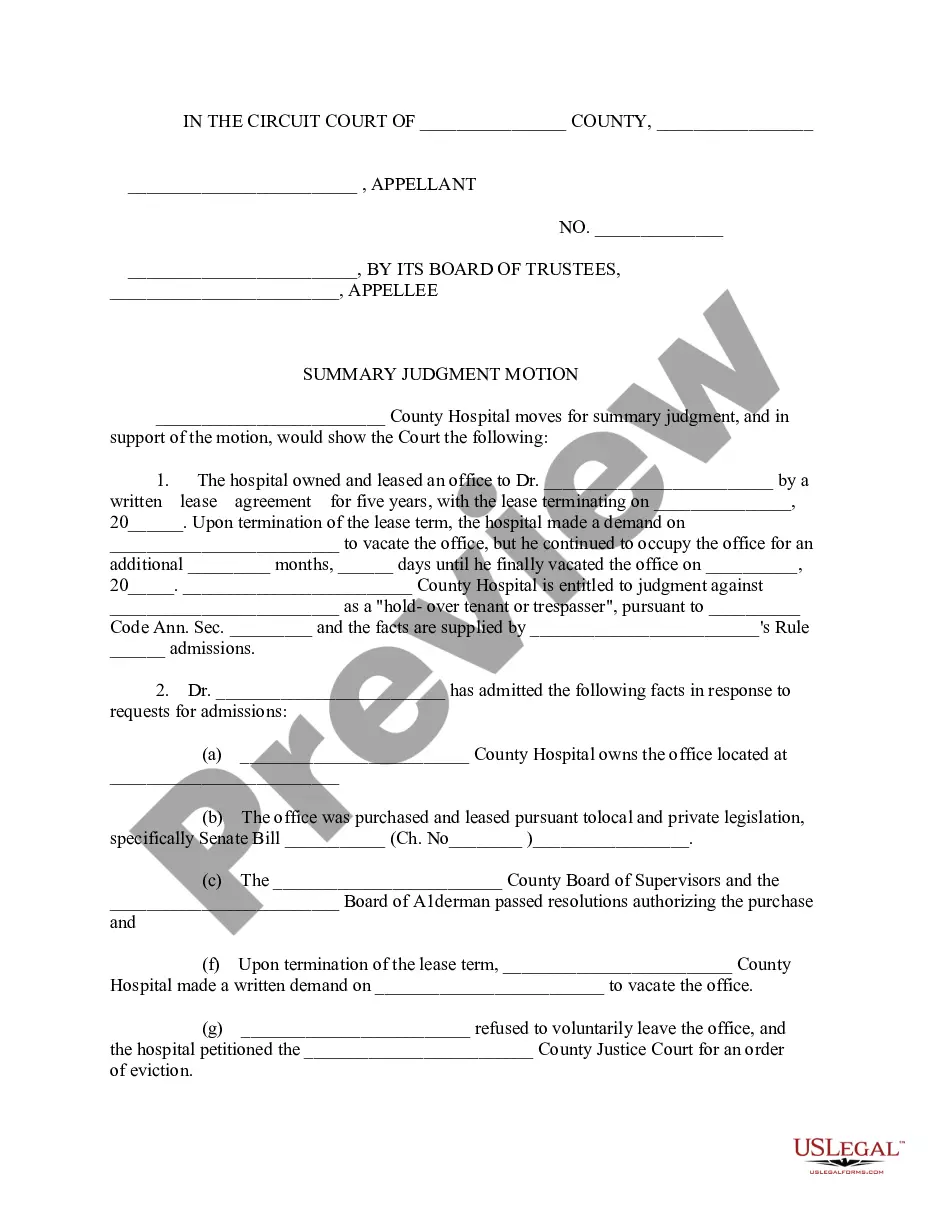
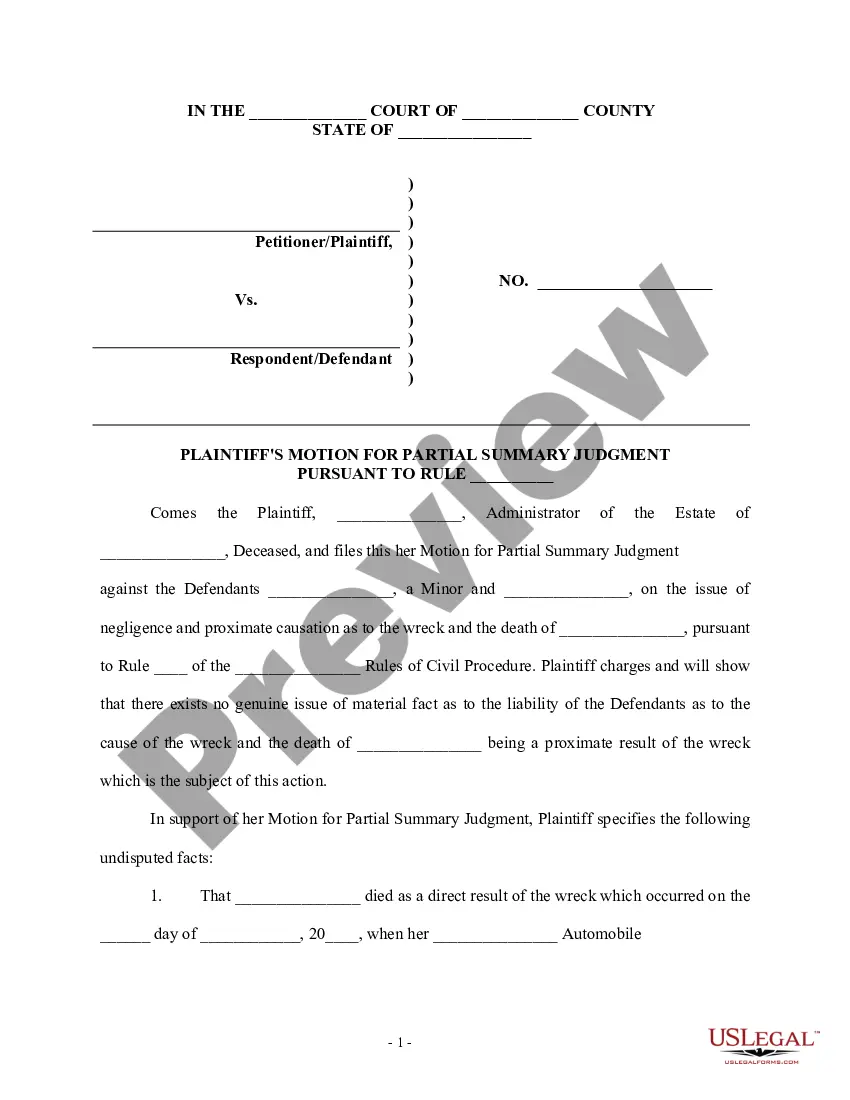
This is a suit on two notes and a modification agreement. Defendants are in default. Plaintiff attempts to recover the balance due with interest and attorneys' fees and costs of court, all as a matter of law.
Minnesota Plaintiff's Second Motion for Summary Judgment
Category:
State:
Minnesota
Control #:
MN-9015D
Format:
Word;
Rich Text
Instant download
Description
Free preview
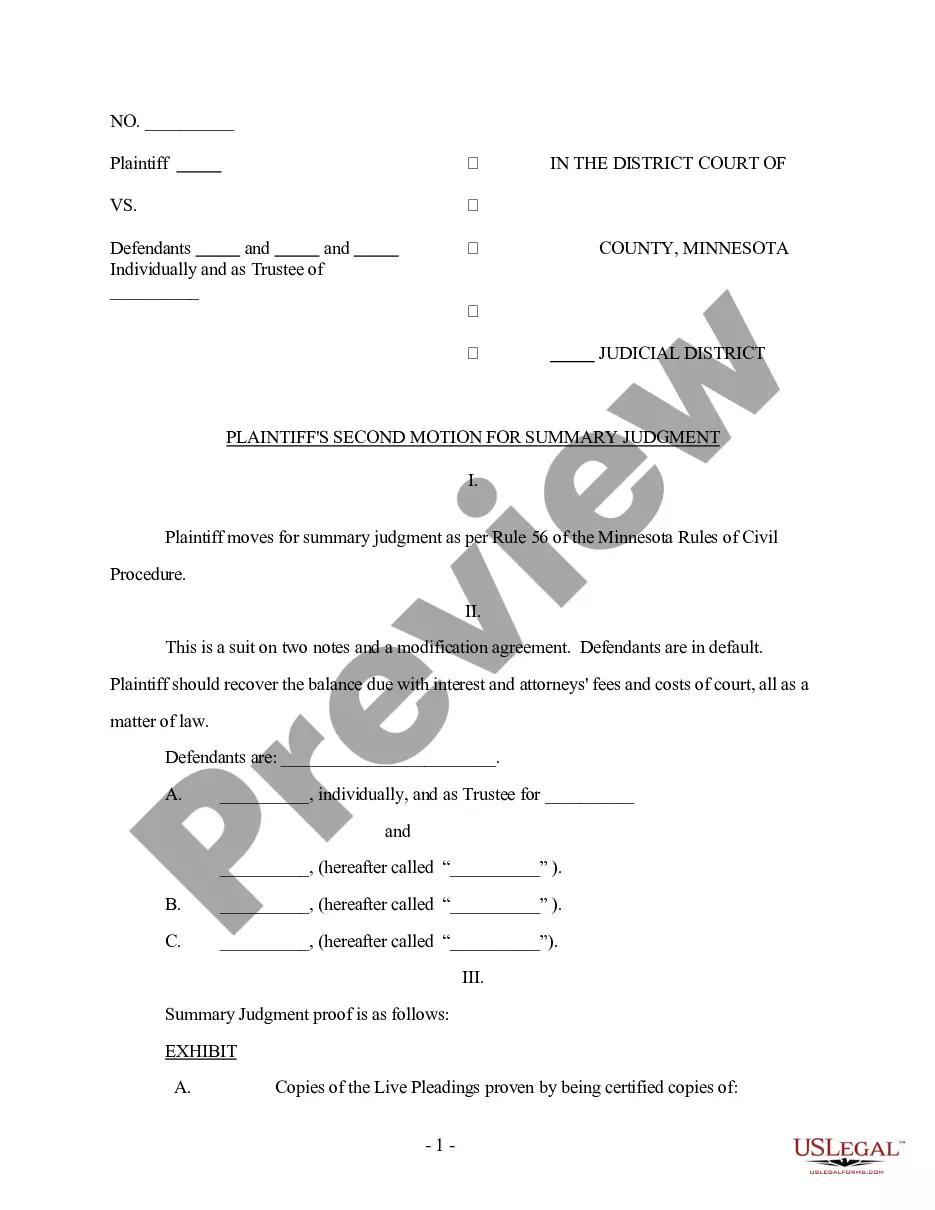
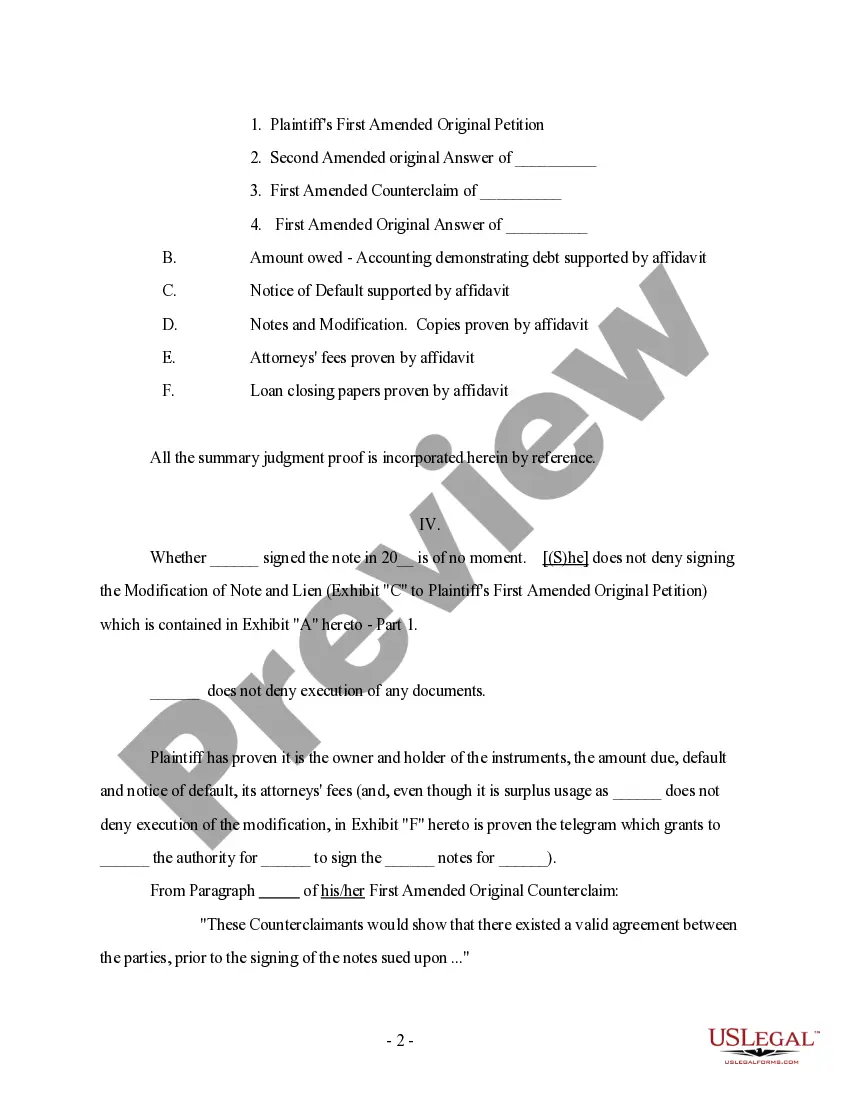
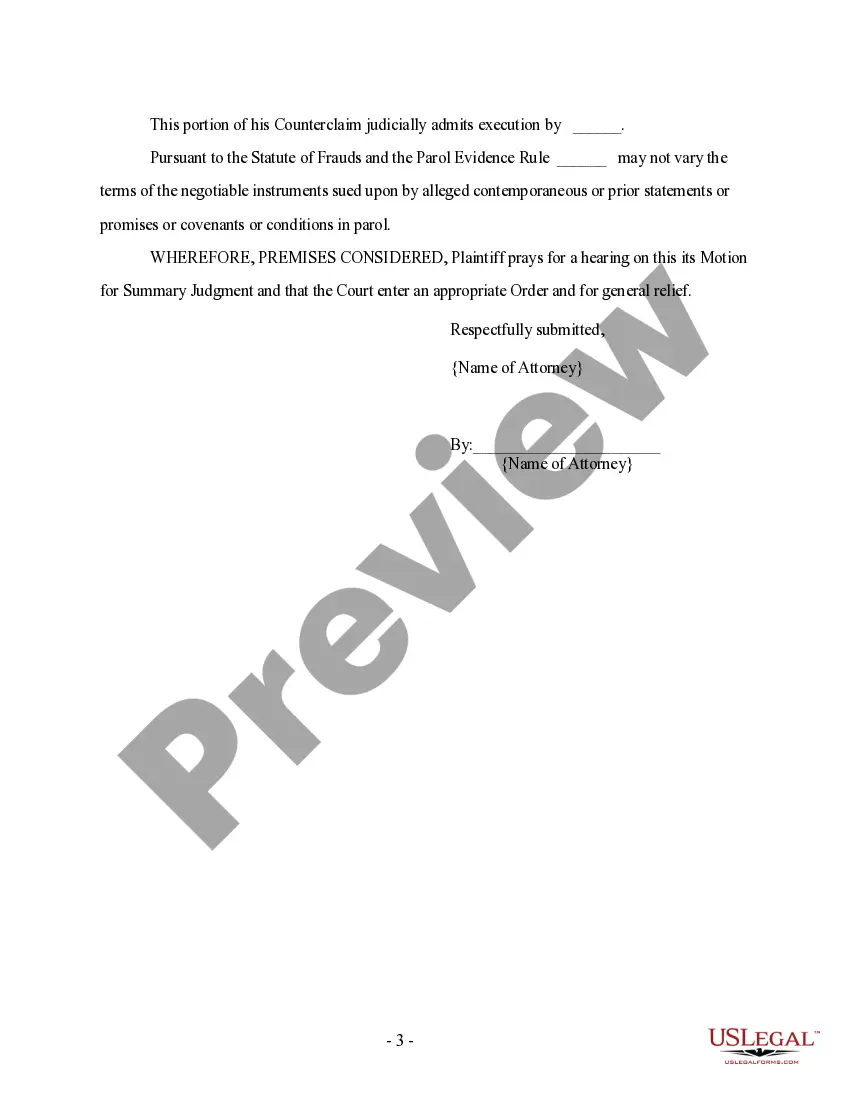

How to fill out Minnesota Plaintiff's Second Motion For Summary Judgment?
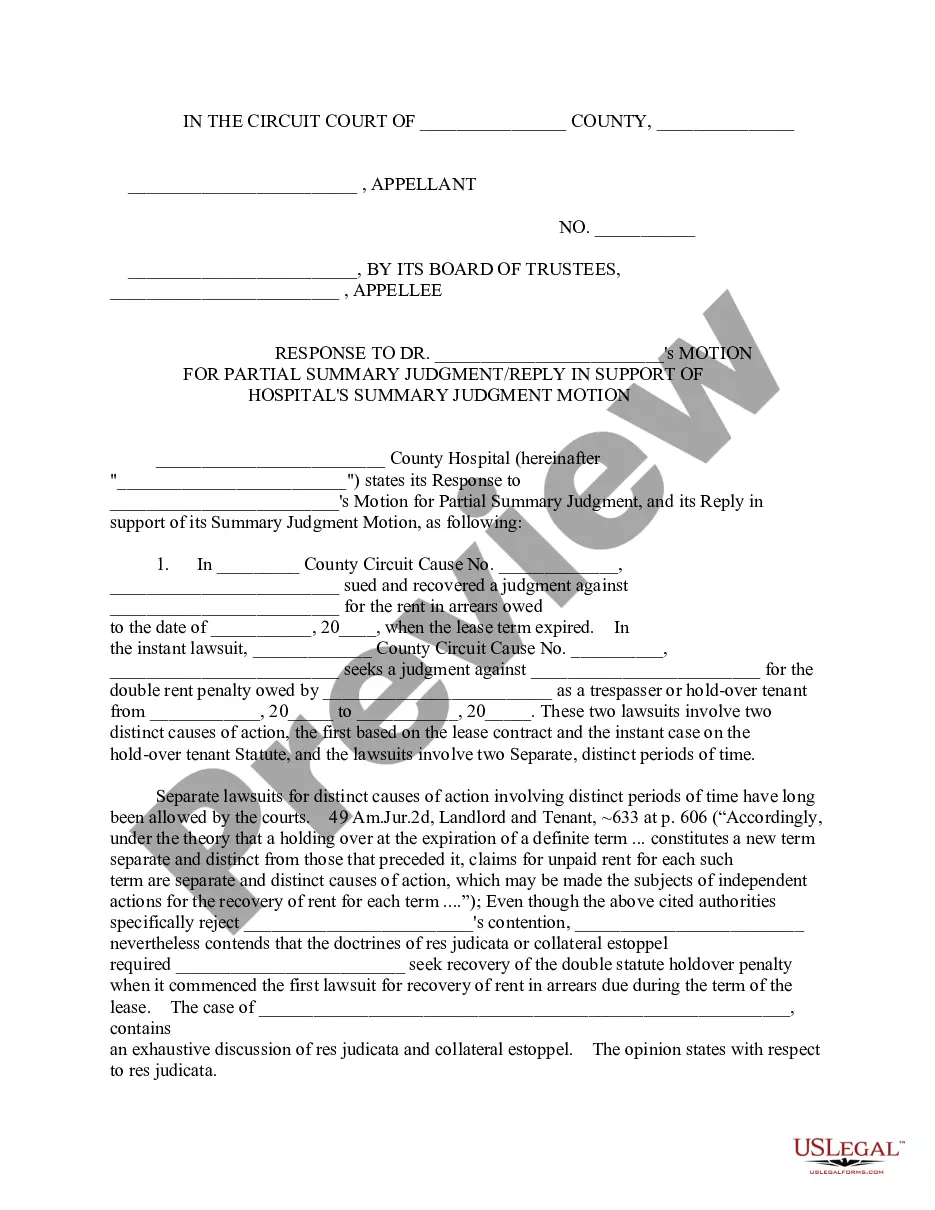
Obtain any type from 85,000 legal documents including Minnesota Plaintiff's Second Motion for Summary Judgment online with US Legal Forms. Each template is created and updated by state-certified legal experts.
If you already have a membership, sign in. When you are on the document’s page, click the Download button and navigate to My documents to access it.
If you haven’t subscribed yet, follow the instructions below: Check the state-specific criteria for the Minnesota Plaintiff's Second Motion for Summary Judgment you wish to use. Review the description and preview the template. Once you’re confident the sample meets your needs, simply click Buy Now. Choose a subscription plan that fits your budget. Create a personal account. Make your payment in one of two suitable methods: by credit card or through PayPal. Select a format to download the file in; two options are available (PDF or Word). Download the document to the My documents section. After your reusable template is downloaded, print it or save it to your device.
- With US Legal Forms, you’ll always have immediate access to the correct downloadable sample.
- The service provides you with access to forms and categorizes them to facilitate your search.
- Utilize US Legal Forms to acquire your Minnesota Plaintiff's Second Motion for Summary Judgment quickly and effortlessly.
Form popularity
FAQ
When it comes to summary judgment, plaintiff lawyers are often guilty of forgetting the fact that either party can file one. If you have solid evidence that can't be disputed, you may very well be able to prove your claim without going to trial.
Unless the requirements of Code of Civil Procedure 437c, subdivision (f)(2), are met a party may not file a second summary judgment motion. The pertinent provision provides: However, a party may not move for summary judgment...
Motions filed, the percent of cases with motions granted in whole or in part, and the percent of cases terminated by summary judgment. The percentage of cases with summary judgment motions, averaged across the six courts in the study, has increased from approximately 12% in 1975, to 17% in 1985, to 19% in 1988.
You cannot file a second motion dismiss. You have to raise it as an affirmative defense in your answer and present it with evidence at summary judgement or trial...
Under the Federal Rules, a summary judgment motion can be made at any time until 30 days after close of fact discovery. However, judges are also required to issue scheduling orders that set deadlines for the filing of motions. The trial court may refuse to hear a motion for summary judgment filed after the deadline.
A response must be in writing and include the same supporting documents as a motion for summary judgment. The opposition to the motion for summary judgment should also include a statement of facts showing the dispute and supporting documents.
Rule 56 of the Federal Rules of Civil Procedure governs summary judgment for federal courts. Under Rule 56, in order to succeed in a motion for summary judgment, a movant must show 1) that there is no genuine dispute as to any material fact, and 2) that the movant is entitled to judgment as a matter of law.
Instead the party who believes that the undisputed facts compel a ruling in his or her favor will file a motion for summary judgment. The motion asks the court to consider the undisputed facts and apply the law to them, and argues that the law requires a judgment for the party bringing the motion.