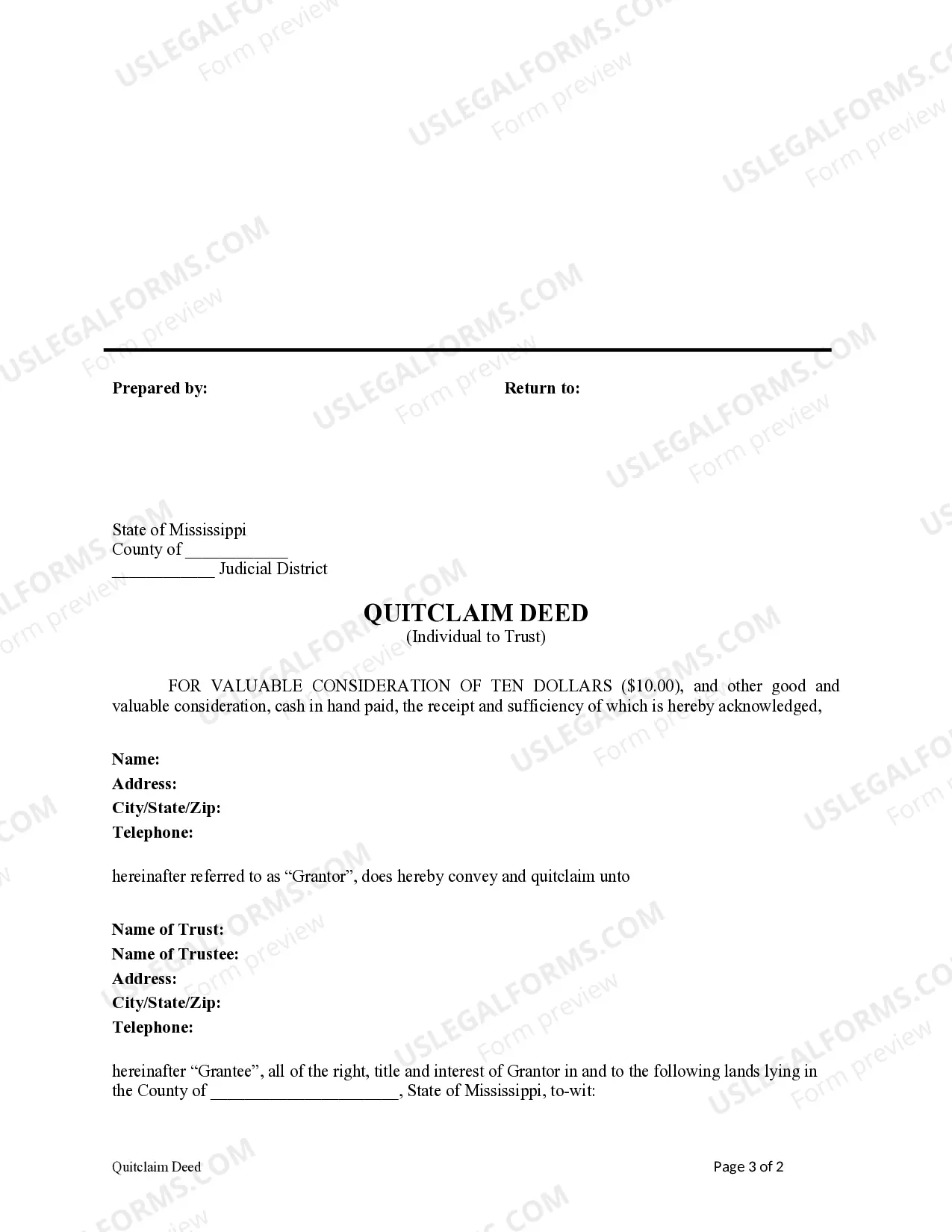
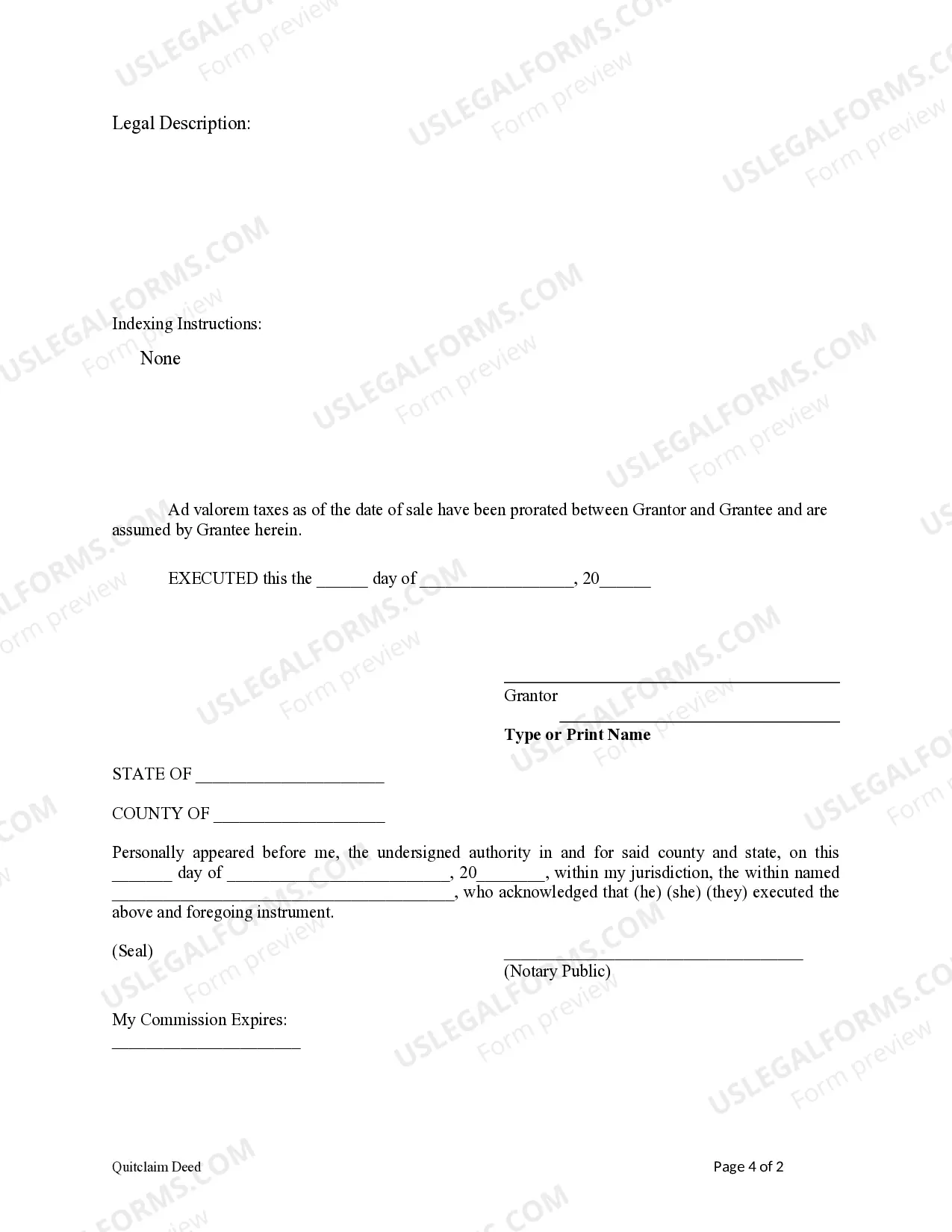
This form is a Quitclaim Deed where the Grantor is an individual and the Grantee is a Trust. Grantor conveys and quitclaims the described property to Grantee. This deed complies with all state statutory laws.
Mississippi Quitclaim Deed - Individual to a Trust
Category:
State:
Mississippi
Control #:
MS-025-77
Format:
Word;
Rich Text
Instant download
Description
Free preview





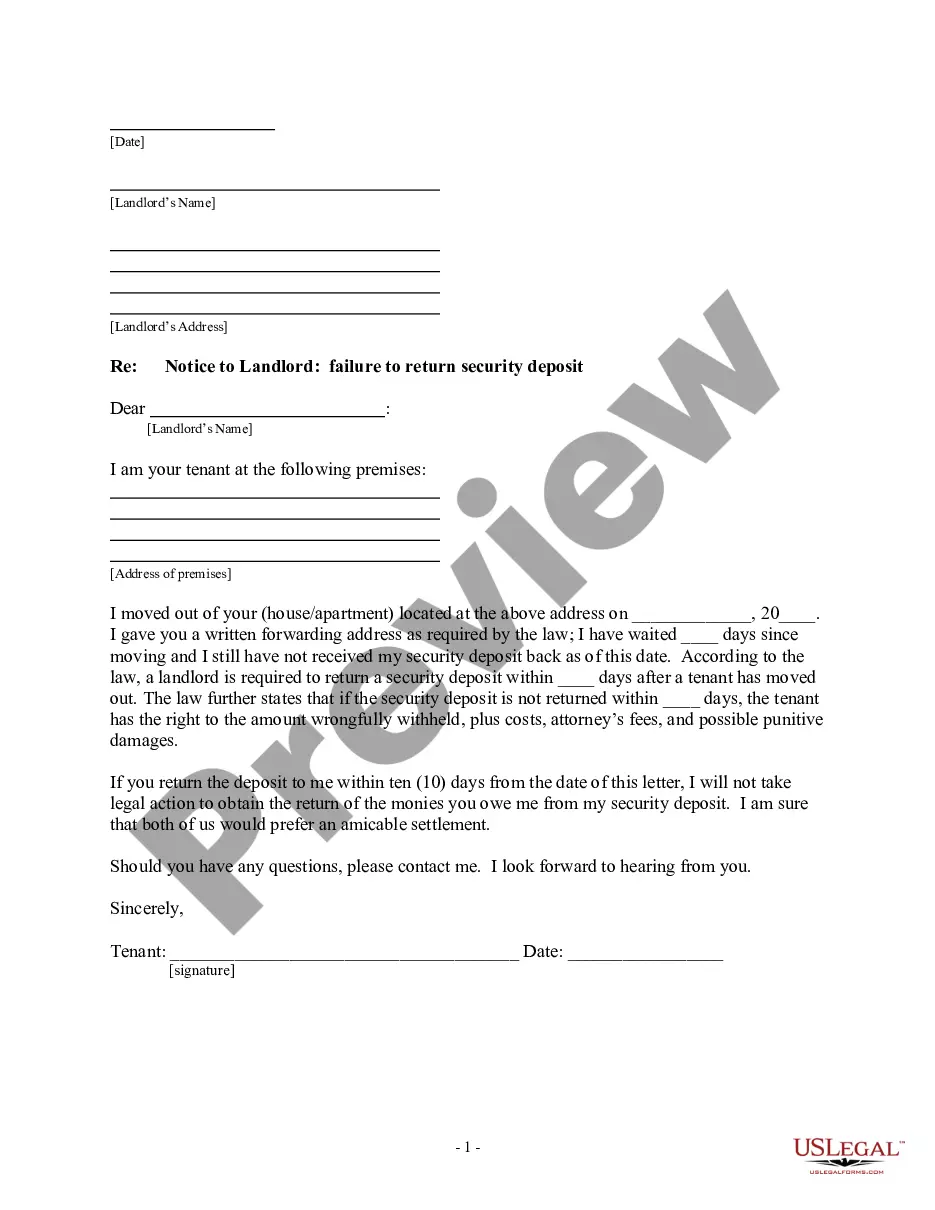
How to fill out Mississippi Quitclaim Deed - Individual To A Trust?
Obtain a printable Mississippi Quitclaim Deed Individual to a Trust in just a few clicks from the most extensive collection of legal electronic forms.
Discover, download, and print expertly prepared and certified samples on the US Legal Forms website. US Legal Forms has been the top supplier of affordable legal and tax forms for US citizens and residents online since 1997.
After downloading your Mississippi Quitclaim Deed Individual to a Trust, you can complete it in any online editor or print it and fill it out manually. Utilize US Legal Forms to access 85,000 professionally drafted, state-specific documents.
- Clients who already possess a subscription must Log In to their US Legal Forms account, retrieve the Mississippi Quitclaim Deed Individual to a Trust, and see it stored in the My documents section.
- Clients without a subscription should adhere to the steps outlined below.
- Verify your template complies with your state’s regulations.
- If accessible, review the form’s description to gain additional insights.
- If accessible, preview the form to examine more content.
- When you are assured the form meets your needs, click on Buy Now.
- Establish a personal account.
- Select a plan.
- Make a payment using PayPal or credit card.
- Download the template in Word or PDF format.
Form popularity
FAQ
Yes, a quit claim deed supercedes the trust. The only thing that can be done is to file a suit in court challenging the deed as the product of fraud and undue influence. A court action like that will cost thousands of dollars, but might be worth it if the house was owned free and clear.
Before a quitclaim deed can be recorded with a county recorder in Mississippi, the grantor must sign and acknowledge it. The names, addresses, and telephone numbers of the grantors and grantees to the quit claim deed, along with a legal description of the real property should be provided on the first page (89-5-24).
It's usually a very straightforward transaction, but it's possible for a quitclaim deed to be challenged. If a quitclaim deed is challenged in court, the issue becomes whether the property was legally transferred and if the grantor had the legal right to transfer the property.
No. And unless the deed identifies the trust as an owner, then father is the owner of an interest. It is a common mistake to set up a trust and then fail to deed property into the trust. However, you cannot force him to make the changes you are...
But you might be wondering if an owner can transfer a deed to another person without a real estate lawyer. The answer is yes. Parties to a transaction are always free to prepare their own deeds.A quitclaim deed, for example, is far simpler than a warranty deed.
If the quitclaim deed requires the signature of all co-owners, the deed is invalid unless all co-owners have signed it and the deed is then delivered to the grantee.If one individual owns real estate and desires to add a co-owner such as a spouse, a quitclaim deed might be used.
The drawback, quite simply, is that quitclaim deeds offer the grantee/recipient no protection or guarantees whatsoever about the property or their ownership of it. Maybe the grantor did not own the property at all, or maybe they only had partial ownership.