North Carolina Deed of Distribution - Trust to an Individual
Overview of this form
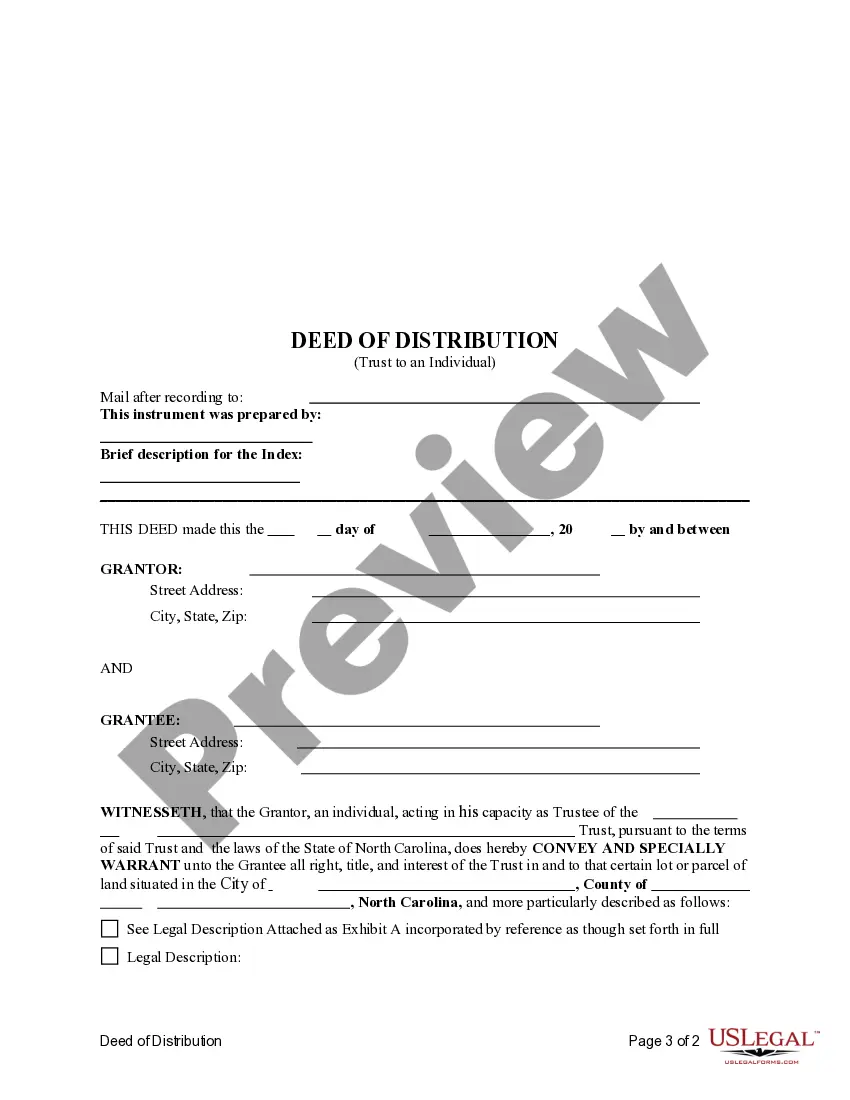
The Deed of Distribution - Trust to an Individual is a legal document used when a trustee transfers property to a beneficiary as dictated by the terms of a trust. This form facilitates the transfer of ownership from the trust to the individual beneficiary while ensuring compliance with state laws. This deed outlines the rights, title, and interest the trustee has in the property and conveys it directly to the designated grantee.
Form components explained
- Grantor and Grantee information: Identifies the trustee and the beneficiary involved in the transfer.
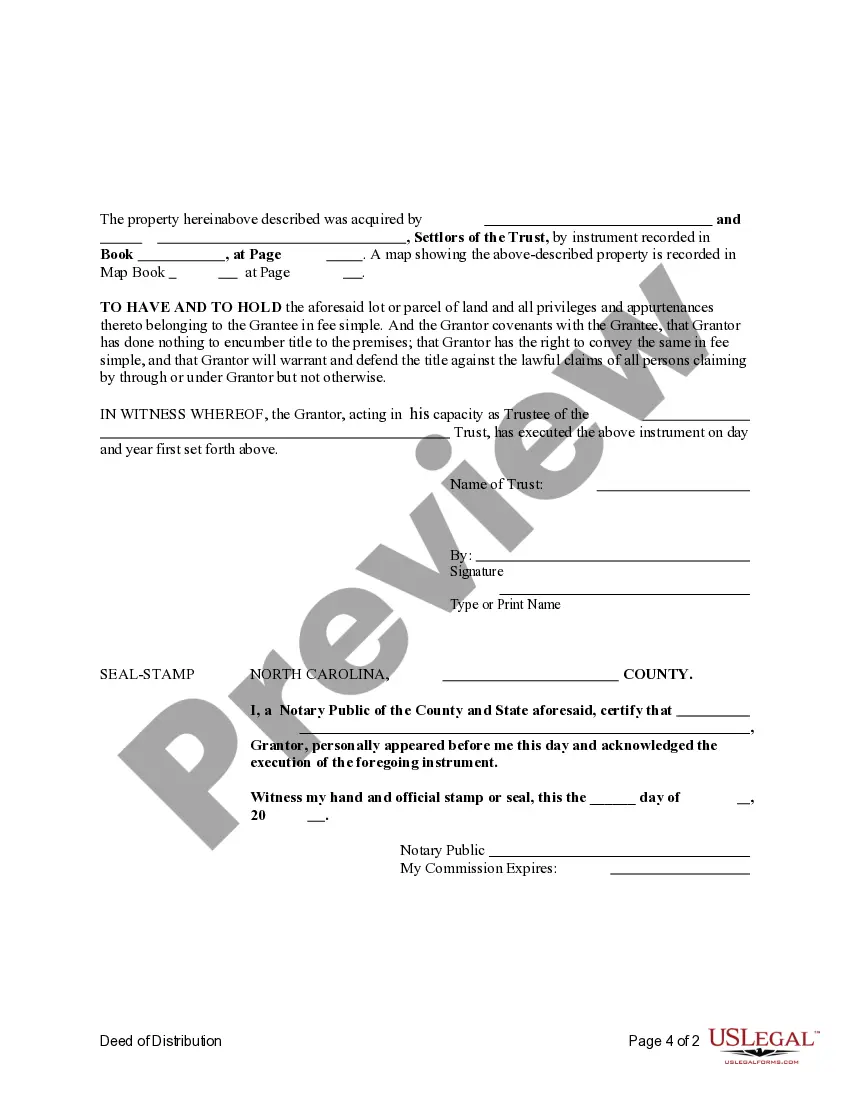
- Property description: Details the lot or parcel of land being transferred, including legal descriptions and references to recorded instruments.
- Covenants by the Grantor: Assurance that the Grantor can convey the property free of encumbrances and will defend the title against claims.
- Execution details: Includes space for signatures and notary acknowledgment, essential for valid execution.
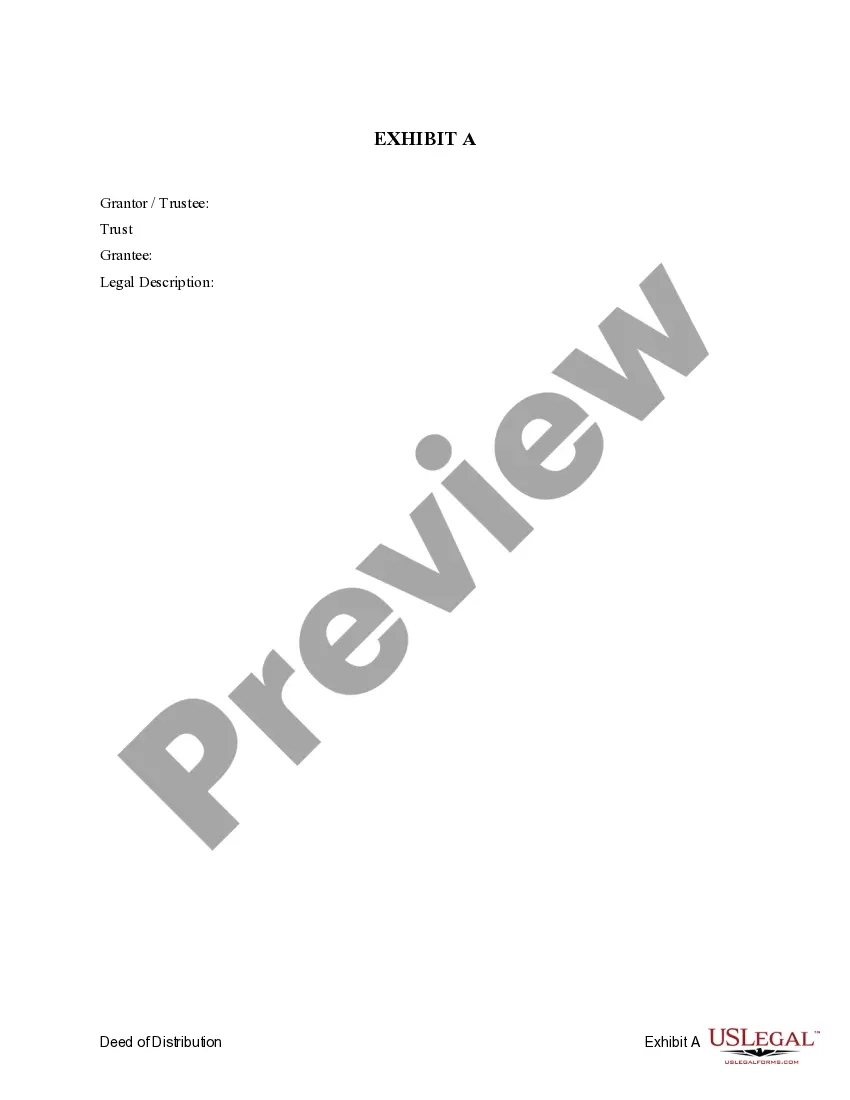
- Exhibit A: Provides additional legal descriptions of the property being transferred.


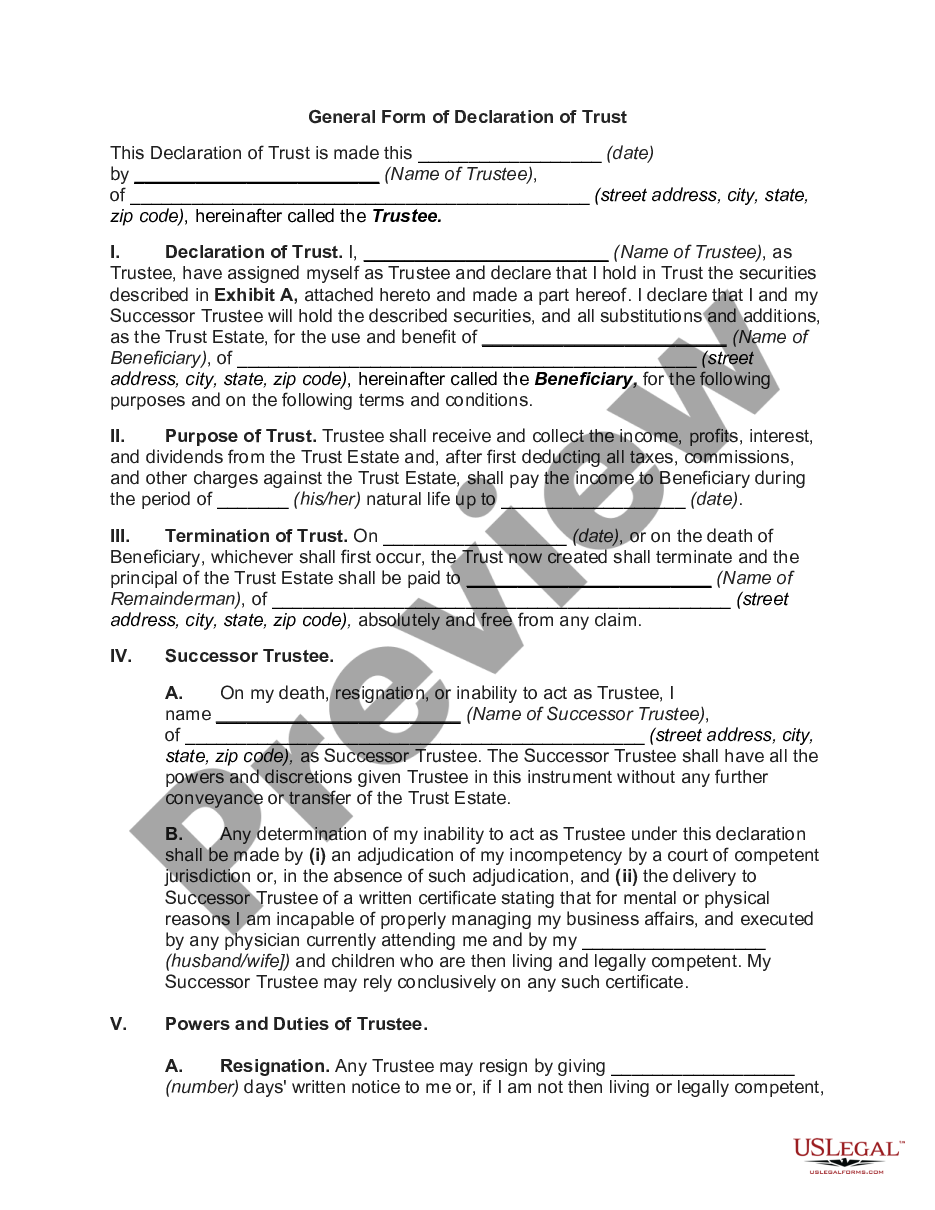
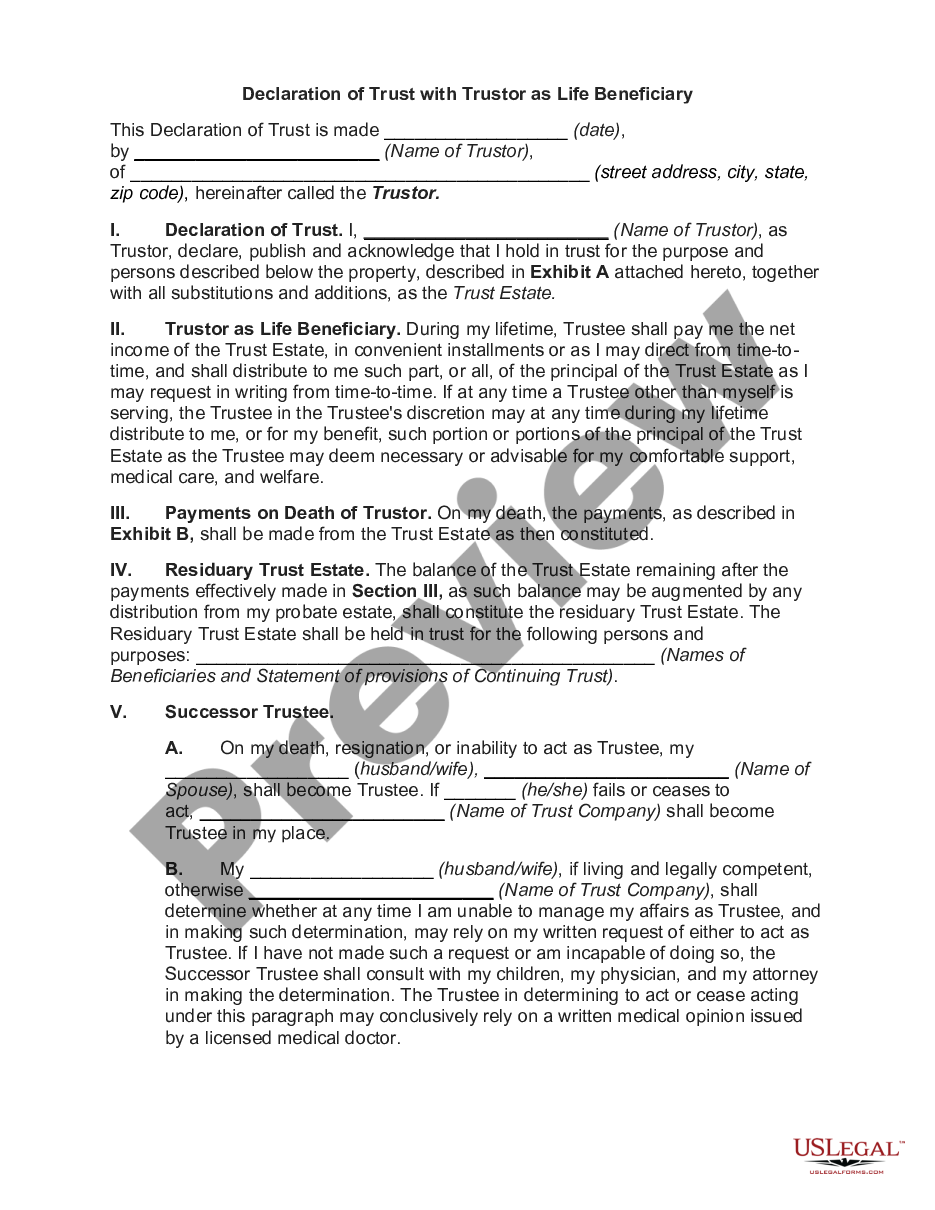

Common use cases
This form is typically used in circumstances where a trustee is distributing property or assets from a trust to an individual beneficiary. Common scenarios include a trust being unwound after the death of the grantor, or when a beneficiary must take possession of property according to the trustâs terms.
Who can use this document
- Trustees seeking to legally transfer ownership of property to a beneficiary.
- Beneficiaries of a trust who are receiving property as part of their inheritance.
- Individuals involved in estate planning who wish to formally document property distribution from a trust.
Steps to complete this form
- Identify the parties: Fill in the names and addresses of the Grantor (Trustee) and Grantee (Beneficiary).
- Specify the property: Provide a detailed description of the property being conveyed, including any legal descriptions or references to recorded instruments.
- Enter the relevant dates: Ensure all dates pertaining to the deed's execution are clearly stated.
- Sign the document: The Grantor must sign the deed in the appropriate section, acknowledging their role as Trustee.
- Notarization: Ensure the form is notarized if required, with the notary completing their certification section.
Is notarization required?
Yes, this form must be notarized to be legally valid. U.S. Legal Forms provides integrated online notarization options, available 24/7 through secure video calls, ensuring that your document meets legal requirements without the need for travel.
Get your form ready online
Our built-in tools help you complete, sign, share, and store your documents in one place.
Make edits, fill in missing information, and update formatting in US Legal Forms—just like you would in MS Word.
Download a copy, print it, send it by email, or mail it via USPS—whatever works best for your next step.
Sign and collect signatures with our SignNow integration. Send to multiple recipients, set reminders, and more. Go Premium to unlock E-Sign.
If this form requires notarization, complete it online through a secure video call—no need to meet a notary in person or wait for an appointment.
We protect your documents and personal data by following strict security and privacy standards.

Make edits, fill in missing information, and update formatting in US Legal Forms—just like you would in MS Word.

Download a copy, print it, send it by email, or mail it via USPS—whatever works best for your next step.

Sign and collect signatures with our SignNow integration. Send to multiple recipients, set reminders, and more. Go Premium to unlock E-Sign.

If this form requires notarization, complete it online through a secure video call—no need to meet a notary in person or wait for an appointment.

We protect your documents and personal data by following strict security and privacy standards.
Typical mistakes to avoid
- Failing to accurately describe the property being transferred, which can lead to future disputes.
- Not providing complete information for all parties involved, including addresses.
- Skipping the notary signature, which is essential for the deed to hold legal weight.
Why use this form online
- Convenience of completing the form at your own pace without needing to visit an attorney.
- Editability allows for easy corrections or updates before finalization.
- Access to legally accurate documents drafted by licensed attorneys ensures compliance and reduces risk.
Looking for another form?
Form popularity
FAQ
Estates and trusts work in distinctively different ways and serve different functions. Estates function as a one-time transfer of assets that are distributed after death. Trusts, in contrast, allow the trust creator (the trustor) to establish an ongoing transfer of assets to beneficiaries before and after death.
Assets owned in the deceased person's name.
An Estate represents the total asset value of an individual after they pass away. A Trust, on the other hand, is a financial vehicle used to hold, manage, and distribute assets on behalf of beneficiaries.
A trust account works like any bank account does: funds can be deposited into it and payments made from it. However, unlike most bank accounts, it is not held or owned by an individual or a business. Instead, a trust account is set up in the name of the trust itself, such as the Jane Doe Trust.
What Is a Beneficiary of Trust? A beneficiary of trust is the individual or group of individuals for whom a trust is created. The trust creator or grantor designates beneficiaries and a trustee, who has a fiduciary duty to manage trust assets in the best interests of beneficiaries as outlined in the trust agreement.
To transfer real property into your Trust, a new deed reflecting the name of the Trust must be executed, notarized and recorded with the County Recorder in the County where the property is located. Care must be taken that the exact legal description in the existing deed appears on the new deed.
Distribute trust assets outright The grantor can opt to have the beneficiaries receive trust property directly without any restrictions. The trustee can write the beneficiary a check, give them cash, and transfer real estate by drawing up a new deed or selling the house and giving them the proceeds.
This means you don't need to do anything to change the deed on a property you inherit. The deed to the property automatically transfers to you after your loved one passes away. From that point, all you would need to prove that you are the rightful owner of the property is: A copy of your loved one's death certificate.