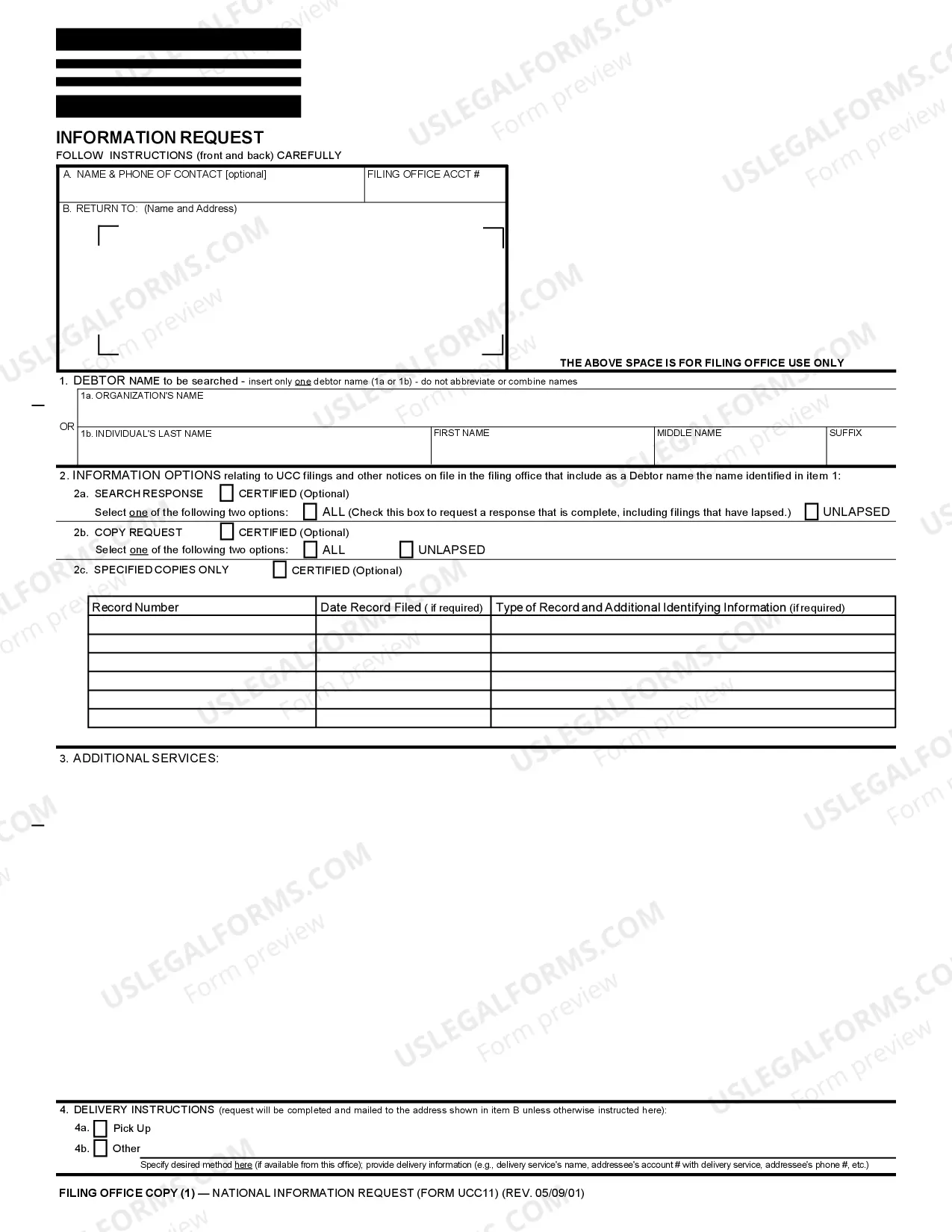
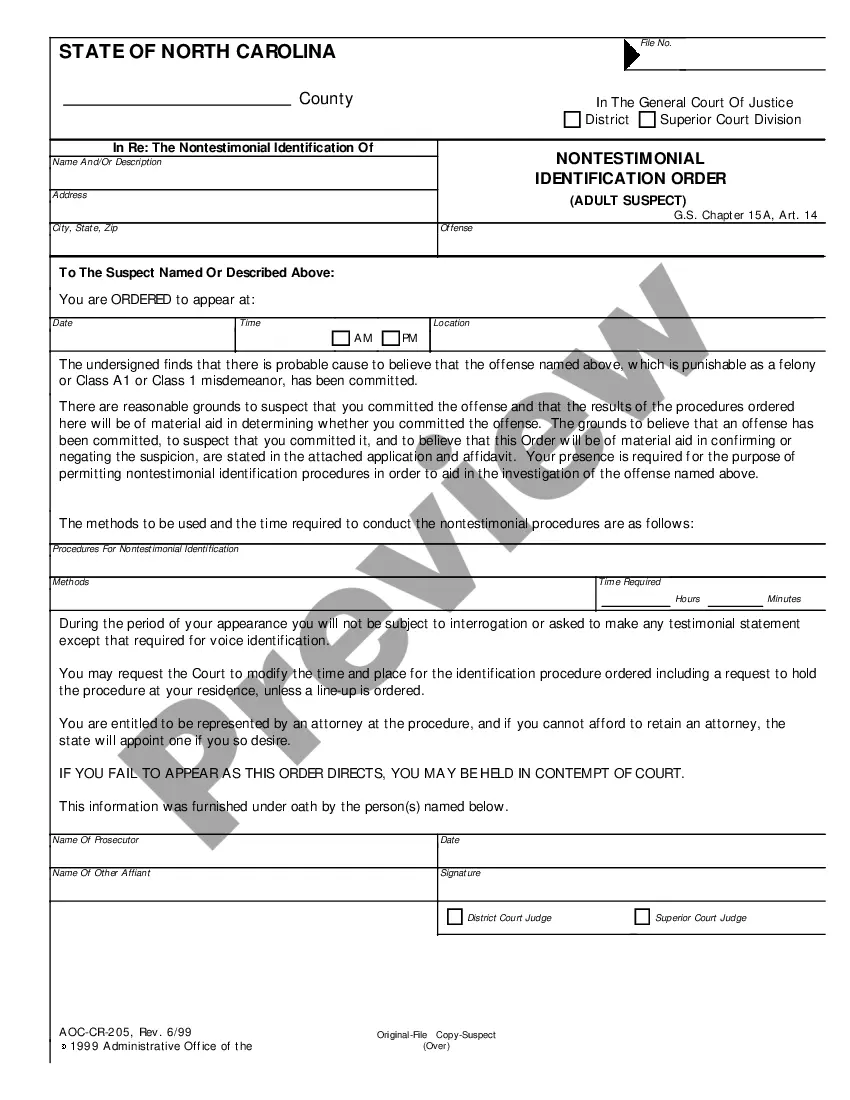
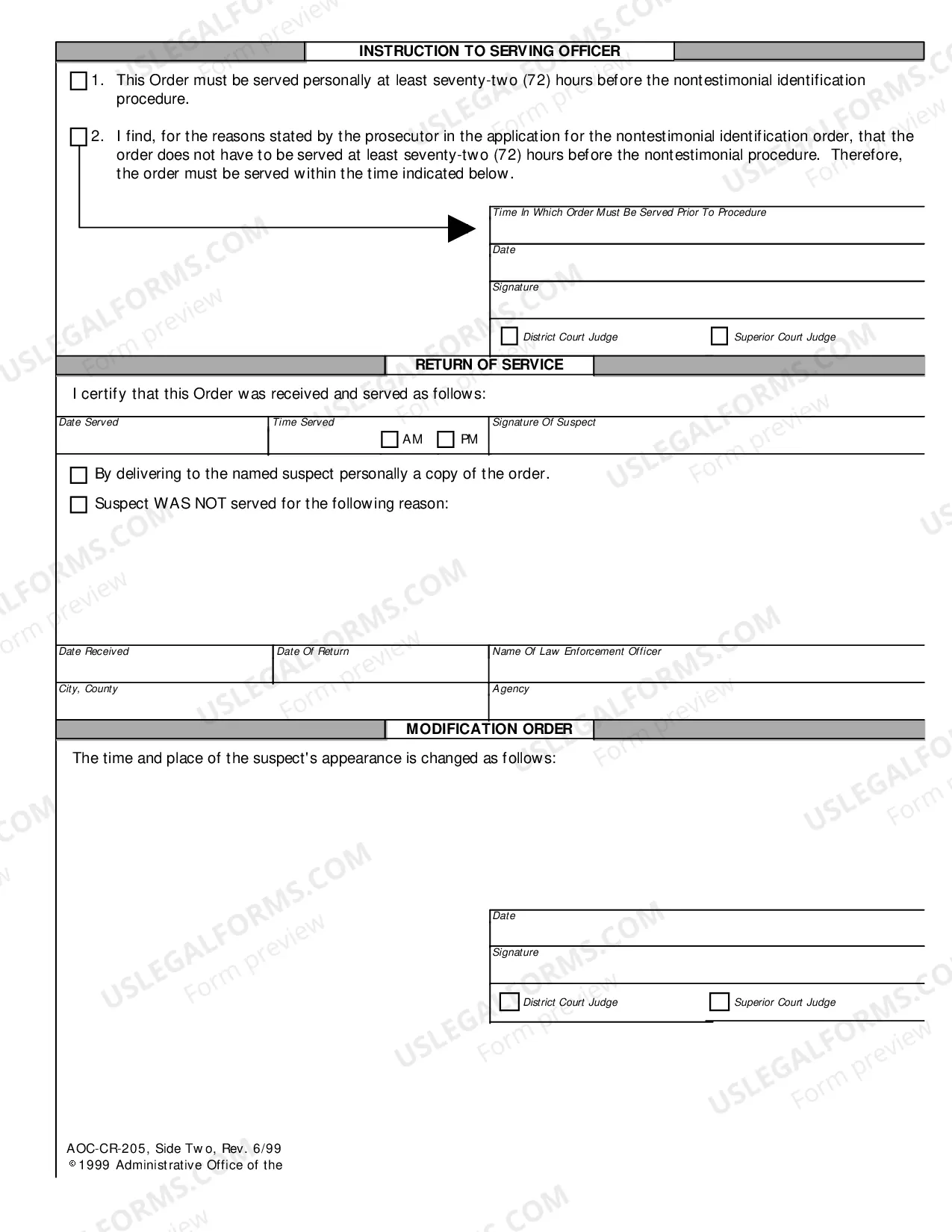
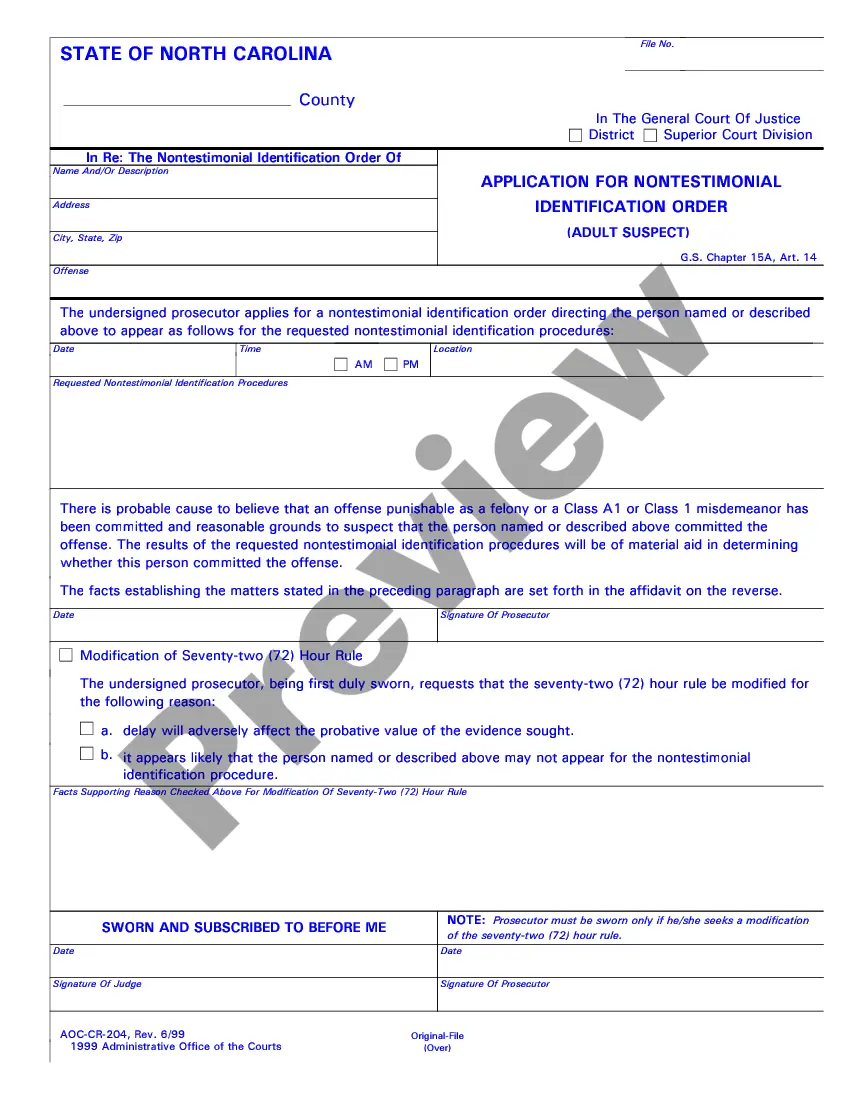
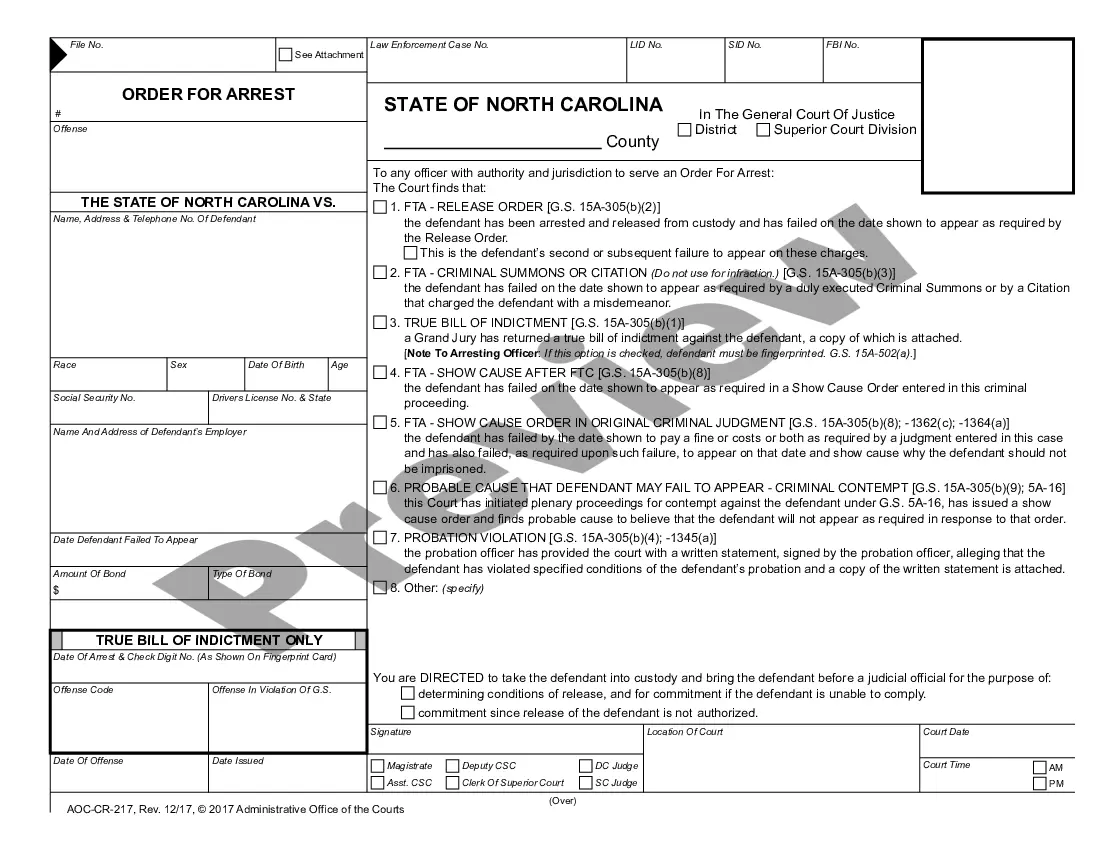
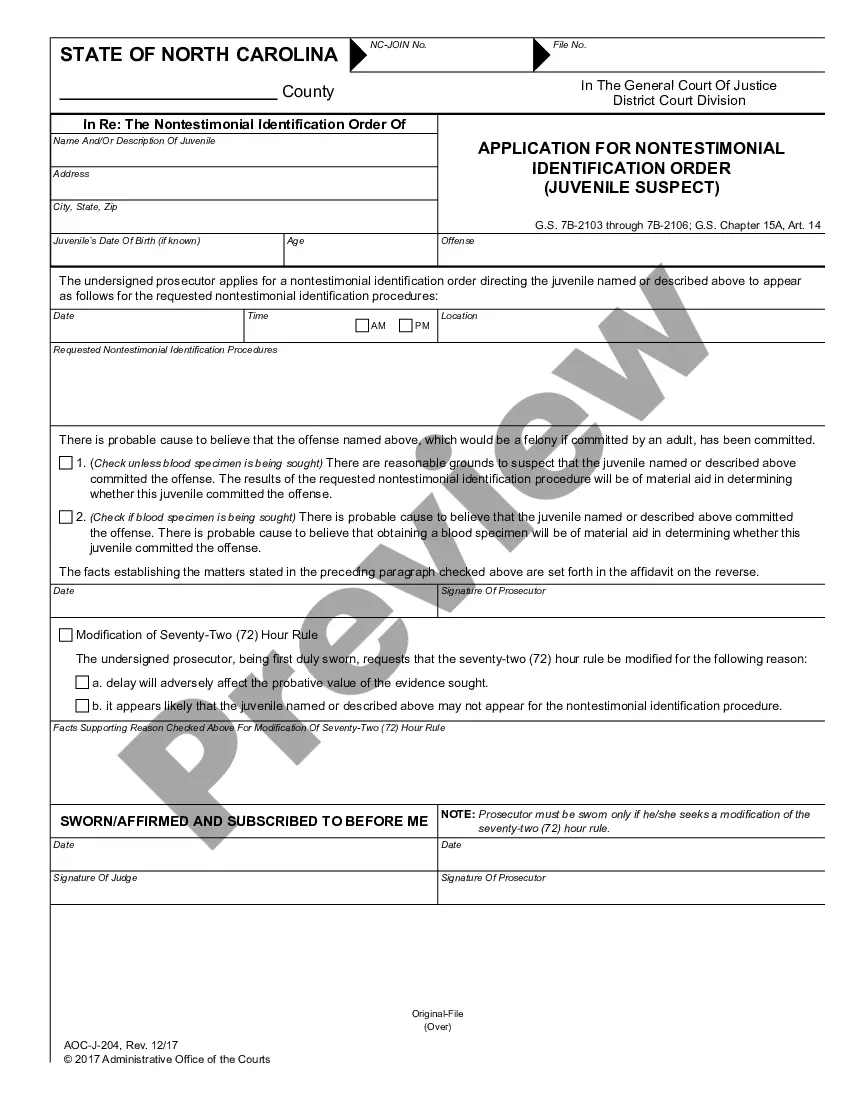
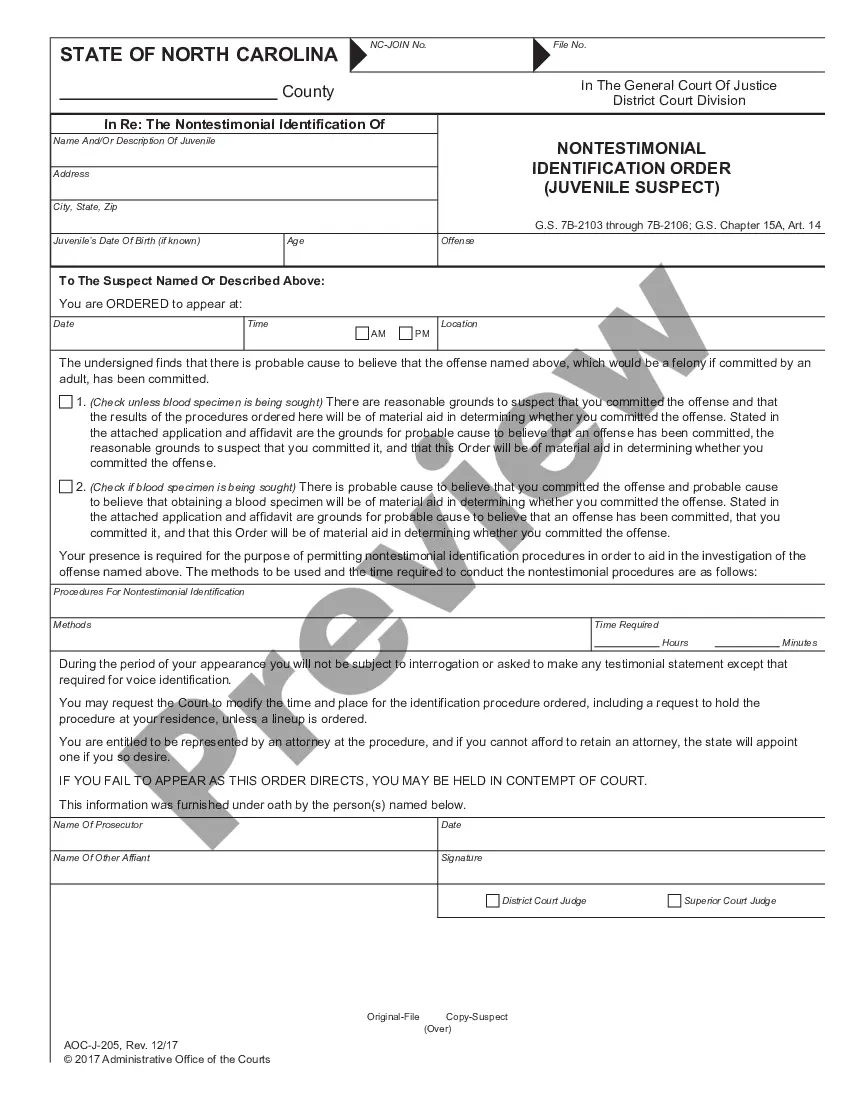
Nontestimonial Identification Order: This is an official form from the North Carolina Administration of the Courts (AOC), which complies with all applicable laws and statutes. USLF amends and updates the forms as is required by North Carolina statutes and law.
North Carolina Nontestimonial Identification Order
Instant download
This website is not affiliated with any governmental entity
Public form
Description
Free preview
Get your form ready online
Our built-in tools help you complete, sign, share, and store your documents in one place.
Built-in online Word editor
Make edits, fill in missing information, and update formatting in US Legal Forms—just like you would in MS Word.
Export easily
Download a copy, print it, send it by email, or mail it via USPS—whatever works best for your next step.
E-sign your document
Sign and collect signatures with our SignNow integration. Send to multiple recipients, set reminders, and more. Go Premium to unlock E-Sign.
Notarize online 24/7
If this form requires notarization, complete it online through a secure video call—no need to meet a notary in person or wait for an appointment.
Store your document securely
We protect your documents and personal data by following strict security and privacy standards.

Make edits, fill in missing information, and update formatting in US Legal Forms—just like you would in MS Word.

Download a copy, print it, send it by email, or mail it via USPS—whatever works best for your next step.

Sign and collect signatures with our SignNow integration. Send to multiple recipients, set reminders, and more. Go Premium to unlock E-Sign.

If this form requires notarization, complete it online through a secure video call—no need to meet a notary in person or wait for an appointment.

We protect your documents and personal data by following strict security and privacy standards.
Looking for another form?
How to fill out North Carolina Nontestimonial Identification Order?
Steer clear of costly lawyers and discover the North Carolina Nontestimonial Identification Order you require at a reasonable price on the US Legal Forms website.
Utilize our straightforward groups feature to search for and download legal and tax documents. Review their descriptions and preview them before downloading.
Choose to receive the document in PDF or DOCX format. Just click Download and locate your form in the My documents section. You can easily save the template to your device or print it. After downloading, you can complete the North Carolina Nontestimonial Identification Order by hand or using editing software. Print it out and reuse the form multiple times. Achieve more for less with US Legal Forms!
- Furthermore, US Legal Forms provides users with step-by-step guidance on how to download and complete each document.
- US Legal Forms members simply need to Log In and retrieve the specific form they need from their My documents section.
- Those who haven't subscribed yet should adhere to the instructions outlined below.
- Verify that the North Carolina Nontestimonial Identification Order is valid for use in your location.
- If possible, examine the description and utilize the Preview feature before downloading the template.
- If you are confident the document meets your requirements, click Buy Now.
- If the template is incorrect, use the search function to locate the correct one.
- After that, establish your account and select a subscription option.
- Make payment via credit card or PayPal.
Form popularity
FAQ
The persuasiveness of nontestimonial evidence (or any information for that matter) is influenced by how jurors attend to the evidence, process it into their memories, and recall the evidence from memory at a later time. The first requirement of persuasive nontestimonial evidence is that jurors attend to the evidence.
Testimonial evidence does not need any kind of evidence to make it admissible. It simply implies what is confessed in a court proceeding by a viable witness. Testimonial evidence may be used for proving or disproving different things. It can be used by both the prosecution and the defense.
Nontestimonial hearsay is usually regarded as hearsay that falls under one of the following categories: a. A statement by a conspirator made during and in furtherance of the conspiracy. b. Any casual statement not made for the purpose of going in a record with a government agent or agency.
Testimonial evidence is a statement made under oath. An example would be a witness pointing to someone in the courtroom and saying, That's the guy I saw robbing the grocery store. This is also called direct evidence or prima facie evidence. Physical evidence can be any object or material relevant in a crime.
As used in this Article, "nontestimonial identification" means identification by fingerprints, palm prints, footprints, measurements, blood specimens, urine specimens, saliva samples, hair samples, or other reasonable physical examination, handwriting exemplars, voice samples, photographs, and lineups or similar
Indiana, 547 U.S. 813 (2006), the Court held that statements are non-testimonial when made in the course of police interrogation under circumstances objectively indicating that the primary purpose of the interrogation is to enable police assistance to meet an ongoing emergency. Statements are testimonial when the
Testimonial evidence is where a person takes the stand and answers questions about a case.Such statements often constitute hearsay evidence and are generally not admissible because they're not as reliable as statements made in court and under oath.
Supreme Court of the United States Docket no. A 911 phone call describing an "ongoing emergency" is not testimonial in nature, and thus may be admitted at trial even if the caller is not available without violating the Sixth Amendment's Confrontation Clause.