North Carolina Deed of Easement for Slope Purposes
What this document covers
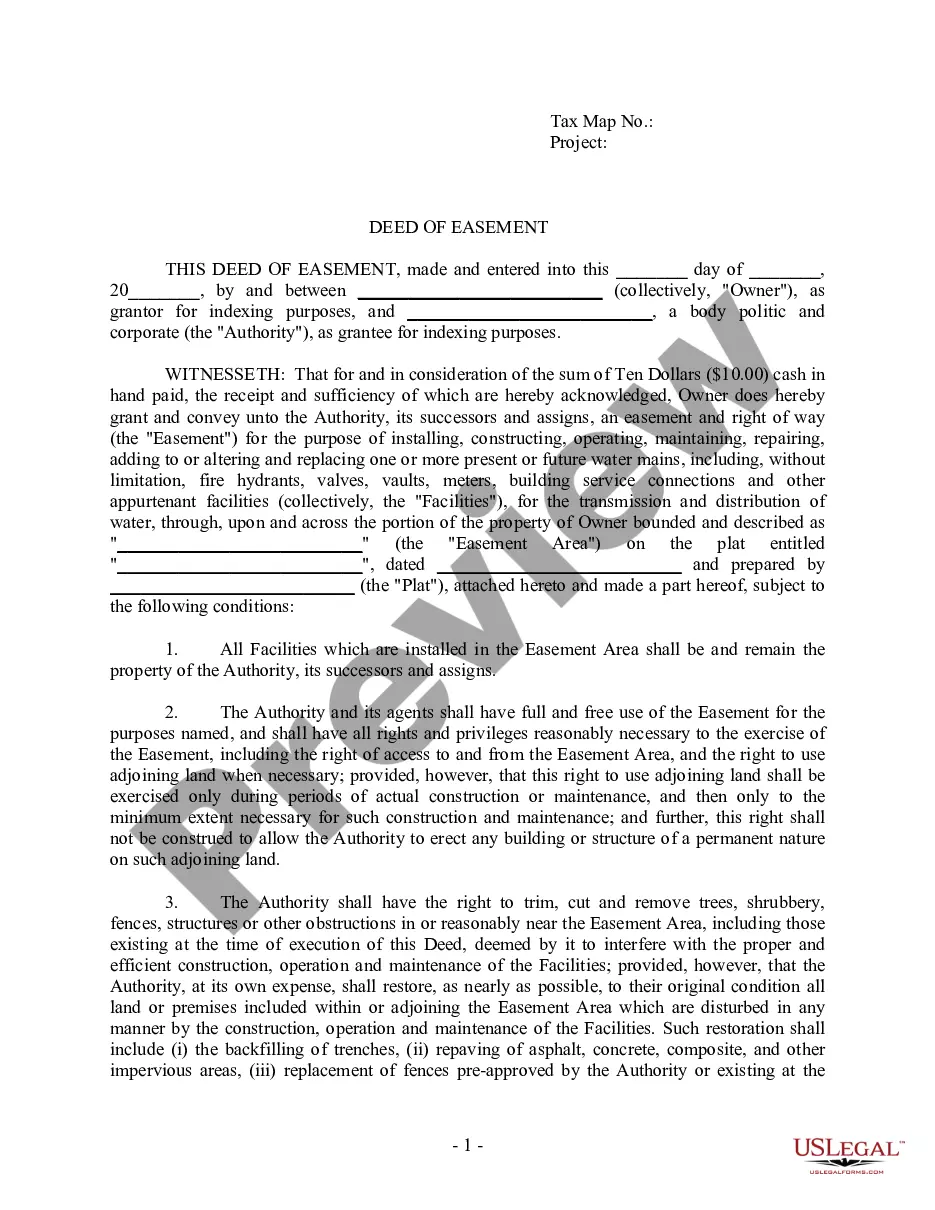
The Deed of Easement for Slope Purposes is a legal document that grants a specific use or benefit of a tract of land to another party, typically a municipal corporation, for limited purposes related to slope maintenance. Unlike other types of easements, this form does not transfer possession or ownership of the land but allows for use related to land grading and slope management, ensuring safety and compliance with local regulations. This form is essential for property developers and owners involved in projects that require grading adjacent to public streets or sidewalks.
Key components of this form
- Identification of Grantor and Grantee.
- Description of the easement area and its specific rights granted.
- Subordination of existing liens and encumbrances.
- Legal acknowledgment and notarization sections for signatures.
- Exhibit map detailing the easement area.


When to use this form
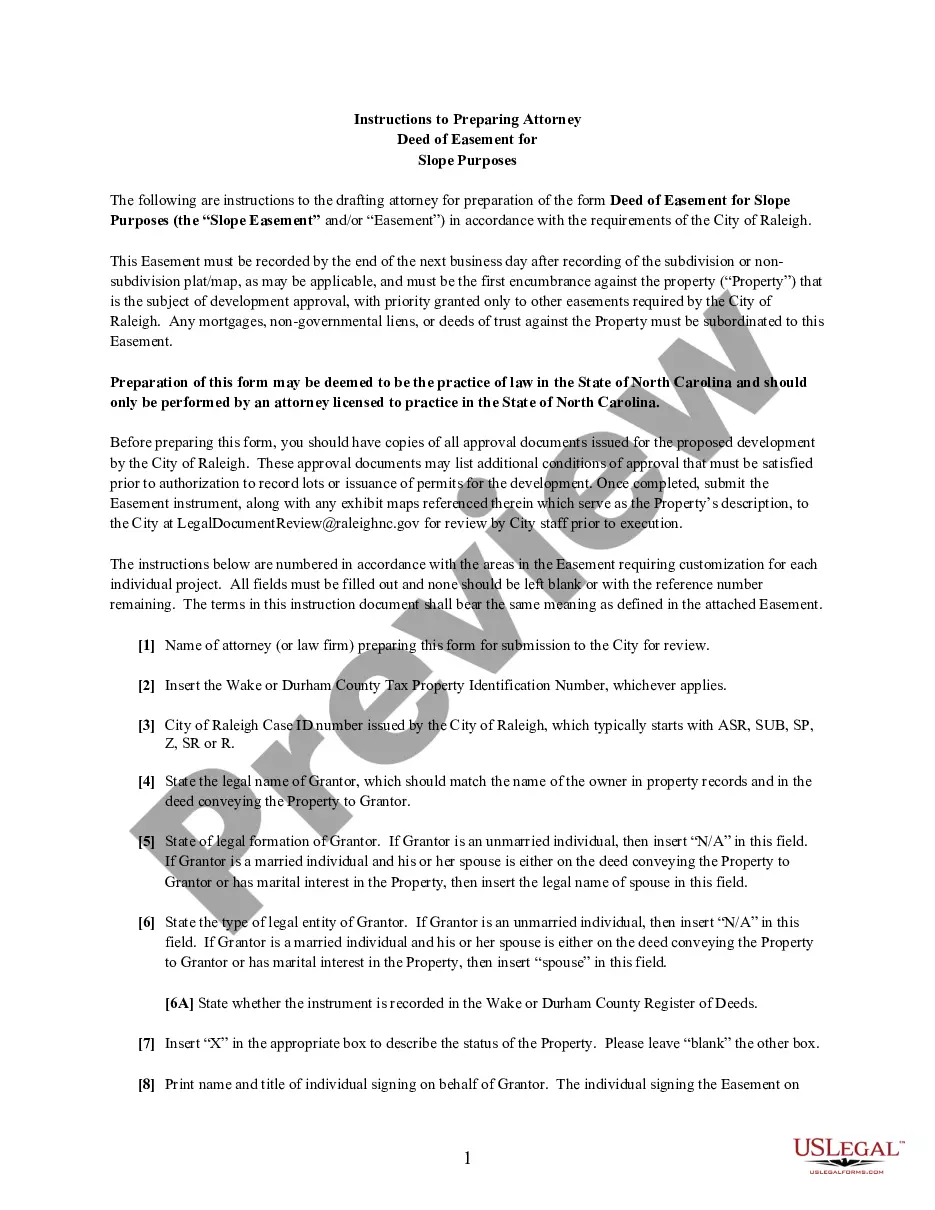
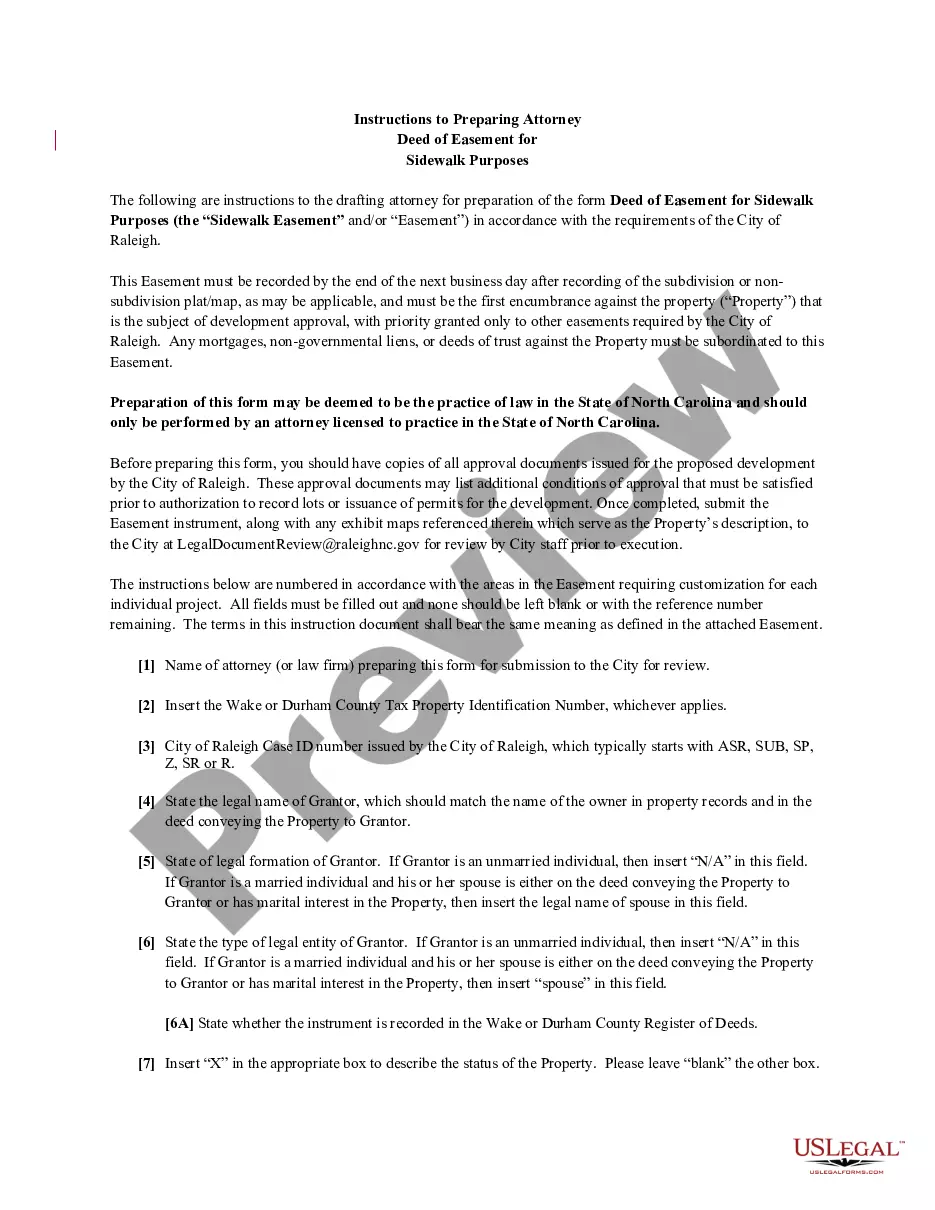
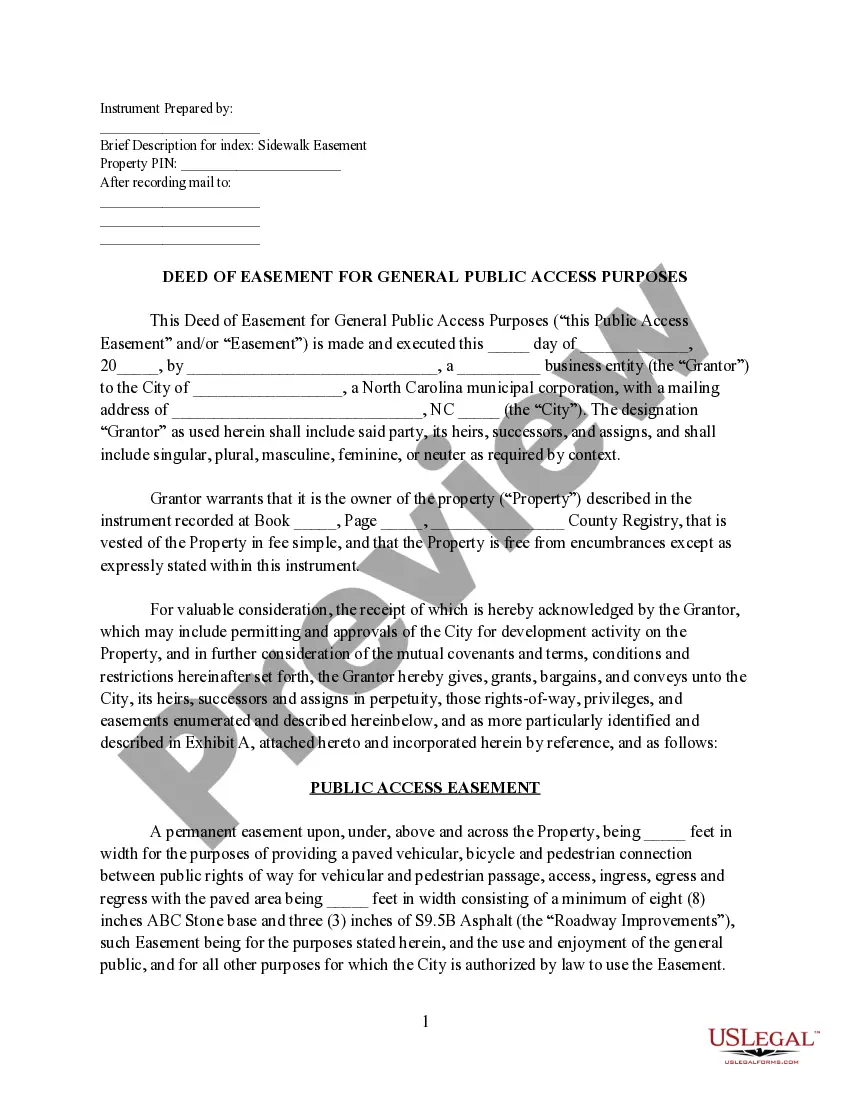
This form is used when a property owner needs to grant the City of Raleigh or another municipal corporation the right to access and maintain slopes related to a public street or sidewalk. Developers should use this easement when seeking approvals for construction projects that involve grading, landscaping, or drainage, ensuring compliance with local zoning and development regulations.
Who can use this document
- Property owners in Raleigh seeking development approval.
- Developers working on projects that require grading or land modification.
- Legal professionals drafting or reviewing property easements.
- Municipalities requiring easements for public works or infrastructure projects.
Completing this form step by step
- Identify the parties involved as Grantor and Grantee.
- Specify the property details, including the Tax Property Identification Number and city case ID.
- Clearly describe the easement area and its intended use regarding slopes and drainage.
- Ensure all existing liens and deeds of trust are appropriately subordinated to the easement.
- Have the document signed and notarized as required for legal validity.
Is notarization required?
Yes, this form must be notarized to be legally valid. US Legal Forms offers integrated online notarization, providing a secure video call process that is available 24/7. This ensures the easement is executed properly without the need for travel.
Get your form ready online
Our built-in tools help you complete, sign, share, and store your documents in one place.
Make edits, fill in missing information, and update formatting in US Legal Forms—just like you would in MS Word.
Download a copy, print it, send it by email, or mail it via USPS—whatever works best for your next step.
Sign and collect signatures with our SignNow integration. Send to multiple recipients, set reminders, and more. Go Premium to unlock E-Sign.
If this form requires notarization, complete it online through a secure video call—no need to meet a notary in person or wait for an appointment.
We protect your documents and personal data by following strict security and privacy standards.

Make edits, fill in missing information, and update formatting in US Legal Forms—just like you would in MS Word.

Download a copy, print it, send it by email, or mail it via USPS—whatever works best for your next step.

Sign and collect signatures with our SignNow integration. Send to multiple recipients, set reminders, and more. Go Premium to unlock E-Sign.

If this form requires notarization, complete it online through a secure video call—no need to meet a notary in person or wait for an appointment.

We protect your documents and personal data by following strict security and privacy standards.
Common mistakes
- Leaving essential fields, like property identification numbers or party names, blank.
- Failing to subordinate existing liens or encumbrances properly.
- Neglecting to attach the required exhibit map for the easement area.
- Not adhering to local recording deadlines, risking the easement's enforceability.
What to keep in mind
- The Deed of Easement for Slope Purposes allows specific use of land for maintenance and grading.
- Ensure prompt recording following local guidelines to maintain legal standing.
- Consult a licensed attorney for proper completion and submission of the document.
- Failure to comply with subordination or recording requirements can impact property rights.
Looking for another form?
Form popularity
FAQ
An easement is a right to use land belonging to another. Individual rights can be severed from the full bundle of property rights. held by a entity other than the primary owner.
The North Carolina courts have defined an easement as ?a non-possessory right to make limited use of land owned by another without taking a part thereof.?
Generally, the owner of any easement has a duty to maintain the easement. If the easement is owned by more than one person, or is attached parcels of land under different ownership, each owner must share in the cost of maintaining the easement pursuant to their agreement.
The Easement attaches to and passes with the dominant tract as an interest in real property interest in real property. If A and B are adjoining parcels of land and j g p the owner of A grants the owner of B a Road Easement across A , the easement is Appurtenant.
A drainage easement is a dedicated area of land reserved for the storage and passage of stormwater via open channel, pipe, or culvert. It is identified on an official plat of a development and kept on file with the county register of deeds for public record (available online at ).
Drainage Law in North Carolina is based on Common Law and court precedent. The law states that the person on the lower estate must receive and pass the water from the higher estate(s). Also, specific statutes prohibit the blockage of streams, drainageways and easements that remove water from higher elevations.
Property owners may not interfere with the purpose of an easement. For example, if a beneficiary electric company has wires strung across your yard, you can not take them down or block the workers' path. Violators may be held liable for damages to the easement holder.
Slope Easements - allows for the permanent creation and maintenance of a "sloping" transition between properties of different elevations.