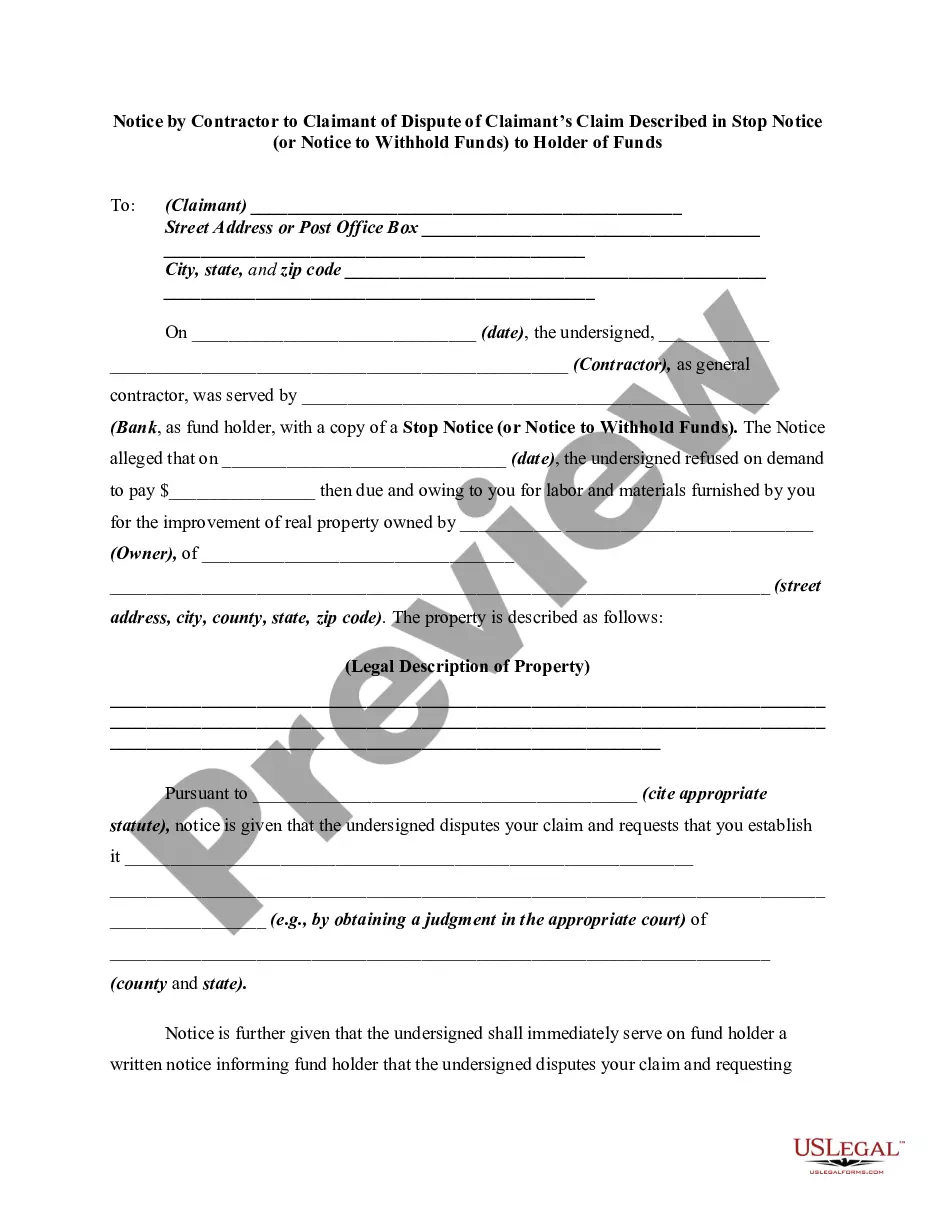
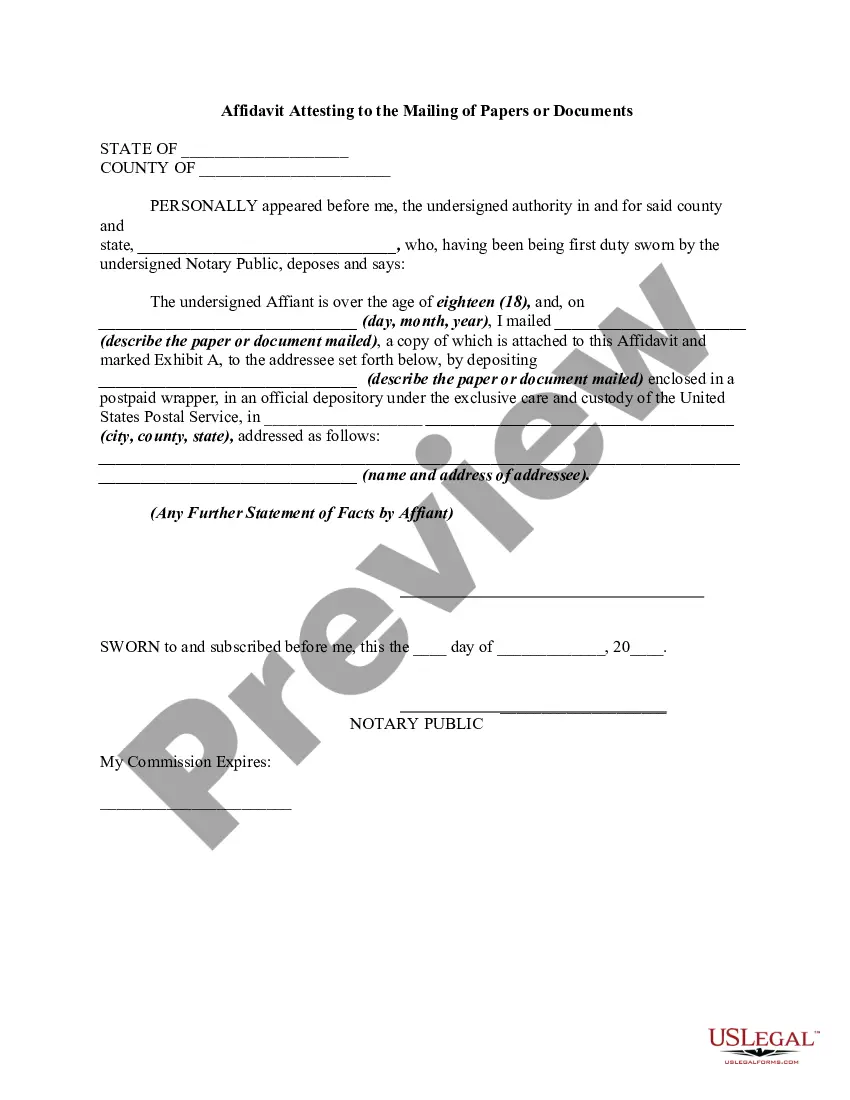
The following form is an affidavit which attests to the proper mailing of papers or documents to a specific person at a specific address.
North Carolina Affidavit Attesting to the Mailing of Papers or Documents
State:
Multi-State
Control #:
US-00493BG
Format:
Word;
Rich Text
Instant download
Description
How to fill out Affidavit Attesting To The Mailing Of Papers Or Documents?
If you need to acquire, download, or print legal document templates, utilize US Legal Forms, the largest collection of legal forms available online.
Take advantage of the site's user-friendly and efficient search to locate the documents you require.
Various templates for business and personal use are categorized by groups and states, or keywords.
Once you have found the form you want, click the Get now option. Choose the pricing plan you prefer and provide your details to register for an account.
Process the payment. You can use your credit card or PayPal account to complete the transaction. Step 6. Choose the format of your legal form and download it to your device. Step 7. Complete, edit, and print or sign the North Carolina Affidavit Attesting to the Mailing of Papers or Documents. Every legal document template you acquire is your property indefinitely. You have access to every form you downloaded within your account. Click on the My documents section and choose a form to print or download again.
- Use US Legal Forms to locate the North Carolina Affidavit Attesting to the Mailing of Papers or Documents in just a few clicks.
- If you are already a US Legal Forms user, Log In to your account and click on the Download option to obtain the North Carolina Affidavit Attesting to the Mailing of Papers or Documents.
- You can also access forms you previously downloaded in the My documents tab of your account.
- If you are using US Legal Forms for the first time, follow the instructions below.
- Ensure you have selected the form for the correct city/state.
- Use the Preview option to review the form's content. Remember to read the summary.
- If you are not satisfied with the form, utilize the Search area at the top of the screen to find other types of your legal form template.
Form popularity
FAQ
An affidavit is a legal document, which means it has to be signed. But simply signing the affidavit may not be enough; often, it must be signed in front of a witness who can attest to its authenticity.
What is The Affidavit for Collection of Personal Property? ing to the North Carolina statute § 28A-25-1, a heir can settle a deceased person's estate without going through probate by applying for the Affidavit for Collection of Personal Property of the Decedent (form AOC-E-203B).
An affidavit is a statement given under oath that its contents are true and accurate. Any false statement or information contained in this affidavit may subject you to prosecution for the felony of perjury, N.C.G.S. 14-209, or under other statutes that prohibit false statements under oath.
Like affidavits, declarations are commonly used by litigants to submit factual evidence, such as witness statements or documentary evidence. Unlike affidavits, however, declarations are not formally sworn before a notary public or other officer authorized to administer oaths.
The following are six critical sections that must be included: Title. This is either your name (?Affidavit of Jane Doe?) or the specific case information. Statement of identity. The next paragraph tells the court about yourself. ... Statement of truth. ... Statement of facts. ... Closing statement of truth. ... Sign and notarize.
Example: I, Jane Smith, swear that the information in my sworn statement is truthful to the best of my knowledge and understanding. Your statement of truth must be in the first person and you need to identify yourself in it.