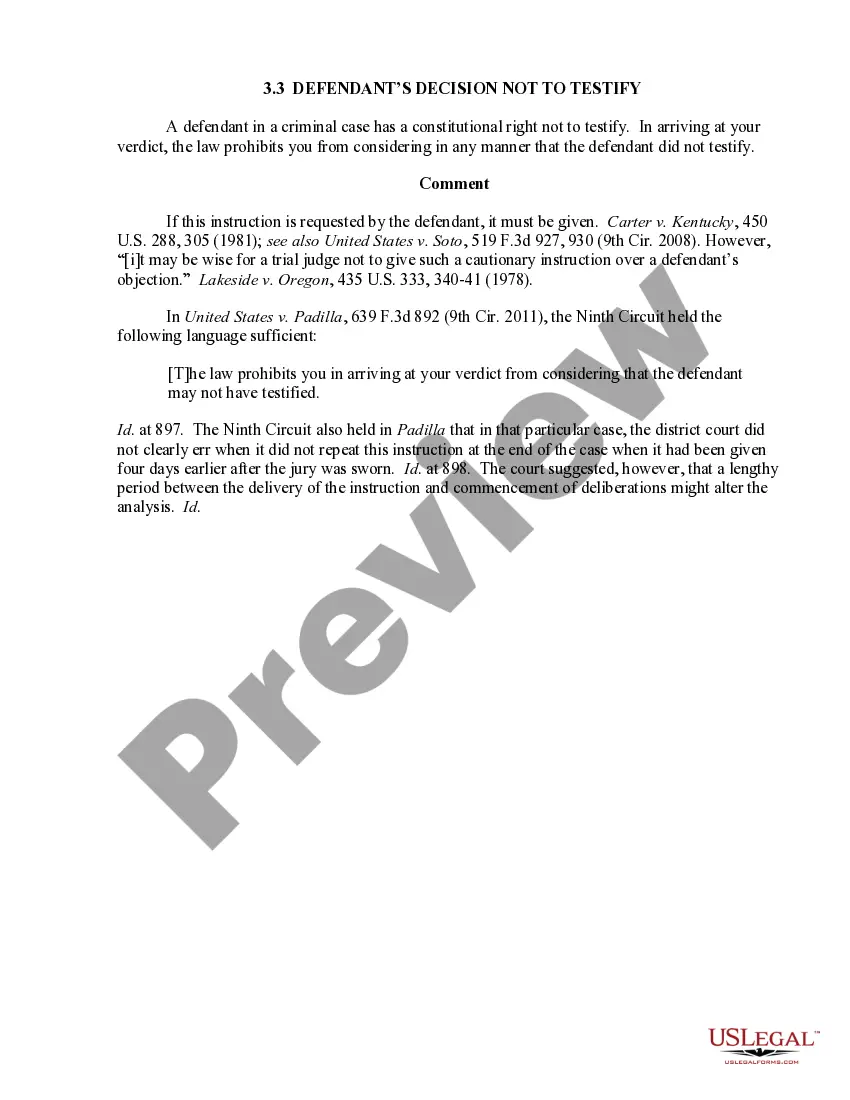
North Dakota Jury Instructions - Defendant's Failure to Testify
Description
How to fill out Jury Instructions - Defendant's Failure To Testify?
Selecting the optimal legal document template can be a challenge. Of course, there are numerous templates available online, but how do you find the legal form you need? Visit the US Legal Forms website. The platform offers a vast array of templates, including the North Dakota Jury Instructions - Defendant's Failure to Testify, suitable for both business and personal use. All documents are reviewed by experts and comply with state and federal regulations.
If you are already registered, Log In to your account and click on the Download button to retrieve the North Dakota Jury Instructions - Defendant's Failure to Testify. Use your account to browse the legal documents you may have previously purchased. Go to the My documents section of your account to obtain another copy of the document you need.
If you are a new user of US Legal Forms, here are simple steps for you to follow: First, ensure that you have selected the correct form for your city/state. You can view the form using the Review button and read the form description to confirm it is suitable for you. If the form does not meet your requirements, utilize the Search field to find the appropriate form. Once you are confident that the form is suitable, click on the Purchase now button to acquire the form. Choose the payment plan you want and fill in the necessary details. Create your account and pay for the order using your PayPal account or credit card. Select the file format and download the legal document template to your device. Complete, edit, and print and sign the acquired North Dakota Jury Instructions - Defendant's Failure to Testify.
Utilize US Legal Forms to simplify your legal document needs and ensure compliance with applicable laws.
- US Legal Forms is the largest collection of legal documents, where you can find numerous document templates.
- Use the service to download professionally created documents that comply with state regulations.
- The platform offers a user-friendly interface for easy navigation.
- All templates are crafted by legal professionals to ensure accuracy.
- You can access your documents at any time after purchase.
- Customer support is available for any inquiries or issues you may encounter.
Form popularity
FAQ
There are three burdens of proof that exist for most cases: proof beyond a reasonable doubt, clear and convincing evidence, and preponderance of the evidence.
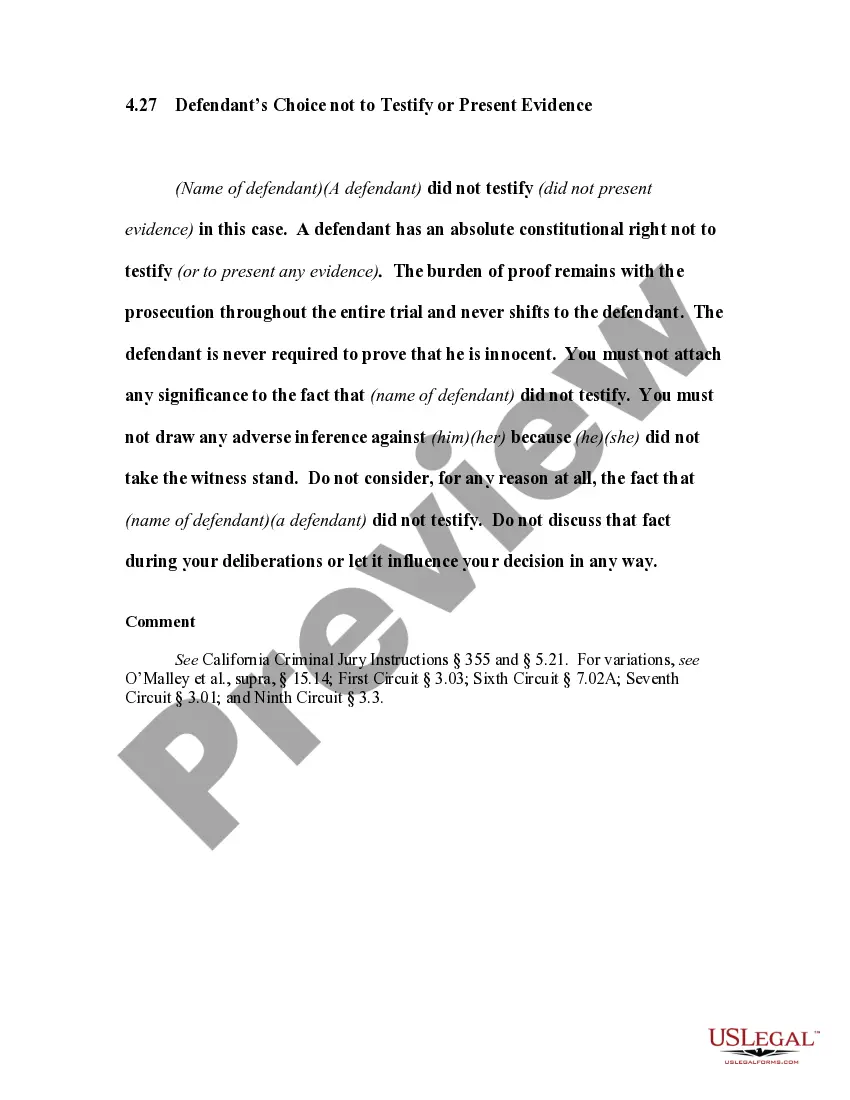
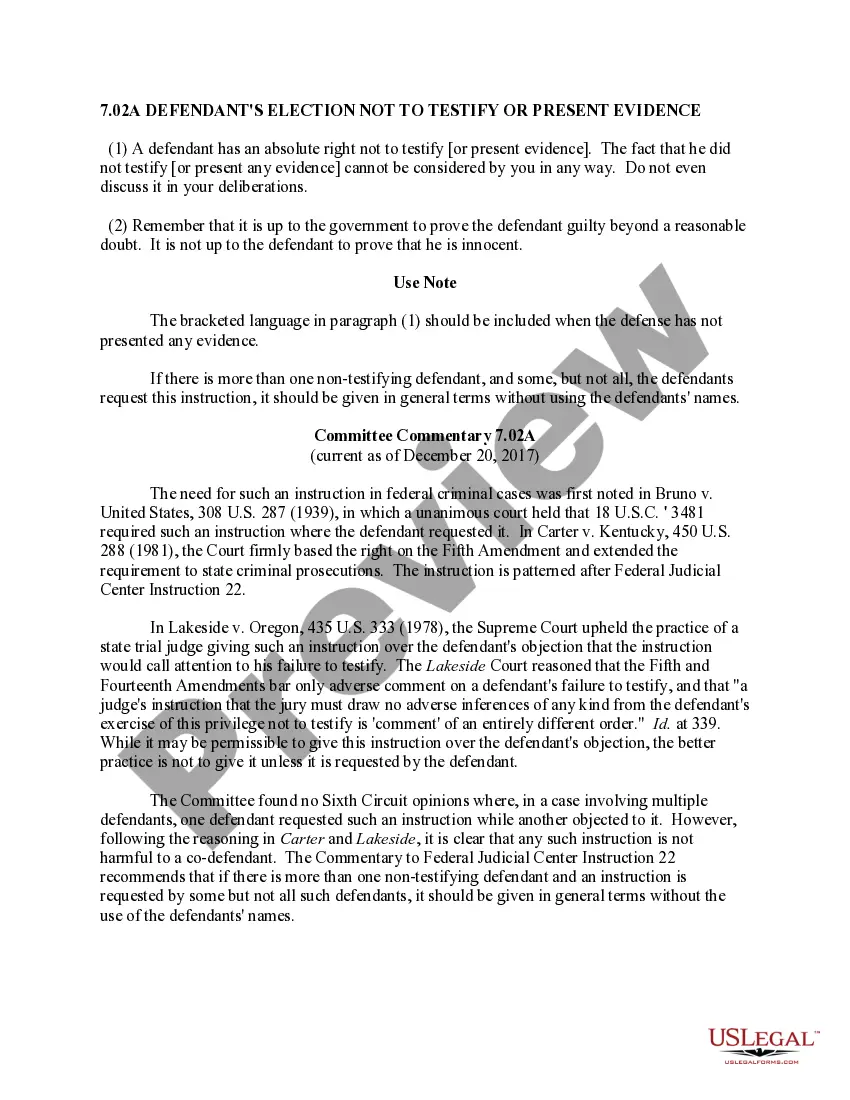
' The Court holds that upon a defendant's proper request, a state trial judge has a constitutional obligation to instruct the jury that no adverse inference is to be drawn from the defendant's failure to testify.
Proof beyond a reasonable doubt is proof that leaves you firmly convinced the defendant is guilty. It is not required that the government prove guilt beyond all possible doubt. A reasonable doubt is a doubt based upon reason and common sense and is not based purely on speculation.
A party must persuade you, by the evidence presented in court, that what he or she is required to prove is more likely to be true than not true. This is referred to as "the burden of proof."
The burden of proof is a legal standard that requires parties to provide evidence to demonstrate that a claim is valid. Three levels of the burden of proof, "beyond a reasonable doubt," a "preponderance of the evidence," and "clear and convincing" determine the level of evidence required for a claim.
When a party has the burden of proving any claim [or affirmative defense] by a preponderance of the evidence, it means you must be persuaded by the evidence that the claim [or affirmative defense] is more probably true than not true.