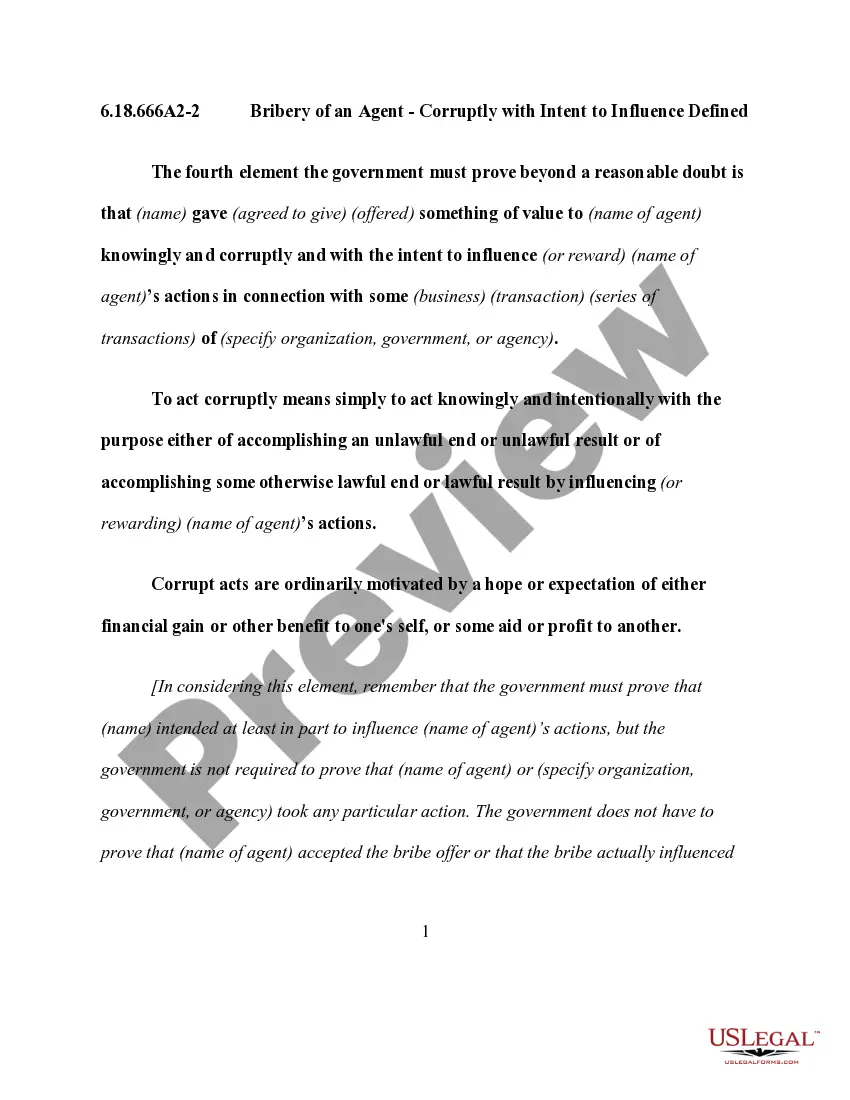
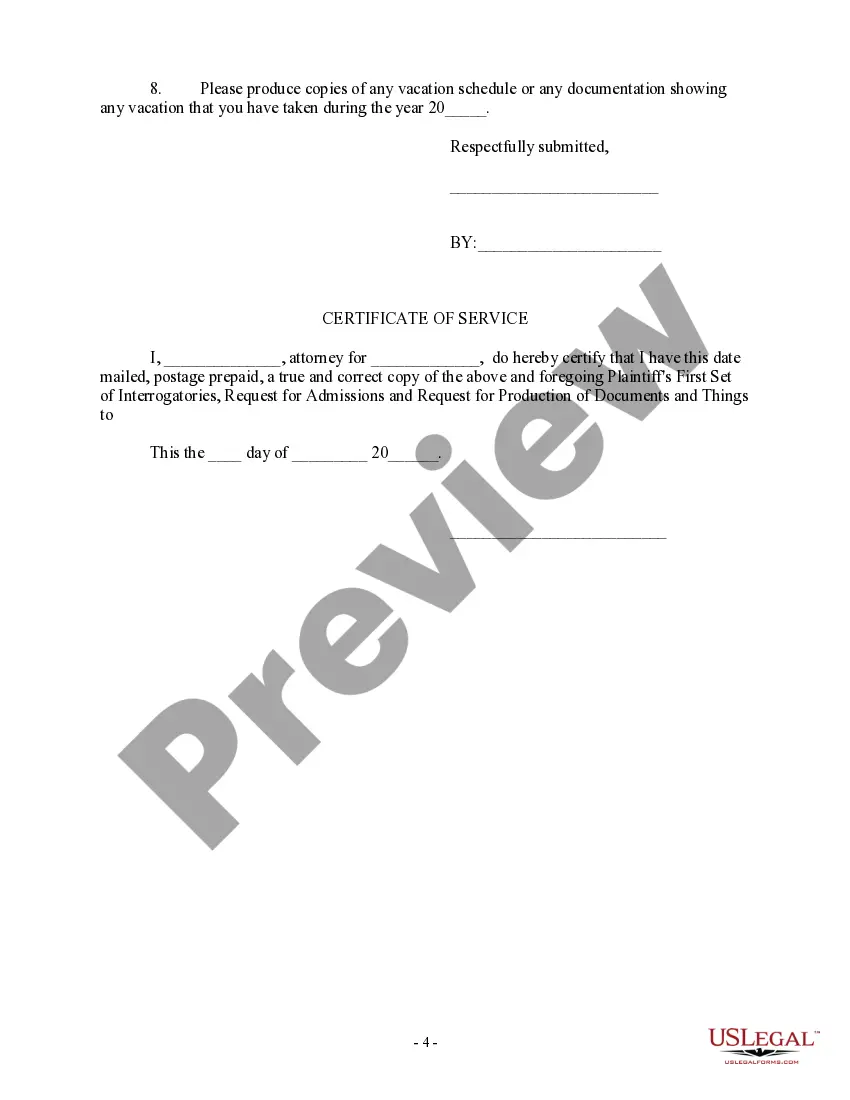
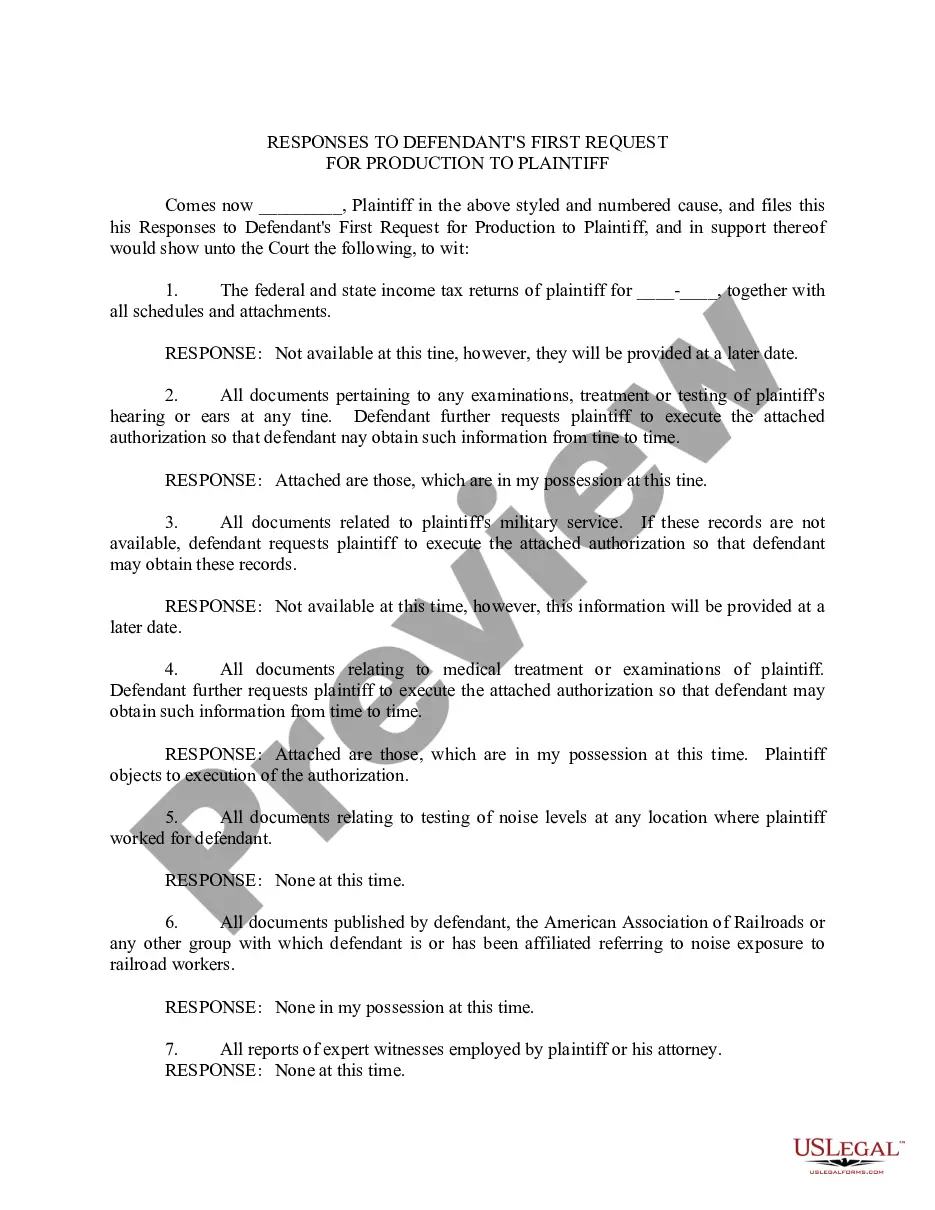
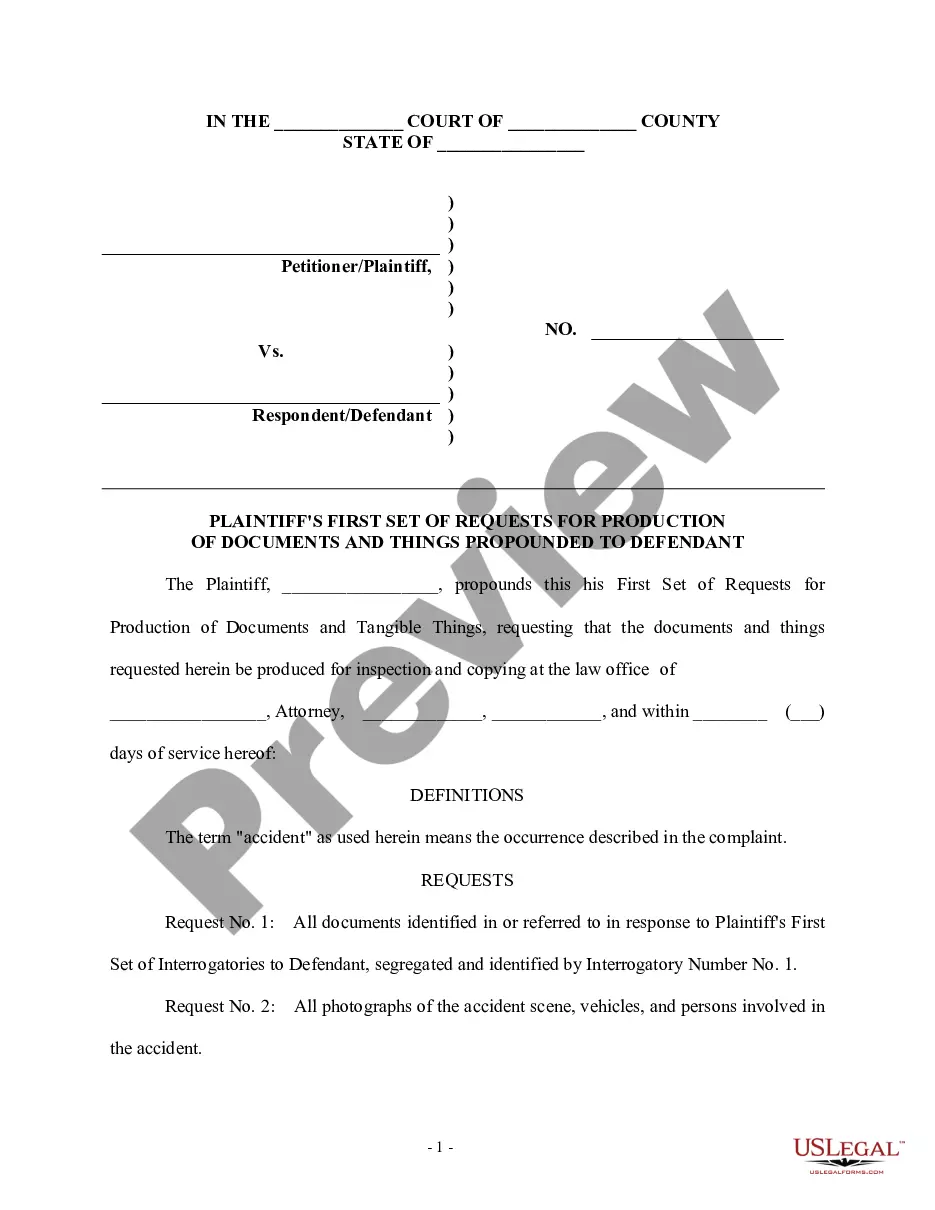
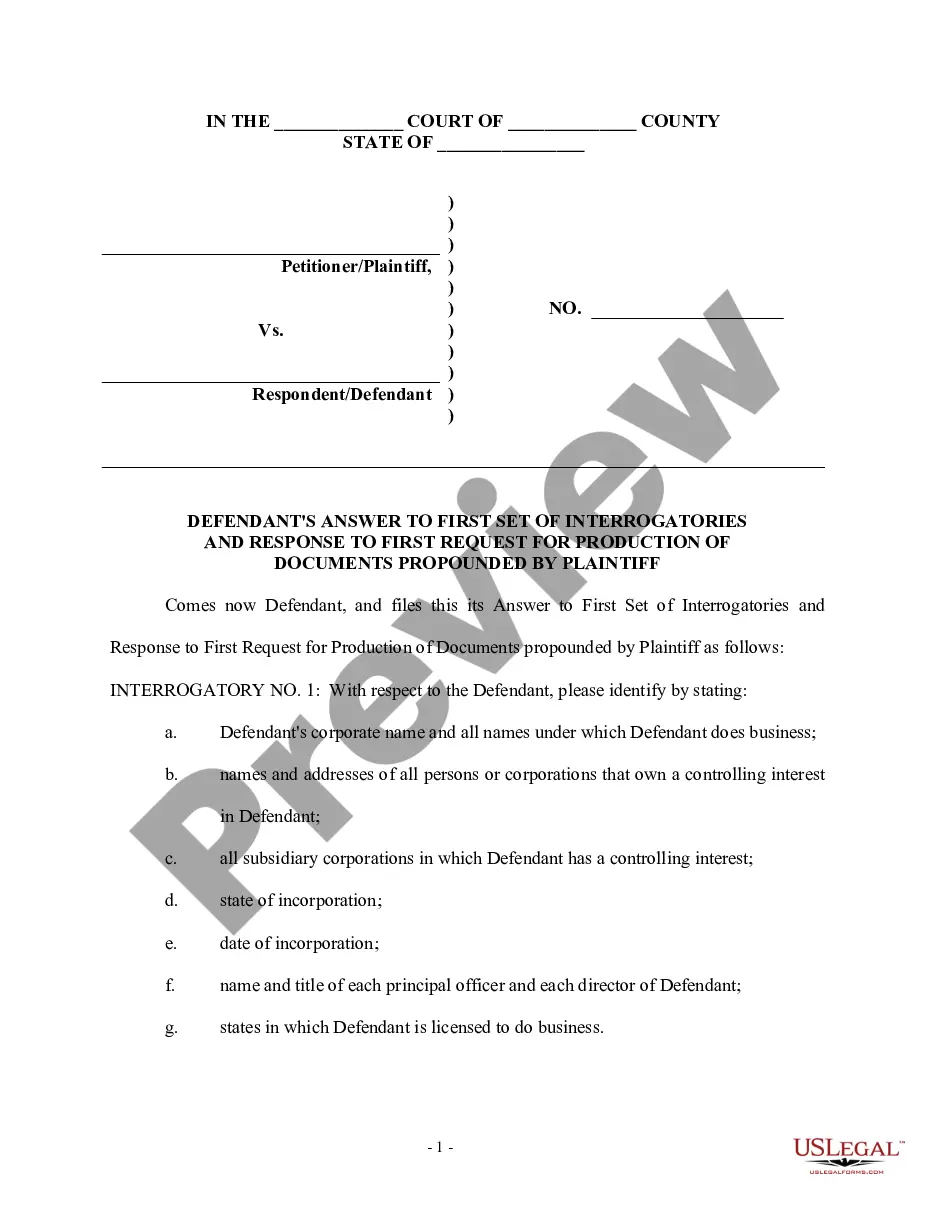
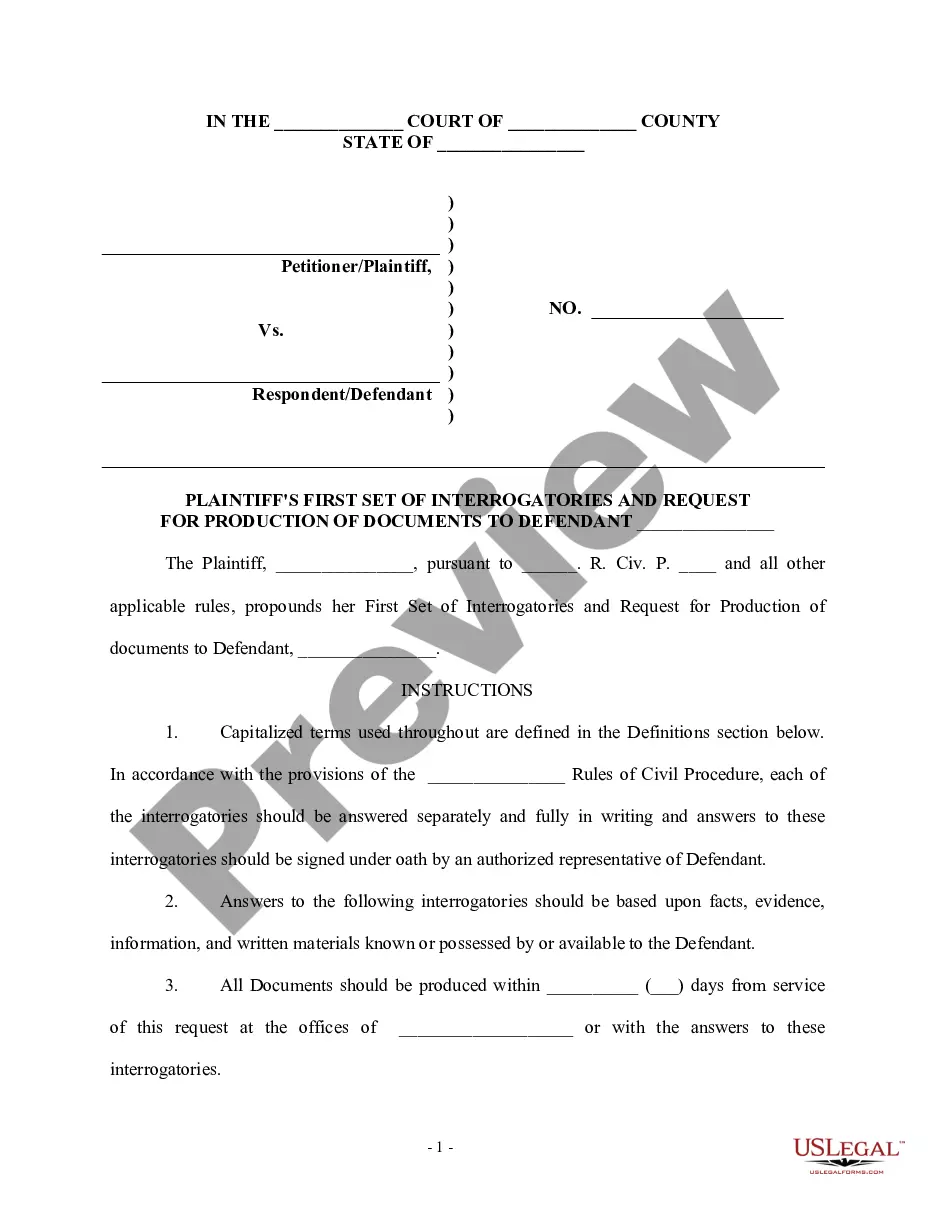
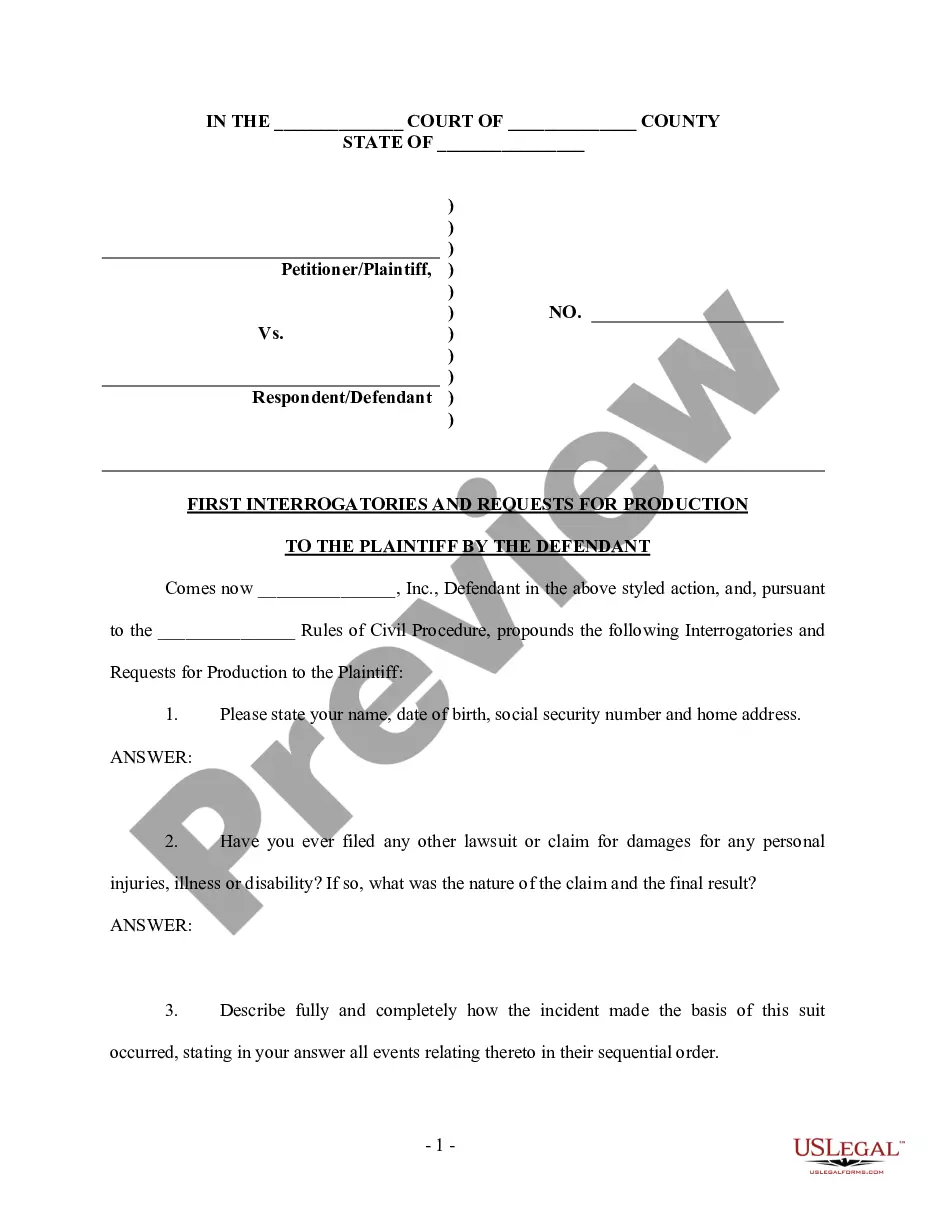
This form is Plaintiff's First Set of Interrogatories. The plaintiff also submits a Request for Admissions, Production of Documents and Things, and the form also contains a Certificate of Service.
North Dakota Plaintiff's First Set of Interrogatories and Request for Production of Documents
Category:
State:
Multi-State
Control #:
US-01582
Format:
Word;
Rich Text
Instant download
Description
Free preview
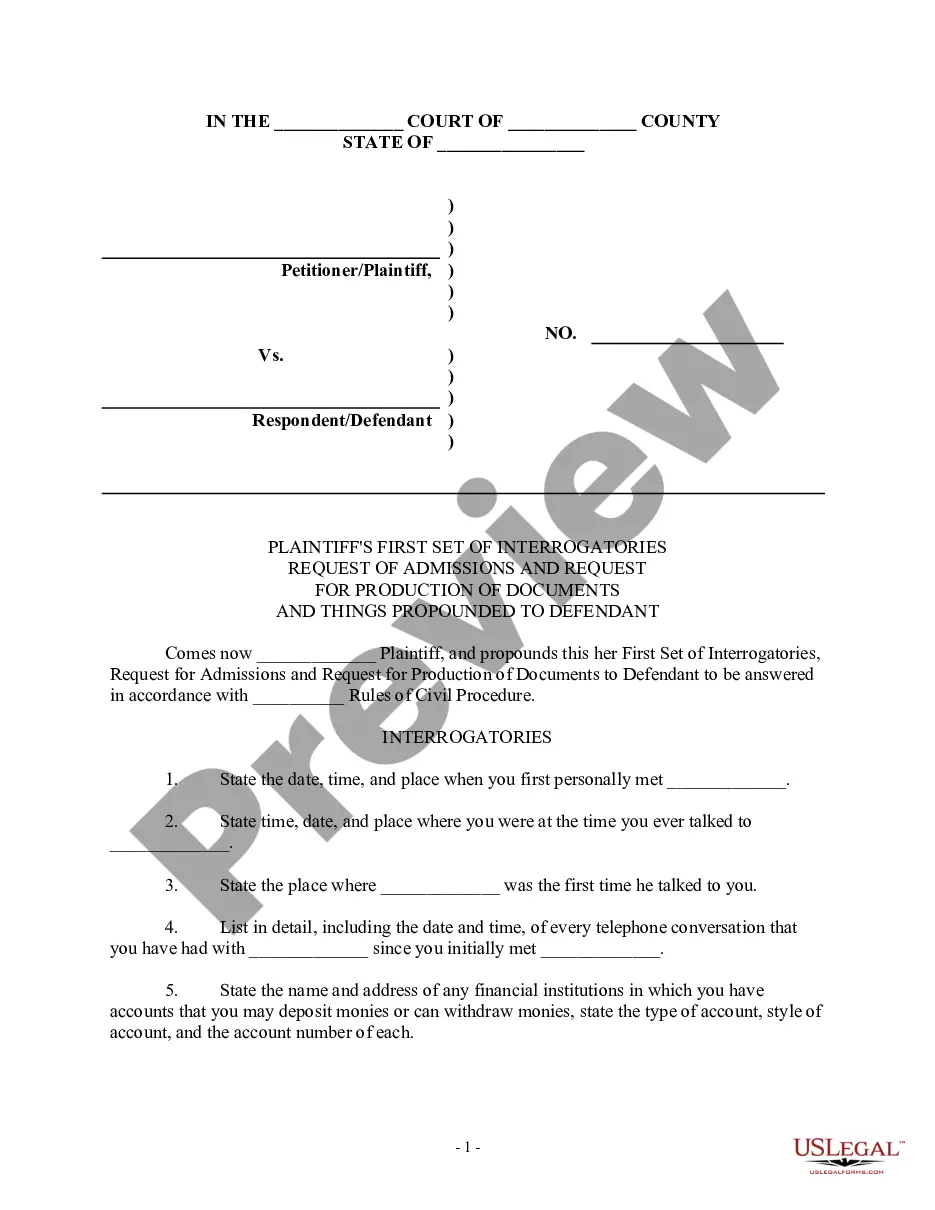
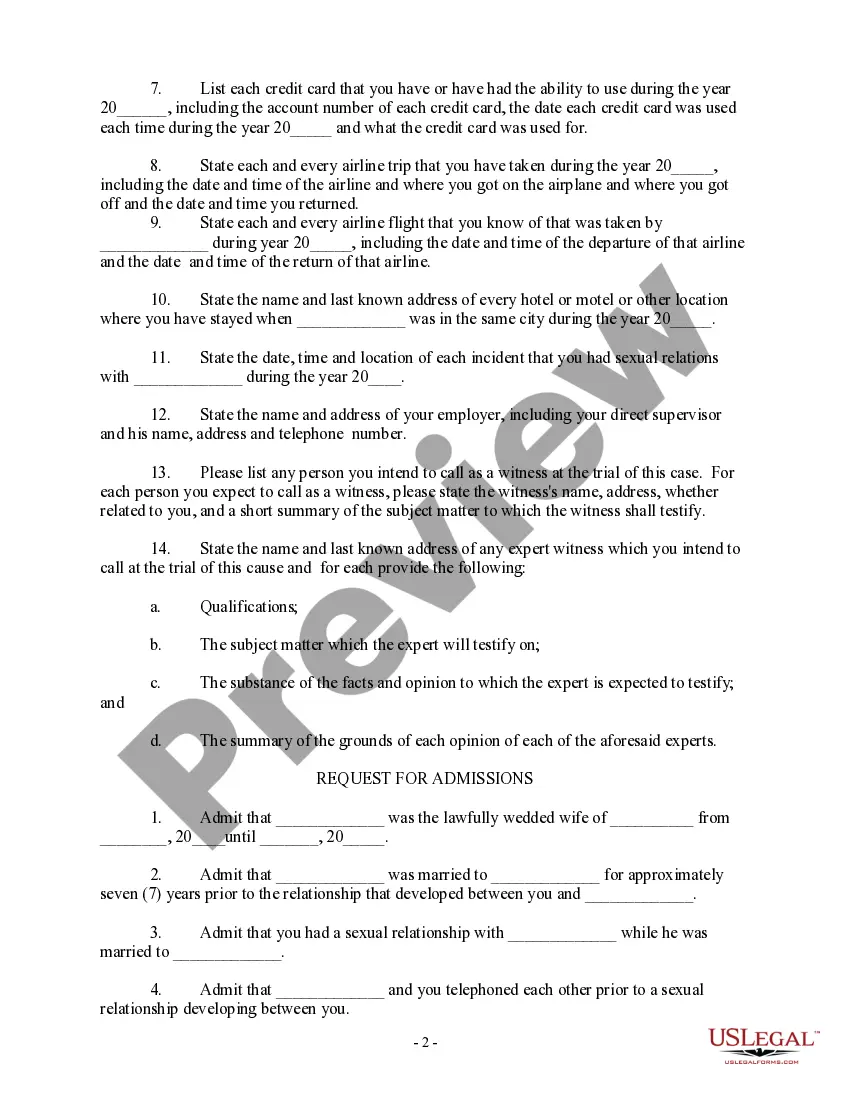
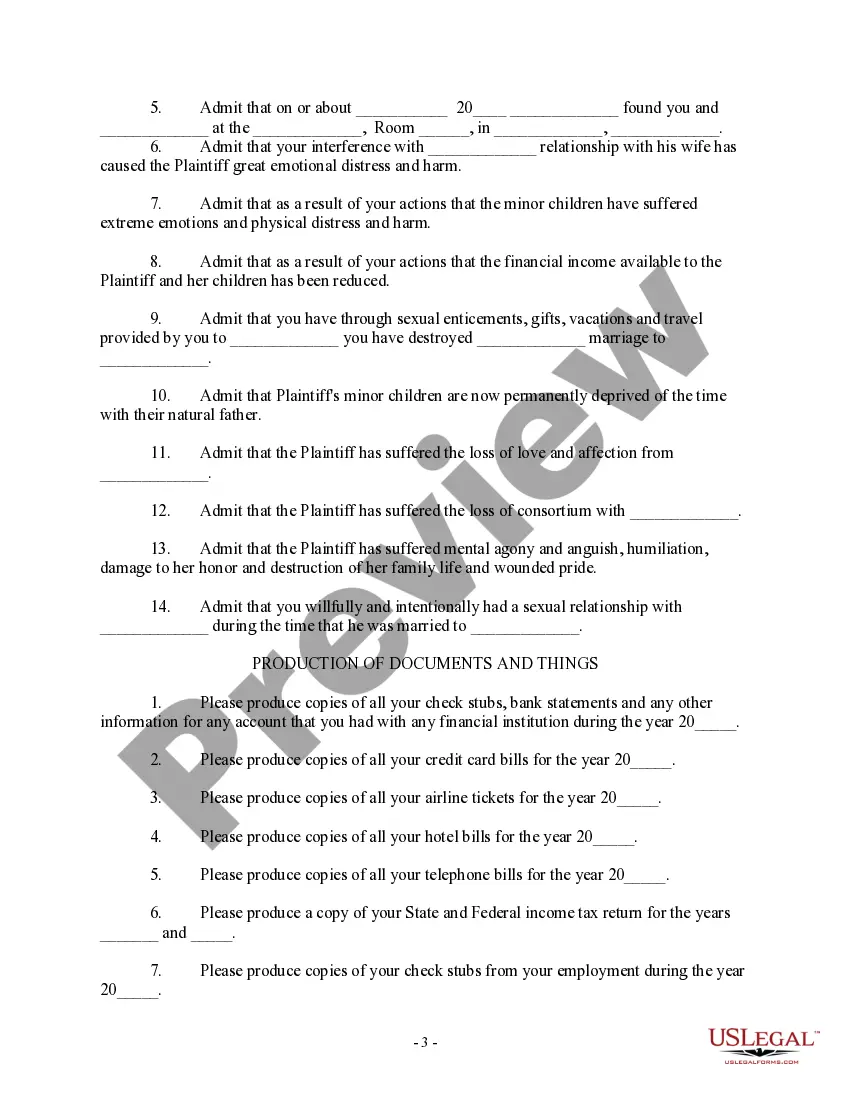
How to fill out Plaintiff's First Set Of Interrogatories And Request For Production Of Documents?
US Legal Forms - one of the largest collections of legal documents in the USA - offers a range of legal form templates that you can download or create. By using the site, you will find thousands of forms for business and personal purposes, categorized by type, state, or keywords. You can access the latest forms such as the North Dakota Plaintiff's First Set of Interrogatories and Request for Production of Documents within moments.
If you already have a subscription, Log In and download the North Dakota Plaintiff's First Set of Interrogatories and Request for Production of Documents from the US Legal Forms library. The Download button will appear on every form you view. You can access all previously downloaded forms in the My documents section of your account.
If you are using US Legal Forms for the first time, here are some simple steps to help you get started: Ensure you have chosen the correct form for your area/county. Click the Preview button to review the content of the form. Check the form description to confirm that you have selected the right form. If the form does not meet your needs, use the Search field at the top of the screen to find one that does. If you are satisfied with the form, confirm your selection by clicking the Get now button. Then, choose your preferred payment plan and provide your details to register for an account. Proceed with the payment. Use your credit card or PayPal account to complete the transaction. Select the format and download the form to your device. Make modifications. Fill out, edit, print, and sign the downloaded North Dakota Plaintiff's First Set of Interrogatories and Request for Production of Documents.
By using US Legal Forms, you gain access to a wealth of resources that can simplify your documentation process and ensure compliance with legal standards.
Take advantage of the extensive options available and streamline your legal paperwork today.
- Every template you save to your account has no expiration date and is yours permanently.
- If you want to download or create another copy, simply go to the My documents section and click on the form you need.
- Access the North Dakota Plaintiff's First Set of Interrogatories and Request for Production of Documents with US Legal Forms, the most comprehensive collection of legal form templates.
- Utilize thousands of professional and state-specific templates that meet your business or personal needs and requirements.
- Experience convenience and efficiency in managing your legal documents.
- Enjoy the reliability of a trusted source for all your legal form needs.
Form popularity
FAQ
The amendment to North Dakota's rule requires the prosecution, upon written request, to disclose that portion of any written record containing the substance of any oral statement made by the defendant in response to interrogation by any person then known to the defendant to be an agent of the government.
Each party is allowed to serve 50 interrogatories on any other party, but must obtain leave of court (or a stipulation from the opposing party) to serve a larger number. Parties cannot evade this limitation by joining as "subparts" questions that seek information about discrete separate subjects.
Rule 26(f) requires federal litigants to confer early in a case, develop a discovery plan, and submit to the court a written report outlining the plan. Fed. R. Civ.
A party who discovers additional evidence or material before or during trial must promptly disclose its existence to the other party or the court if: (1) the evidence or material is subject to discovery or inspection under this rule; and. (2) the other party previously requested, or the court ordered, its production.
A witness who is qualified as an expert by knowledge, skill, experience, training, or education may testify in the form of an opinion or otherwise if the expert's scientific, technical, or other specialized knowledge will help the trier of fact to understand the evidence or to determine a fact in issue.
In a non-felony case, if the defendant pleads guilty without appearing in court, a written form must be used advising the defendant of his or her constitutional rights and creating a record showing that the plea was made voluntarily, knowingly, and understandingly.
Unless otherwise limited by court order, the scope of discovery is as follows: Parties may obtain discovery regarding any nonprivileged matter that is relevant to any party's claim or defense, including the existence, description, nature, custody, condition, and location of any documents, electronically stored ...
Upon a defendant's request, the government must furnish the defendant with a copy of the defendant's prior criminal record that is within the government's possession, custody, or control if the attorney for the government knows-or through due diligence could know-that the record exists.