Nebraska Newly Widowed Individuals Package
What is this form package?
The Nebraska Newly Widowed Individuals Package provides essential legal documents specifically designed for individuals who have recently lost a spouse. This comprehensive package helps newly widowed individuals organize their legal affairs and include crucial forms such as an Heirship Affidavit, Power of Attorney, and a Living Will. It differs from other legal packages by focusing on the unique needs and circumstances faced by those navigating life after the loss of a partner.
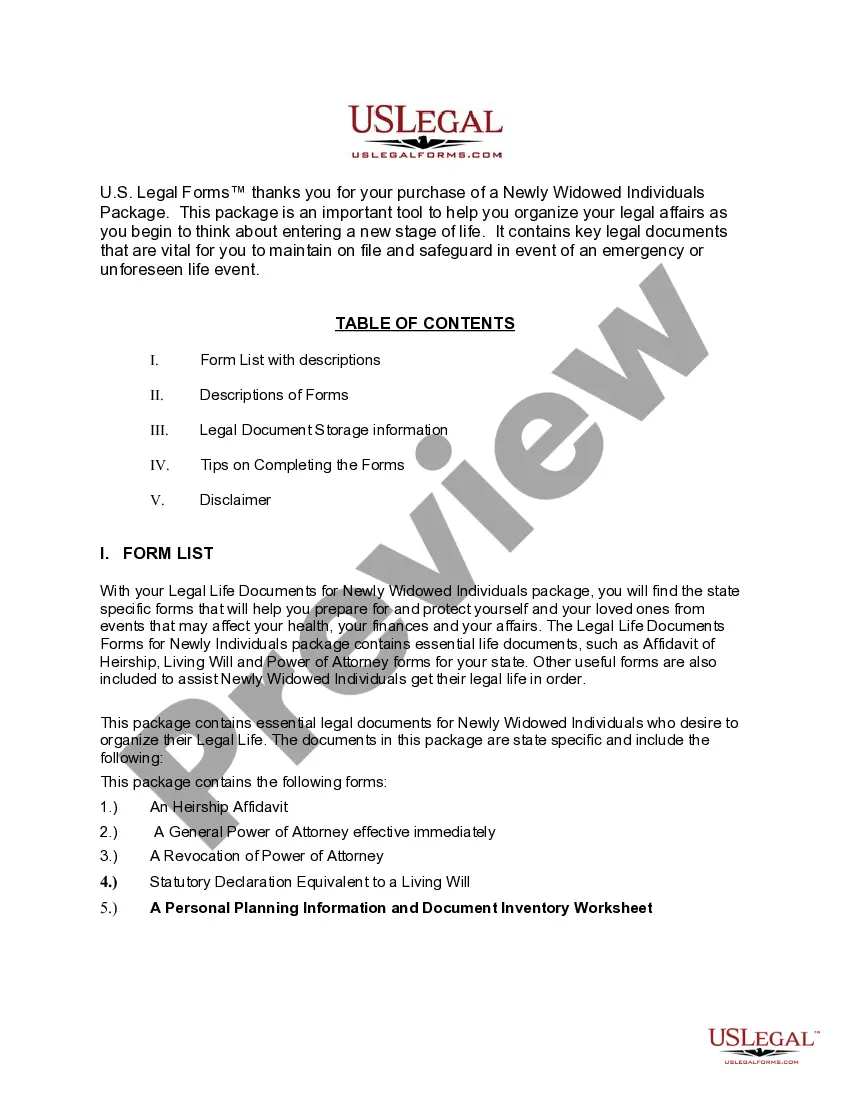
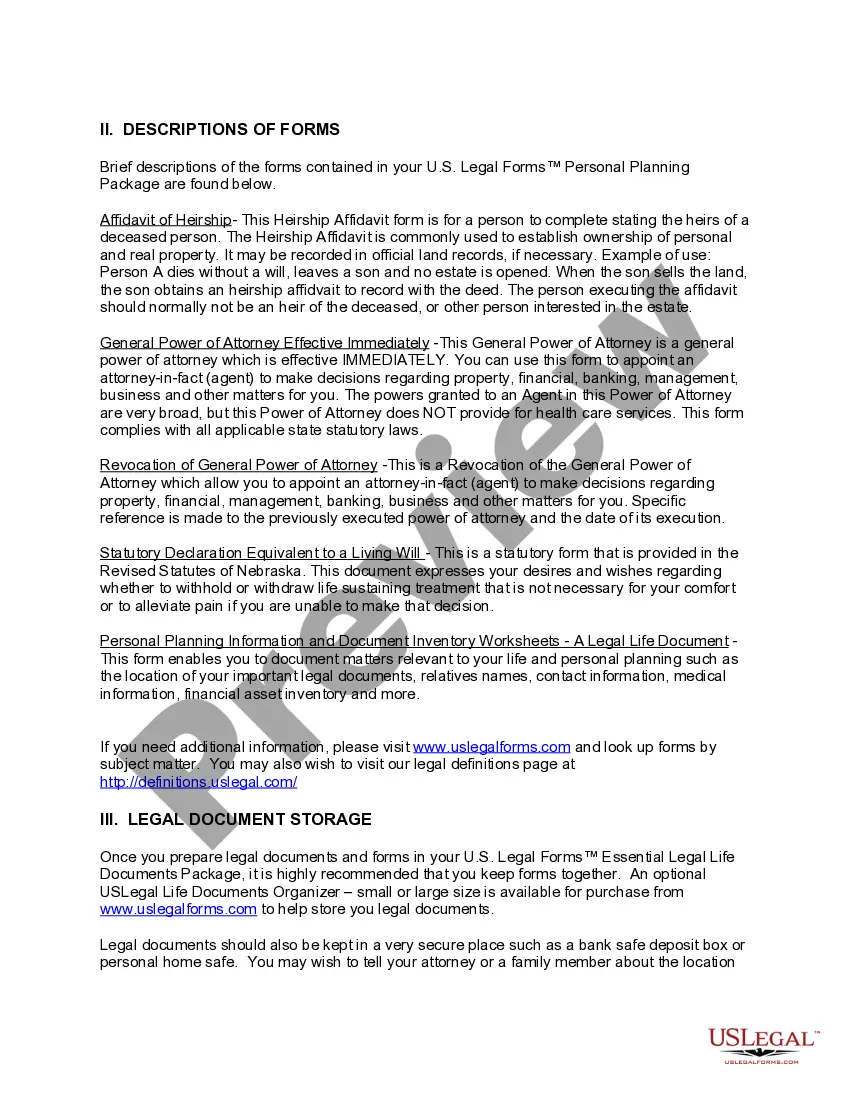
What’s included in this form package
- Last Will and Testament
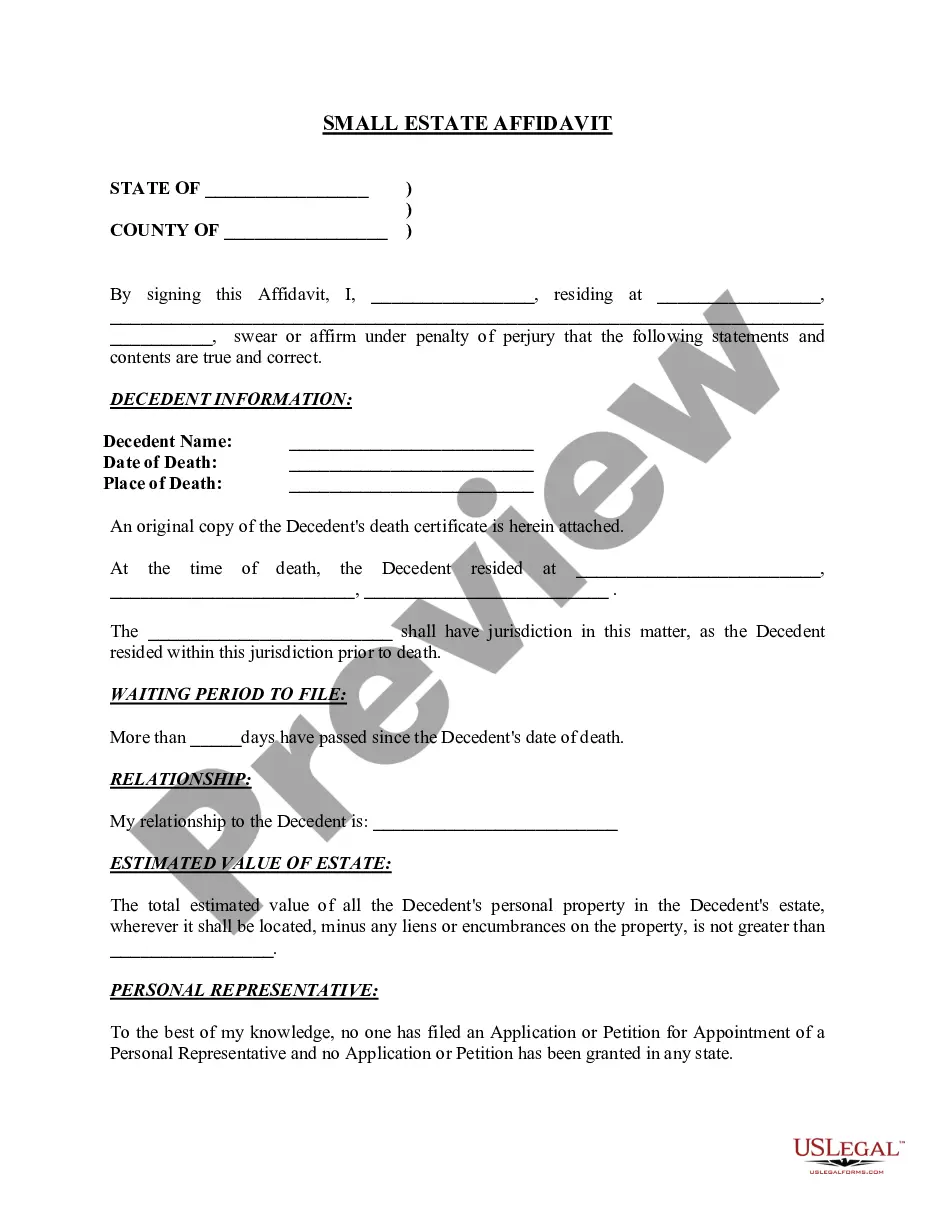
- Heirship Affidavit - Descent
- General Durable Power of Attorney for Property and Finances or Financial Effective Immediately
- Revocation of General Durable Power of Attorney
- Declaration - Living Will - Statutory
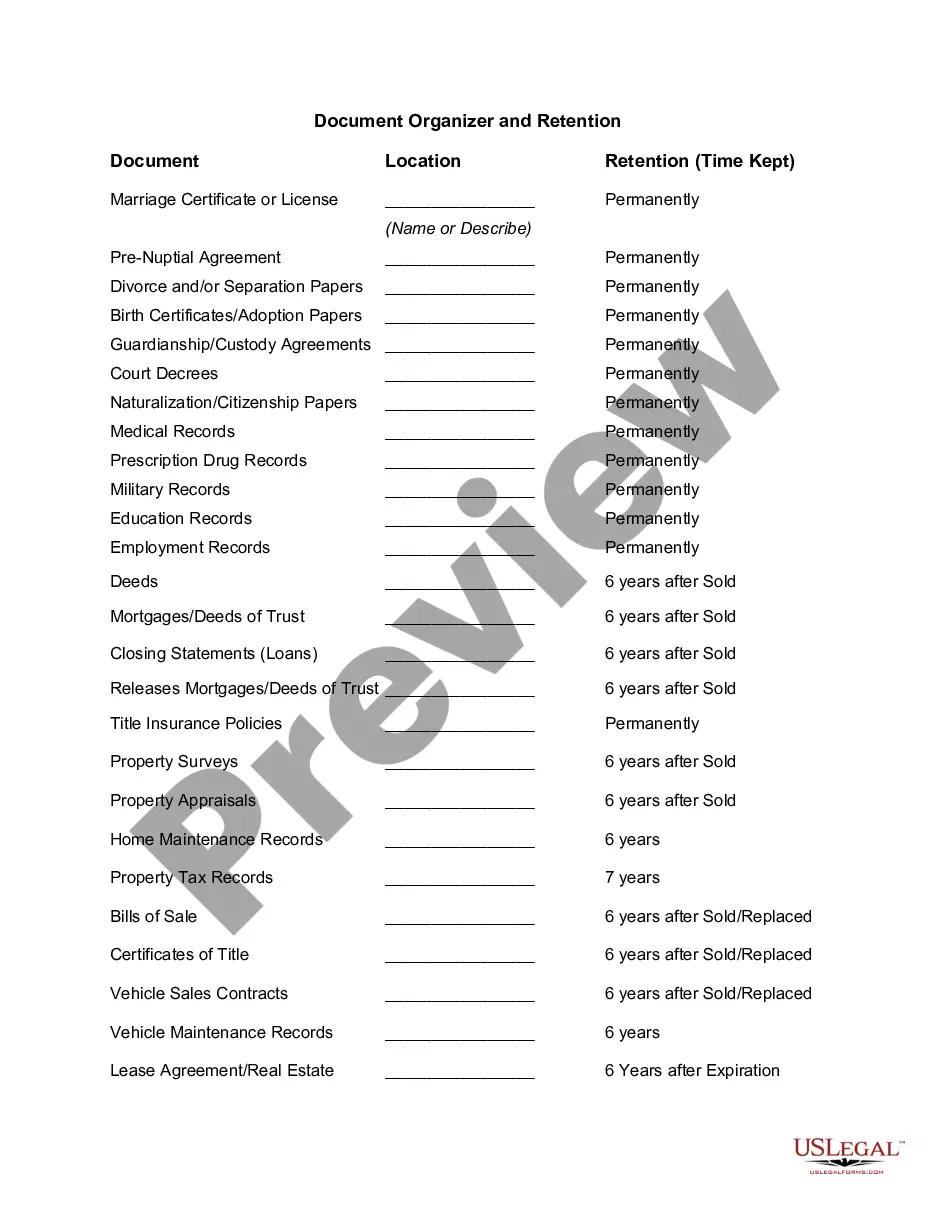
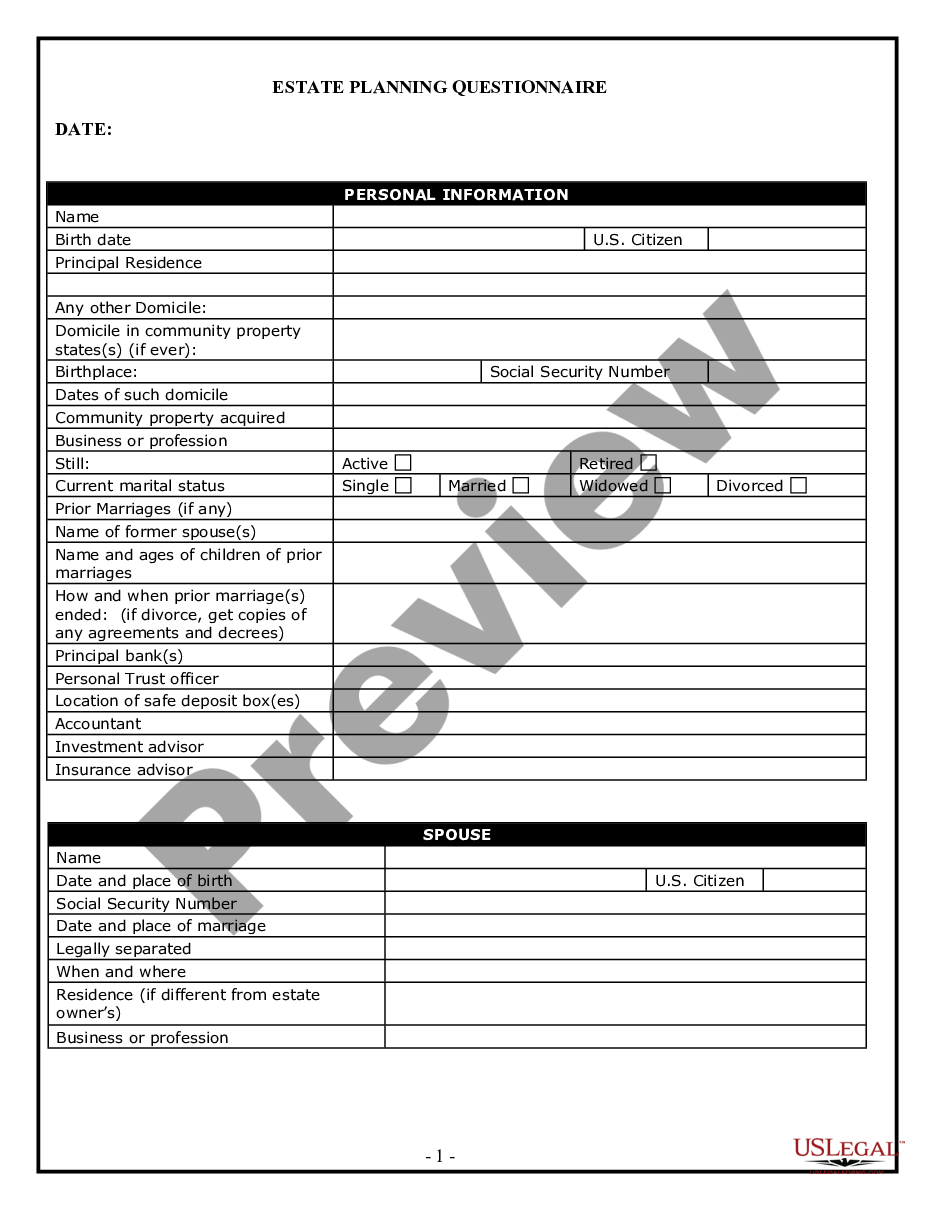
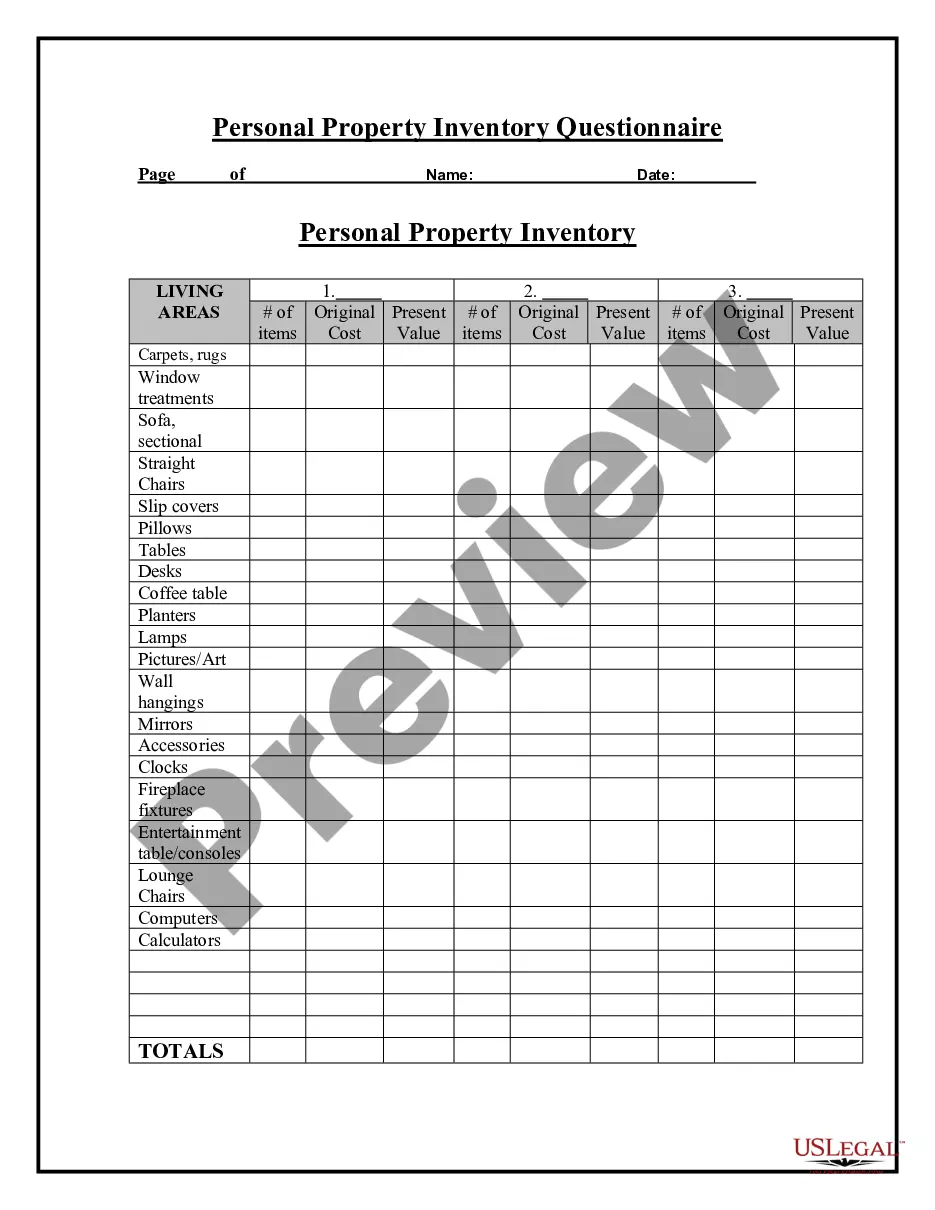
- Personal Planning Information and Document Inventory Worksheets - A Legal Life Document
Common use cases
This package is beneficial in several scenarios, including:
- When you need to establish legal authority for managing shared assets.
- If you want to express your healthcare wishes in the event you cannot communicate them.
- When organizing personal documents after the loss of a spouse.
- If you need to clarify your wishes regarding inheritance and estate management.
Who needs this form package
- Individuals who have recently lost their spouse.
- Persons looking to organize their legal and financial matters.
- Anyone who needs to make decisions on behalf of a deceased partner.
- Families managing an estate after the death of a loved one.
How to complete these forms
- Review each form included in the package thoroughly.
- Gather the necessary information such as personal identification details and asset inventories.
- Fill out the forms accurately, providing all required signatures and dates.
- Ensure that any additional documentation or attachments are prepared as required.
- Store completed forms in a secure location and inform a trusted individual of their whereabouts.
Notarization requirements for forms in this package
Certain documents in this package must be notarized for legal effectiveness. Our online notarization service, powered by Notarize, lets you verify and sign documents remotely through an encrypted video session, available anytime.
Get your form ready online
Our built-in tools help you complete, sign, share, and store your documents in one place.
Make edits, fill in missing information, and update formatting in US Legal Forms—just like you would in MS Word.
Download a copy, print it, send it by email, or mail it via USPS—whatever works best for your next step.
Sign and collect signatures with our SignNow integration. Send to multiple recipients, set reminders, and more. Go Premium to unlock E-Sign.
If this form requires notarization, complete it online through a secure video call—no need to meet a notary in person or wait for an appointment.
We protect your documents and personal data by following strict security and privacy standards.

Make edits, fill in missing information, and update formatting in US Legal Forms—just like you would in MS Word.

Download a copy, print it, send it by email, or mail it via USPS—whatever works best for your next step.

Sign and collect signatures with our SignNow integration. Send to multiple recipients, set reminders, and more. Go Premium to unlock E-Sign.

If this form requires notarization, complete it online through a secure video call—no need to meet a notary in person or wait for an appointment.

We protect your documents and personal data by following strict security and privacy standards.
Mistakes to watch out for
- Failing to date the documents, which can affect their validity.
- Not providing required signatures, particularly on the Power of Attorney.
- Neglecting to keep copies of the completed forms for personal records.
- Overlooking state-specific requirements that could invalidate forms.
Why complete this package online
- The convenience of downloading forms at any time, from anywhere.
- Editability allows you to customize forms to fit your specific needs.
- Reliable, attorney-drafted documents that ensure compliance with Nebraska laws.
- Time-saving access to essential forms without the need for in-person visits.
Looking for another form?
Form popularity
FAQ
Medicare will give the surviving spouse $255 if he or she resided with the beneficiary when the recipient passed away.In the event that no surviving spouse exists, the money goes to a qualifying child, if one exists.
Widows can claim benefits at any time between 60 and their survivor full retirement age.
THE ULTIMATE SURVIVAL GUIDE FOR WIDOWS. ORGANIZE A MEAL TRAIN. ADD FOOD STORAGE CONTAINERS FOR LEFTOVERS. GIVE FOOD GIFT CARDS. PROVIDE A PORTABLE PHONE CHARGER. CONTRIBUTE A GAS GIFT CARD. CREATE A WIDOW CARE PACKAGE FILLED WITH HOUSEHOLD ITEMS. HELP AROUND THE HOUSE.
For Your Widow Or Widower Widows and widowers can receive: Reduced benefits as early as age 60 or full benefits at full retirement age or older. If widows or widowers qualify for retirement benefits on their own record, they can switch to their own retirement benefit as early as age 62.
Employees may also be eligible to receive Medicare benefits through a deceased spouse if that spouse had earned 40 credits prior to their death and they were married to them at the time of the spouse's death.
There are two kinds of benefits that loved ones left behind may be entitled to receive after the death of a spouse. These are: Widowed parent's allowance. Bereavement allowance and bereavement payment.
As a widow: You must be at least 60 years old (unless you are disabled in which case you can claim your benefit as early as age 50). If you are divorced, you can claim the survivors benefit if you were married at least 10 years and are currently unmarried (unless you remarried after age 60).
A surviving spouse can collect 100 percent of the late spouse's benefit if the survivor has reached full retirement age, but the amount will be lower if the deceased spouse claimed benefits before he or she reached full retirement age.
These are examples of the benefits that survivors may receive: Widow or widower, full retirement age or older 100 percent of the deceased worker's benefit amount. Widow or widower, age 60 full retirement age 71½ to 99 percent of the deceased worker's basic amount.