The New Hampshire Self-Insurance Surety Bond is a surety bond required by the New Hampshire Insurance Department for certain self-insured entities. It guarantees the entity's financial responsibility in fulfilling its obligations to pay for any claims that may arise from its business operations. The bond's purpose is to protect policyholders in the event the self-insured entity fails to fulfill its obligations. There are two types of New Hampshire Self-Insurance Surety Bonds: the Stop-Loss Bond and the Property & Casualty Bond. The Stop-Loss Bond guarantees the self-insured entity's payment of any claims that exceed a predetermined dollar amount. The Property & Casualty Bond guarantees the self-insured entity's payment of any claims arising from property and casualty policies.
New Hampshire Self-Insurance Surety Bond
Description
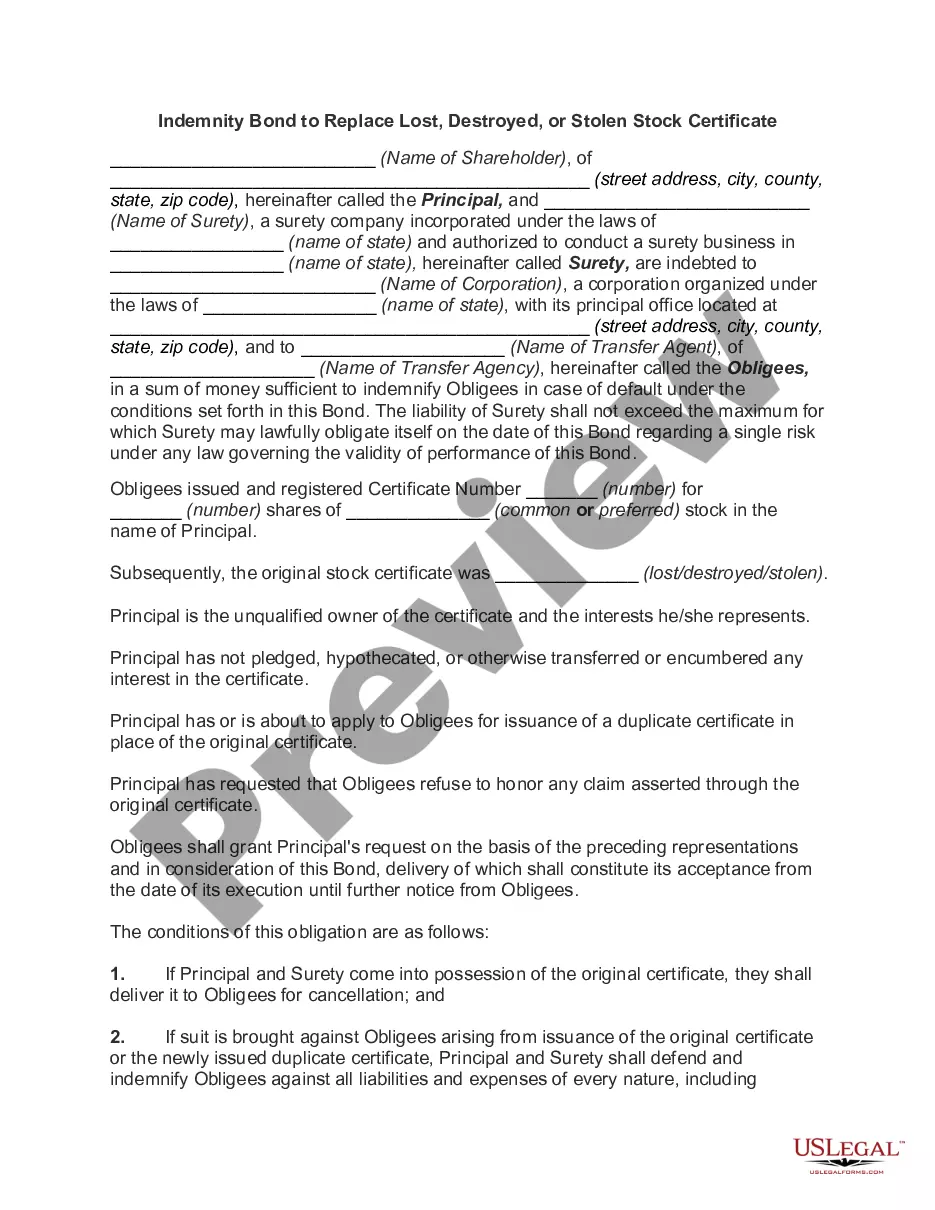


How to fill out New Hampshire Self-Insurance Surety Bond?
Preparing legal paperwork can be a real burden if you don’t have ready-to-use fillable templates. With the US Legal Forms online library of formal documentation, you can be certain in the blanks you find, as all of them comply with federal and state regulations and are examined by our specialists. So if you need to prepare New Hampshire Self-Insurance Surety Bond, our service is the perfect place to download it.
Obtaining your New Hampshire Self-Insurance Surety Bond from our service is as easy as ABC. Previously authorized users with a valid subscription need only log in and click the Download button once they locate the correct template. Later, if they need to, users can get the same document from the My Forms tab of their profile. However, even if you are unfamiliar with our service, registering with a valid subscription will take only a few moments. Here’s a brief guide for you:
- Document compliance verification. You should attentively review the content of the form you want and check whether it suits your needs and fulfills your state law requirements. Previewing your document and reviewing its general description will help you do just that.
- Alternative search (optional). Should there be any inconsistencies, browse the library using the Search tab above until you find an appropriate template, and click Buy Now once you see the one you want.
- Account creation and form purchase. Sign up for an account with US Legal Forms. After account verification, log in and choose your most suitable subscription plan. Make a payment to proceed (PayPal and credit card options are available).
- Template download and further usage. Choose the file format for your New Hampshire Self-Insurance Surety Bond and click Download to save it on your device. Print it to fill out your papers manually, or use a multi-featured online editor to prepare an electronic copy faster and more efficiently.
Haven’t you tried US Legal Forms yet? Sign up for our service today to obtain any official document quickly and easily any time you need to, and keep your paperwork in order!
Form popularity
FAQ
Insurance pays on behalf of you; surety bonds are just a guarantee of payment to another party. The primary difference between a surety bond and insurance is that insurance will pay for losses in a claim, whereas a bonding company will guarantee your obligations are fulfilled.
What Do New Hampshire Surety Bonds Cost? Surety bonds generally cost 1-15% of the required bond amount. Costs vary significantly depending on the bond amount you need and your rate (which is the percentage of the full bond amount you must pay).
To conduct business in New Hampshire, the state may require you to post a surety bond before you can be properly licensed. The purpose of bond coverage is to protect your customers from financial harm in the event of misconduct or mismanagement by your business.
A surety bond is a promise to be liable for the debt, default, or failure of another. It is a three-party contract by which one party (the surety) guarantees the performance or obligations of a second party (the principal) to a third party (the obligee).
The main difference between a cash bond and a surety bond is the number of parties involved. Cash bonds only involve two parties, you and the owner. In a surety bond, there is a third party, the surety company. The term surety refers to any party that guarantees the payment of a debt or performance of a contract.
insurer's bond is a type of surety bond that provides a promise to pay selfinsured losses in case the promisor (selfinsurer) is unable to meet its obligations.
There are many types of surety bonds, and each state has its own bonding requirements for different industries. However, there are three major types of surety bonds that you should know: license and permit bonds, construction and performance bonds, and court bonds.