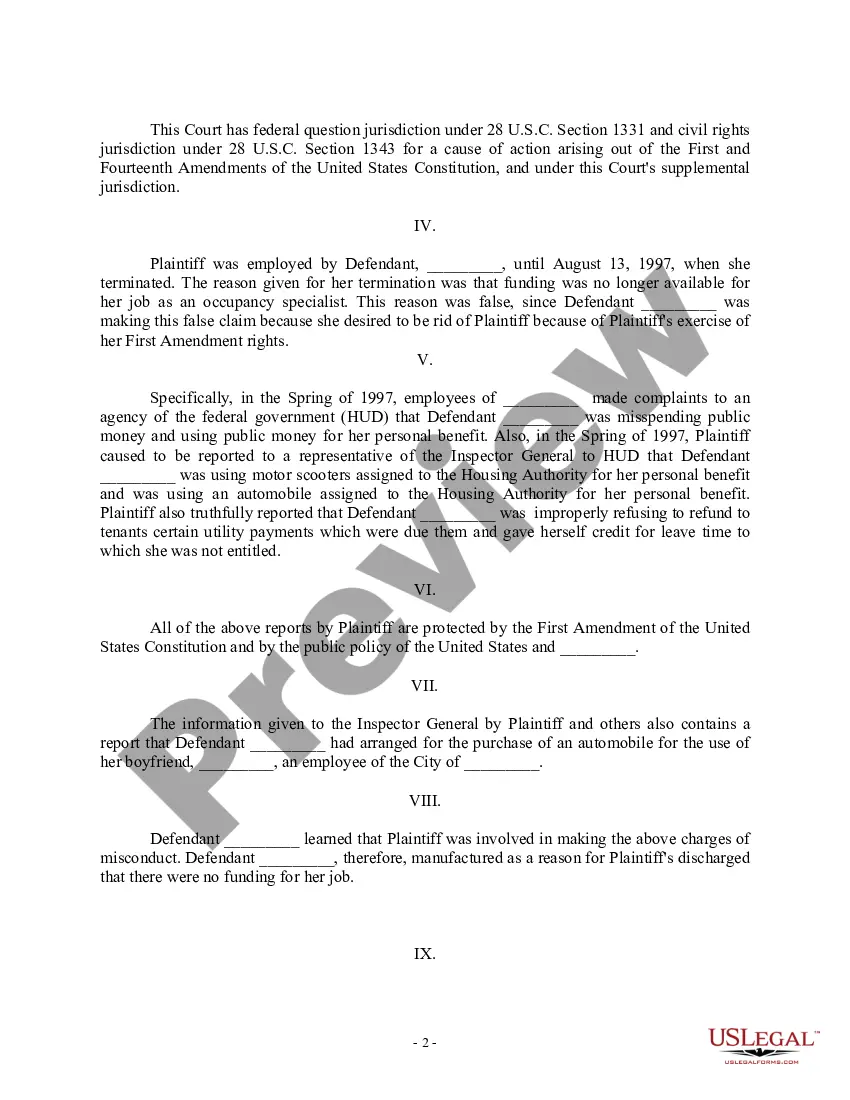
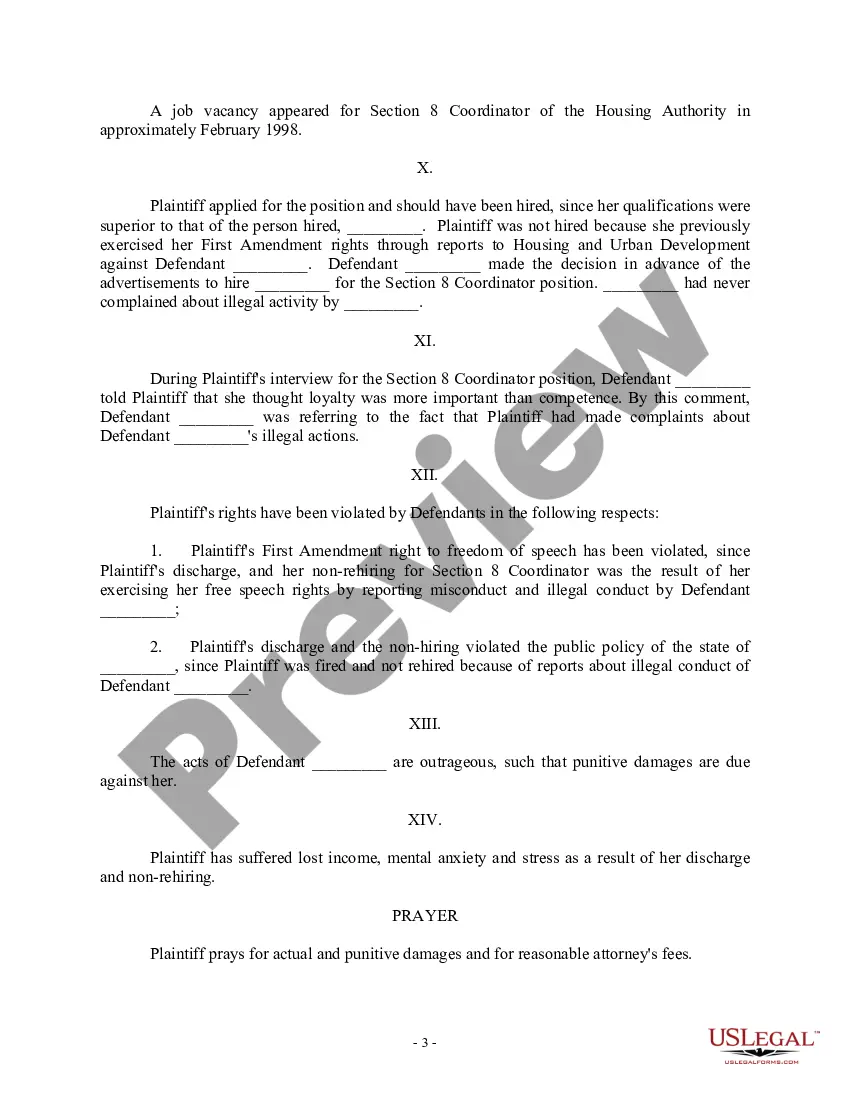
This form is a Complaint. This action is to recover damages for a violation of the First Amendment of the United States Constitution. The plaintiff is seeking punitive damages and reasonable attorney's fees.
New Hampshire Complaint for Violation of Civil Rights and for Wrongful Discharge and Failure To Rehire - 1st, 14th Amendments, US Constitution - Jury Trial Demand
Category:
State:
Multi-State
Control #:
US-000285
Format:
Word;
Rich Text
Instant download
Description
Free preview





How to fill out Complaint For Violation Of Civil Rights And For Wrongful Discharge And Failure To Rehire - 1st, 14th Amendments, US Constitution - Jury Trial Demand?
Are you in a situation where you need documentation for potentially organizational or personal purposes almost every workday? There are numerous authentic document templates accessible online, but locating ones you can rely on is not easy.
US Legal Forms offers a wide variety of form templates, such as the New Hampshire Complaint for Violation of Civil Rights and for Wrongful Discharge and Failure To Rehire - 1st, 14th Amendments, US Constitution - Jury Trial Demand, which are designed to meet state and federal requirements.
If you are already familiar with the US Legal Forms website and have an account, simply Log In. After that, you can download the New Hampshire Complaint for Violation of Civil Rights and for Wrongful Discharge and Failure To Rehire - 1st, 14th Amendments, US Constitution - Jury Trial Demand template.
Choose a convenient document format and download your copy.
Access all of the document templates you have purchased in the My documents section. You can obtain another copy of the New Hampshire Complaint for Violation of Civil Rights and for Wrongful Discharge and Failure To Rehire - 1st, 14th Amendments, US Constitution - Jury Trial Demand at any time if needed. Just click on the required form to download or print the document template. Utilize US Legal Forms, the most complete collection of official forms, to save time and avoid mistakes. The service offers professionally crafted legal document templates that can be utilized for various purposes. Create an account on US Legal Forms and start making your life easier.
- If you do not have an account and want to start using US Legal Forms, follow these steps.
- Find the form you need and ensure it is for the correct jurisdiction/state.
- Use the Preview feature to review the document.
- Check the details to confirm that you have chosen the correct form.
- If the form is not what you are looking for, utilize the Search field to find the form that suits your requirements.
- Once you find the right form, click Buy now.
- Select the payment plan you prefer, complete the necessary information to create your account, and pay for the order using your PayPal or Visa or Mastercard.
Form popularity
FAQ
Yes, you can sue for wrongful termination in New Hampshire if your dismissal violated state or federal laws, including civil rights protections under the 1st and 14th Amendments. Filing a New Hampshire Complaint for Violation of Civil Rights and for Wrongful Discharge and Failure To Rehire - 1st, 14th Amendments, US Constitution - Jury Trial Demand allows you to assert your rights and seek compensation. It's advisable to consult with a legal expert to guide you through the process and maximize your chances of success.
To support your New Hampshire Complaint for Violation of Civil Rights and for Wrongful Discharge and Failure To Rehire - 1st, 14th Amendments, US Constitution - Jury Trial Demand, you'll need to gather evidence such as emails, witness statements, and any documentation that shows discrimination or wrongful actions. It is essential to clearly demonstrate how your rights were violated and how these actions led to your wrongful discharge or failure to be rehired. Collecting strong evidence can significantly strengthen your case.
A civil rights violation occurs when an individual's rights, protected by the 1st and 14th Amendments of the US Constitution, are infringed upon by government actions or policies. This can include discrimination based on race, gender, religion, or disability. If you believe you have suffered such a violation, you may consider filing a New Hampshire Complaint for Violation of Civil Rights and for Wrongful Discharge and Failure To Rehire - 1st, 14th Amendments, US Constitution - Jury Trial Demand to seek justice.
Motions -- Specific. (a) Motions to Amend. (1) No plaintiff shall have leave to amend a pleading, unless in matters of form, after a default until the defendant has been provided with notice and an opportunity to be heard, to show cause why the amendment should not be allowed.
To establish a claim pursuant to Section 1983, a plaintiff must ?demonstrate a violation of a right secured by the Constitution and the laws of the United States [and] that alleged deprivation was committed by a person acting under the color of state law.? Id.
For offenses not resulting in death, there is a seven?year statute of limitations. For offenses resulting in death, there is no statute of limitations.
The Civil Action for Deprivation of Rights Act or as it is commonly known as Section 1983, is part of The Civil Rights Act intended to provide a private remedy for violations of federal law.
For example, you can bring a Section 1983 claim when a local police officer violates your Fourth Amendment rights by arresting you without probable cause. Although there is no specific statute of violations for these claims, courts must apply the one from the most analogous state law (generally three years).
In New York State, the statute of limitations for actions brought pursuant to § 1983 is three years.
The elements of a § 1983 claim are (1) the action occurred ?under color of state law? and (2) the action resulted in the deprivation of a constitutional right or federal statutory right.