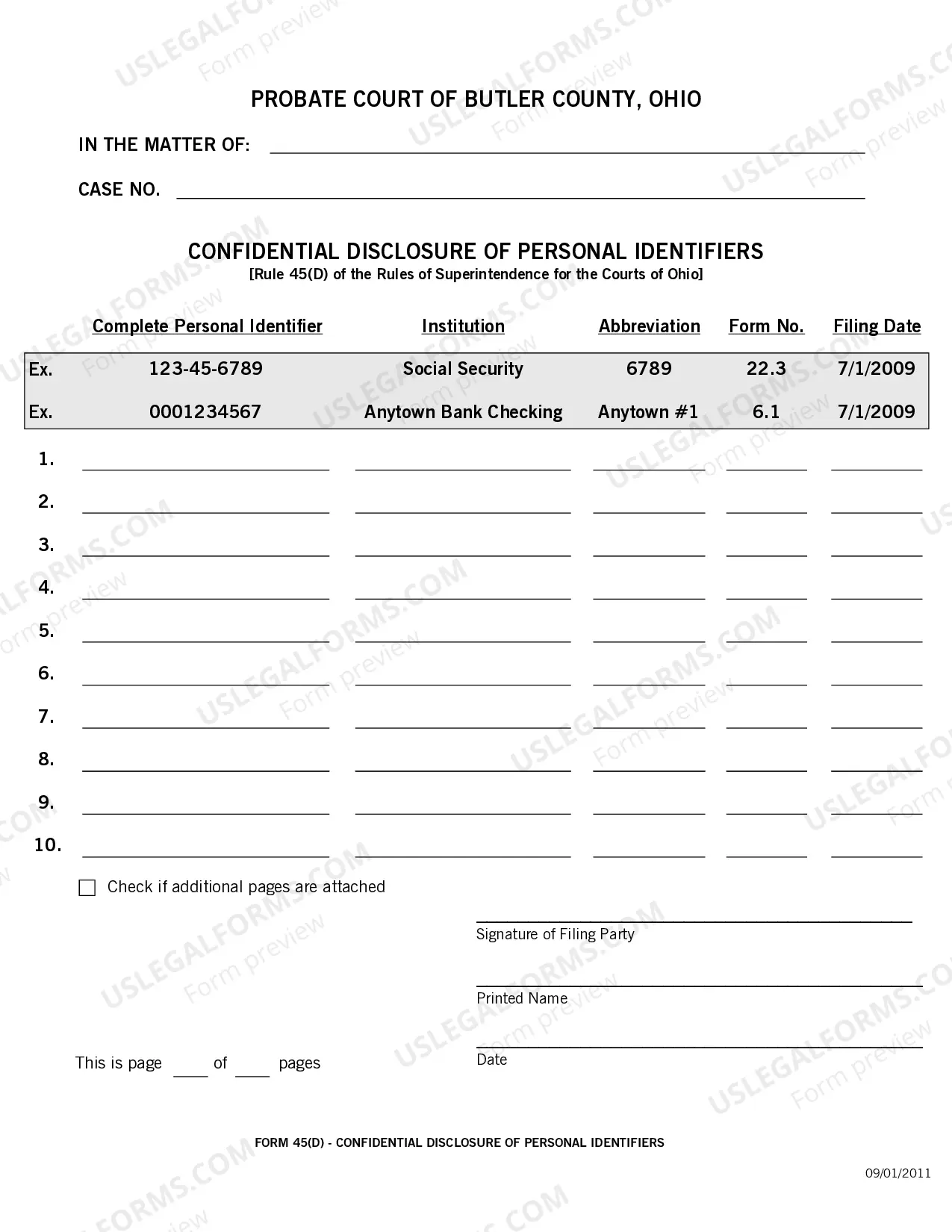
New Jersey Final Judgment of Tax Sale Certificate Foreclosure
About this form
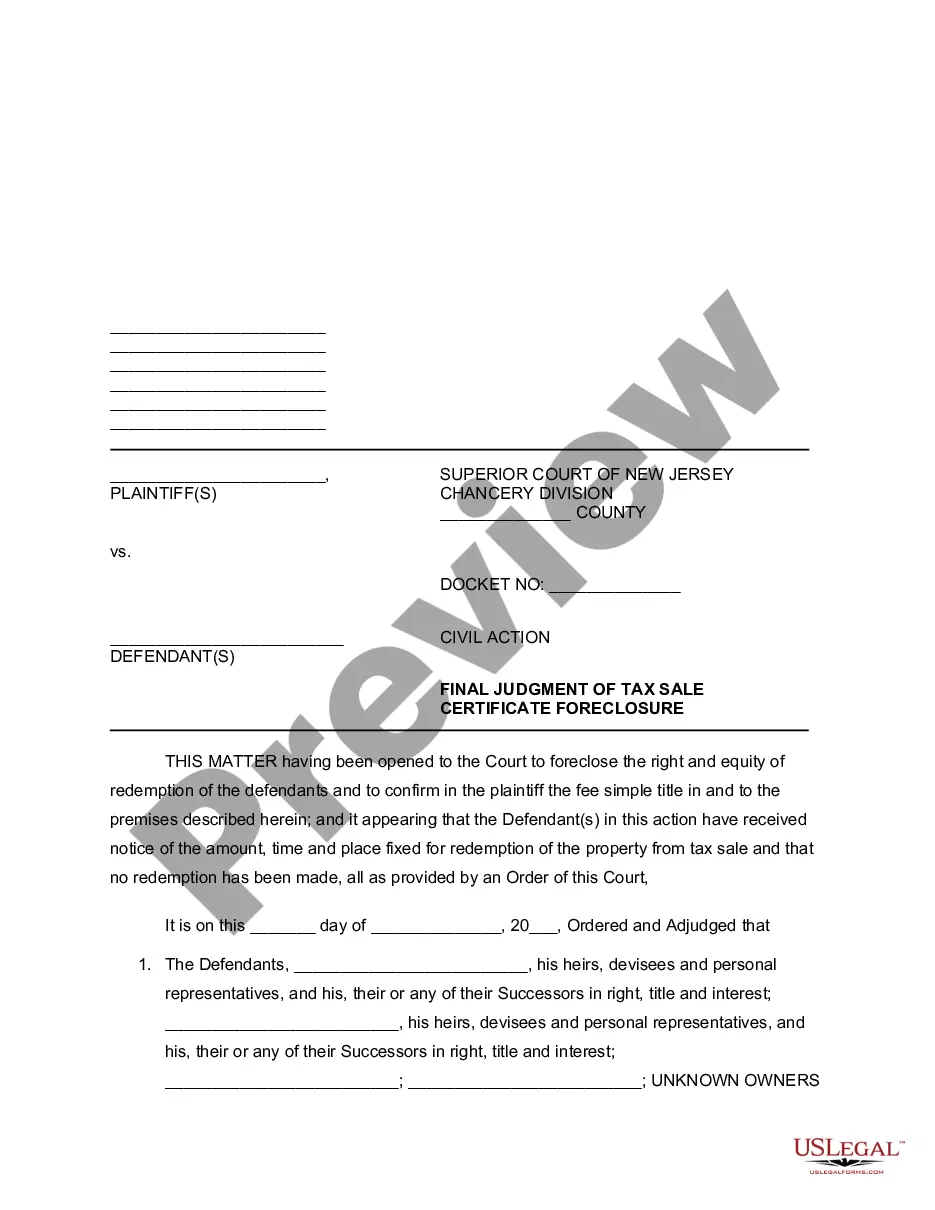
The Final Judgment of Tax Sale Certificate Foreclosure is a legal document issued by the court to finalize the foreclosure process based on unpaid property taxes. This form confirms the transfer of the property title to the plaintiff and ensures that the defendants no longer have any right to redeem the property. Unlike other foreclosure forms, this judgment specifically addresses cases where the redemption period has lapsed, allowing the plaintiff to take possession of the property.
Key parts of this document
- Identification of the court and case details, including the docket number.
- Names of the parties involved, including plaintiffs and defendants.
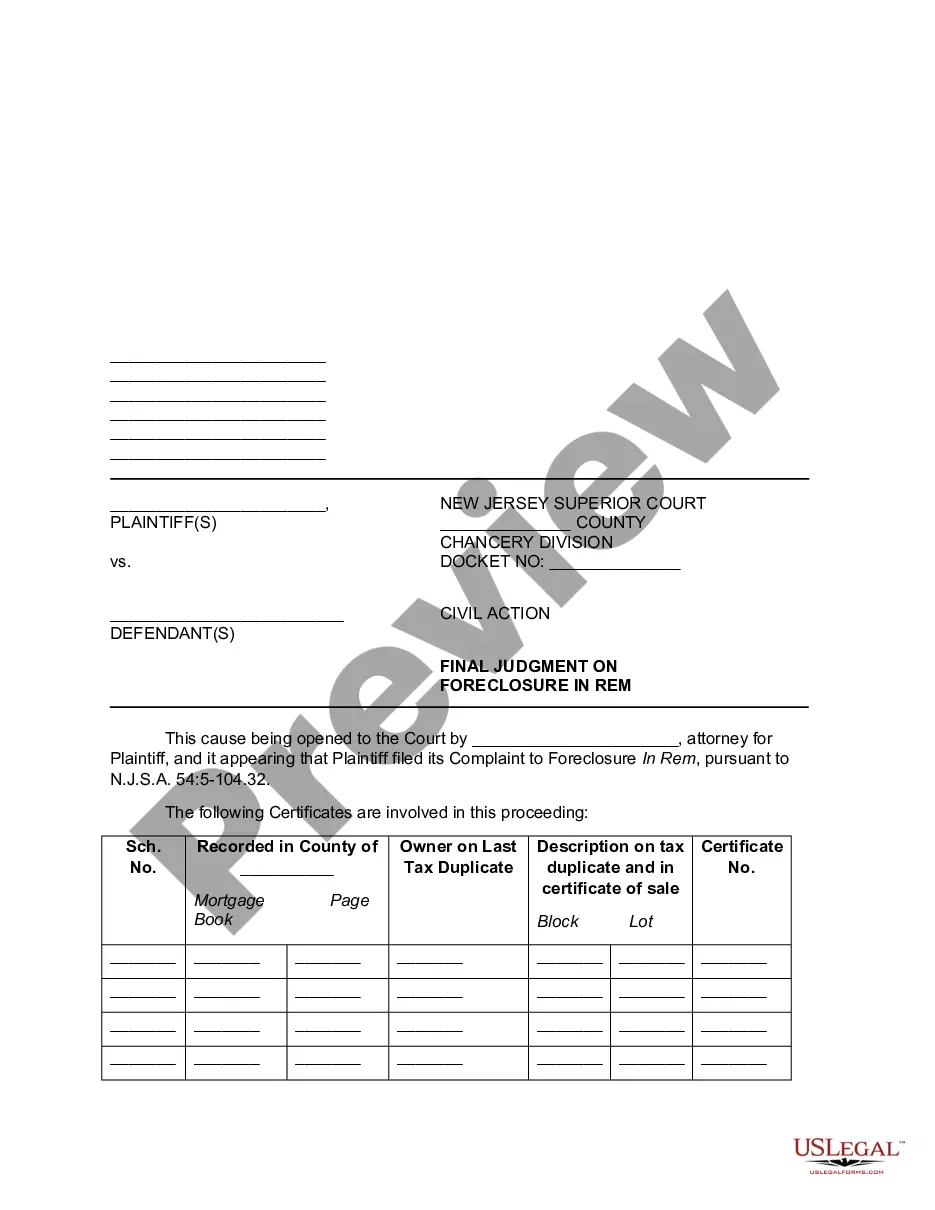
- Description of the property, including block and lot numbers.
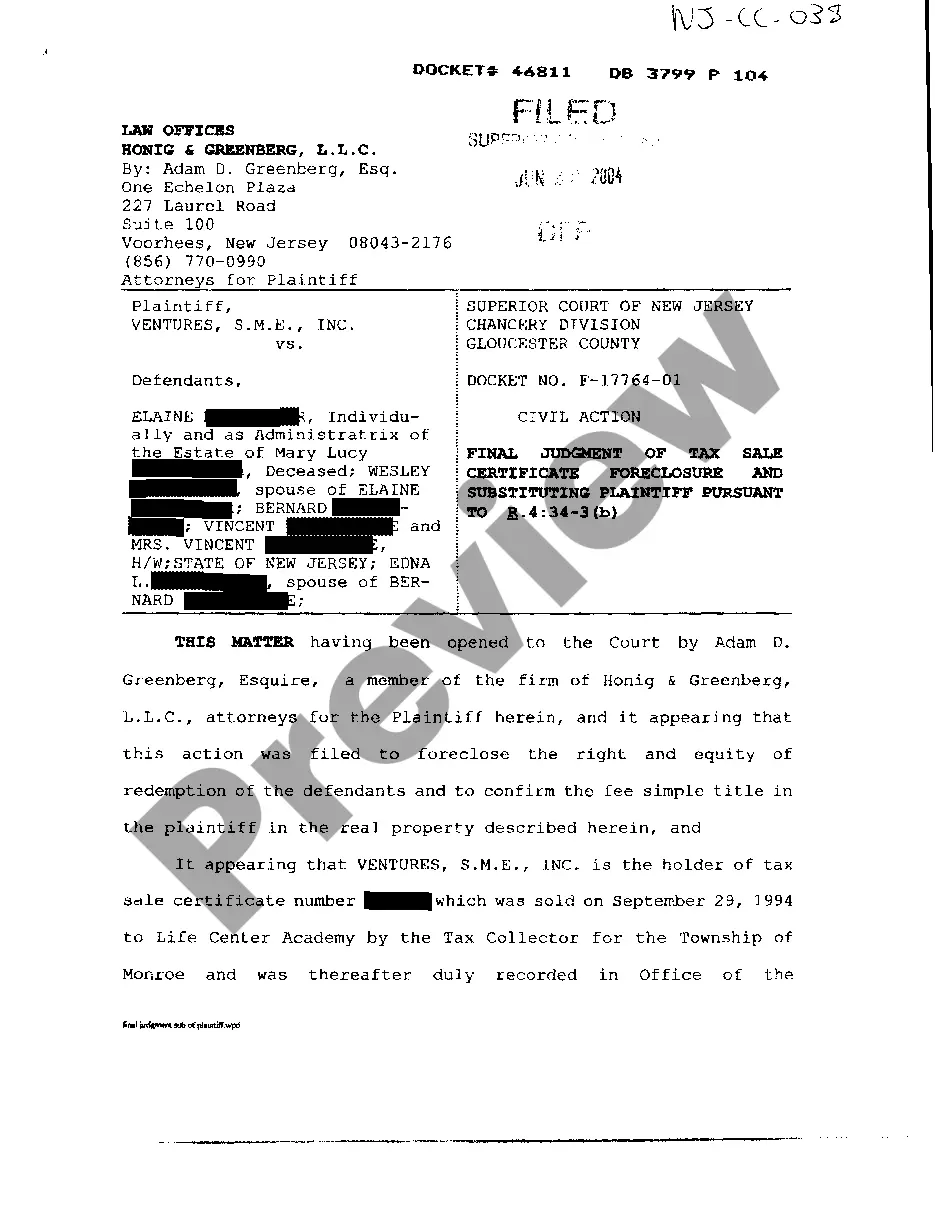
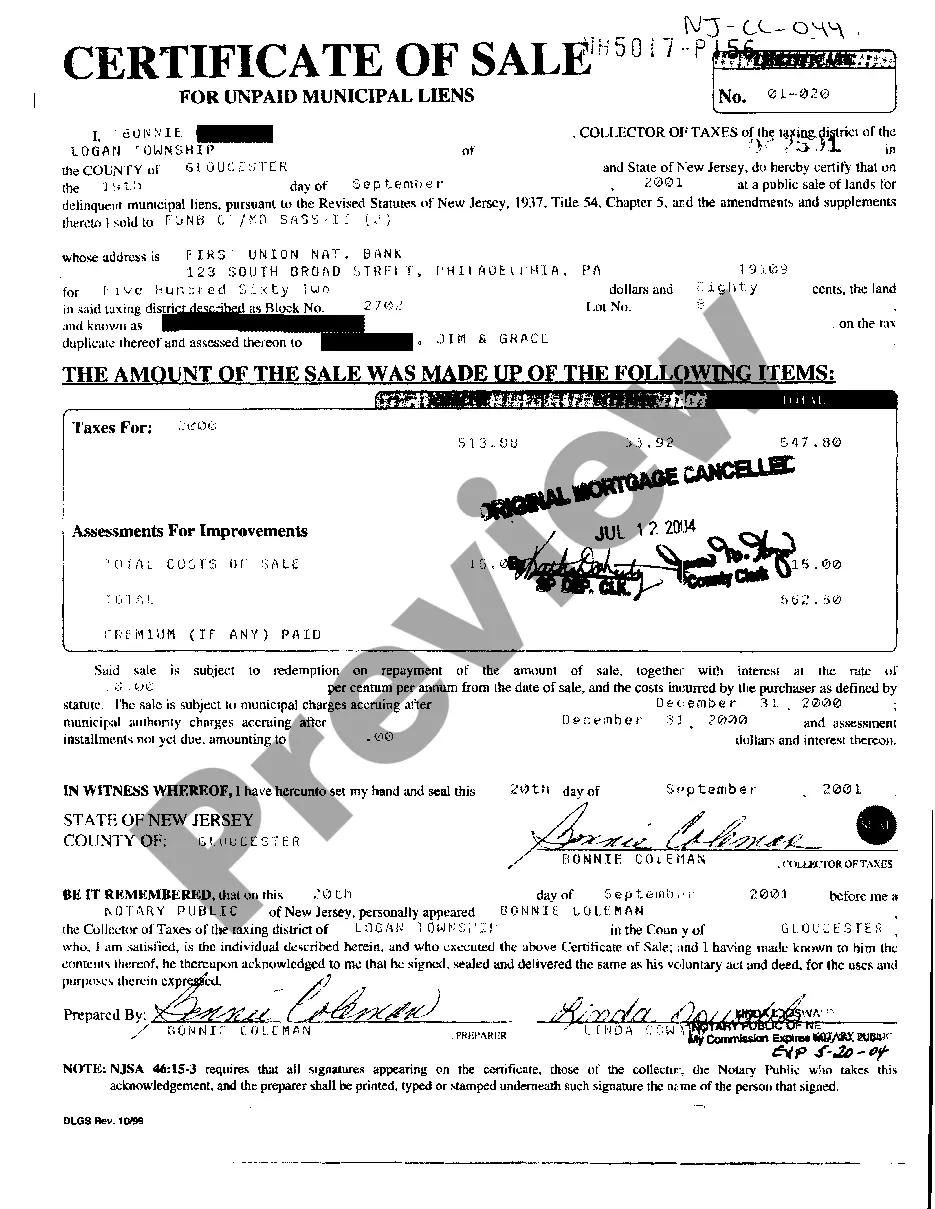
- Confirmation of foreclosure and details regarding the tax sale certificate.
- Legal language ensuring the defendants are barred from redeeming the property.
- Certification by the court clerk affirming the document's validity.


Common use cases
This form is used when a property owner has not paid their property taxes, and the tax sale process has resulted in a foreclosure. If you have received notice of a tax sale and failed to redeem the property within the specified timeframe, this judgment form is necessary to legally transfer ownership to the creditor or government entity that purchased the tax sale certificate.
Who should use this form
- Property owners facing foreclosure due to unpaid taxes.
- Creditors or government entities that have acquired a tax sale certificate.
- Attorneys representing clients in tax foreclosure cases.
- Individuals seeking to understand their rights and obligations in foreclosure situations.
How to prepare this document
- Identify the court and fill in the docket number.
- Enter the names of the plaintiff and defendants.
- Describe the property by specifying the block and lot numbers.
- Ensure the date of the judgment is correctly noted.
- Obtain signatures and necessary certification from the court clerk.
Does this document require notarization?
This form does not typically require notarization unless specified by local law. Always check local regulations to ensure compliance before submission.
Get your form ready online
Our built-in tools help you complete, sign, share, and store your documents in one place.
Make edits, fill in missing information, and update formatting in US Legal Forms—just like you would in MS Word.
Download a copy, print it, send it by email, or mail it via USPS—whatever works best for your next step.
Sign and collect signatures with our SignNow integration. Send to multiple recipients, set reminders, and more. Go Premium to unlock E-Sign.
If this form requires notarization, complete it online through a secure video call—no need to meet a notary in person or wait for an appointment.
We protect your documents and personal data by following strict security and privacy standards.

Make edits, fill in missing information, and update formatting in US Legal Forms—just like you would in MS Word.

Download a copy, print it, send it by email, or mail it via USPS—whatever works best for your next step.

Sign and collect signatures with our SignNow integration. Send to multiple recipients, set reminders, and more. Go Premium to unlock E-Sign.

If this form requires notarization, complete it online through a secure video call—no need to meet a notary in person or wait for an appointment.

We protect your documents and personal data by following strict security and privacy standards.
Mistakes to watch out for
- Failing to properly identify all parties involved, including heirs and unknown claimants.
- Incorrectly stating the property description, leading to legal challenges.
- Omitting the courtâs required signatures and certification from the clerk.
Benefits of completing this form online
- Convenient access to carefully drafted legal documents.
- Edit and customize the form easily to fit your specific situation.
- Assurance of legal compliance enforced by licensed attorneys.
Legal use & context
- This form serves as a final judgment, legally extinguishing the defendants' rights to redeem the property.
- It is enforceable in court, provided all procedural requirements are met.
- This form is subject to the laws governing tax foreclosure in New Jersey.
Looking for another form?
Form popularity
FAQ
What is sold is a tax sale certificate, a lien on the property. Tax sale certificates can earn interest of up to 18 per cent, depending on the winning percentage bid at the auction. At the auction, bidders bid down the interest rate that will be paid by the owner for continuing interest on the certificate amount.
In California, you generally have five years to get current on delinquent property taxes. Otherwise, you could lose your home in a tax sale.
In New Jersey, property taxes are a continuous lien on the real estate. Property taxes are due in four installments during the year: February 1, May 1, August 1, and November 1. Delinquency on a property may accrue interest at up to 8 per cent for the first $1,500 due, and 18 per cent for any amount over $1,500.
When homeowners don't pay their property taxes, the overdue amount becomes a lien on the property. In New Jersey, once a tax lien is on your home, the collector (on behalf of the municipality) can then sell that lien at a public auction.
The taxes will be paid by your lender. After your lender forecloses, all sums that you owed, including the taxes, are satisfied by the transfer of the property to the lender under a foreclosure deed. The property taxes are actually a debt against the property, not against you personally.
The answer is, it depends. For homeowners who would like to keep their homes (by redeeming the mortgage during the 6 month redemption period) they must pay property taxes as well as any interest and costs as well as the balance of the loan. In that case, the answer is simple the homeowner is responsible.
Normally it takes at least two years for a tax lien to be redeemed, but with vacant properties, they can have tax sale certificates foreclosed in as little as 6 months under the New Jersey Tax Sale law and if a municipality owns the lien it can also be foreclosed on in 6 months.
If all attempts to collect on the delinquent taxes have been exhausted and the redemption period expires, the lien holder can initiate a judicial foreclosure proceeding against the property itself. The court then orders a foreclosure auction be held to collect the money to satisfy the unpaid tax lien.