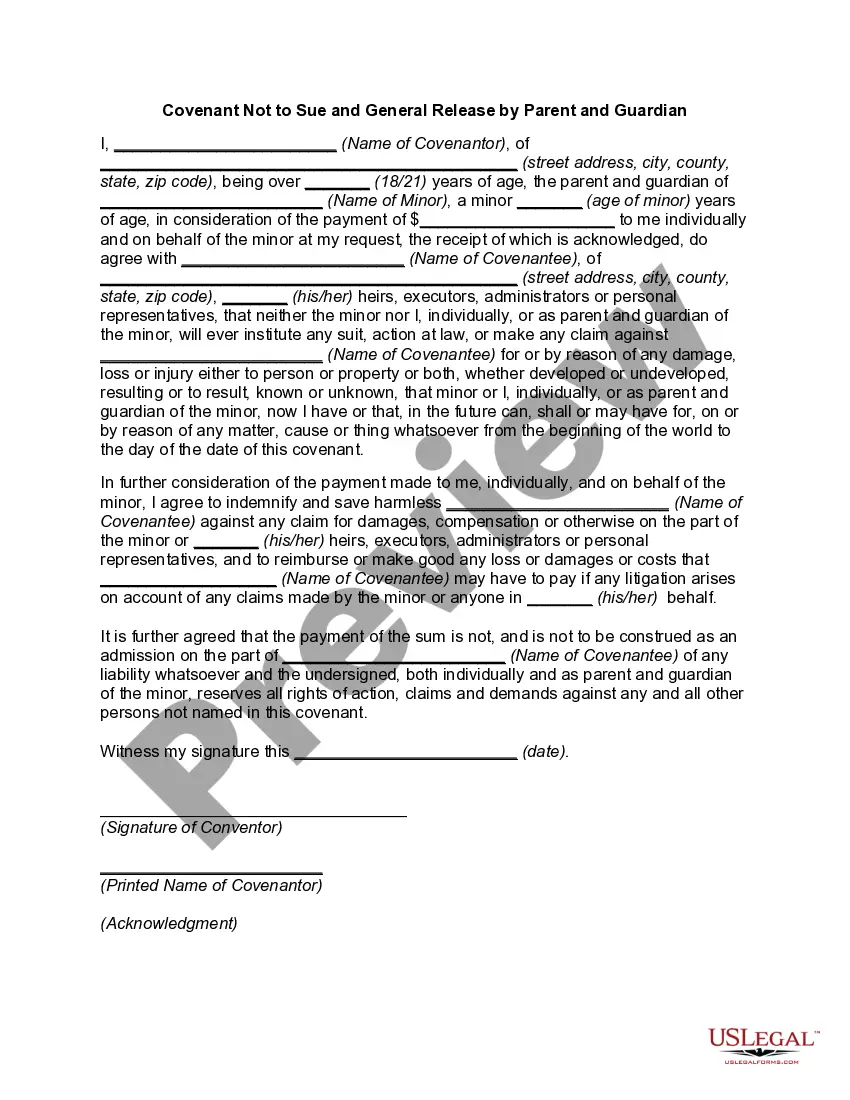
New Mexico Covenant Not to Sue and General Release by Parent and Guardian
Description
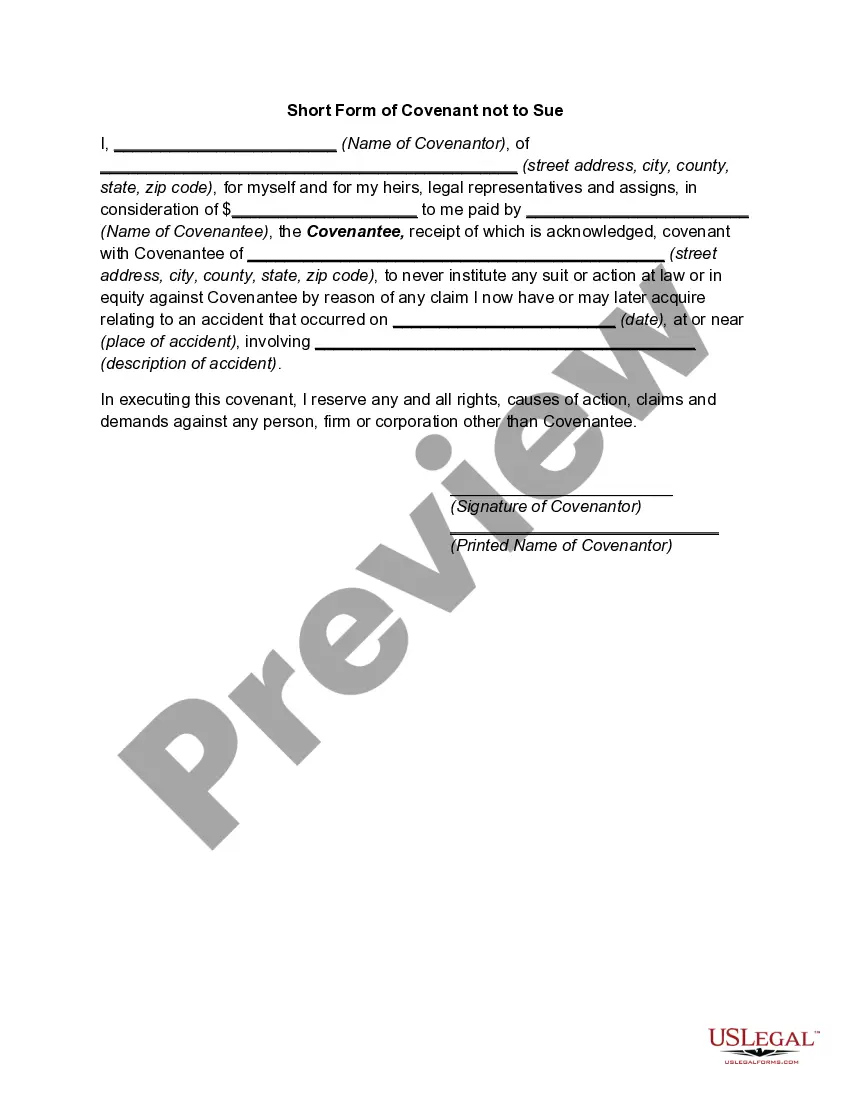
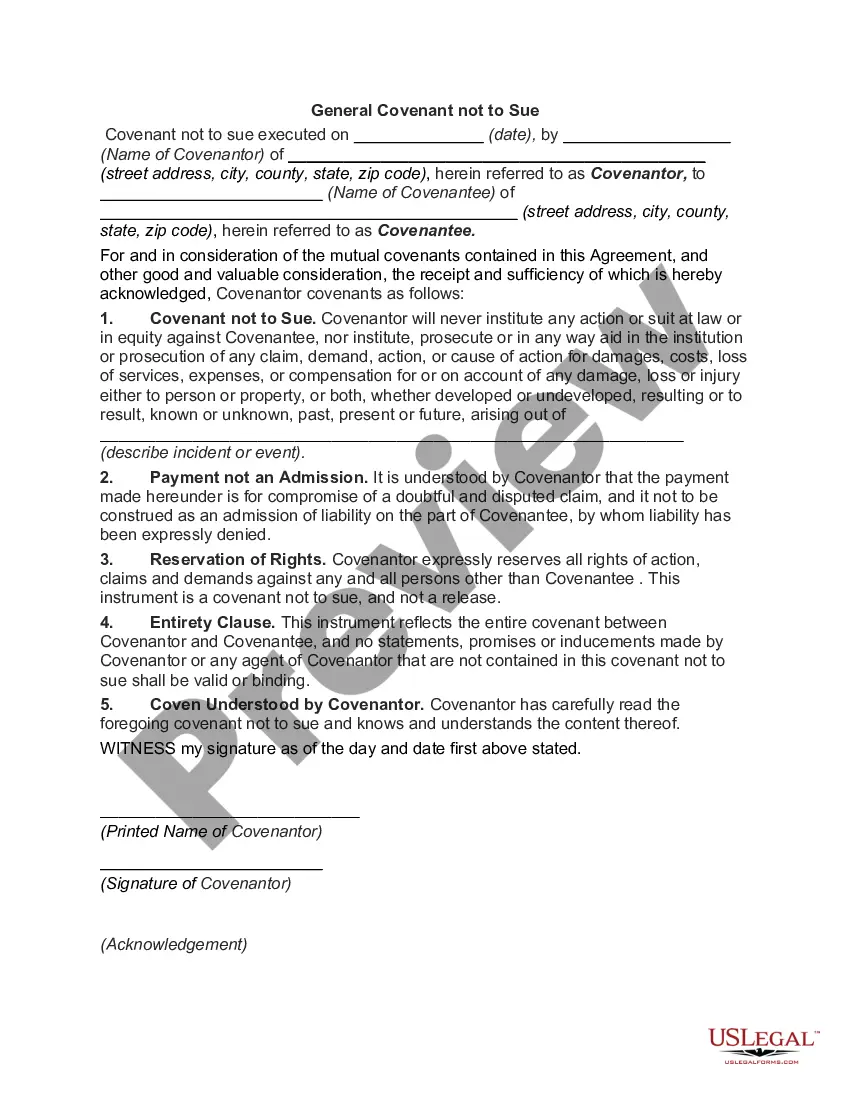
Get your form ready online
Our built-in tools help you complete, sign, share, and store your documents in one place.
Make edits, fill in missing information, and update formatting in US Legal Forms—just like you would in MS Word.
Download a copy, print it, send it by email, or mail it via USPS—whatever works best for your next step.
Sign and collect signatures with our SignNow integration. Send to multiple recipients, set reminders, and more. Go Premium to unlock E-Sign.
If this form requires notarization, complete it online through a secure video call—no need to meet a notary in person or wait for an appointment.
We protect your documents and personal data by following strict security and privacy standards.

Make edits, fill in missing information, and update formatting in US Legal Forms—just like you would in MS Word.

Download a copy, print it, send it by email, or mail it via USPS—whatever works best for your next step.

Sign and collect signatures with our SignNow integration. Send to multiple recipients, set reminders, and more. Go Premium to unlock E-Sign.

If this form requires notarization, complete it online through a secure video call—no need to meet a notary in person or wait for an appointment.

We protect your documents and personal data by following strict security and privacy standards.
Looking for another form?
How to fill out Covenant Not To Sue And General Release By Parent And Guardian?
Selecting the most suitable authentic document template can be somewhat challenging.
Certainly, there are numerous designs accessible online, but how can you find the genuine form you seek.
Make use of the US Legal Forms website.
If you are a new customer of US Legal Forms, here are straightforward instructions for you to follow: First, ensure you have selected the correct form for your city/region. You can review the form using the Review button and read the form description to confirm it is appropriate for you.
- This service provides a vast array of templates, including the New Mexico Covenant Not to Sue and General Release by Parent and Guardian, suitable for both business and personal needs.
- All of the forms are reviewed by experts and comply with federal and state regulations.
- If you are already a registered user, Log In to your account and click the Download button to obtain the New Mexico Covenant Not to Sue and General Release by Parent and Guardian.
- Utilize your account to search through the legal forms you have purchased previously.
- Navigate to the My documents tab in your account to retrieve another copy of the document you need.
Form popularity
FAQ
A formal agreement or promise, usually included in a contract or deed, to do or not do a particular act; a compact or stipulation made in writing or by parol.
Here are some fundamental differences: While a contract is legally binding, a covenant is a spiritual agreement. A contract is an agreement between parties while a covenant is a pledge. A covenant is an agreement you can break while a covenant is a perpetual promise.
An agreement, contract, or written promise between two individuals that frequently constitutes a pledge to do or refrain from doing something. The individual making the promise or agreement is known as the covenantor, and the individual to whom such promise is made is called the covenantee.
Covenant Not to Sue vs. A release is a waiver or relinquishment of a known right. A release of liability will relinquish or destroy the injured party's cause of action. A covenant not to sue, on the other hand, is not a waiver of a known right; nothing is relinquished or destroyed.
A covenant not to compete, also called a "nompete agreement" or "non compete clause," is an agreement where one party promises not to compete with the other party in a specified area for a certain period of time. A covenant not to compete can be found in an employment contract or a sale of business contract.
A covenant is a rule which states what can and cannot be done on the land. They are usually created in a deed between two parties, with one party agreeing to restrict the use of its land in a certain way for the benefit of another's land.
6.Covenant Not to Sue. A covenant not to sue is a legal term that means Executive promises not to file a lawsuit in court. It is different from the General Release of claims contained in Section 4 above.
A covenant not to execute is a contract where a defendant admits to liability and a set amount of damages, and the plaintiff agrees not to seek a judgment against the defendant based on that admission.