New York Affidavit that Power of Attorney is in Full Force
About this form
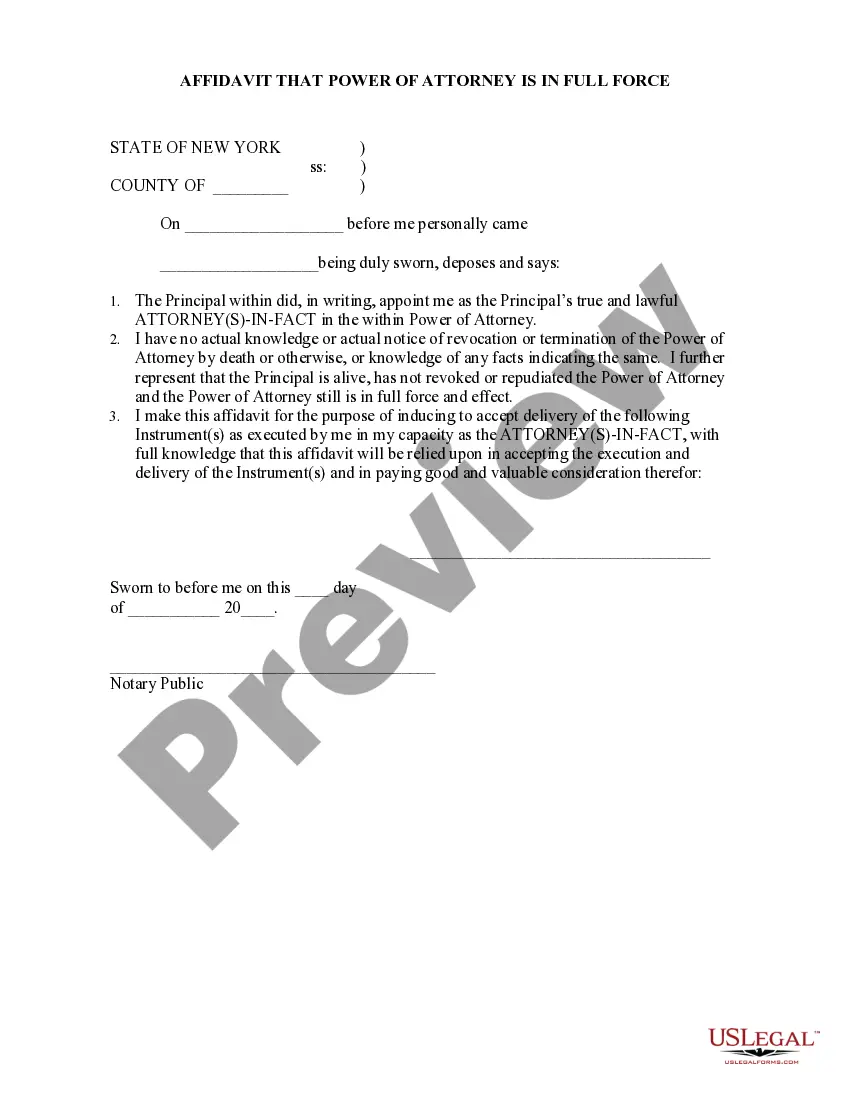
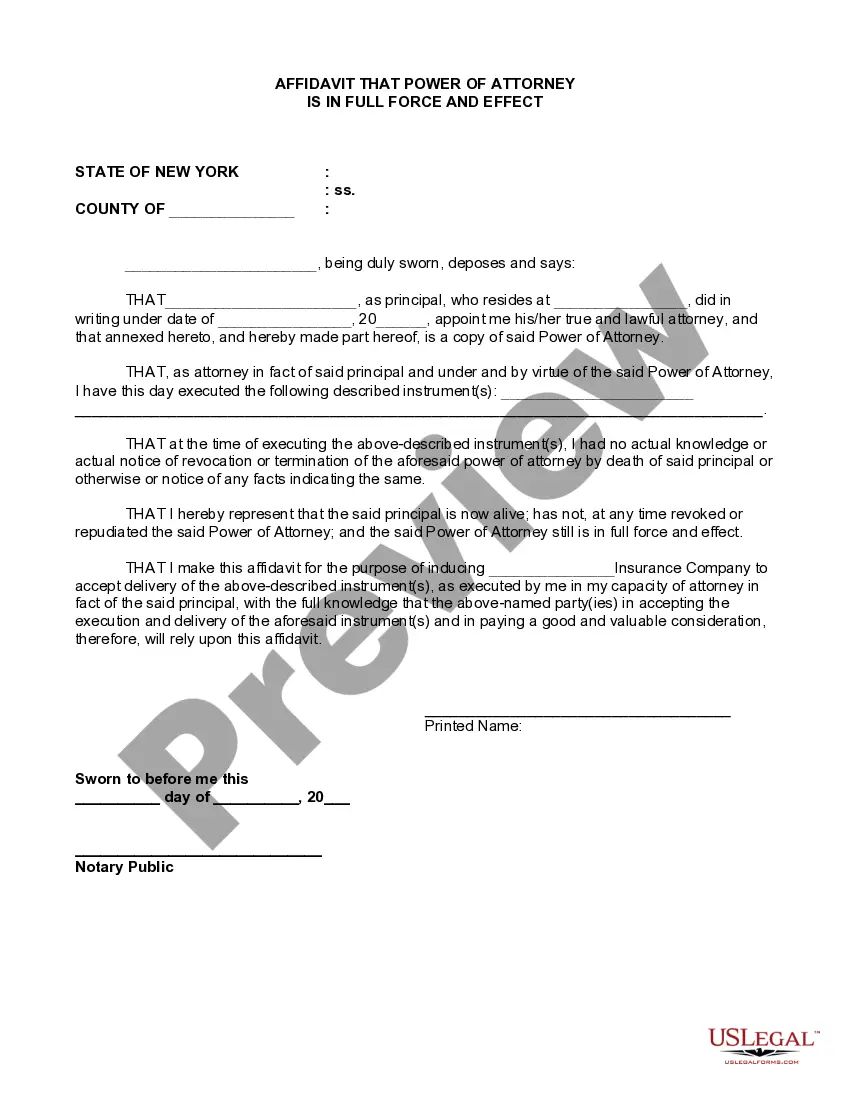
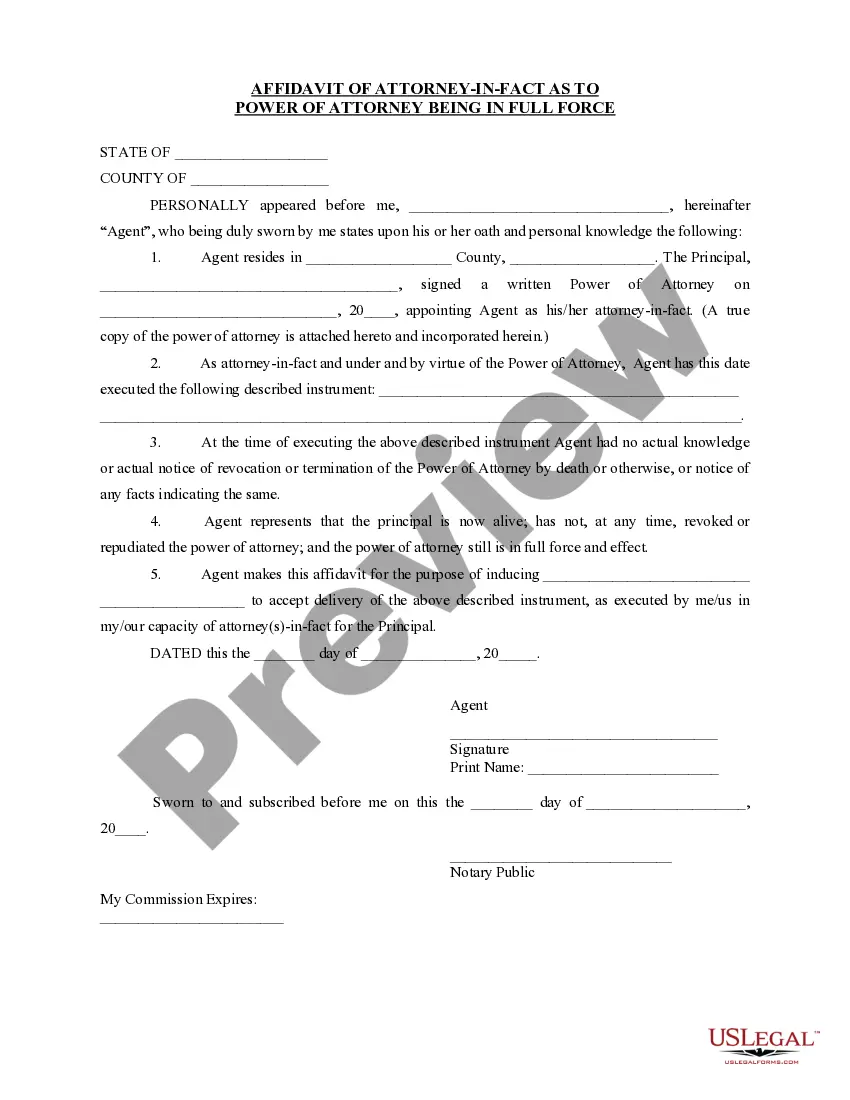
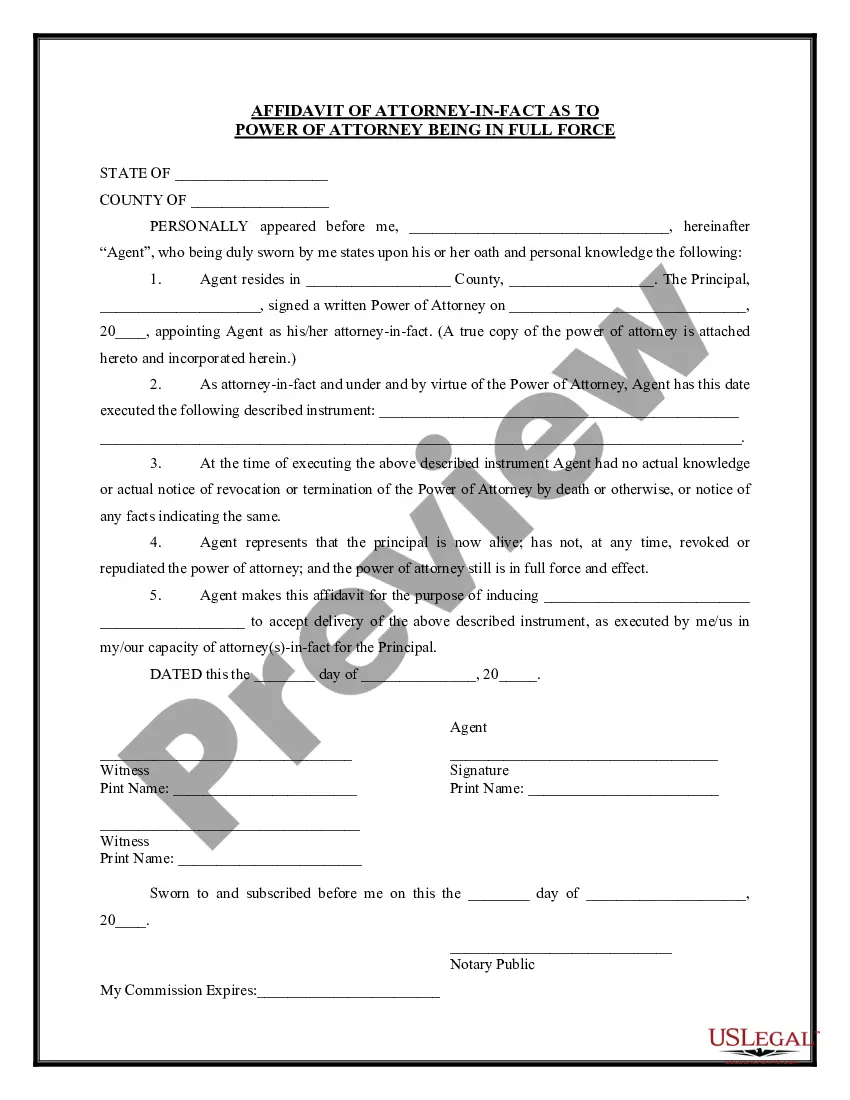
The Affidavit that Power of Attorney is in Full Force is a legal document allowing an attorney-in-fact to confirm that the power of attorney they are acting under is still valid and has not been revoked. This affidavit is crucial in situations where third parties, such as banks or medical institutions, require assurance that the authority granted through the power of attorney remains intact. Unlike other forms, this affidavit specifically addresses the status and validity of the power of attorney in question.
Key components of this form
- Identification of the Principal and Attorney-in-Fact.
- A declaration affirming no knowledge of revocation or termination of the power of attorney.
- Confirmation that the Principal is alive and has not revoked the power of attorney.
- Details of the instruments or documents that the Attorney-in-Fact is authorized to execute.
- Signature of a notary public to validate the affidavit.
When to use this document
This affidavit should be used in situations where an attorney-in-fact needs to prove the continued validity of the power of attorney to conduct transactions. Typical scenarios include real estate transactions, financial dealings, or healthcare decisions where the attorney-in-fact is required to provide proof of authority to act on behalf of the Principal. It helps facilitate operations smoothly with service providers or institutions that may require confirmation of authority.
Who this form is for
- Individuals acting as an attorney-in-fact under a power of attorney.
- Fiduciaries needing to verify their authority in transactions or legal matters.
- Anyone managing another person's affairs and requiring third-party confirmation of authority.
- Real estate agents and financial institutions requiring affidavits for transactions involving clients.
Steps to complete this form
- Enter the date and location where the affidavit is being sworn.
- Provide the full name of the attorney-in-fact and the Principal.
- Include a statement confirming the attorney-in-fact's authority and that there has been no knowledge of its revocation.
- List any documents or instruments that will be executed under this authority.
- Sign the affidavit in the presence of a notary public, who will also sign and seal the document.
Is notarization required?
Yes, this form must be notarized to be legally valid. Having the affidavit notarized ensures that it is recognized by third parties and adds an extra layer of authenticity. US Legal Forms offers integrated online notarization services, making it easy to finalize this document securely through a video call, without the need for travel.
Get your form ready online
Our built-in tools help you complete, sign, share, and store your documents in one place.
Make edits, fill in missing information, and update formatting in US Legal Forms—just like you would in MS Word.
Download a copy, print it, send it by email, or mail it via USPS—whatever works best for your next step.
Sign and collect signatures with our SignNow integration. Send to multiple recipients, set reminders, and more. Go Premium to unlock E-Sign.
If this form requires notarization, complete it online through a secure video call—no need to meet a notary in person or wait for an appointment.
We protect your documents and personal data by following strict security and privacy standards.

Make edits, fill in missing information, and update formatting in US Legal Forms—just like you would in MS Word.

Download a copy, print it, send it by email, or mail it via USPS—whatever works best for your next step.

Sign and collect signatures with our SignNow integration. Send to multiple recipients, set reminders, and more. Go Premium to unlock E-Sign.

If this form requires notarization, complete it online through a secure video call—no need to meet a notary in person or wait for an appointment.

We protect your documents and personal data by following strict security and privacy standards.
Common mistakes
- Failing to correctly identify the Principal or Attorney-in-Fact.
- Not providing the correct date for when the affidavit is sworn.
- Omitting the specific instruments that will be executed under the power of attorney.
- Neglecting to have the document notarized, if required.
Advantages of online completion
- Convenience of downloading and completing the affidavit from home.
- Easy access to state-specific templates that simplify compliance with local laws.
- Editable formats that allow for customization as needed.
- Ensured reliability by templates drafted by licensed attorneys.
Quick recap
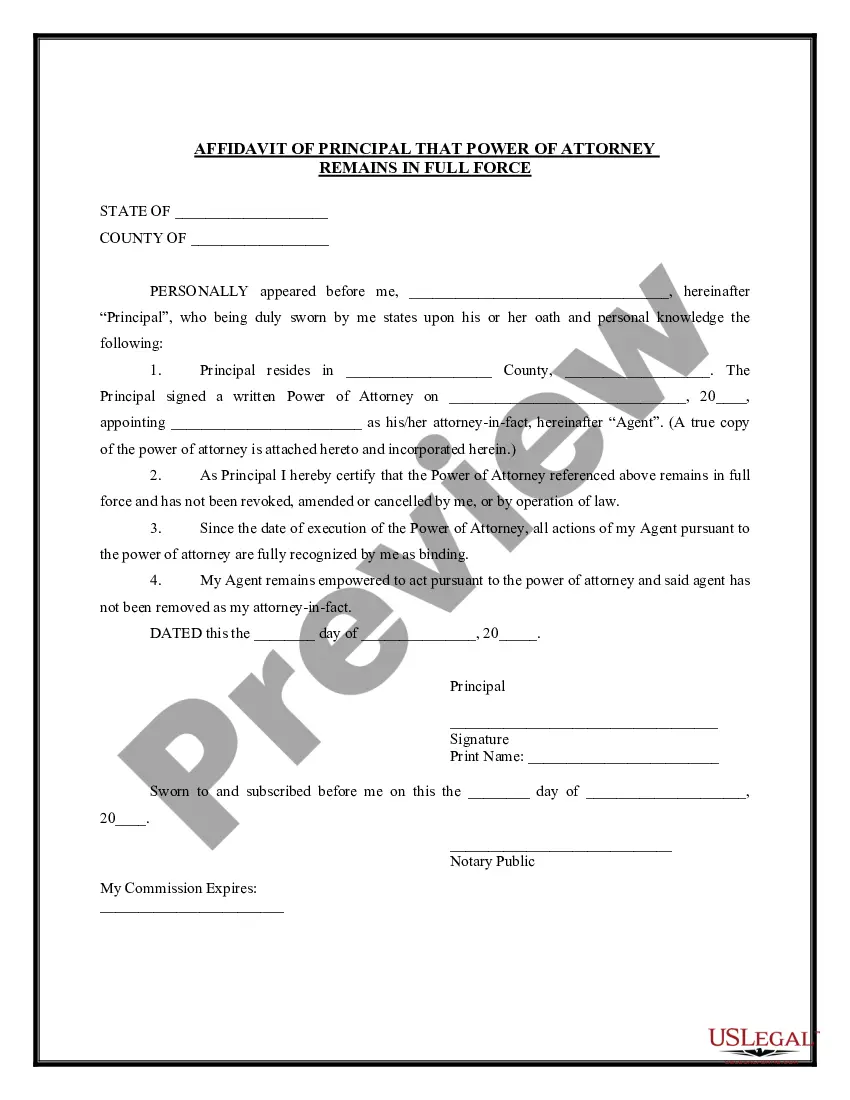
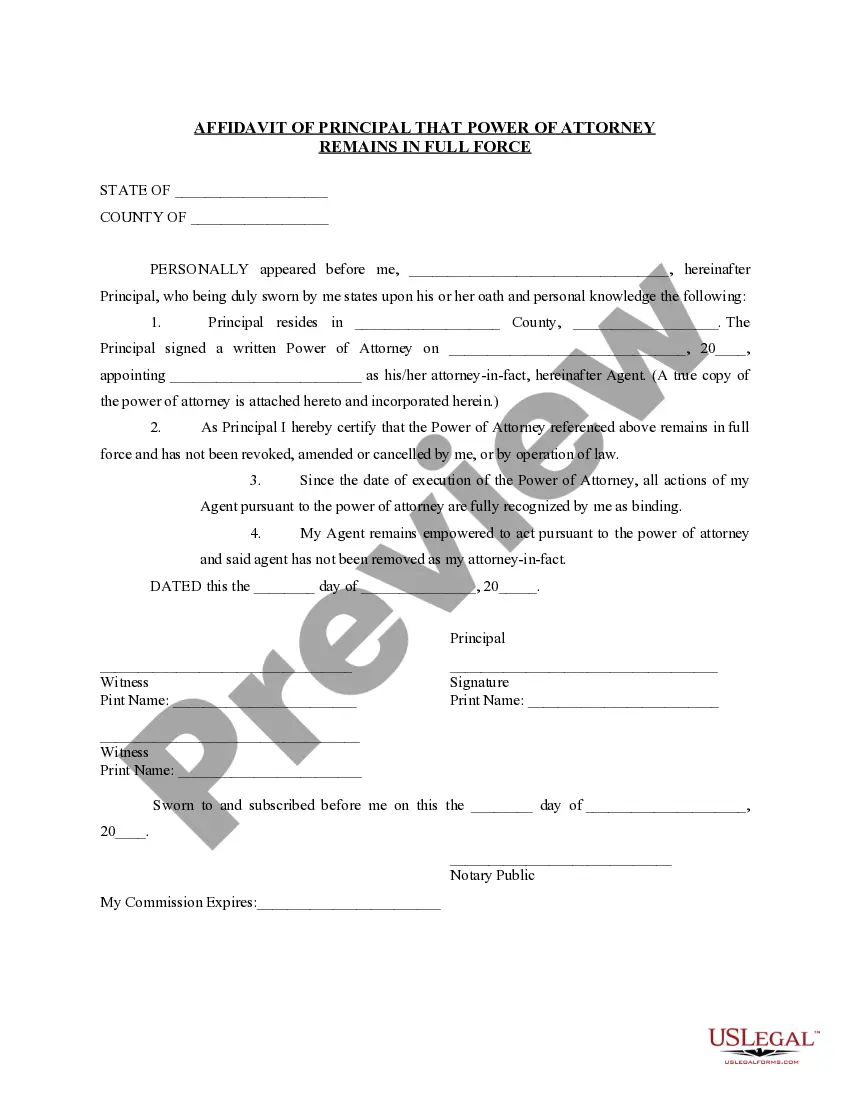
- The Affidavit that Power of Attorney is in Full Force confirms the authority of an attorney-in-fact.
- It is essential for providing assurance to third parties about the validity of the power of attorney.
- Completing this form correctly ensures smooth transactions and legal compliance.
- Notarization is required for the affidavit to be legally binding.
Looking for another form?
Form popularity
FAQ
Your power of attorney also ends if your agent dies or becomes incapacitated unless you have named a successor agent. In addition, if your agent is your spouse, the power of attorney automatically ends if you get divorced.
New York power of attorney agreements only need to be filed if they are used in a real estate transaction. Aside from this, filing is not required. That said, you can still file your POA agreement with your County Clerk to ensure that you're able to obtain copies of your agreement if you ever need it.
The power of Attorney gives legal authority to another person (called an Agent or Attorney-in-Fact) to make property, financial and other legal decisions for the Principal. A Principal can give an Agent broad legal authority, or very limited authority.
Do power of attorney agreements need to be notarized in New York? New York's new POA law requires that the principal's signature be notarized in addition to the POA being signed with two witnesses present (note that the notary can be one of your witnesses).
A New York durable statutory power of attorney allows a person to hand over the power to handle their finances to someone else, and remains valid during their lifetime. The person giving power (?principal?) can choose to give limited or broad powers to their selected individual (?agent?).
A principal may revoke a power of attorney: (a) in ance with the terms of the power of attorney; or (b) by delivering a revocation of the power of attorney to the agent in person or by sending a signed and dated revocation by mail, courier, electronic transmission or facsimile to the agent's last known address.
Sign the POA in the Presence of a Notary Public and Two Witnesses. As mentioned above, you cannot simply sign the document and call it a day. In New York, you must notarize the POA and also have it witnessed by two people who are not named in the POA as agents.
As an experienced New York power of attorney lawyer will explain, in New York, all powers of attorney are durable unless they state otherwise. Under your durable power of attorney, your attorney-in-fact will retain power until your death unless you revoke it while you are not incapacitated.