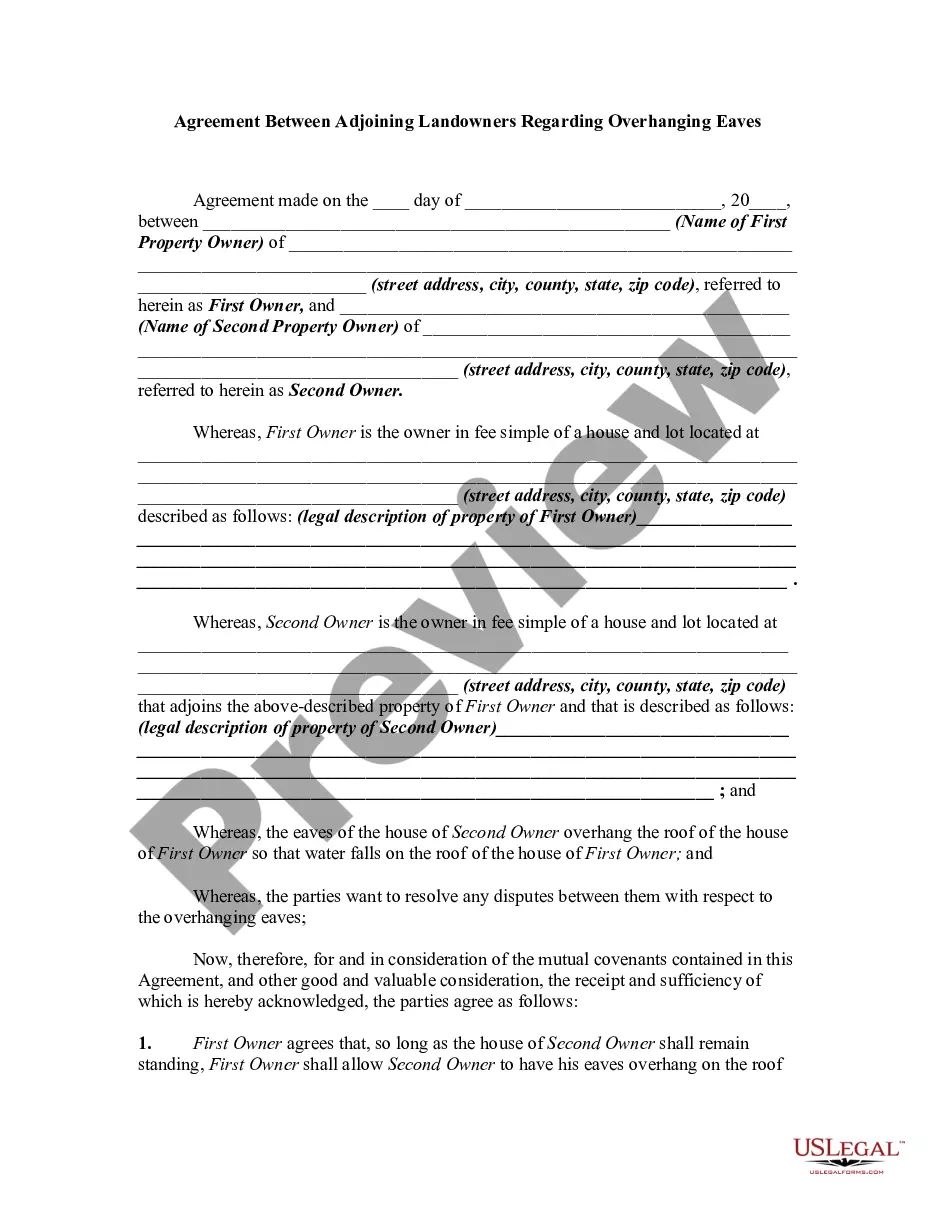
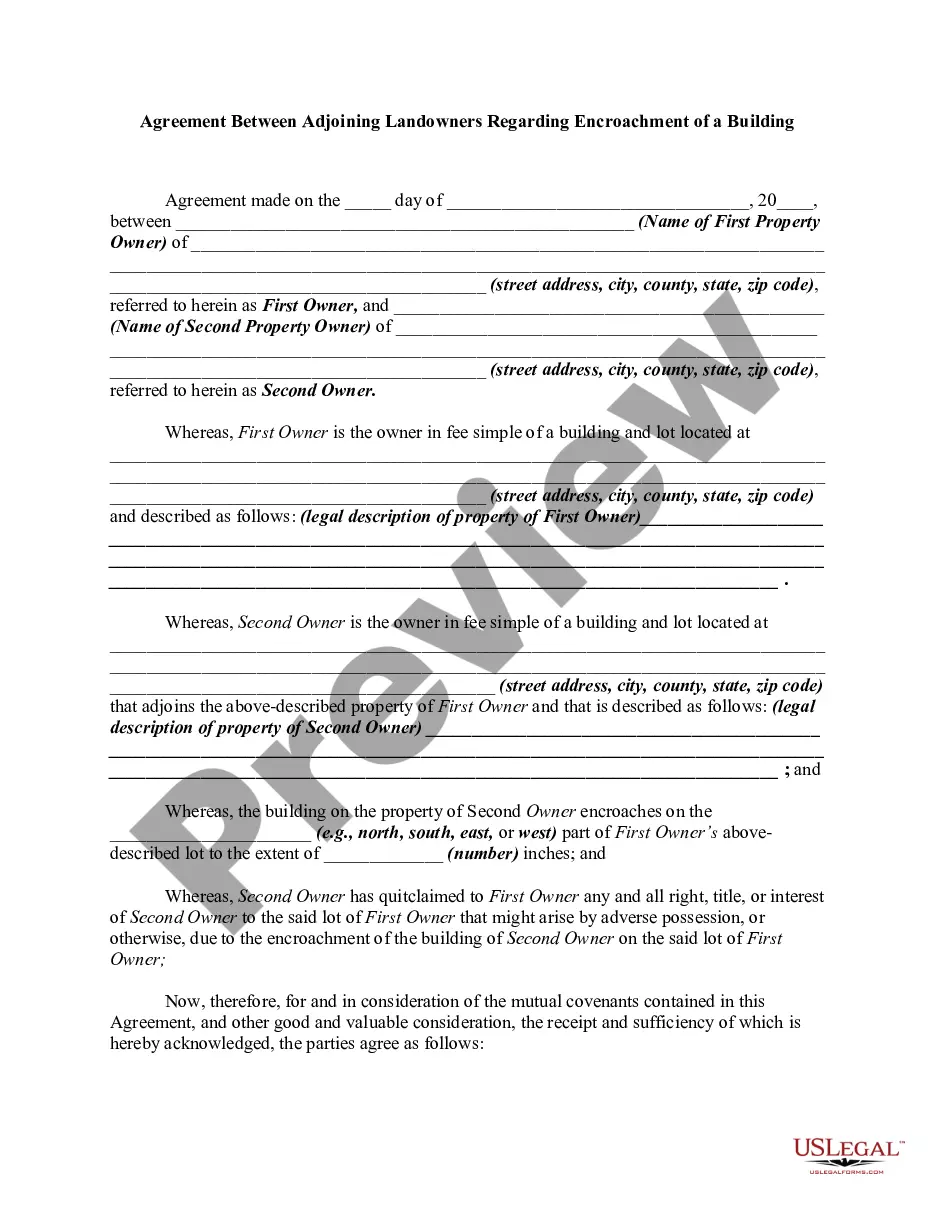
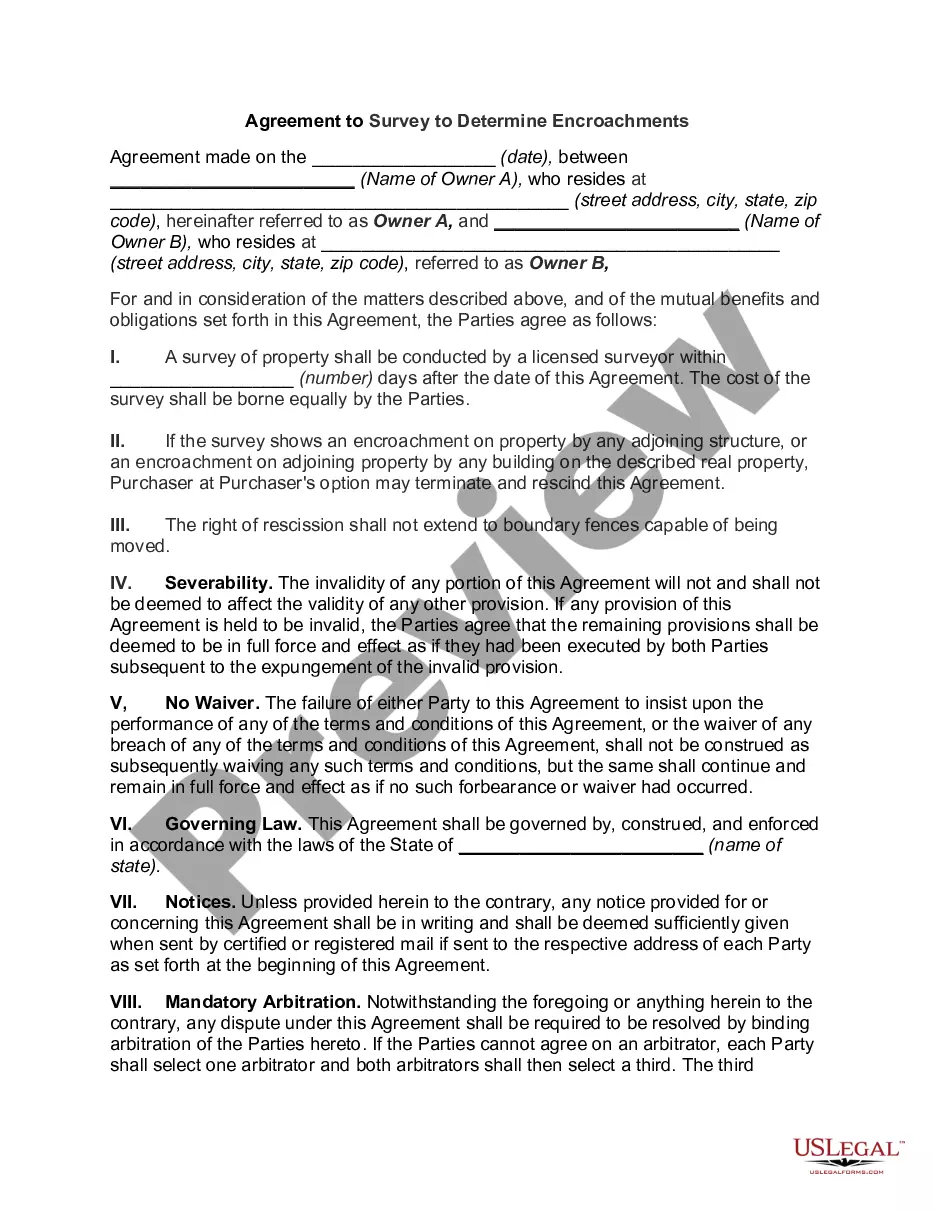
A encroachment occurs when a portion of adjoining real property owned by Owner A hangs over the property line of Owner B's premises or physically intrudes onto Owner B's premises. The actual structure that encroaches might be a tree, bush, fence, a building, or other fixture. In this agreement, Owner B agrees to allow such an encroachment. However, this consent of Owner B shall remain in force and effect only so long as the encroaching material shall remain; on their removal or destruction, this consent shall terminate.
New York Agreement Between Adjoining Landowners Regarding Encroachment of Trees or Bushes
Category:
State:
Multi-State
Control #:
US-01138BG
Format:
Word;
Rich Text
Instant download
Description
Free preview
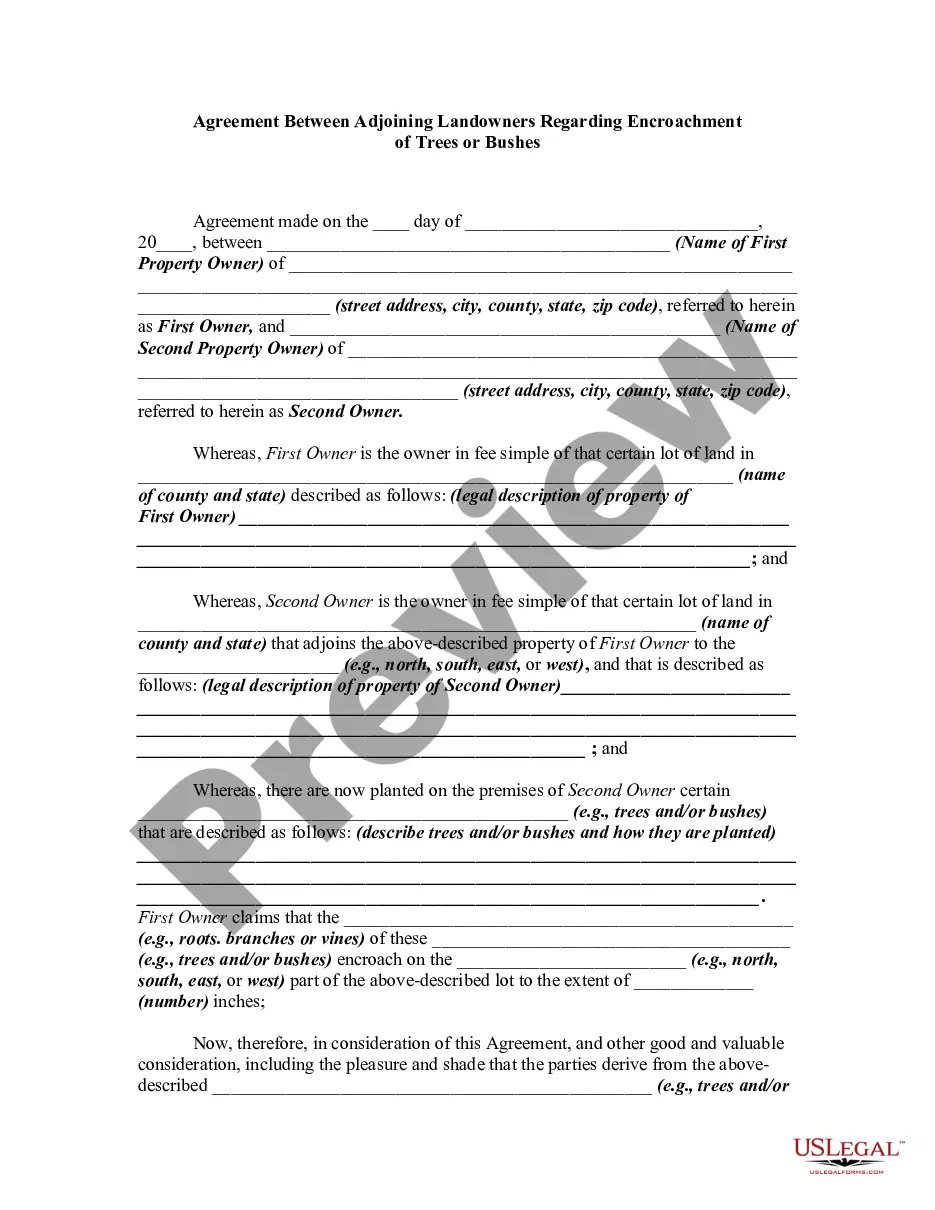
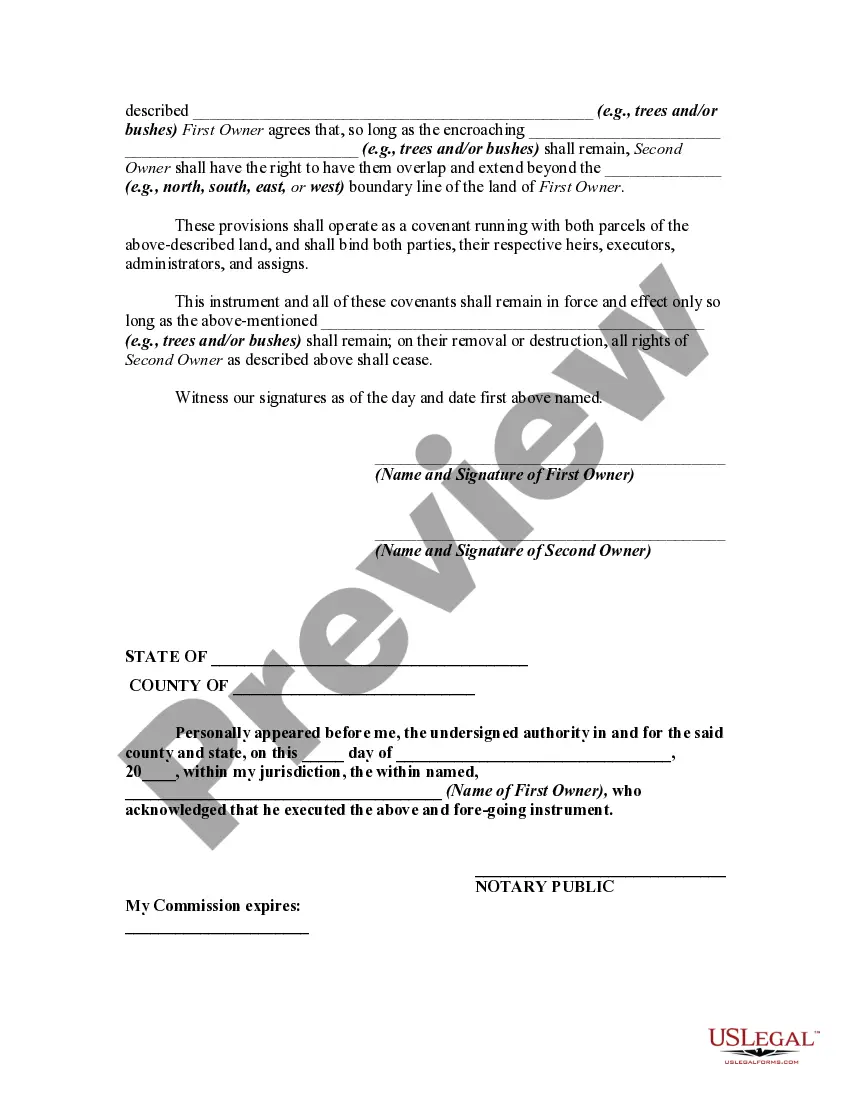
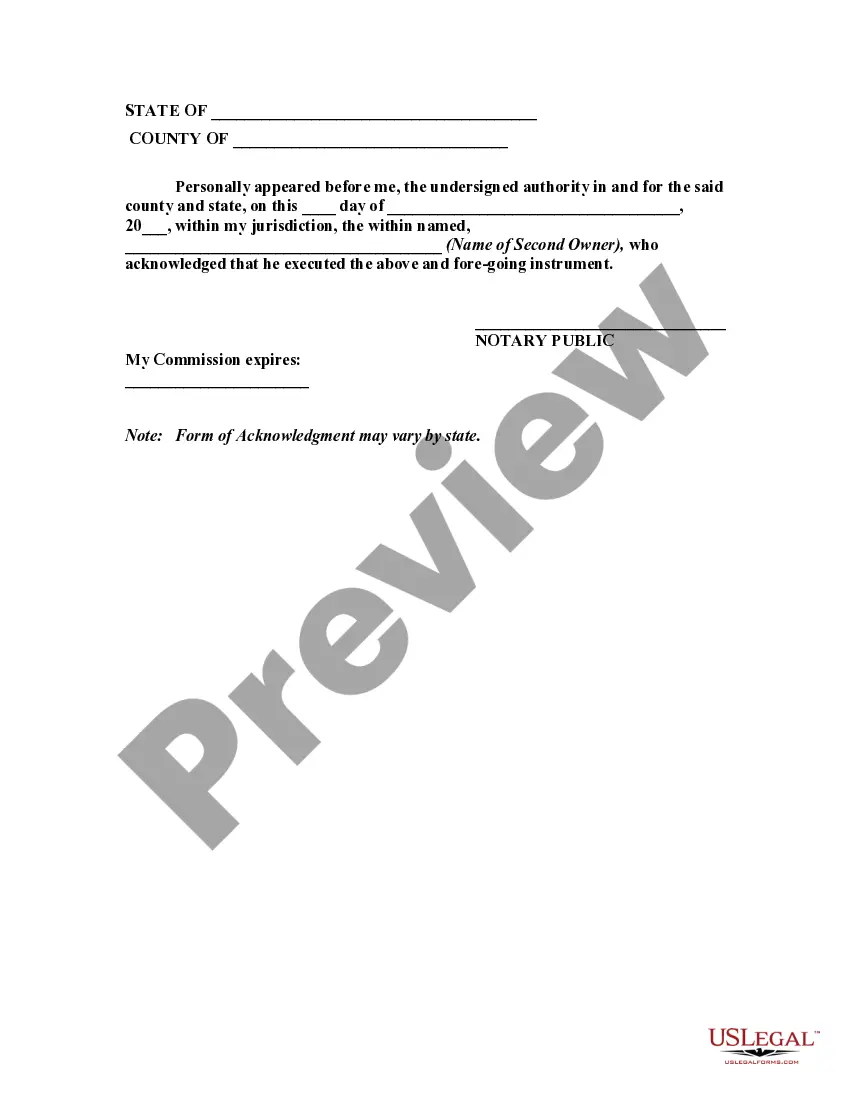

How to fill out Agreement Between Adjoining Landowners Regarding Encroachment Of Trees Or Bushes?
US Legal Forms - one of the largest collections of legal documents in the country - provides a variety of legal form templates that you can download or print.
By utilizing the website, you can access thousands of forms for business and personal purposes, sorted by categories, states, or keywords. You can find the latest versions of forms such as the New York Agreement Between Adjoining Landowners Regarding Encroachment of Trees or Bushes in moments.
If you already have an account, Log In and download the New York Agreement Between Adjoining Landowners Regarding Encroachment of Trees or Bushes from the US Legal Forms library. The Download button will be visible on every form you view. You can access all previously downloaded forms from the My documents section of your account.
Process the transaction. Use your credit card or PayPal account to complete the payment.
Choose the format and download the form to your device. Edit. Complete, modify, print, and sign the downloaded New York Agreement Between Adjoining Landowners Regarding Encroachment of Trees or Bushes. Every template saved to your account has no expiration date and belongs to you indefinitely. Therefore, to download or print another copy, simply visit the My documents section and click on the form you need. Access the New York Agreement Between Adjoining Landowners Regarding Encroachment of Trees or Bushes with US Legal Forms, the most extensive collection of legal document templates. Utilize thousands of professional and state-specific templates that cater to your business or personal needs and requirements.
- If you wish to use US Legal Forms for the first time, here are simple steps to get started.
- Ensure you have selected the appropriate form for your city/county.
- Click the Review button to inspect the content of the form.
- Read the form description to confirm you have chosen the correct one.
- If the form does not meet your needs, use the Search field at the top of the screen to find one that does.
- Once satisfied with the form, confirm your choice by clicking the Purchase now button.
- Then, select the payment plan you want and provide your information to create an account.
Form popularity
FAQ
New York regulations do not have a state-wide rule on how close you can plant a tree to your property line; however, local municipalities often have specific setbacks. Generally, a commonly accepted guideline is to plant trees at least 2 to 3 feet from the boundary line. This distance helps prevent future disputes and aligns with the New York Agreement Between Adjoining Landowners Regarding Encroachment of Trees or Bushes. Consider consulting local ordinances to ensure compliance and avoid potential issues.
In New York, the tree law encompasses regulations regarding the ownership and maintenance of trees on private property. The law often hinges on the New York Agreement Between Adjoining Landowners Regarding Encroachment of Trees or Bushes, which allows neighbors to address potential disputes over encroaching trees or branches. Understanding these laws can help you avoid costly disputes. As an option, you can utilize platforms like uslegalforms to draft agreements that protect your property rights.
While it may feel reasonable to toss back your neighbor's tree branches that fall on your property, this could escalate into a conflict. Instead, consider discussing the matter with your neighbor, as open communication can often resolve issues amicably. A formal agreement, like a New York Agreement Between Adjoining Landowners Regarding Encroachment of Trees or Bushes, can help establish clear guidelines and prevent future misunderstandings.
No, your neighbor cannot cut your tree without your consent. Doing so could lead to legal issues, especially if the tree is healthy and your neighbor has no right to the tree on their property. You may want to consider establishing a New York Agreement Between Adjoining Landowners Regarding Encroachment of Trees or Bushes to outline clear communication and permissions regarding property lines and tree care.
In New York, you generally have the right to trim tree limbs that encroach over your property line, but it is wise to check local laws. It's important to ensure that your actions do not harm the overall health of the tree or violate any local regulations. To avoid disputes, consider discussing the situation with your neighbor and possibly drafting a New York Agreement Between Adjoining Landowners Regarding Encroachment of Trees or Bushes, which can clarify responsibilities and encourage cooperation.
The encroachment law in New York defines how property boundaries can be interfered with by trees or structures. Neighbors must navigate these issues carefully to preserve their rights. Using a New York Agreement Between Adjoining Landowners Regarding Encroachment of Trees or Bushes can effectively outline responsibilities and help remedy disputes. Understanding these laws fosters better relationships between property owners.
In New York, simply mowing a neighbor's land does not automatically grant ownership rights, but it can lead to a claim of adverse possession if done for 10 years and under certain conditions. Open and continuous use is essential for such claims. It’s wise to keep the lines of communication open and consider a New York Agreement Between Adjoining Landowners Regarding Encroachment of Trees or Bushes to clarify boundaries. Consulting with a legal expert can provide guidance in such situations.
In New York, adverse possession requires occupancy of the land for ten years, continuous and uninterrupted use, openness to public view, and the use must be hostile to the interests of the true owner. Additionally, the possessor must claim ownership in a way that is exclusive. Understanding these elements is crucial, especially when discussing a New York Agreement Between Adjoining Landowners Regarding Encroachment of Trees or Bushes. Clarity on property rights can help avoid legal complications.
The neighbor tree law in New York grants property owners certain rights regarding trees. If a neighbor's tree threatens your property, you may take action to protect your space, including trimming branches. Formalizing any agreements through a New York Agreement Between Adjoining Landowners Regarding Encroachment of Trees or Bushes is advisable to prevent future conflicts. Communicating openly about tree maintenance fosters better relationships.
New York’s tree boundary law dictates that property lines determine ownership of trees and their branches. If a tree's trunk sits on the boundary line, both property owners hold equal rights to the tree. A New York Agreement Between Adjoining Landowners Regarding Encroachment of Trees or Bushes can mitigate potential disputes. Being aware of these laws helps neighbors cooperate effectively.