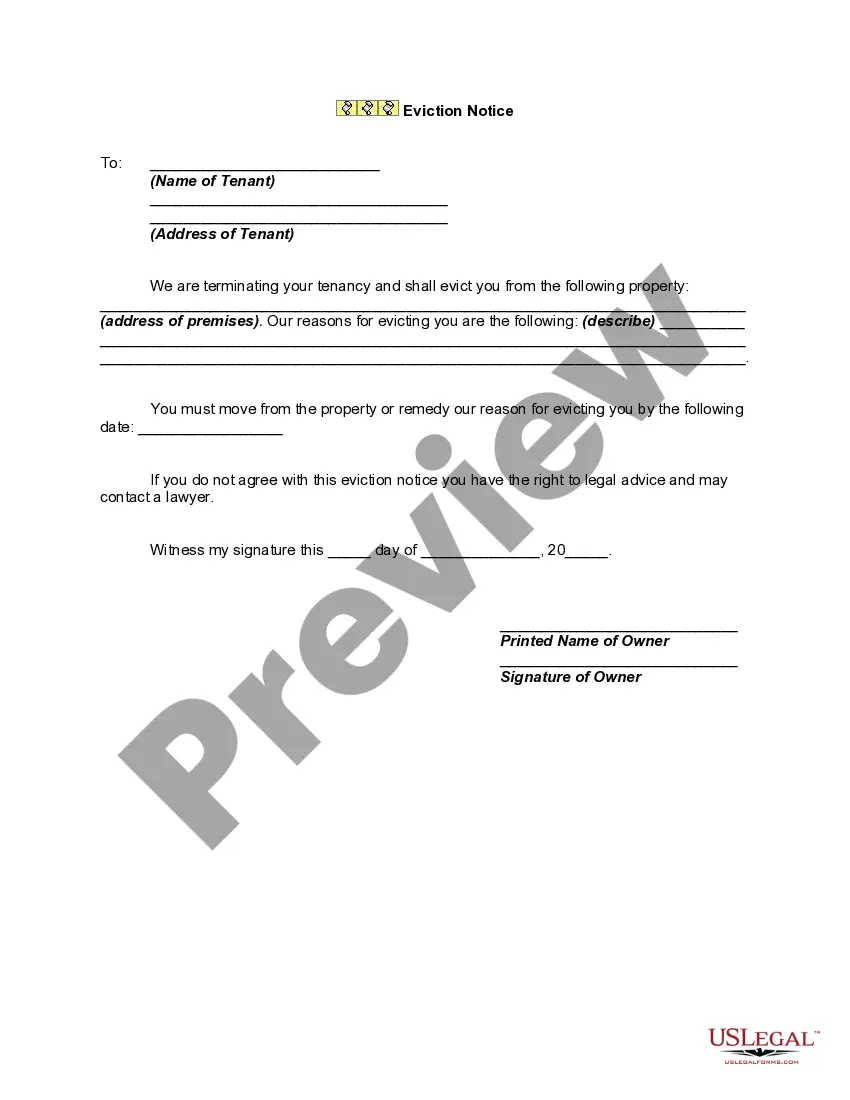
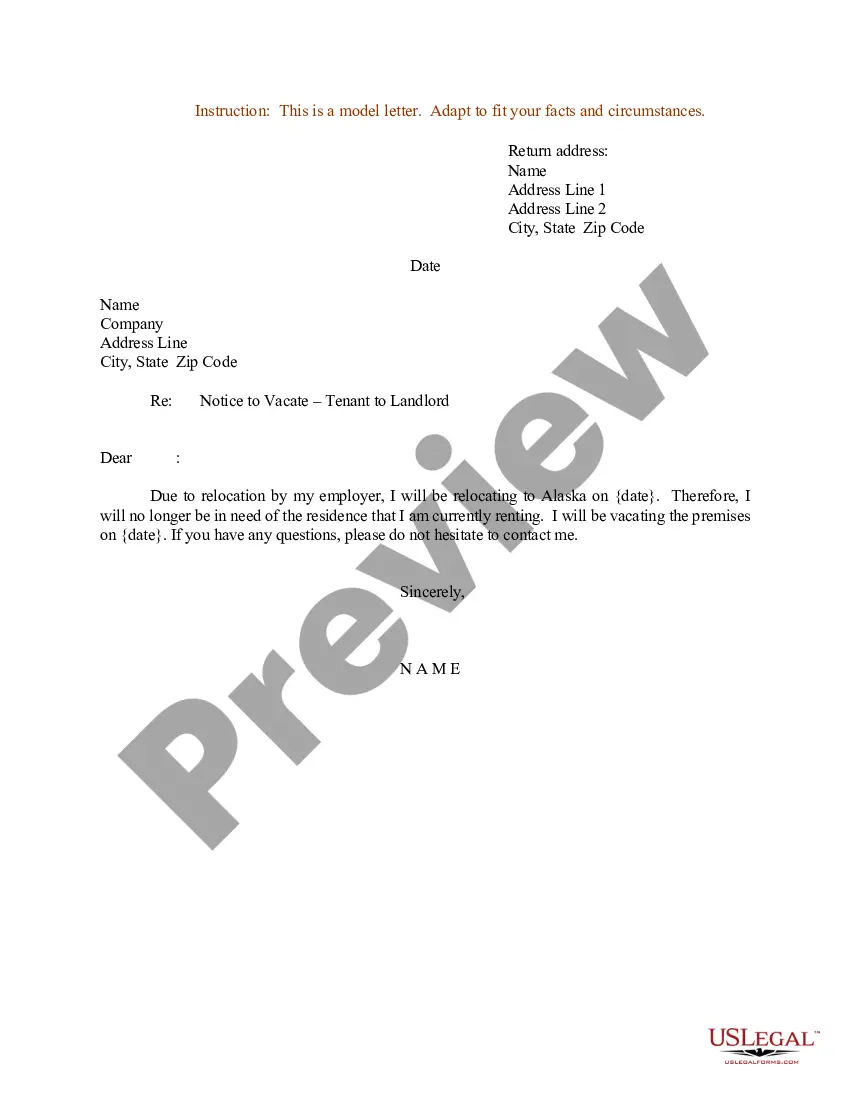
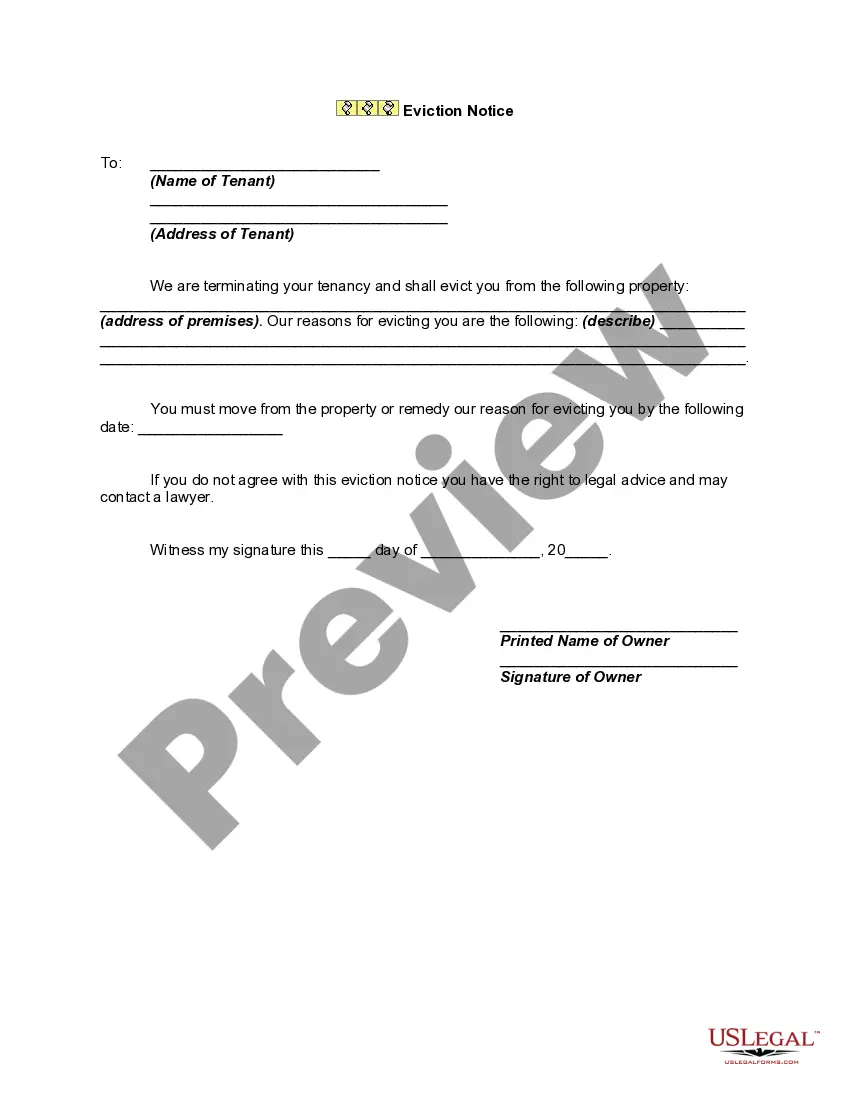
New York Eviction Notice for Renovations
Description
Get your form ready online
Our built-in tools help you complete, sign, share, and store your documents in one place.
Make edits, fill in missing information, and update formatting in US Legal Forms—just like you would in MS Word.
Download a copy, print it, send it by email, or mail it via USPS—whatever works best for your next step.
Sign and collect signatures with our SignNow integration. Send to multiple recipients, set reminders, and more. Go Premium to unlock E-Sign.
If this form requires notarization, complete it online through a secure video call—no need to meet a notary in person or wait for an appointment.
We protect your documents and personal data by following strict security and privacy standards.

Make edits, fill in missing information, and update formatting in US Legal Forms—just like you would in MS Word.

Download a copy, print it, send it by email, or mail it via USPS—whatever works best for your next step.

Sign and collect signatures with our SignNow integration. Send to multiple recipients, set reminders, and more. Go Premium to unlock E-Sign.

If this form requires notarization, complete it online through a secure video call—no need to meet a notary in person or wait for an appointment.

We protect your documents and personal data by following strict security and privacy standards.
Looking for another form?
How to fill out Eviction Notice For Renovations?
If you need to completely, download, or print legal document templates, utilize US Legal Forms, the largest collection of legal forms available online.
Utilize the site's straightforward and user-friendly search to locate the documents you require.
Different templates for business and personal purposes are categorized by types and states, or keywords. Use US Legal Forms to find the New York Eviction Notice for Renovations with a few clicks.
Every legal document template you purchase is yours permanently. You have access to every form you downloaded in your account. Select the My documents section and choose a form to print or download again.
Compete and download, and print the New York Eviction Notice for Renovations with US Legal Forms. There are millions of professional and state-specific forms you can use for your business or personal needs.
- If you are already a US Legal Forms customer, sign in to your account and click the Download button to obtain the New York Eviction Notice for Renovations.
- You can also access forms you previously downloaded in the My documents tab of your account.
- If you are using US Legal Forms for the first time, follow the instructions below.
- Step 1. Ensure you have selected the form for the correct area/state.
- Step 2. Use the Preview option to review the form's content. Don't forget to check the details.
- Step 3. If you are not satisfied with the form, utilize the Search field at the top of the screen to find other templates in the legal form directory.
- Step 4. Once you have found the form you need, click on the Get now button. Select the payment plan you prefer and enter your details to register for an account.
- Step 5. Process the transaction. You can use your credit card or PayPal account to complete the transaction.
- Step 6. Choose the format of the legal document and download it to your device.
- Step 7. Complete, modify, and print or sign the New York Eviction Notice for Renovations.
Form popularity
FAQ
Rent must be at least 14 days late and the landlord must provide a 14-day notice to pay or vacate. A holdover tenancy occurs when a tenant continues to occupy the premises after the lease term has ended or violates lease terms. The landlord must provide a 30-day notice to terminate the tenancy.
On average, it would take anywhere between 35 days to more than 1 year for a complete eviction process. Give your tenant a written Notice to Vacate before the eviction process. Make sure no mistakes were made in the filing process. If you win the case, the judge will give you a Writ of Execution.
For example, if the landlord wants the tenant to move out by November 1 and the rent is due on the first of each month, the landlord must give notice by September 30. In New York 5 Page 9 City, 30 days' notice is required, rather than one month.
Tenants in New York cannot be denied based on past legal conflicts with a landlord (for example, if they have previously sued a landlord). Landlords in New York are also not allowed to charge any additional fees for the processing, review, or acceptance of an application.
New York Unlawful Eviction Law Explained: Under New York City Administrative Code Section 26-521, it is unlawful to evict or attempt to evict an occupant of a residential unit, who has: Occupied the premises for 30 consecutive days, OR. Entered into a leave with respect to such residence, OR.
If the tenant confirms that rent is still unpaid or does not reply, the landlord may proceed with a written 14-Day Notice to Pay to begin the eviction process. In the case that the tenant pays the rent or moves out of the property within fourteen days, then the eviction process does not continue.
In New York State, an eviction of a tenant is lawful only if an owner has brought a court proceeding and obtained a judgment of possession from the court. A sheriff, marshal or constable can carry out a court ordered eviction. An owner may not evict a tenant by use of force or unlawful means.
In New York State, an eviction of a tenant is lawful only if an owner has brought a court proceeding and obtained a judgment of possession from the court. o A sheriff, marshal, or constable can carry out a court ordered eviction. An owner may not evict a tenant by use of force or unlawful means.