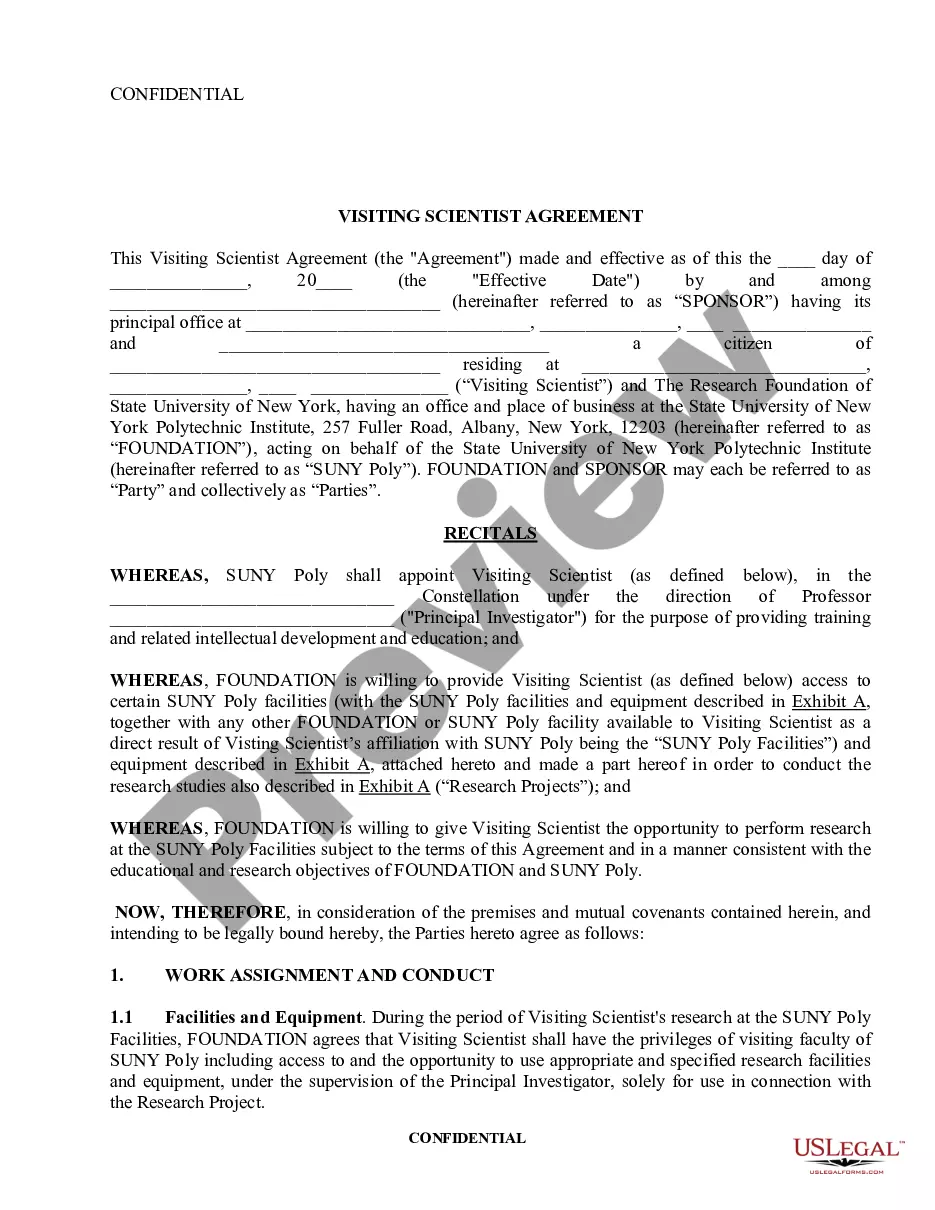
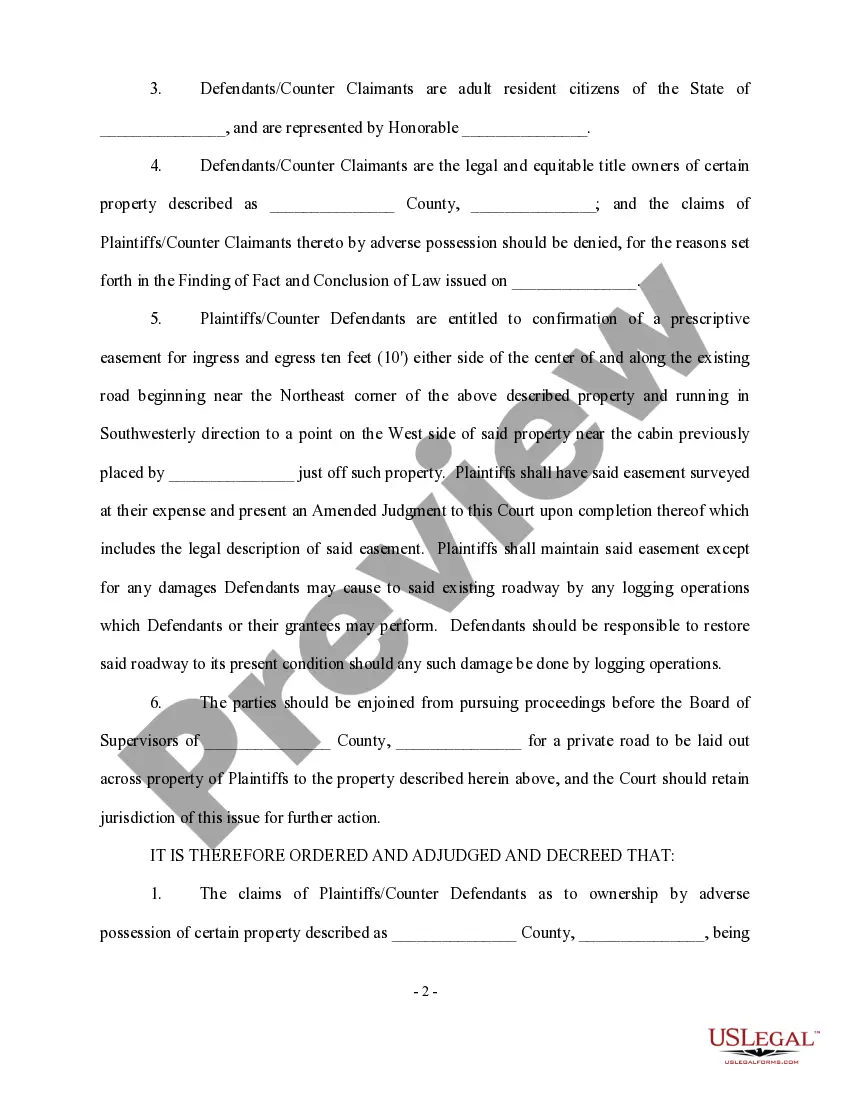
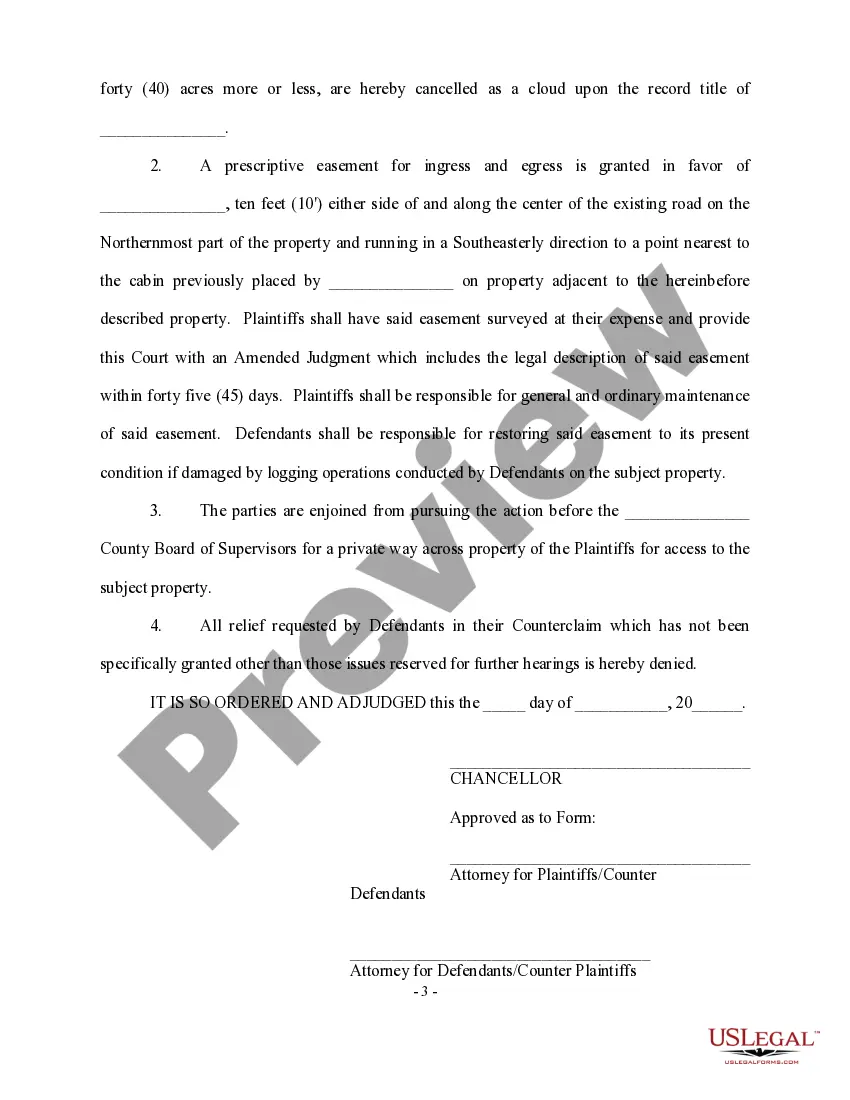
This form is a Judgment. The judgment provides that the plaintiffs/ counter defendants are entitled to a prescriptive easement for ingress and egress along an existing road. The judgment also provides that all relief requested by defendants in their counterclaim which was not specifically granted, other than those issues reserved for further hearing, are denied by the court.
Ohio Judgment regarding Boundary Line Dispute
Category:
State:
Multi-State
Control #:
US-00748
Format:
Word;
Rich Text
Instant download
Description
Free preview

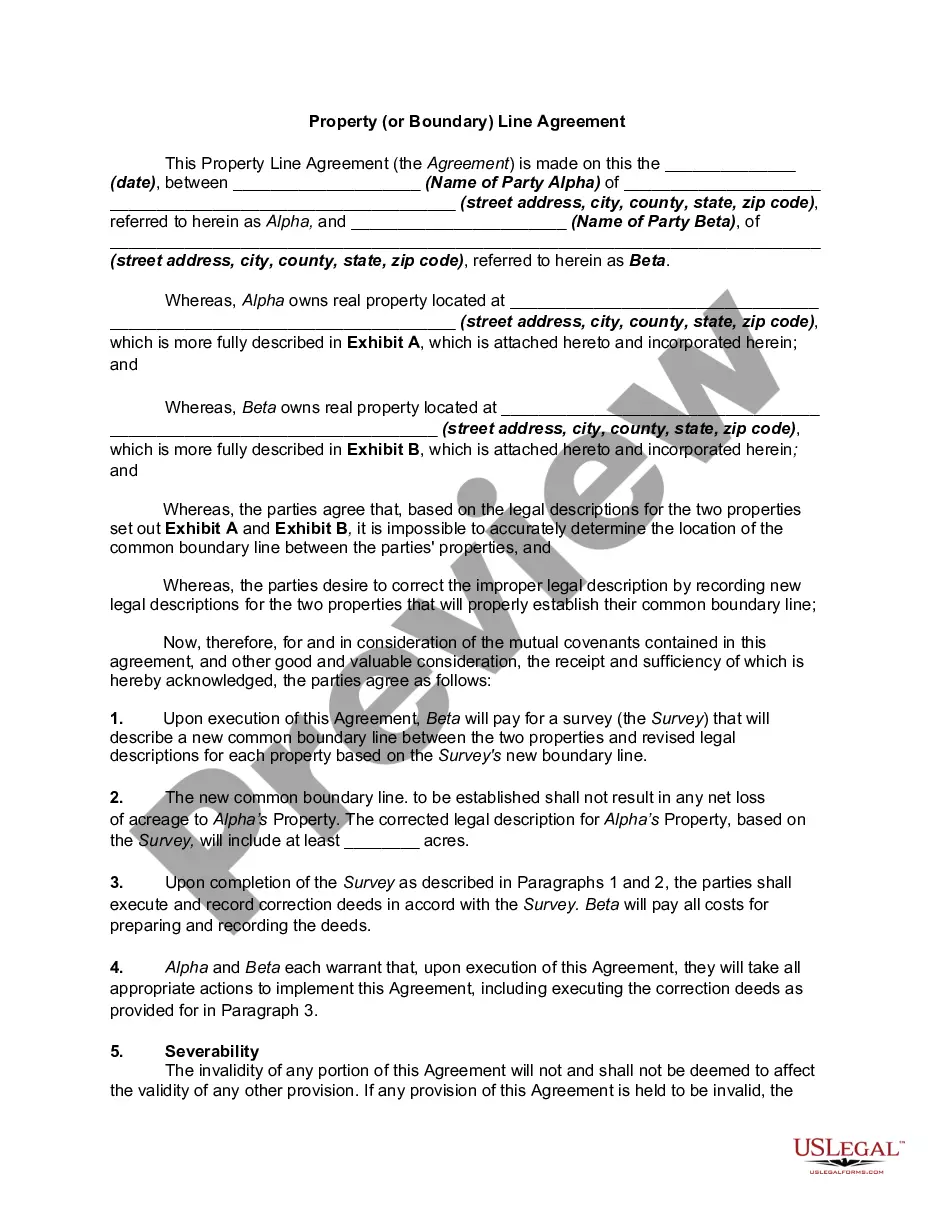
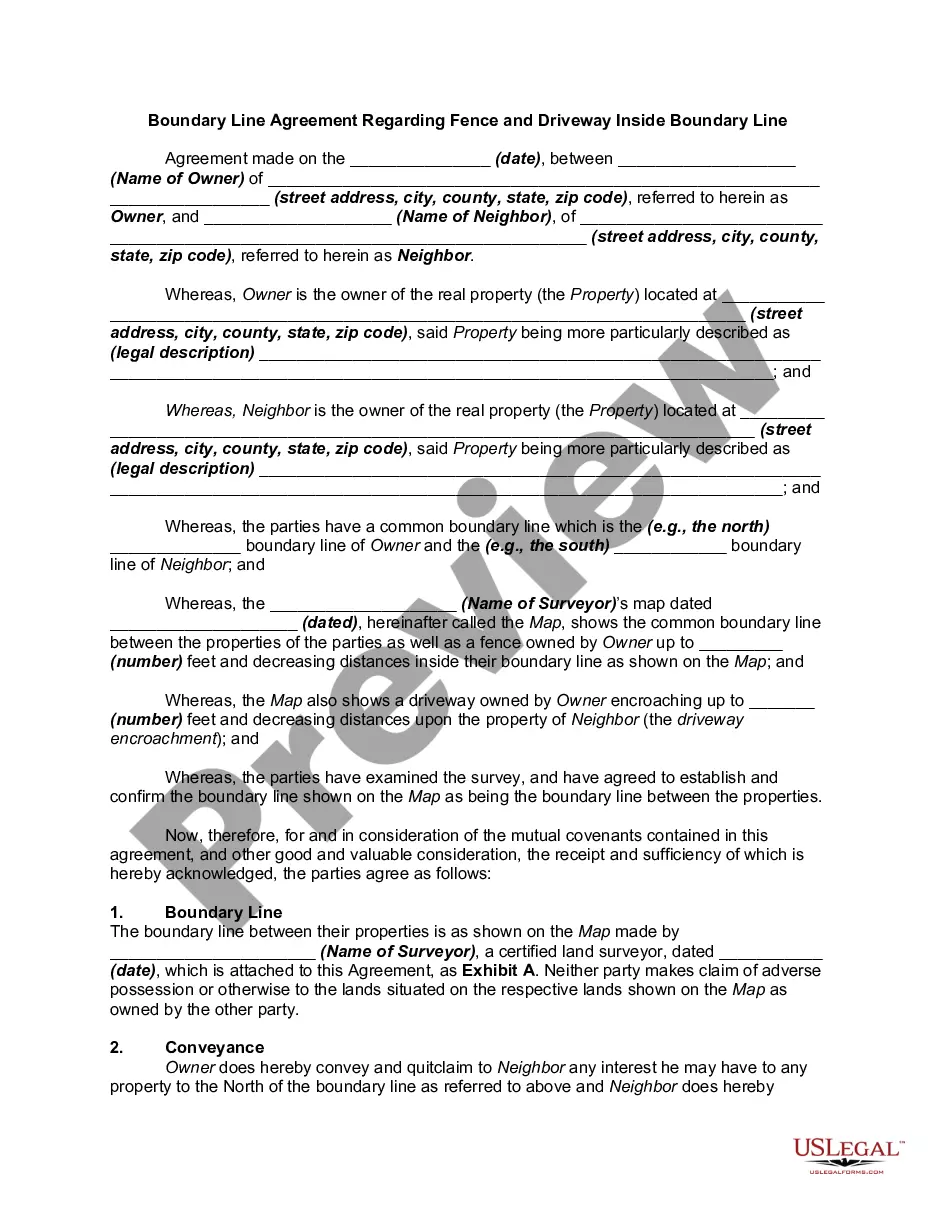
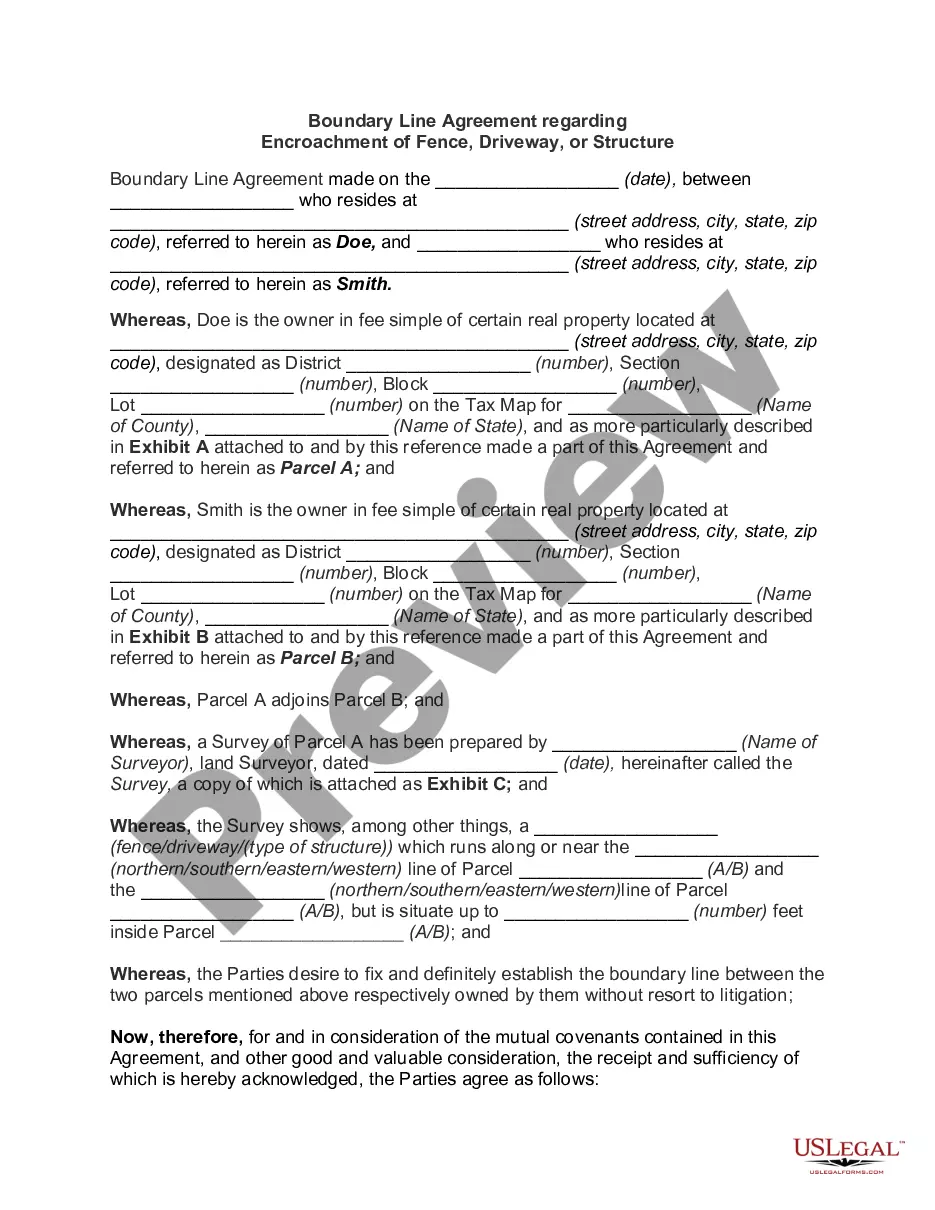
Get your form ready online
Our built-in tools help you complete, sign, share, and store your documents in one place.
Built-in online Word editor
Make edits, fill in missing information, and update formatting in US Legal Forms—just like you would in MS Word.
Export easily
Download a copy, print it, send it by email, or mail it via USPS—whatever works best for your next step.
E-sign your document
Sign and collect signatures with our SignNow integration. Send to multiple recipients, set reminders, and more. Go Premium to unlock E-Sign.
Notarize online 24/7
If this form requires notarization, complete it online through a secure video call—no need to meet a notary in person or wait for an appointment.
Store your document securely
We protect your documents and personal data by following strict security and privacy standards.

Make edits, fill in missing information, and update formatting in US Legal Forms—just like you would in MS Word.

Download a copy, print it, send it by email, or mail it via USPS—whatever works best for your next step.

Sign and collect signatures with our SignNow integration. Send to multiple recipients, set reminders, and more. Go Premium to unlock E-Sign.

If this form requires notarization, complete it online through a secure video call—no need to meet a notary in person or wait for an appointment.

We protect your documents and personal data by following strict security and privacy standards.
Looking for another form?
How to fill out Judgment Regarding Boundary Line Dispute?
Are you in a situation where you require documents for either business or personal reasons almost every day? There are numerous legal document templates accessible online, but finding ones you can trust is not easy.
US Legal Forms provides a vast array of form templates, including the Ohio Judgment for Boundary Line Dispute, that are designed to comply with federal and state regulations.
If you are already acquainted with the US Legal Forms website and possess an account, simply Log In. After that, you can download the Ohio Judgment for Boundary Line Dispute template.
Select a convenient format and download your copy.
Access all the document templates you have purchased in the My documents section. You can obtain another copy of the Ohio Judgment for Boundary Line Dispute anytime, if needed. Just click on the required form to download or print the document template. Utilize US Legal Forms, the most extensive collection of legal forms, to save time and avoid mistakes. The service offers professionally crafted legal document templates that can be utilized for various purposes. Create an account on US Legal Forms and start streamlining your life.
- If you do not have an account and wish to start using US Legal Forms, follow these steps.
- Obtain the form you require and ensure it is for the correct city/state.
- Use the Preview button to review the document.
- Check the information to confirm that you have selected the right form.
- If the form is not what you are looking for, utilize the Search field to find the form that suits your needs and requirements.
- Once you find the appropriate form, click on Acquire now.
- Choose the pricing plan you prefer, enter the necessary information to create your account, and complete the purchase using your PayPal or Visa or Mastercard.
Form popularity
FAQ
How to resolve a boundary dispute. Speak to your neighbour. Sometimes the simplest solutions can be the most effective. ... Mediate. You can do this formally or informally. ... Litigate. If you can't agree a solution, your only option is to go to court if you want to force a remedy through.
If they refuse, try going to mediation. Many homeowners associations offer mediation services. If yours does not, you can hire a private mediator to help you work through the encroachment issues. Otherwise, you will have to go to court and have a judge order the guy next door to keep his things next door.
Acquiescence applies when you and the titleholder have mutually treated a specific line as the boundary between your respective properties for 21 years. This doctrine can be used when one or more of the elements of adverse possession cannot be satisfied.
8 Hotly Disputed Borders of the World Senkaku (Diaoyu) islands, East China Sea. The East China, South China, and Yellow seas. ... Kuril Islands. Kraternaya Bay Michael V. ... The Korean peninsula. Lest we forget, the Korean War never really came to an end. ... Western Sahara. ... Antarctica. ... Israel/Palestine. ... Somaliland. ... Taiwan.
The law requires that line fences be maintained by the adjoining landowners in a good and substantial manner and that each landowner bear an equal share of the cost of repair and maintenance.
The four major types of boundary disputes are operational, allocational, locational, and definitional.
Involve a Real Estate Attorney at the Onset of a Dispute Often, a resolution between the disputing parties could allow for a monetary settlement, an agreement to divide the land, or for an easement. If no resolution can be reached, then only a lawsuit can resolve a boundary dispute.
Boundary disputes usually arise when one person asserts ownership over a piece of land, which is owned by their neighbour. A common example would be if one neighbour moves their fence towards their neighbours' property, annexing the neighbour's land to theirs - this would give rise to a boundary dispute.