Oklahoma Quitclaim Deed - Limited Liability Company to Limited Liability Company
About this form
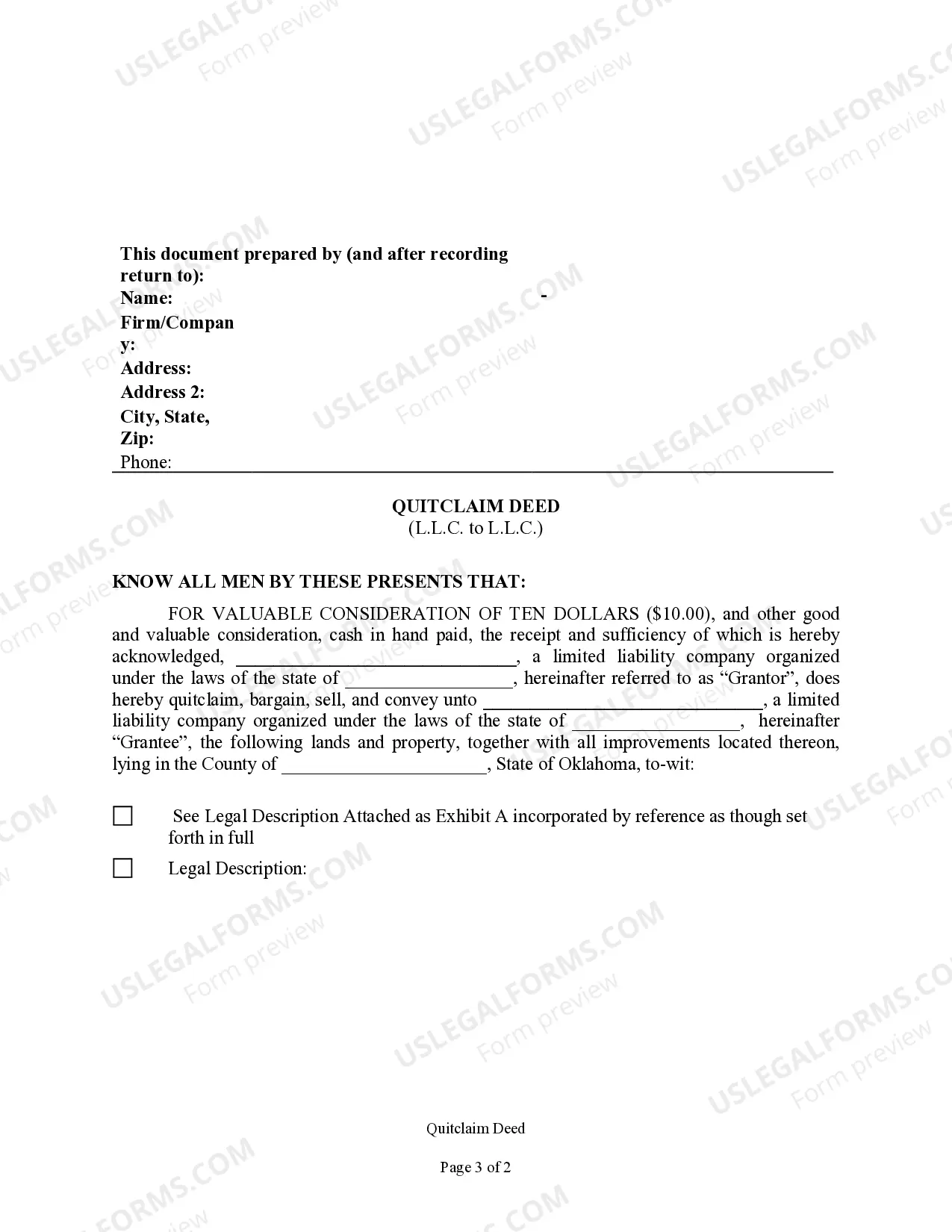
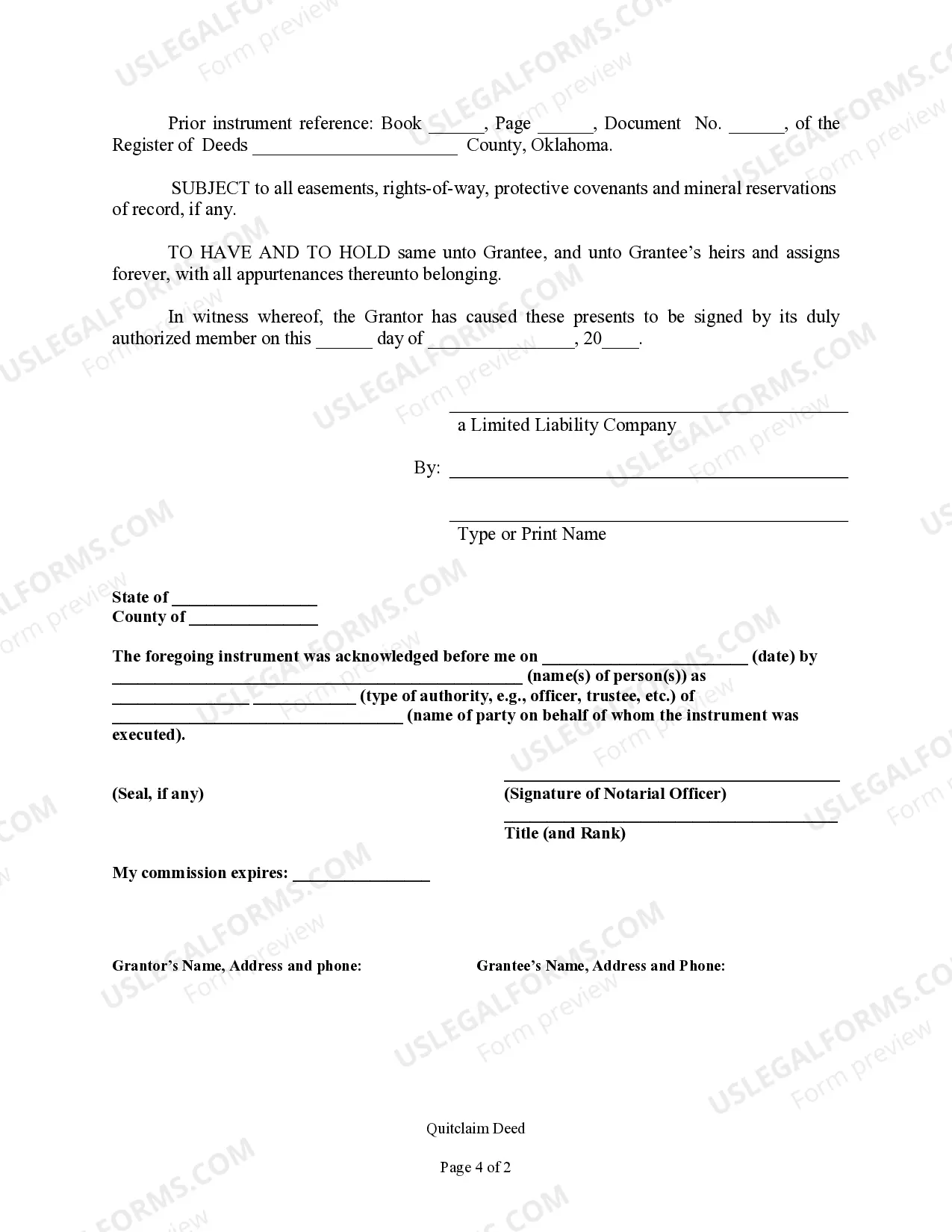
The Quitclaim Deed is a legal document that allows one limited liability company (LLC) to transfer its interest in a property to another LLC. Unlike a warranty deed, a quitclaim deed does not guarantee that the property title is clear of encumbrances or claims. This form is essential for LLCs wishing to convey property ownership without making any assurances about the title.
What’s included in this form
- Identification of the grantor (the transferring LLC).
- Identification of the grantee (the receiving LLC).
- A legal description of the property being transferred.
- Signatures of authorized representatives of the LLCs involved.
- Date of the transaction.



When to use this form
This form is typically used when one limited liability company wants to transfer ownership of a property to another LLC. Common scenarios include business mergers, internal restructuring, or simplifying property holdings among related entities. It can also be used when an LLC is changing the structure of its ownership without monetary exchange.
Who this form is for
This form is suitable for:
- Limited liability companies (LLCs) transferring property to other LLCs.
- Business owners involved in property management or real estate transactions.
- Legal representatives or attorneys managing the property transfer.
Instructions for completing this form
- Identify the grantor LLC by entering its legal name.
- Identify the grantee LLC by entering its legal name.
- Provide a detailed legal description of the property being transferred.
- Ensure authorized representatives of both LLCs sign the form.
- Enter the date of the property transfer in the designated space.
Does this document require notarization?
This document requires notarization to meet legal standards. US Legal Forms provides secure online notarization powered by Notarize, allowing you to complete the process through a verified video call, available 24/7.
Get your form ready online
Our built-in tools help you complete, sign, share, and store your documents in one place.
Make edits, fill in missing information, and update formatting in US Legal Forms—just like you would in MS Word.
Download a copy, print it, send it by email, or mail it via USPS—whatever works best for your next step.
Sign and collect signatures with our SignNow integration. Send to multiple recipients, set reminders, and more. Go Premium to unlock E-Sign.
If this form requires notarization, complete it online through a secure video call—no need to meet a notary in person or wait for an appointment.
We protect your documents and personal data by following strict security and privacy standards.

Make edits, fill in missing information, and update formatting in US Legal Forms—just like you would in MS Word.

Download a copy, print it, send it by email, or mail it via USPS—whatever works best for your next step.

Sign and collect signatures with our SignNow integration. Send to multiple recipients, set reminders, and more. Go Premium to unlock E-Sign.

If this form requires notarization, complete it online through a secure video call—no need to meet a notary in person or wait for an appointment.

We protect your documents and personal data by following strict security and privacy standards.
Typical mistakes to avoid
- Failing to include a complete legal description of the property.
- Missing signatures from authorized representatives of either LLC.
- Using incorrect names or designations for either LLC.
- Not dating the form, which may affect its validity.
Why complete this form online
- Convenience of completing the form from any location.
- Editability allows for easy corrections and adjustments.
- Reliability, as the form complies with state-specific legal standards.
Legal use & context
- This Quitclaim Deed allows for property transfer without warranty; therefore, the grantee takes the property as-is.
- It is enforceable in court provided it is executed correctly according to state requirements.
- Limited liability companies can utilize this form to streamline property transactions and organizational changes.
Main things to remember
- The Quitclaim Deed is crucial for transferring property between LLCs.
- Ensure accurate completion to avoid legal disputes later.
- This form is compliant with Oklahoma laws and may require local verification for specific uses.
Looking for another form?
Form popularity
FAQ
Recording A quit claim deed must be filed with the County Clerk's Office along with the required filing fee (varies by location). Signing (§ 16-26) This form is required to be authorized by the Grantor(s) in front of a Notary Public with their acknowledgment and seal.
How to Quitclaim Deed to LLC. A quitclaim deed to LLC is actually a very simple process. You will need a deed form and a copy of the existing deed to make sure you identify titles properly and get the legal description of the property.
File articles of incorporation with the state in which you will purchase investment property. Keep the LLC in good standing by having a Registered Agent in each state where you form an LLC.
A quitclaim deed must meet all state and local standards for recorded instruments. Sign the deed in the presence of a notary public and record at the clerk's office in the county where the property is located for a valid transfer. Contact the same office to verify accepted forms of payment.
Real estate companies structured under an LLC are allowed to buy real estate. In fact, LLCs afford investors one of the most versatile vehicles to shelter their taxes and protect their assets.
Limited Liability Companies are legally capable of purchasing and selling real estate. When LLCs dispose of real estate holdings, they must transfer ownership to new owners via property deeds. A person must have legal authority to sign a deed to convey property for an LLC.
Step 1: Form an LLC or Corporation. You can't transfer your real estate property, or any other personal property, into your LLC or corporation until you've actually formed a new legal entity. Step 2: Complete a Quitclaim Deed. Step 3: Record Your Quitclaim Deed.
For many investors, an LLC is the best way to purchase property. Arguably the biggest advantage is asset protection/liability indemnity avoidance. In California, one cannot avoid being sued; one can only protect his or her assets in case of a lawsuit.
No you can't. A single member LLC is just you as far as the IRS is concerned. You're just living in your own property. You can't rent your own house to yourself.