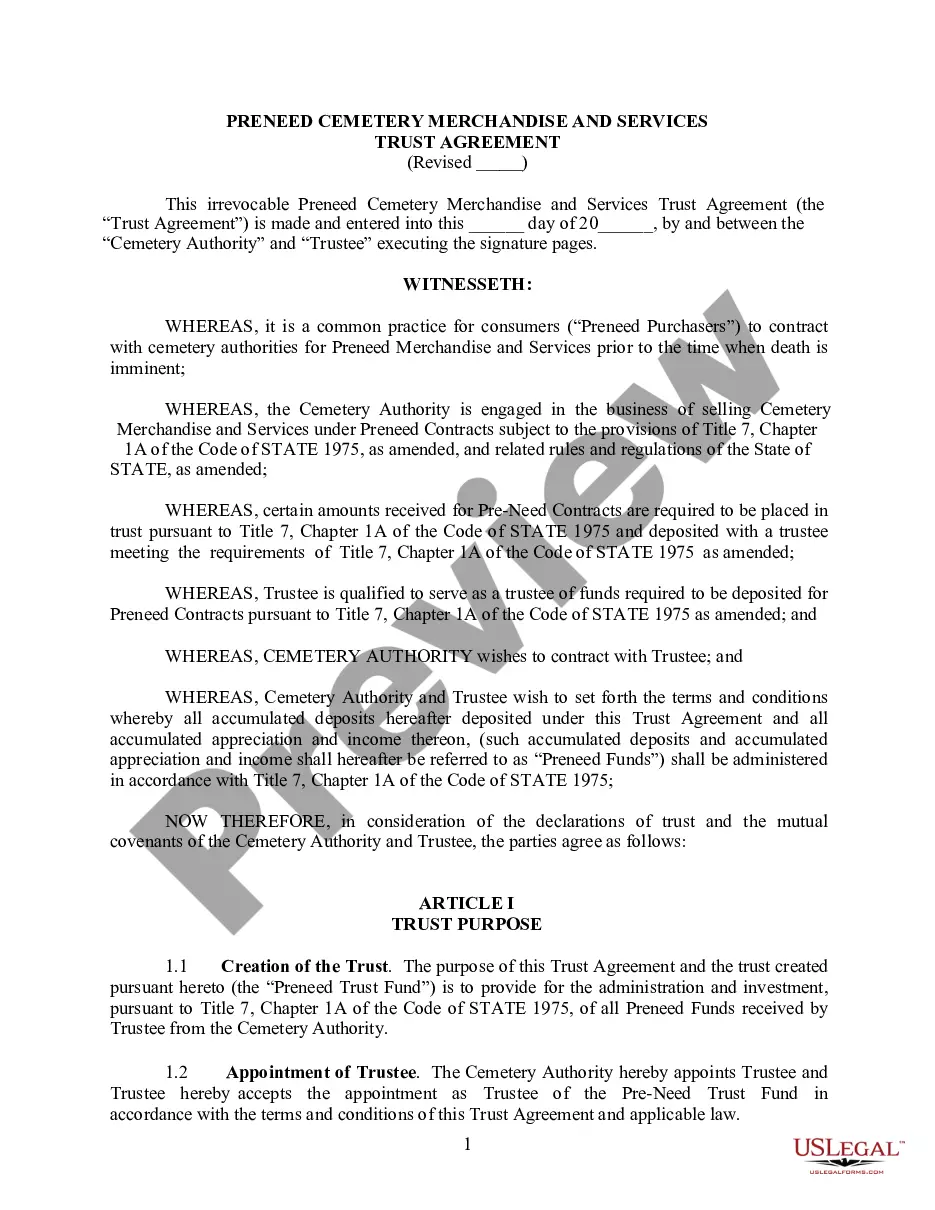
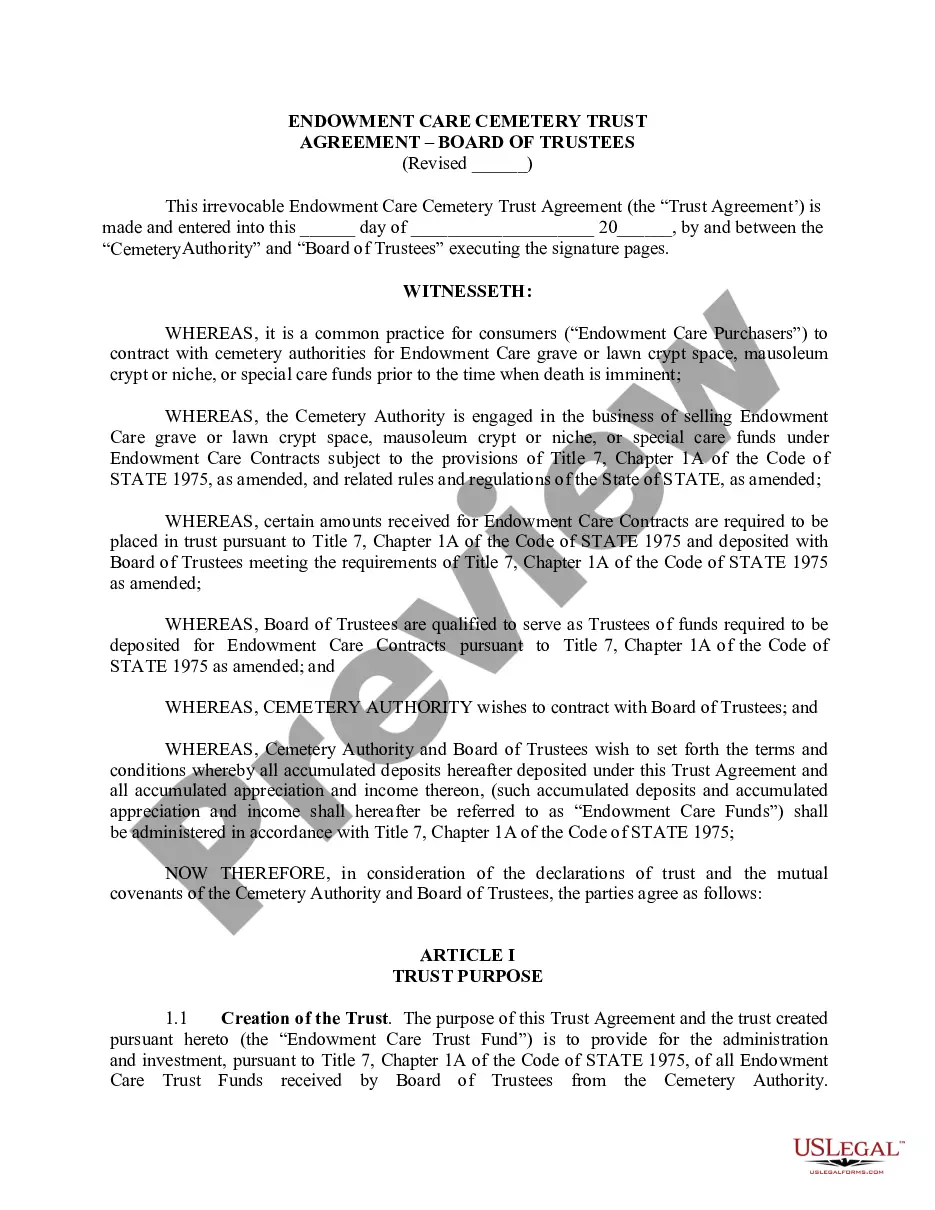
Statutory regulation of partition fences exists in many states. Such statutes may require a particular kind of fence and prohibit other kinds of fences, and may establish certain requirements of cooperation between adjoining landowners as to partition fences. Even where statutory regulation exists, adjoining landowners are usually free to execute agreements with respect to fences that are at variance from the requirements of the statutes. If there is no applicable statute, control over the construction and maintenance of fences is usually regulated by agreement between the adjoining landowners.
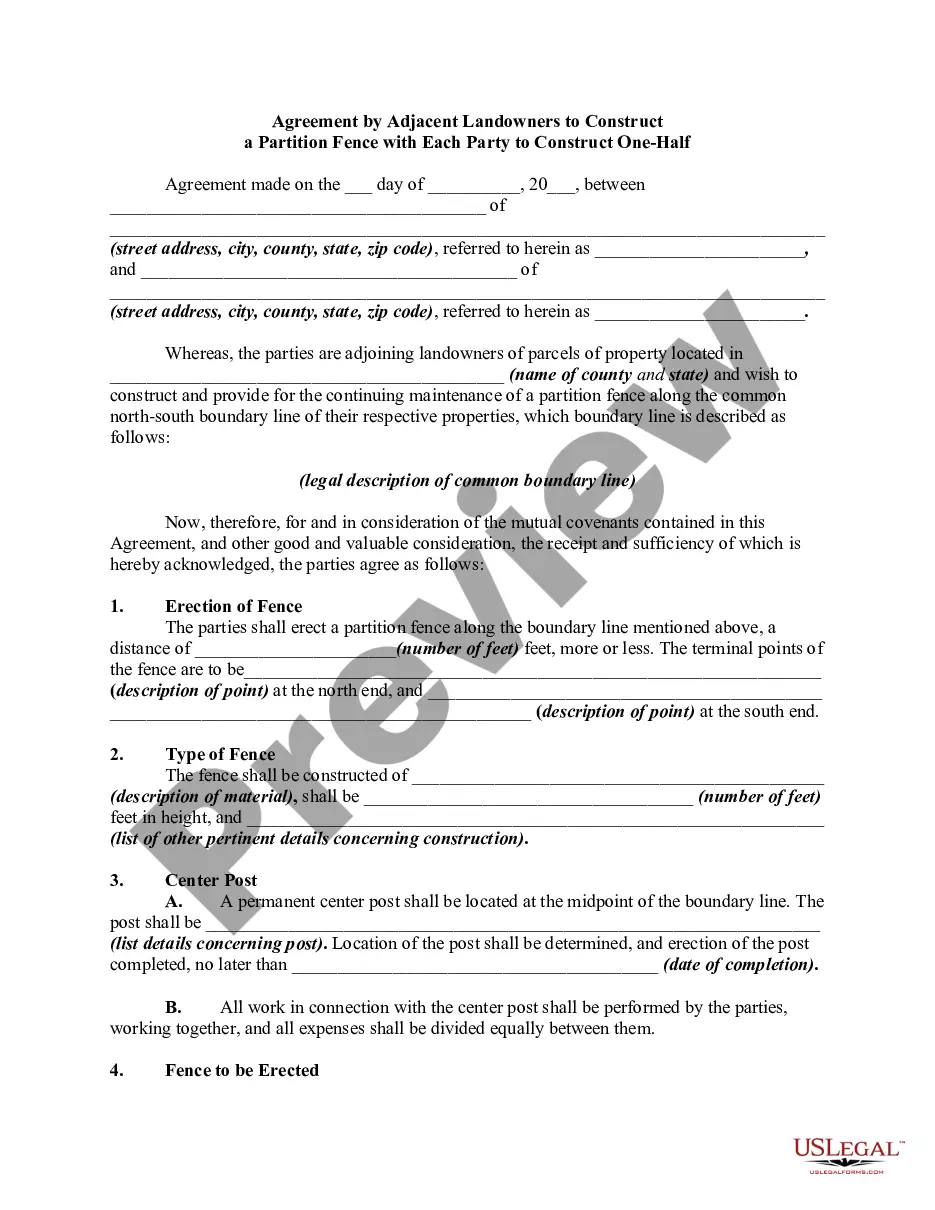
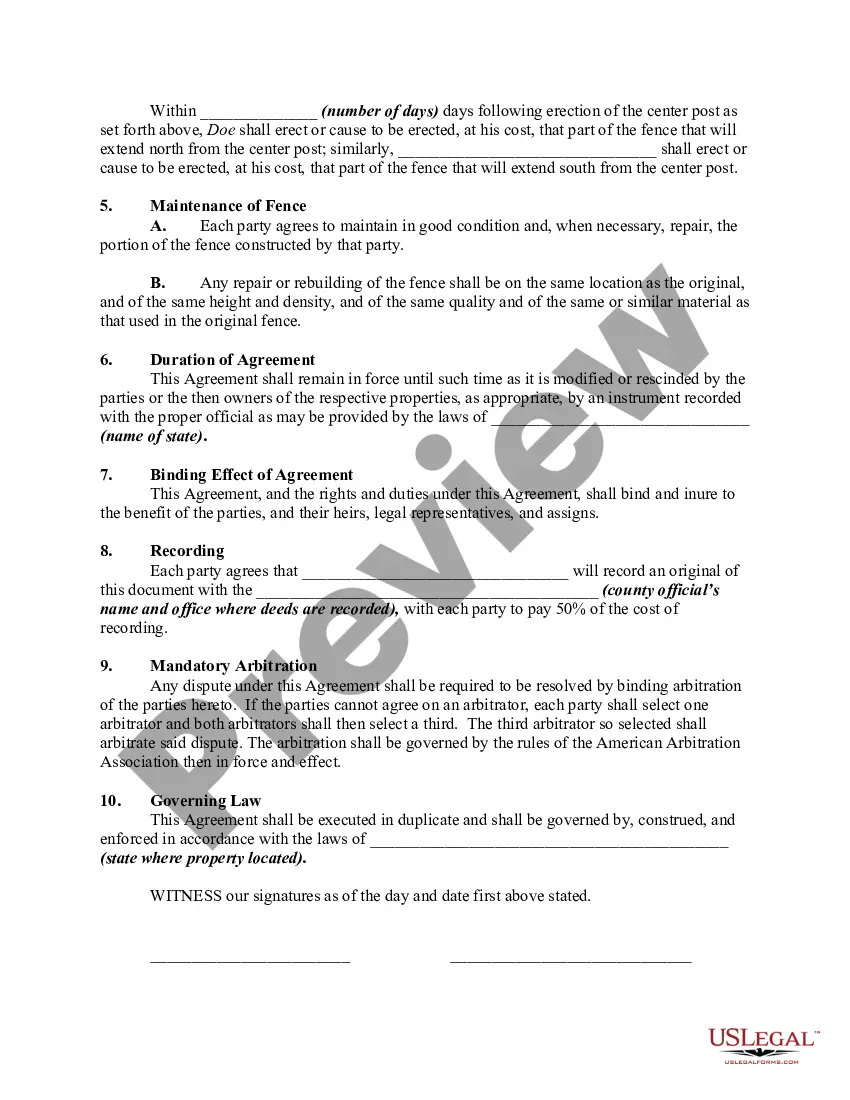
Oregon Agreement by Adjacent Landowners to Construct a Partition Fence with Each Party to Construct One-Half
Category:
State:
Multi-State
Control #:
US-00945BG
Format:
Word;
Rich Text
Instant download
Description
Free preview
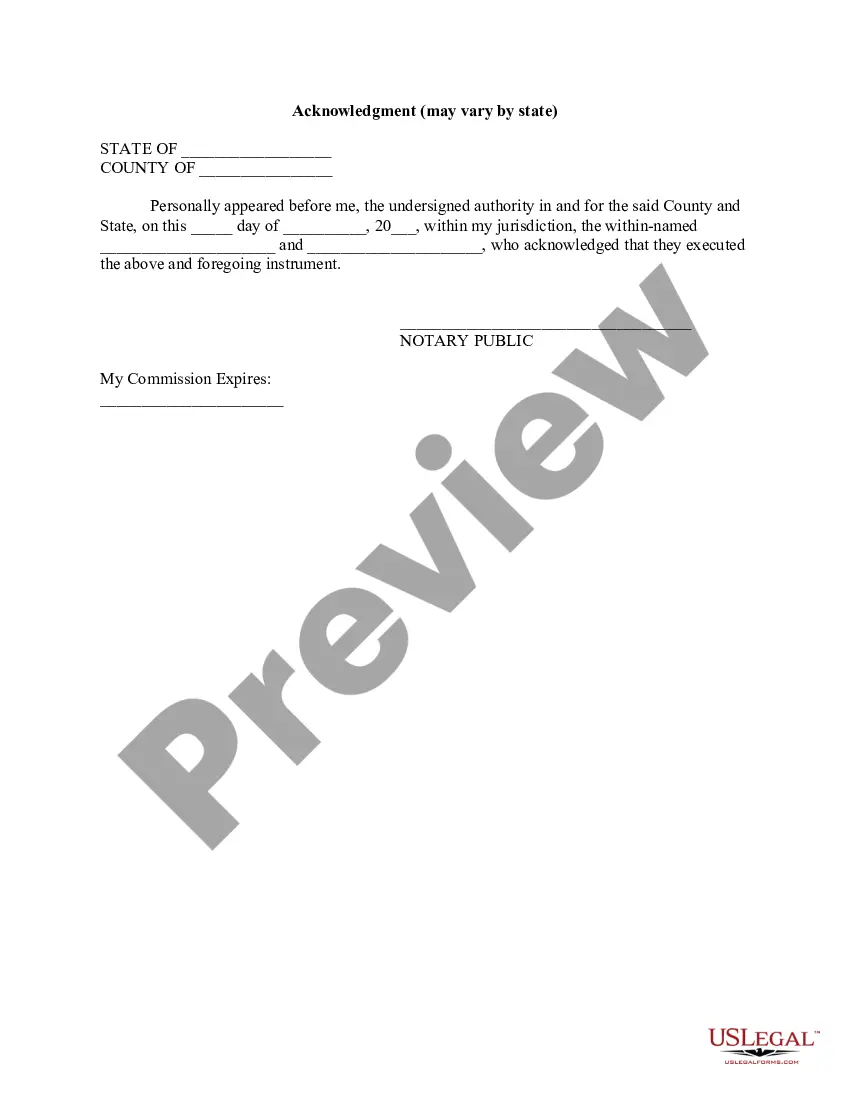
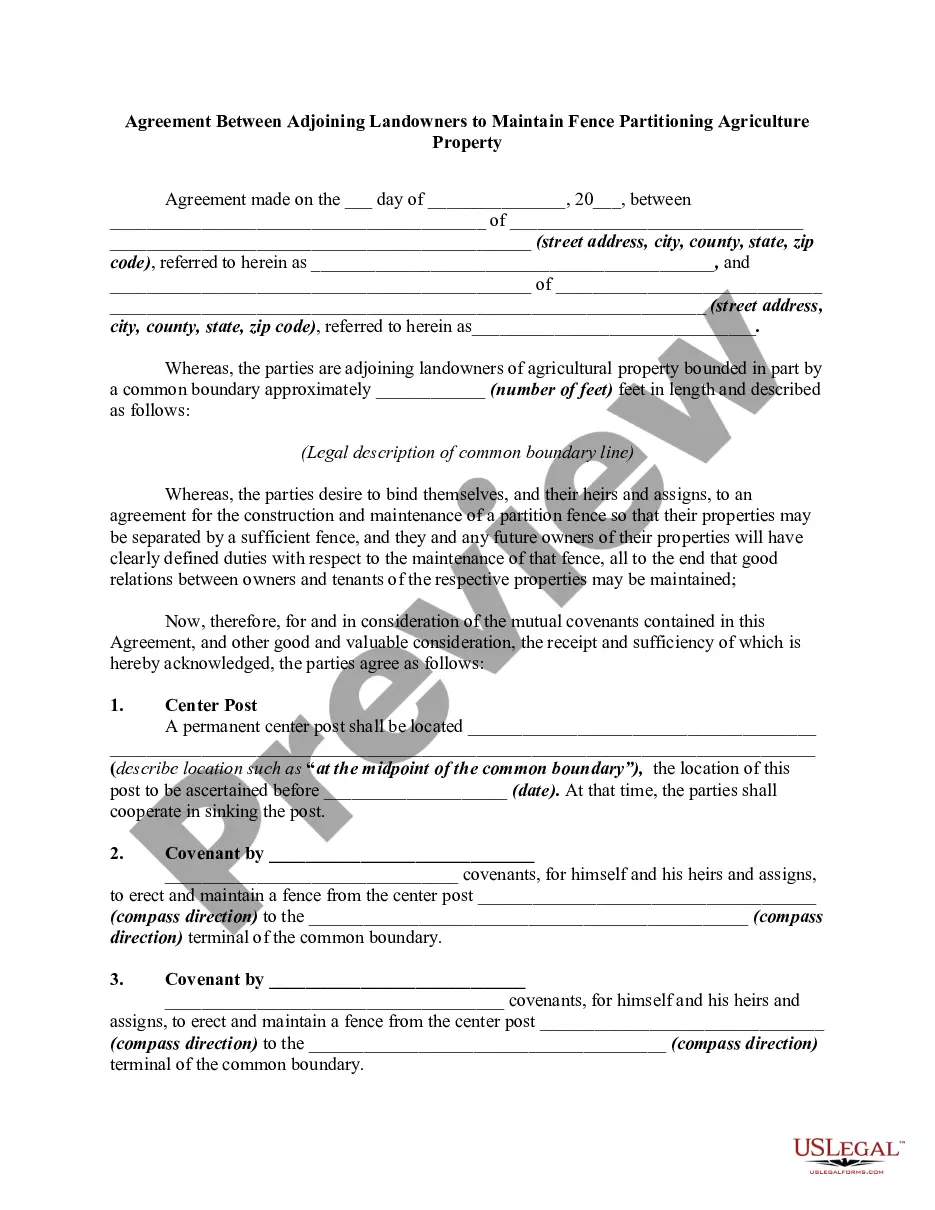
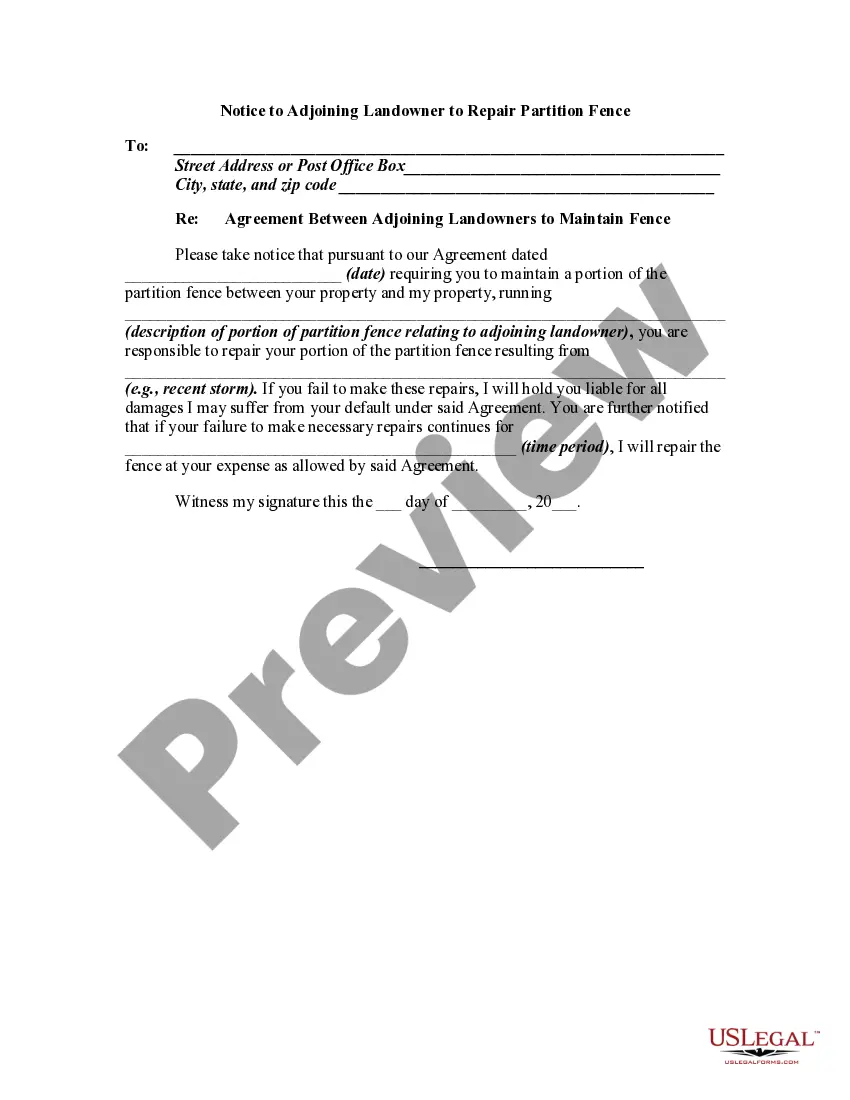
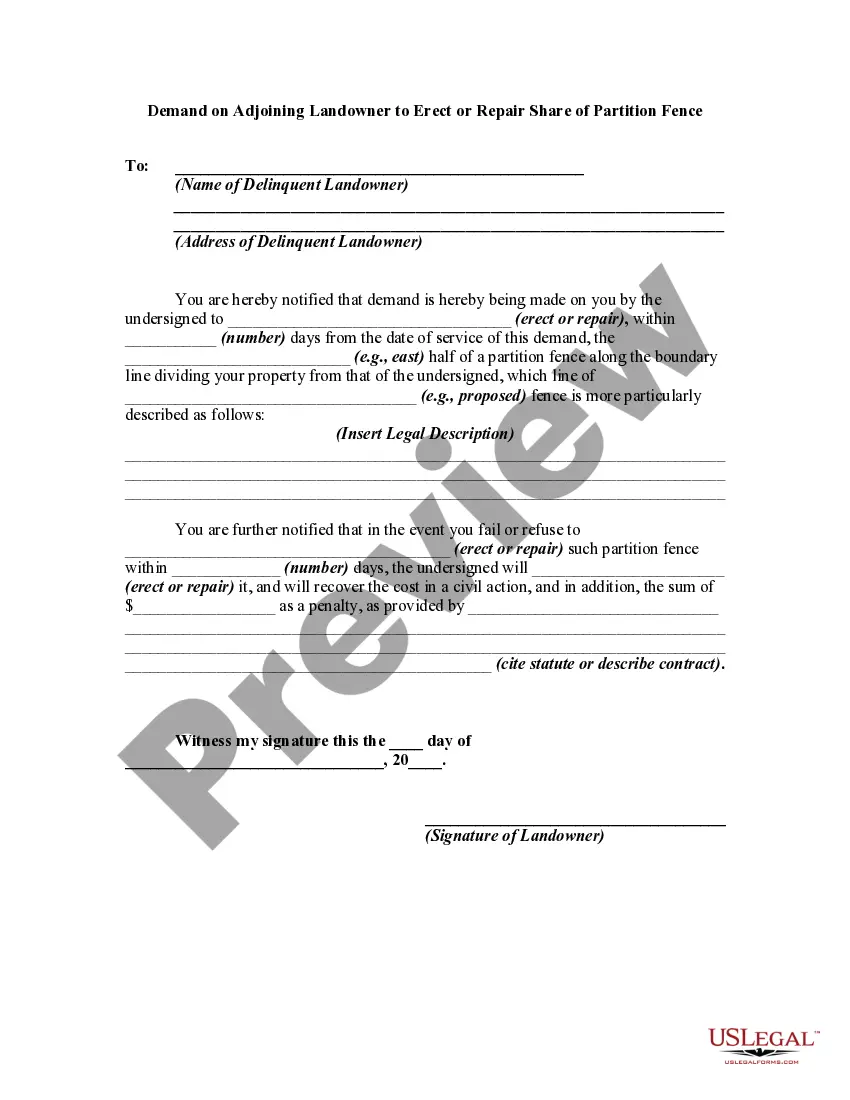
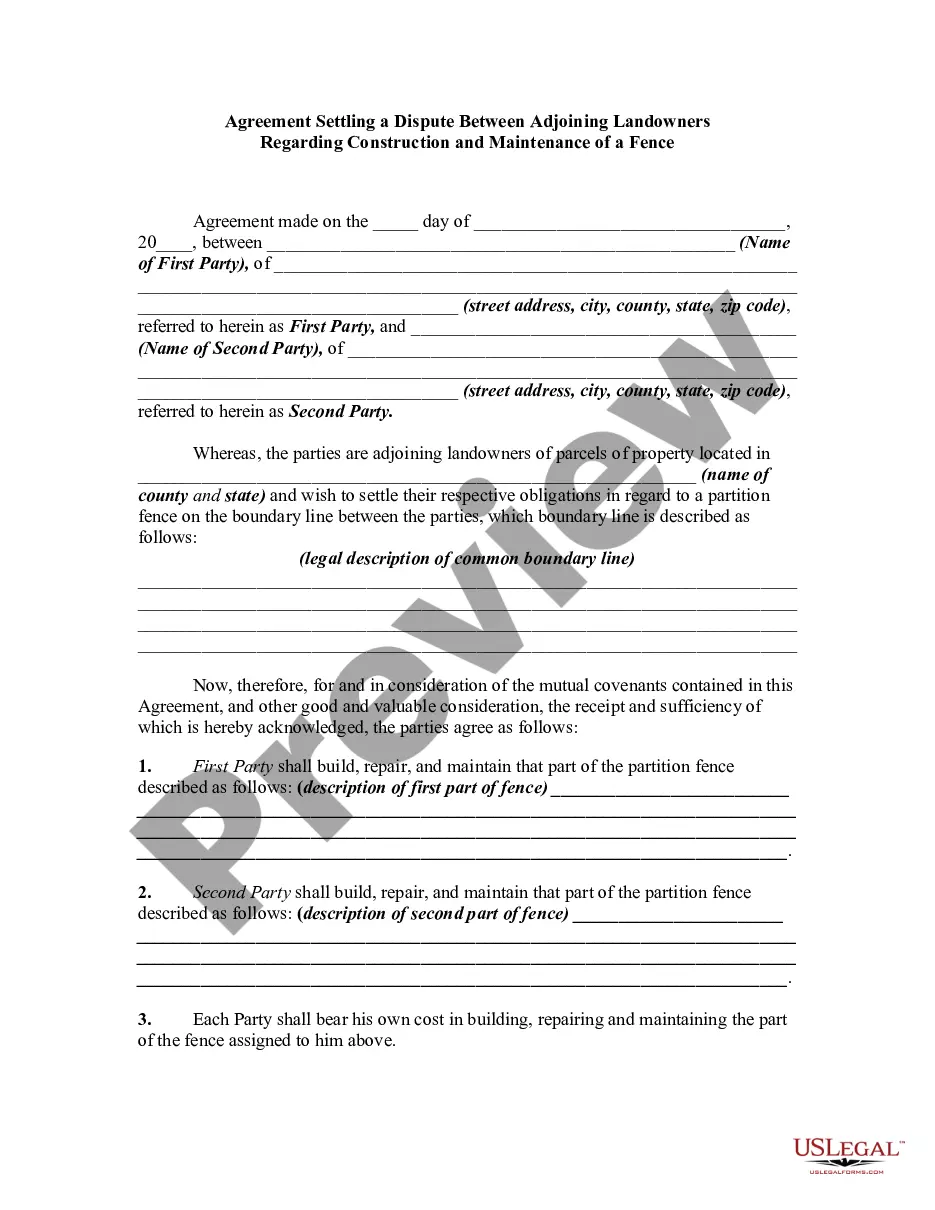
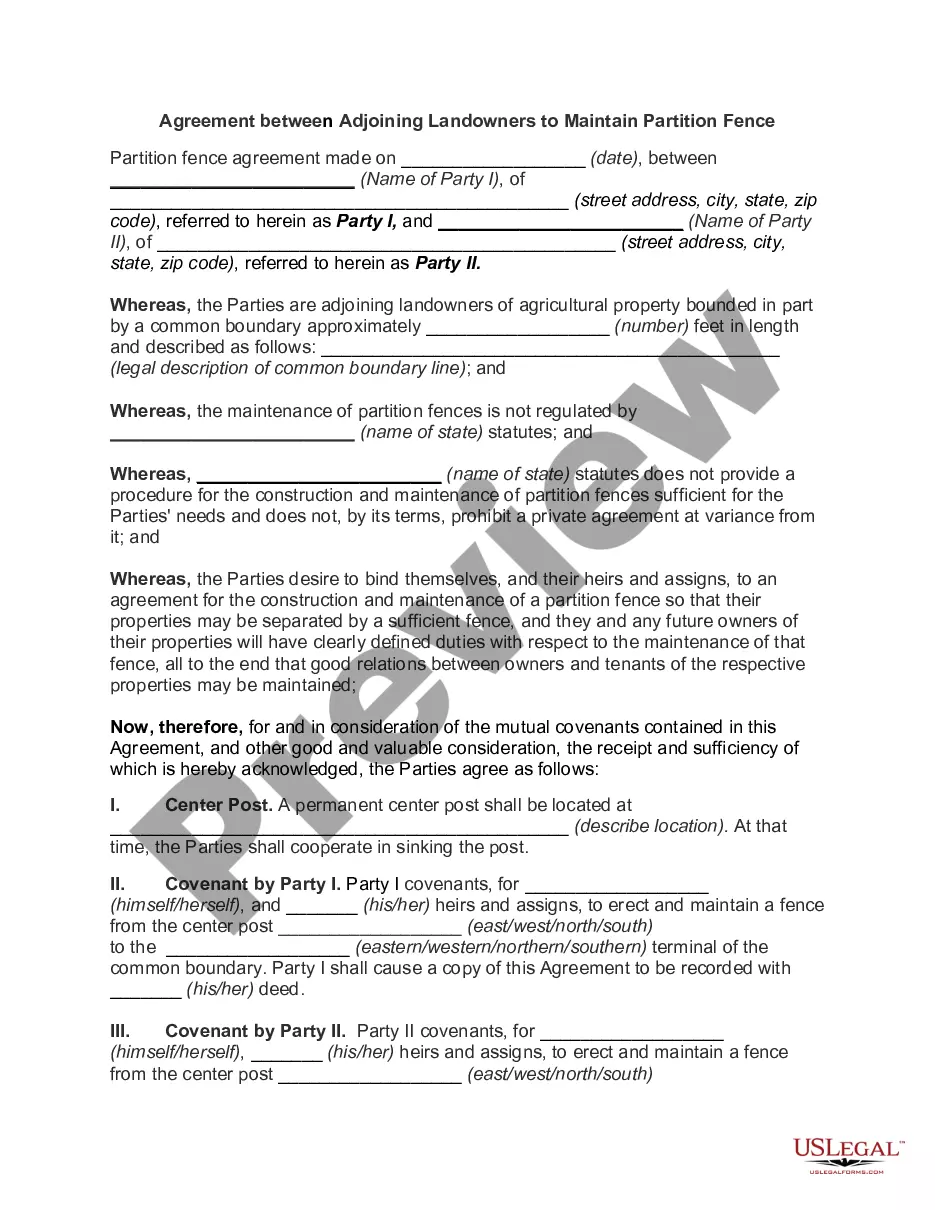
How to fill out Agreement By Adjacent Landowners To Construct A Partition Fence With Each Party To Construct One-Half?
Finding the appropriate legal document template can be quite challenging. Naturally, there are numerous designs accessible online, but how will you locate the legal form you require? Utilize the US Legal Forms website. The platform offers a vast array of templates, including the Oregon Agreement by Adjacent Landowners to Build a Partition Fence with Each Party to Construct One-Half, which can be utilized for both commercial and personal purposes. All the documents are reviewed by experts and comply with state and federal regulations.
If you are already registered, Log In to your account and click the Download button to obtain the Oregon Agreement by Adjacent Landowners to Build a Partition Fence with Each Party to Construct One-Half. Use your account to browse through the legal documents you have acquired in the past. Navigate to the My documents section of your account and retrieve another copy of the document you require.
If you are a new user of US Legal Forms, here are simple steps for you to follow: First, ensure you have selected the correct form for your city/region. You can review the form using the Preview feature and read the form description to confirm it is suitable for you. If the form does not meet your requirements, use the Search bar to find the correct form. Once you are confident that the form is appropriate, click the Get Now button to acquire the form. Choose the payment plan you prefer and fill in the necessary information. Create your account and pay for the order using your PayPal account or credit card. Select the file format and download the legal document template to your device. Complete, modify, and print out and sign the obtained Oregon Agreement by Adjacent Landowners to Build a Partition Fence with Each Party to Construct One-Half.
- US Legal Forms is the largest repository of legal forms where you can find various document templates.
- Utilize the service to download professionally crafted documents that comply with state regulations.
- Browse through an extensive collection of templates tailored for different legal needs.
- Access forms for both personal and business requirements effortlessly.
- Ensure compliance with state and federal standards with every document you acquire.
- Experience a user-friendly platform designed for easy navigation and form retrieval.
Form popularity
FAQ
In short, Oregon has historically been a "fence out" rather than a "fence in" state. The first comprehensive livestock district law (often referred to as a "herd law") was enacted by the Oregon legislature in 1893. General Laws of Oregon (1893) p.
As a rule, if a fence is not a boundary fence, it must be built at least two feet inside your property line. The best options for building near a neighbor's existing fence are placing the new one right up against the current one or leaving enough space between the fences for someone to mow.
Fences may be built on private property, as long as they are not located within the public right of way and they meet certain height and setback requirements. A setback is the distance measured from your property line to a point inside the property.
Where a fence is on the property line between your own property and your neighbor's, the law states that expenses should be shared for installation and repair of the new fence. If a dispute arises, the property owner who pays for the fence is entitled to sue the non-paying homeowner for their half of the costs.
In Colorado, livestock owners are not required to fence their livestock in. Instead, if landowners want to keep livestock off their property, they must fence the livestock out. This is sometimes referred to as the ?Open Range Law?, but the concept of open range is not a law.
Where a fence is on the property line between your own property and your neighbor's, the law states that expenses should be shared for installation and repair of the new fence. If a dispute arises, the property owner who pays for the fence is entitled to sue the non-paying homeowner for their half of the costs.
These requirements are known as ?fencing in? laws and ?estray statutes.? However, within a designated grazing area, the law changes to one of ?fencing out?, meaning any property owner who does not want cattle to wandering onto their property must build a fence to keep them out.
Texas is an open-range state, tracing its roots back to the trail drives and cattle barons of the 1800s. Open range means exactly that?livestock owners are not required to fence in their livestock to prevent them from roaming at large.