Pennsylvania Summary of Revocable Living Trust Agreement
Overview of this form
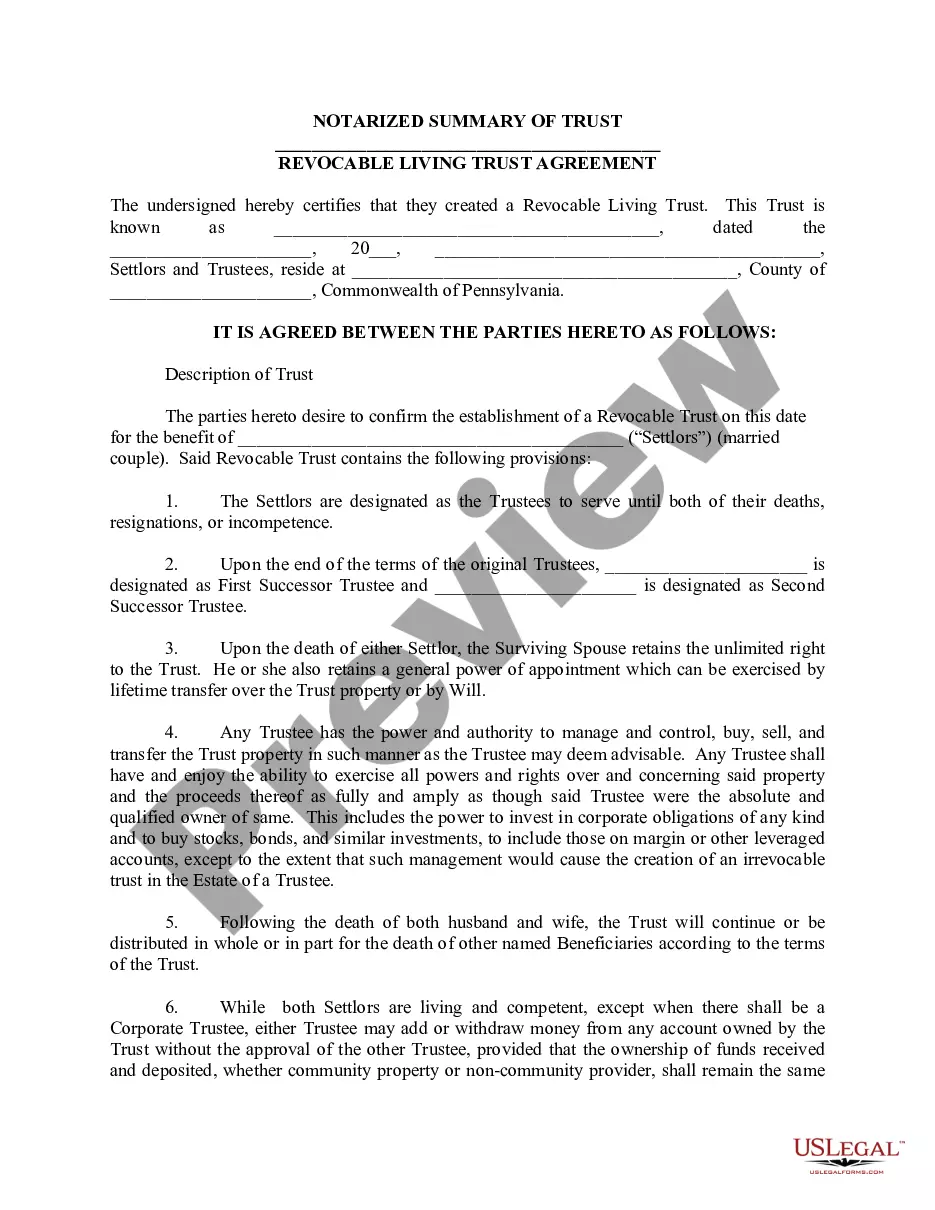
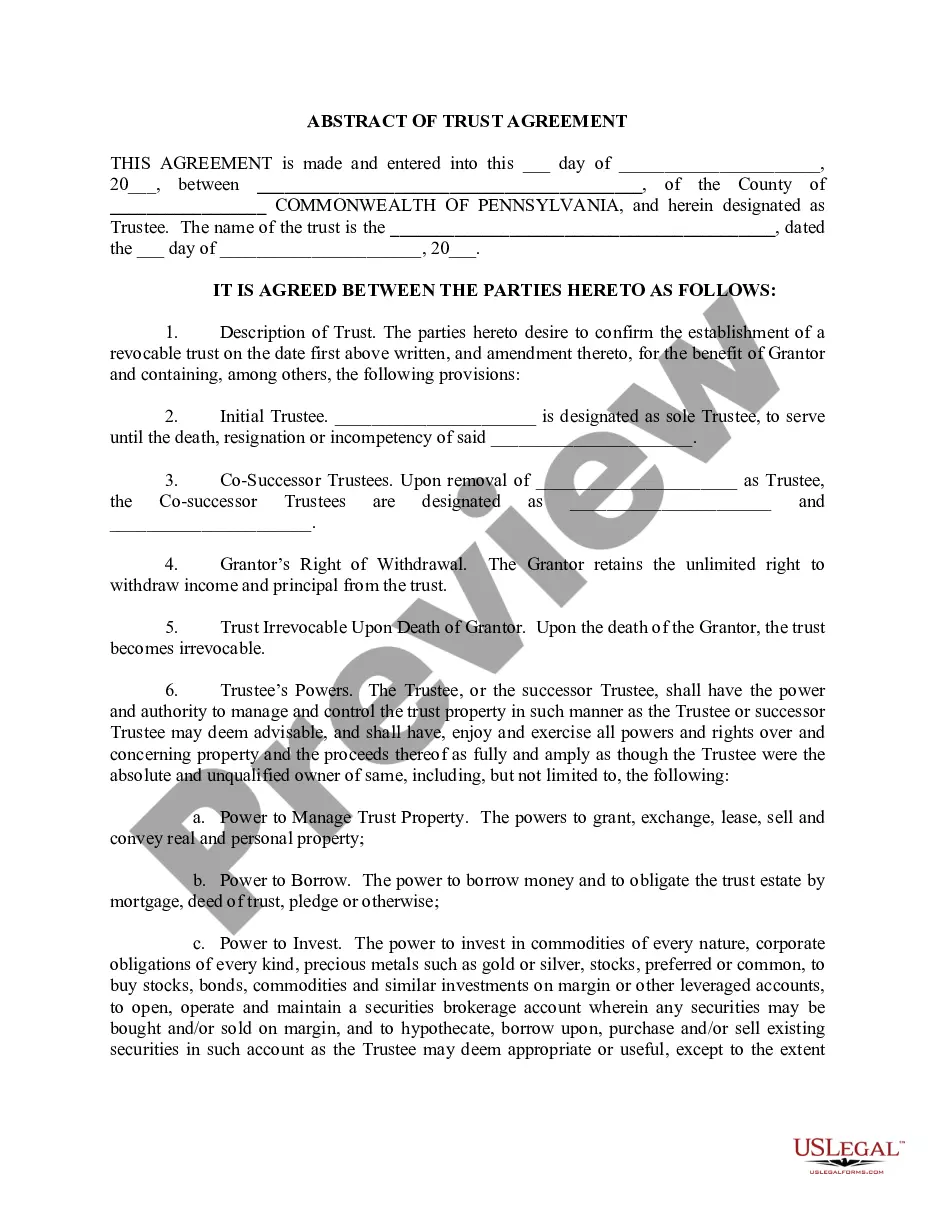
This Summary of Revocable Living Trust Agreement is a legal document that outlines the establishment and provisions of a revocable living trust. It provides a clear summary of the trust's terms, which allow the grantor (or settlor) to maintain control of their assets during their lifetime while designating how those assets will be managed or distributed after death. Unlike an irrevocable trust, a revocable living trust can be altered or revoked by the grantor at any time before their death, offering flexibility in estate planning.
Form components explained
- The name and date of the revocable trust.
- Identification of the settlors and trustees, including successor trustees.
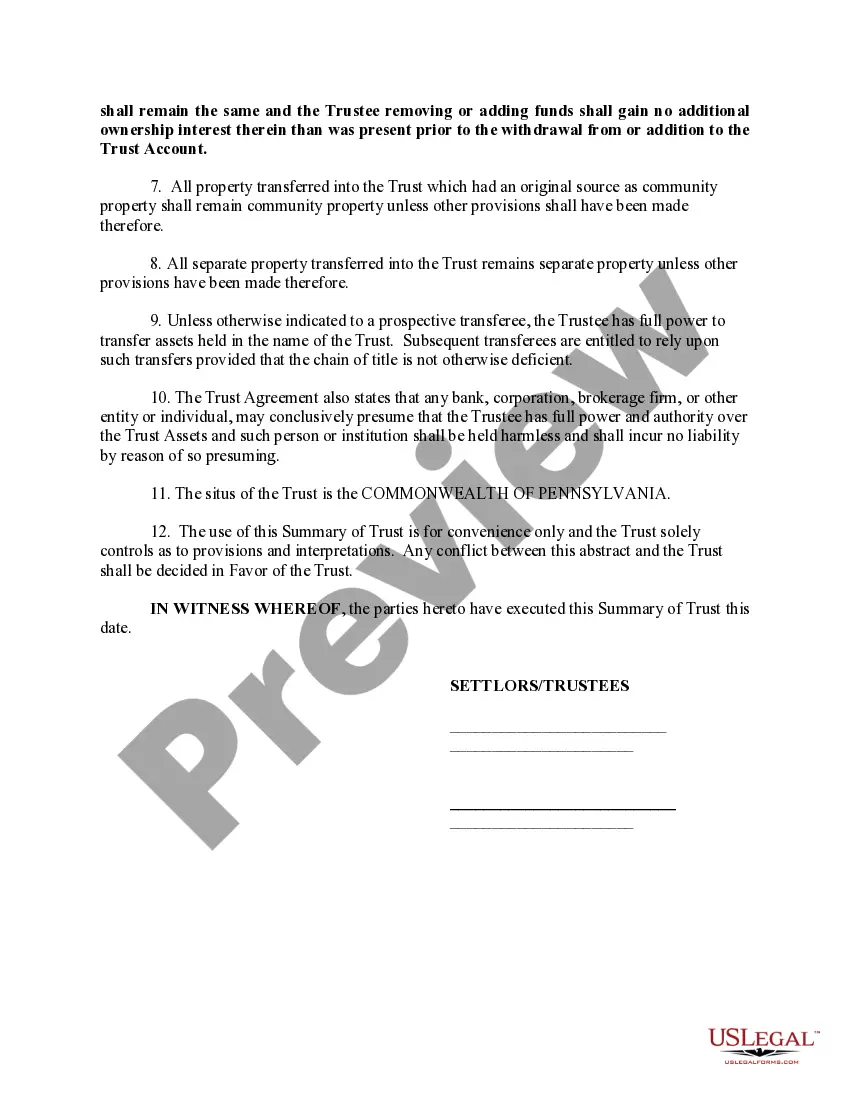
- Provisions for asset management and control by the trustees.
- Rights of the surviving spouse upon the death of a settlor.
- Rules about community and separate property in the trust.
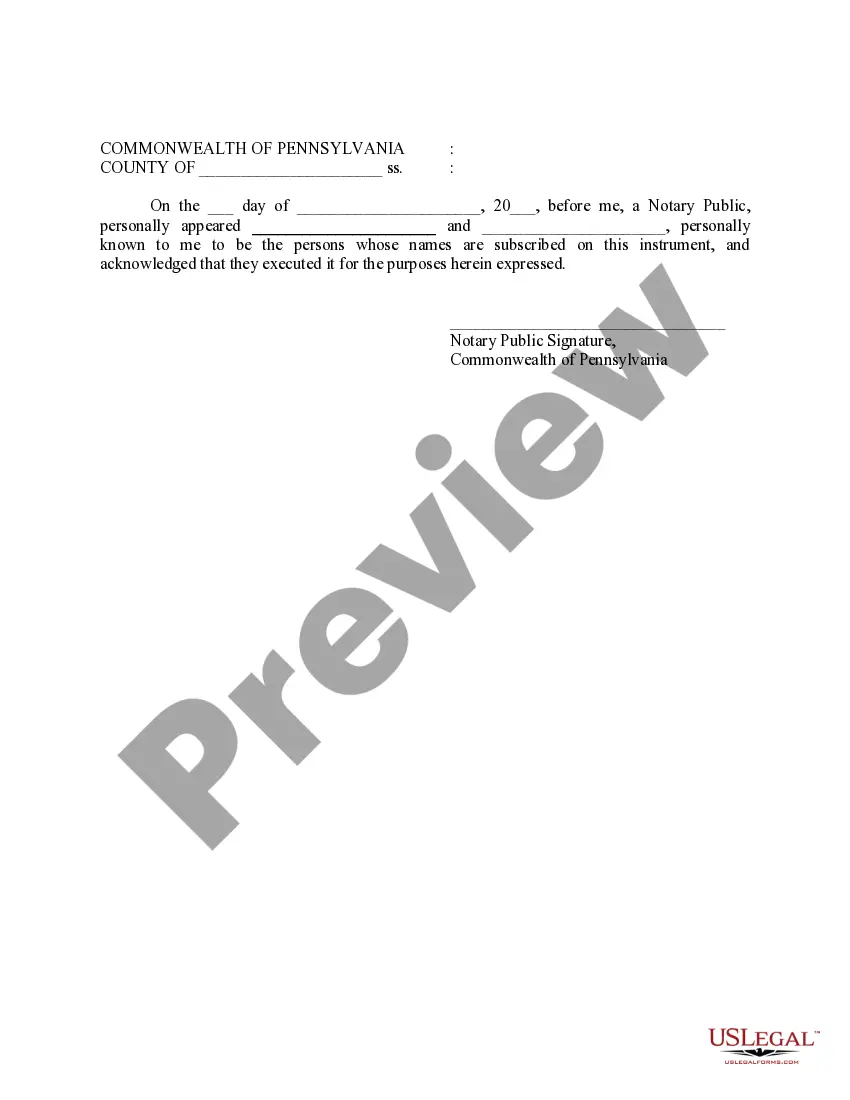
- Notarization and legal acknowledgment of the trust agreement.
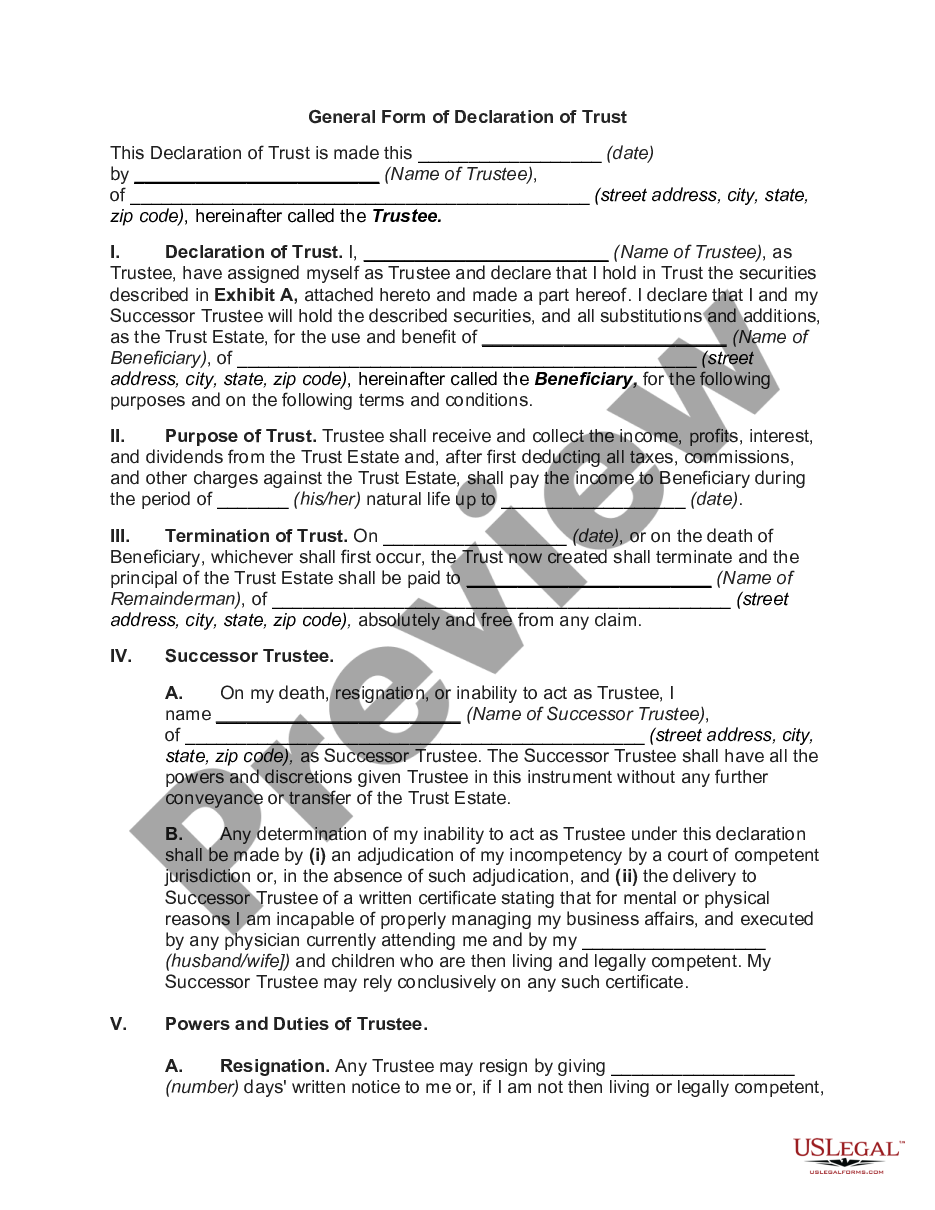
When to use this document
This form should be used when creating or summarizing a revocable living trust. It is beneficial for individuals or couples looking to establish a clear estate plan that includes directives for asset management during their lifetime and distribution after death. This form is particularly useful for those who want to ensure that their assets are handled according to their wishes and are interested in avoiding probate upon their passing.
Who needs this form
- Individuals or couples seeking to establish a revocable living trust.
- Those who want to maintain control over their assets while providing for their beneficiaries.
- Individuals looking to simplify the estate planning process and avoid probate.
- Anyone interested in ensuring their wishes regarding asset distribution are clearly defined.
Steps to complete this form
- Identify the full name and date of creation of the revocable living trust.
- Enter the names and addresses of the settlors and trustees involved.
- Designate the successor trustees in case of death or resignation.
- Specify the rights of the surviving spouse and asset management powers of the trustees.
- Sign the document in the presence of a notary public to validate the trust agreement.
Is notarization required?
Yes, this form must be notarized to be legally valid. It requires the signatures of the settlers to be witnessed and acknowledged by a notary public. US Legal Forms offers integrated online notarization, allowing for a secure video call with a notary, making the process simple and accessible at any time without the need for travel.
Get your form ready online
Our built-in tools help you complete, sign, share, and store your documents in one place.
Make edits, fill in missing information, and update formatting in US Legal Forms—just like you would in MS Word.
Download a copy, print it, send it by email, or mail it via USPS—whatever works best for your next step.
Sign and collect signatures with our SignNow integration. Send to multiple recipients, set reminders, and more. Go Premium to unlock E-Sign.
If this form requires notarization, complete it online through a secure video call—no need to meet a notary in person or wait for an appointment.
We protect your documents and personal data by following strict security and privacy standards.

Make edits, fill in missing information, and update formatting in US Legal Forms—just like you would in MS Word.

Download a copy, print it, send it by email, or mail it via USPS—whatever works best for your next step.

Sign and collect signatures with our SignNow integration. Send to multiple recipients, set reminders, and more. Go Premium to unlock E-Sign.

If this form requires notarization, complete it online through a secure video call—no need to meet a notary in person or wait for an appointment.

We protect your documents and personal data by following strict security and privacy standards.
Avoid these common issues
- Failing to notarize the document, which may render it invalid.
- Not clearly naming the successor trustees, leading to confusion about asset management.
- Omitting specific provisions regarding community and separate property.
- Using vague language that could lead to disputes among beneficiaries.
Why complete this form online
- Convenience of downloading and filling out the form from the comfort of your home.
- Editable format that allows for customization according to your specific needs.
- Access to templates drafted by licensed attorneys to ensure legal validity.
- Quick turnaround without the need for in-person appointments with attorneys.
Looking for another form?
Form popularity
FAQ
Establishing a trust requires serious legal help, which is not cheap. A typical living trust can cost $2,000 or more, while a basic last will and testament can be drawn up for about $150 or so.
At the most basic level, a revocable living trust, also known simply as a revocable trust, is a written document that determines how your assets will be handled after you die.Assets you place in the trust are then transferred to your designated beneficiaries upon your death.
As far as the Internal Revenue Service is concerned, trust property belongs to the grantor. The grantor names a trustee to manage the assets, but during their lifetime, most people name themselves in this position. A successor trustee is named to carry on when the grantor dies or becomes incapacitated.
The need for a lawyer to help with your estate has nothing to do with a Revocable Living Trust. If your executor could handle your estate alone, then there is no need for a lawyer even if you had no Revocable Living Trust.For example, with filing inheritance and estate tax returns or obtaining beneficiary releases.
No, you don't need a lawyer to set up a trust, but it might be a good idea to seek legal advice to ensure the trust is set up correctly and that you have considered all long-term financial and estate planning aspects of the trust.Some living trusts are revocable, which means the trust can be changed at any time.
Sure you can write your own revocable living trust. In fact, you can do it better than a lot of the attorneys. First you have to ascertain that you really want a trust.
Pick a type of living trust. If you're married, you'll first need to decide whether you want a single or joint trust. Take stock of your property. Choose a trustee. Draw up the trust document. Sign the trust. Transfer your property to the trust.
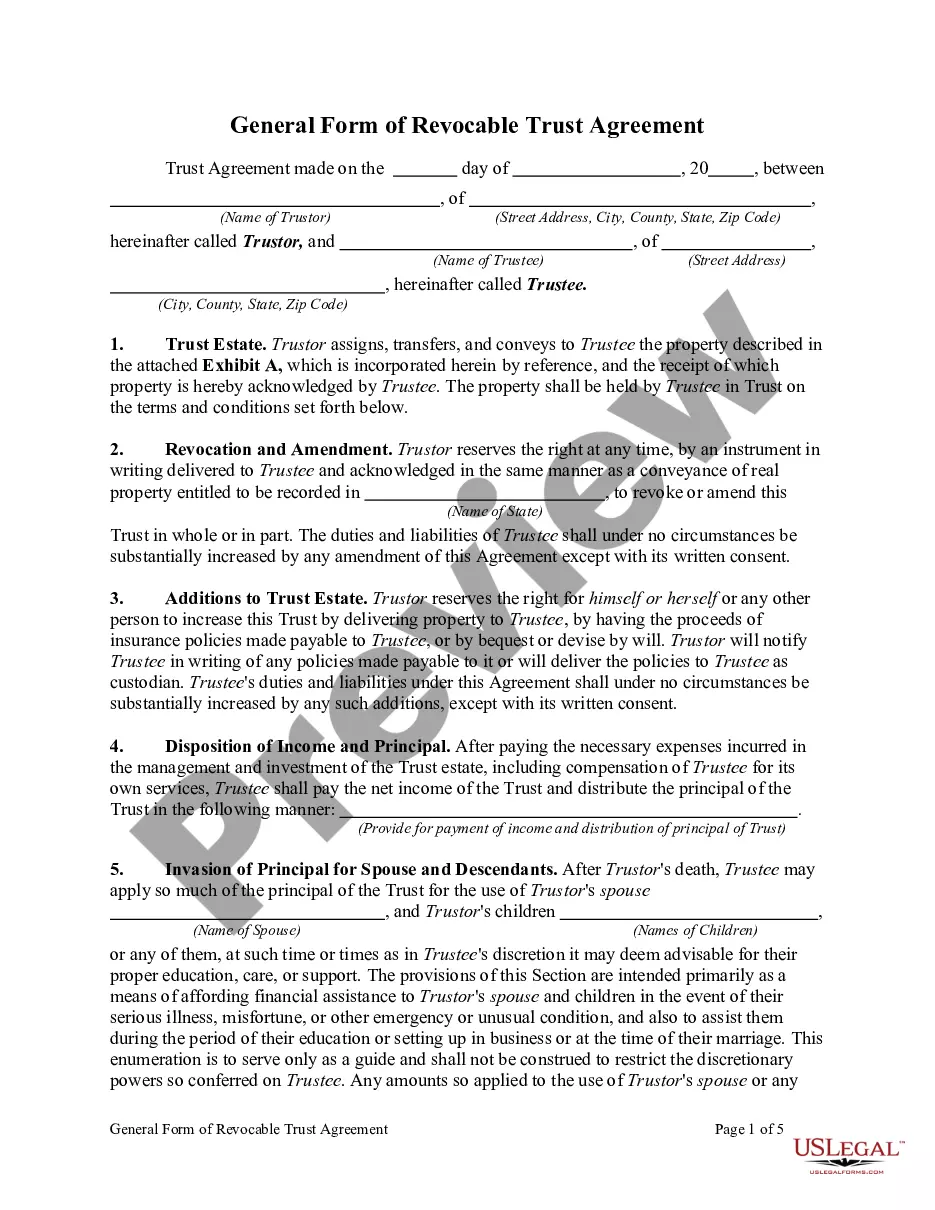
A revocable living trust is a trust document created by an individual that can be changed over time. Revocable living trusts are used to avoid probate and to protect the privacy of the trust owner and beneficiaries of the trust as well as minimize estate taxes.
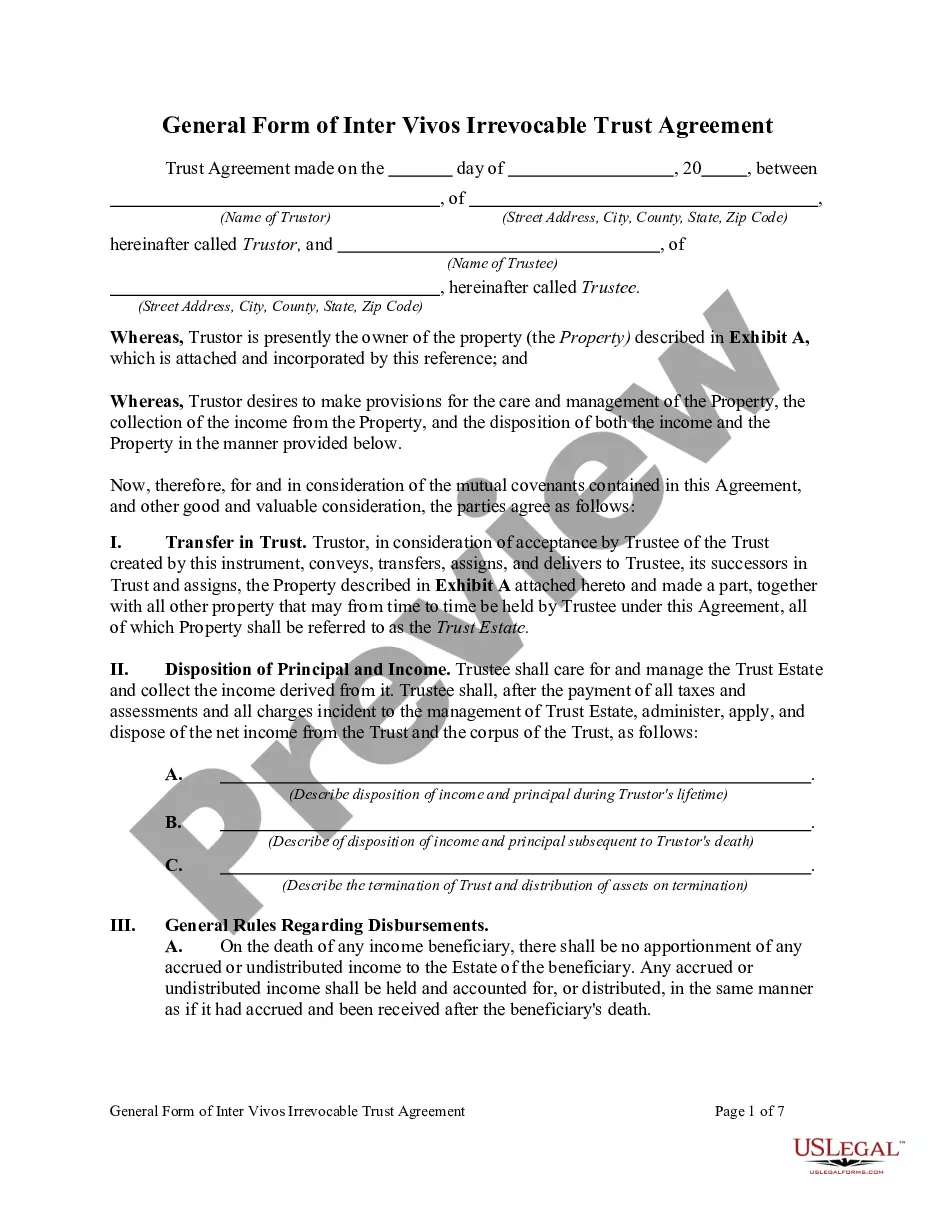
A revocable trust and living trust are separate terms that describe the same thing: a trust in which the terms can be changed at any time. An irrevocable trust describes a trust that cannot be modified after it is created without the consent of the beneficiaries.