Pennsylvania Decree
About this form
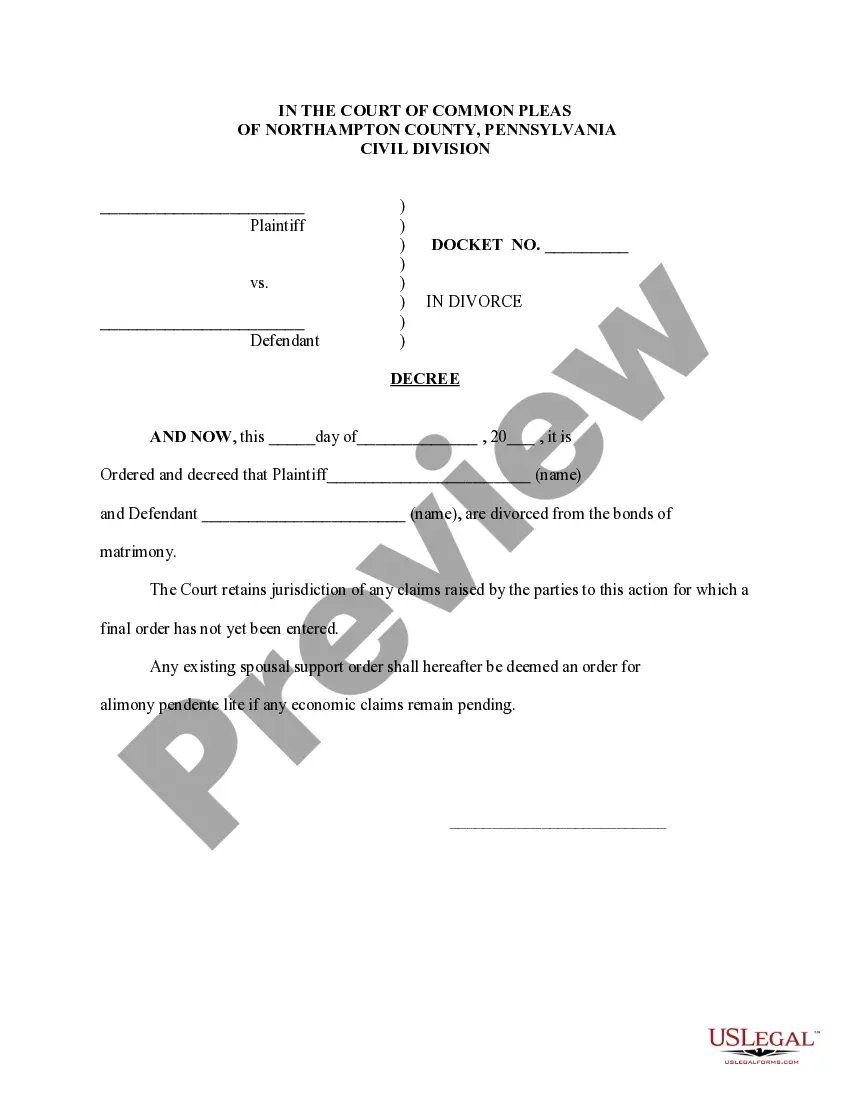
A Decree is an official order issued by a legal authority, specifically addressing the dissolution of marriage. This form serves to formalize the divorce process, distinguishing it from other related legal documents such as divorce petitions or settlements. By obtaining this decree, both parties are officially recognized as divorced, allowing them to proceed with their lives independently.
Form components explained
- The date of issuance of the decree.
- The names of both the Plaintiff and Defendant involved in the divorce.
- The court's jurisdiction in the matter.
- A statement confirming the divorce from the bonds of matrimony.
- Conditions regarding any pending claims or spousal support orders.

When to use this form
This decree should be used once both parties have agreed to the terms of their divorce, or after a court hearing has taken place. It is essential in legal proceedings for officially terminating the marital relationship and is necessary for moving forward with personal matters, including property division and custody arrangements.
Intended users of this form
- Individuals looking to finalize their divorce in Northampton County, Pennsylvania.
- Parties who have reached a mutual agreement on divorce terms.
- Anyone who has gone through a legal divorce process but requires a formal decree to complete the proceedings.
Steps to complete this form
- Identify the parties involved by entering the names of the Plaintiff and Defendant.
- Enter the date the decree is issued.
- Provide the appropriate docket number assigned to the case.
- Ensure that any claims related to spousal support or alimony are clearly stated.
- Review the completed form for accuracy and ensure all required fields are filled.
Notarization guidance
This form does not typically require notarization unless specified by local law. However, it is advisable to check with court requirements for your specific case to ensure compliance.
Get your form ready online
Our built-in tools help you complete, sign, share, and store your documents in one place.
Make edits, fill in missing information, and update formatting in US Legal Forms—just like you would in MS Word.
Download a copy, print it, send it by email, or mail it via USPS—whatever works best for your next step.
Sign and collect signatures with our SignNow integration. Send to multiple recipients, set reminders, and more. Go Premium to unlock E-Sign.
If this form requires notarization, complete it online through a secure video call—no need to meet a notary in person or wait for an appointment.
We protect your documents and personal data by following strict security and privacy standards.

Make edits, fill in missing information, and update formatting in US Legal Forms—just like you would in MS Word.

Download a copy, print it, send it by email, or mail it via USPS—whatever works best for your next step.

Sign and collect signatures with our SignNow integration. Send to multiple recipients, set reminders, and more. Go Premium to unlock E-Sign.

If this form requires notarization, complete it online through a secure video call—no need to meet a notary in person or wait for an appointment.

We protect your documents and personal data by following strict security and privacy standards.
Common mistakes to avoid
- Failing to include the docket number, which is crucial for court records.
- Not providing full legal names of both parties, leading to potential validation issues.
- Incorrectly drafting conditions regarding spousal support, which could lead to complications later.
Advantages of online completion
- Convenience of downloading and completing the form at your own pace.
- Editability allows users to make changes easily before finalizing their decree.
- Reliability with forms drafted by licensed attorneys, ensuring compliance with legal standards.
Summary of main points
- The Decree serves as the formal documentation of divorce.
- Accurate completion is essential to avoid legal complications.
- Familiarity with local requirements ensures proper enforcement.
Looking for another form?
Form popularity
FAQ
The decree is a binding legal court order that says what you and your spouse must do moving forward. If you settle your case, your settlement is submitted to the court in writing or it is spoken into the record at the courtroom.
Legally speaking, a judgment (decree) is a written court order stating that the spouses are divorced. After the spouses and the judge signs this order, it must be filed with the clerk, who will enter it into the system.
Locate the county courthouse responsible for issuing the divorce decree. Contact the courthouse and speak with a clerk, who will disclose what information a party must provide to search their records. Type and print their request, including the date, identifying information, and the requestor's signature.
A decree is an order handed down by a judge that resolves the issues in a court case. Though a decree is similar to a judgment, it differs in a few key ways: Historically, courts of equity, admiralty, divorce, or probate could make decrees while a court of law rendered judgments.
A divorce decree is a court document that is a final judgment from divorce court. It contains information about your case including spousal support, child support, custody, visitation, property division, and other information.
What Is A PA Divorce Decree? A PA divorce decree is nothing more than an order of court declaring the end of a marriage. The Pennsylvania divorce decree allows either spouse to remarry or leave their estate upon their death to the person of their choosing.
A certified copy of a Divorce Decree can be obtained in the Office of Judicial Records, Civil Filing Center, Room 296, City Hall either in person over-the-counter or by written request via mail. Acceptable payment options are cash, certified check or money order.
Simply put, a final decree of divorce is a formal order from the court that grants the termination of the marriage. If your divorce is contested and ends up at a trial, the judge will issue a judgment. The judgment is confirmed when the decree is signed and dated by the family court judge and the clerk of court.