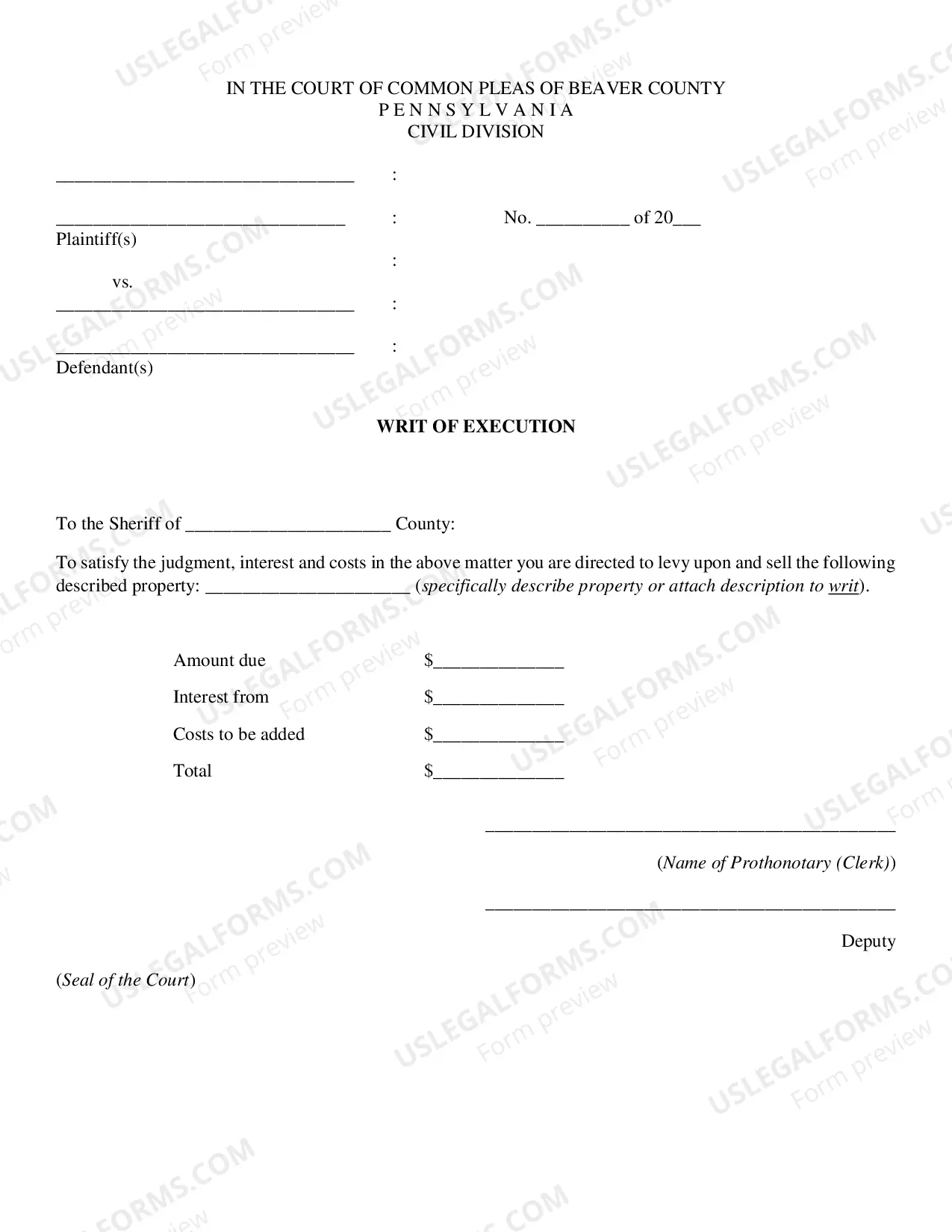
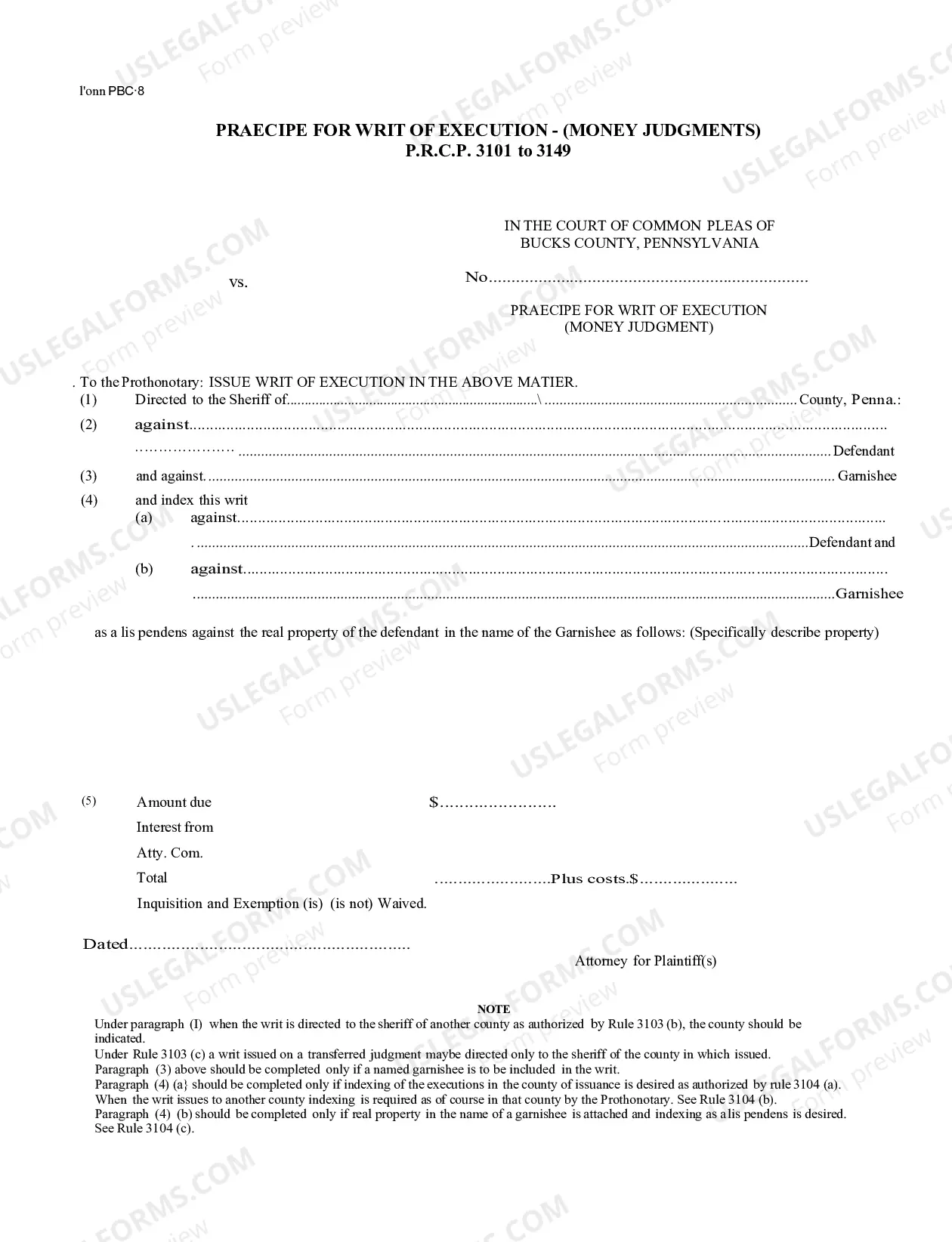
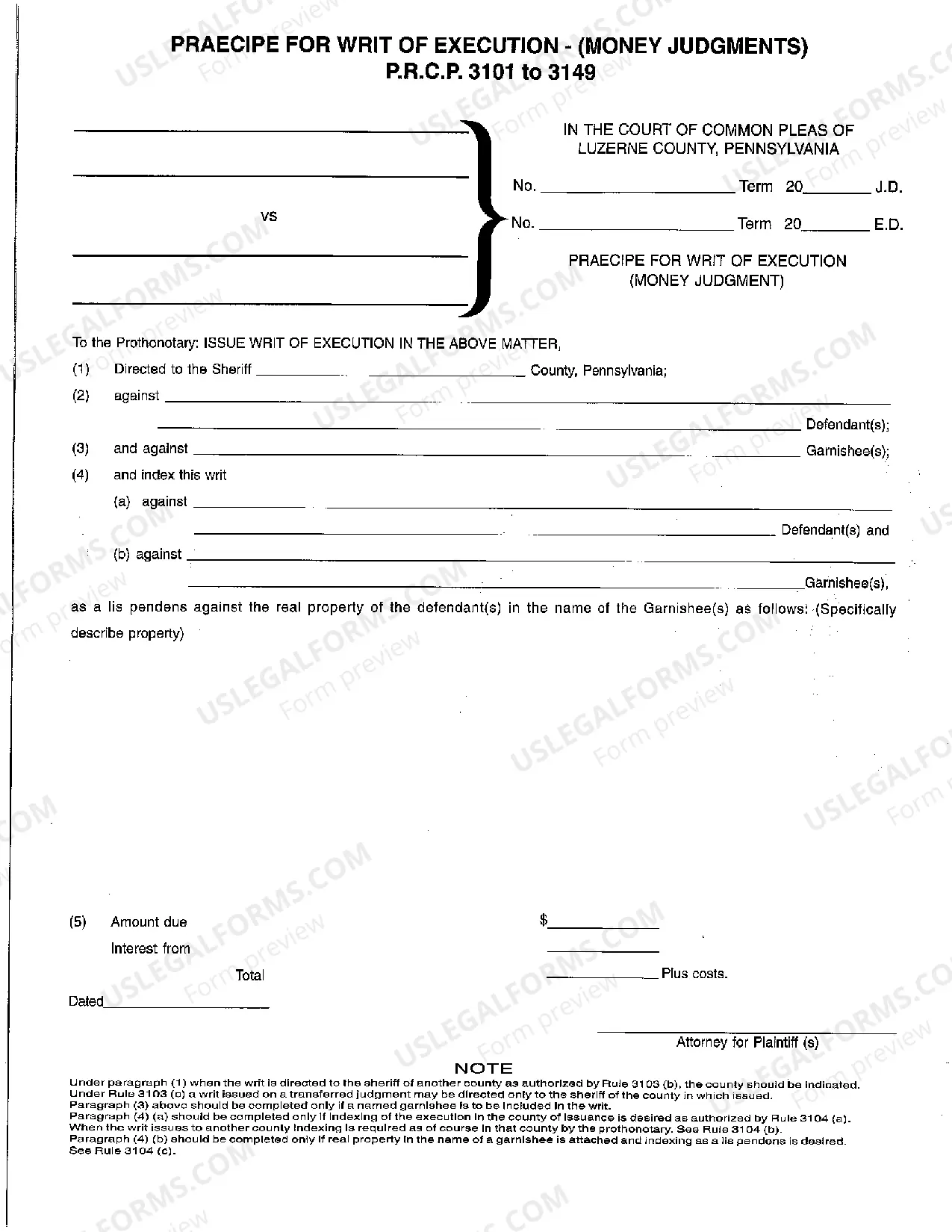
Pennsylvania Praecipe For Writ of Execution-Money Judgments
About this form
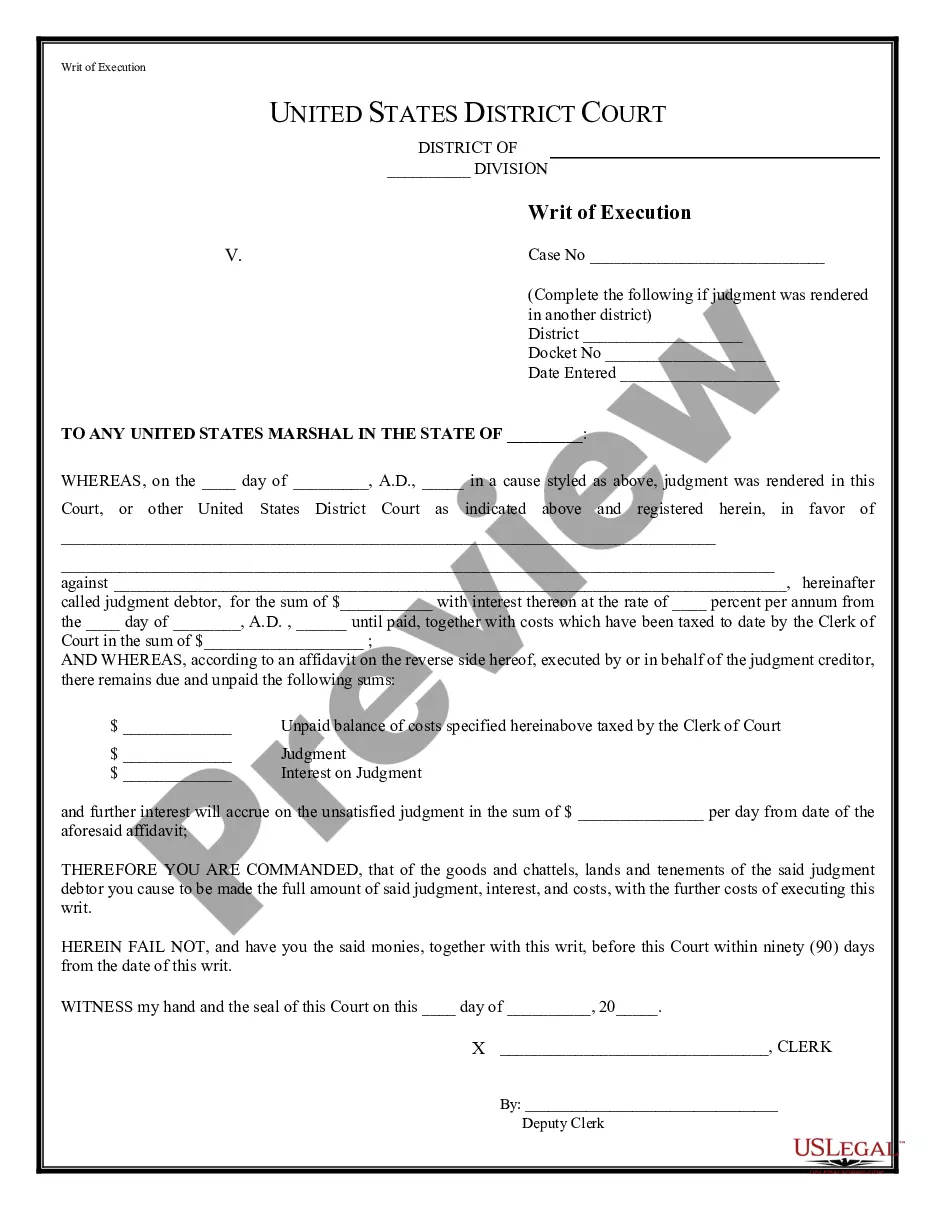
The Praecipe For Writ of Execution-Money Judgments is a legal document used to request the court to direct a sheriff to enforce a money judgment. This form differs from other judgment enforcement methods by specifically focusing on the seizure and sale of property to satisfy a monetary judgement against a defendant. It is essential for creditors seeking to collect debts through property liquidation.
What’s included in this form
- Identification of the court and parties involved in the case.
- Details of the property to be levied, including specific descriptions.
- Financial breakdown: amount due, interest, costs to be added, and total amount owed.
- Signature and stamp from the Prothonotary (Clerk) indicating court approval.
- Instructions to the sheriff for executing the writ.
When to use this document
This form is used when a creditor has obtained a money judgment against a debtor and wishes to enforce it by levying the debtorâs property. It is necessary when previous attempts to collect the debt have failed or when the creditor seeks a court-authorized method to recover the owed amounts through the sale of the debtor's property.
Who should use this form
- Creditors who have received a legal judgment in their favor for unpaid debts.
- Attorneys representing clients in collections proceedings.
- Individuals seeking to enforce court judgments against personal assets.
Completing this form step by step
- Identify the court handling the case and enter the case number.
- Fill in the names of the plaintiff(s) and defendant(s) involved.
- Clearly describe the property to be levied upon to satisfy the judgment.
- Enter the amount due, interest amount, costs, and the total owed.
- Obtain the necessary signatures and court seal from the Prothonotary.
Does this document require notarization?
This form does not typically require notarization unless specified by local law.
Get your form ready online
Our built-in tools help you complete, sign, share, and store your documents in one place.
Make edits, fill in missing information, and update formatting in US Legal Forms—just like you would in MS Word.
Download a copy, print it, send it by email, or mail it via USPS—whatever works best for your next step.
Sign and collect signatures with our SignNow integration. Send to multiple recipients, set reminders, and more. Go Premium to unlock E-Sign.
If this form requires notarization, complete it online through a secure video call—no need to meet a notary in person or wait for an appointment.
We protect your documents and personal data by following strict security and privacy standards.

Make edits, fill in missing information, and update formatting in US Legal Forms—just like you would in MS Word.

Download a copy, print it, send it by email, or mail it via USPS—whatever works best for your next step.

Sign and collect signatures with our SignNow integration. Send to multiple recipients, set reminders, and more. Go Premium to unlock E-Sign.

If this form requires notarization, complete it online through a secure video call—no need to meet a notary in person or wait for an appointment.

We protect your documents and personal data by following strict security and privacy standards.
Typical mistakes to avoid
- Neglecting to provide a detailed description of the property to be levied, which can lead to delays.
- Incorrectly calculating the total amount owed, including interest and costs.
- Failing to acquire the required signature from the Prothonotary or court official.
Benefits of completing this form online
- Convenient access to legal forms from anywhere at any time.
- Editable templates that help ensure accuracy and compliance.
- Reliable and up-to-date documents drafted by licensed attorneys.
Legal use & context
- This form is legally enforceable upon proper completion and filing with the court.
- It allows creditors to recover debts effectively through the seizure of specific assets.
Main things to remember
- The Praecipe For Writ of Execution-Money Judgments is essential for collecting debts through property seizure.
- Accurate completion is crucial to avoid delays in enforcement.
- This form operates under Pennsylvania law and is specific to addressing money judgments.
Looking for another form?
Form popularity
FAQ
A writ of execution is a court order directing the Sheriff to take an action to enforce a judgement.
What happens if a defendant does not pay a judgement? A creditor can enforce the judgement and use state laws to seize assets in the hands of the debtor or third parties to collect the amount owed.
Stopping the Writ of Execution The most effective way to stop a writ of execution is to ask the Judgment Creditor to stop it. The sheriff will often back off if the parties are working to resolve the judgment.
Once granted, a Writ of Execution is good for 90 days.
Code § 237.5 - Form of Notice of Praecipe to Enter Judgment by Default. YOU ARE IN DEFAULT BECAUSE YOU HAVE FAILED TO ENTER A WRITTEN APPEARANCE PERSONALLY OR BY ATTORNEY AND FILE IN WRITING WITH THE COURT YOUR DEFENSES OR OBJECTIONS TO THE CLAIMS SET FORTH AGAINST YOU.
Description. A writ of execution is a process issued by the court directing the U.S. Marshal to enforce and satisfy a judgment for payment of money. (Federal Rules of Civil Procedure 69).
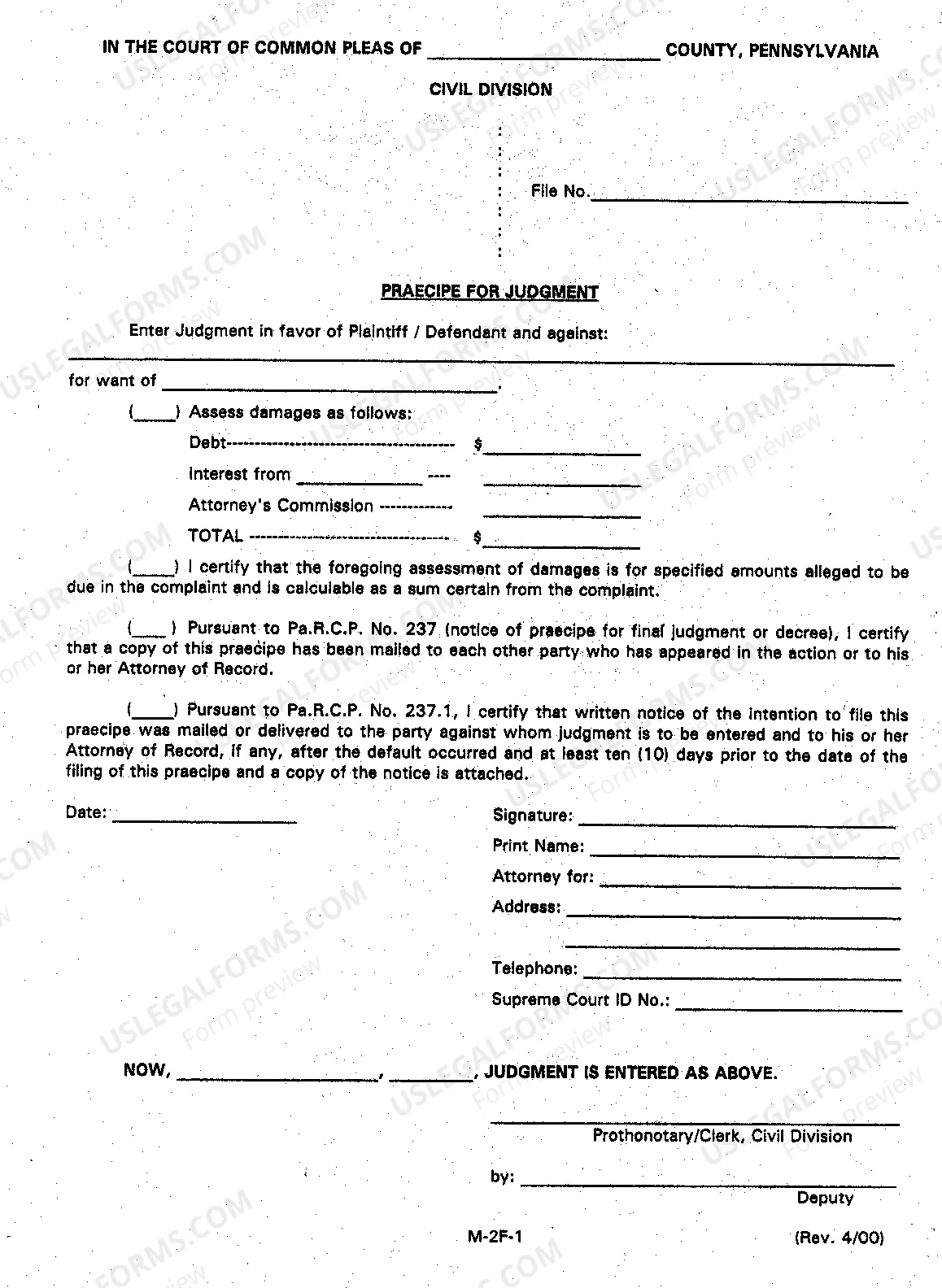
A document that a plaintiff files with the prothonotary to commence a civil action in a Pennsylvania court of common pleas before filing a complaint (Pa. R. Civ.
The writ authorizes the sheriff's office to take certain action to collect the monies against the debtor. When you file a writ of execution you are then directing the sheriff to take some additional action concerning the judgment. This can apply significant pressure for the debtor to pay.