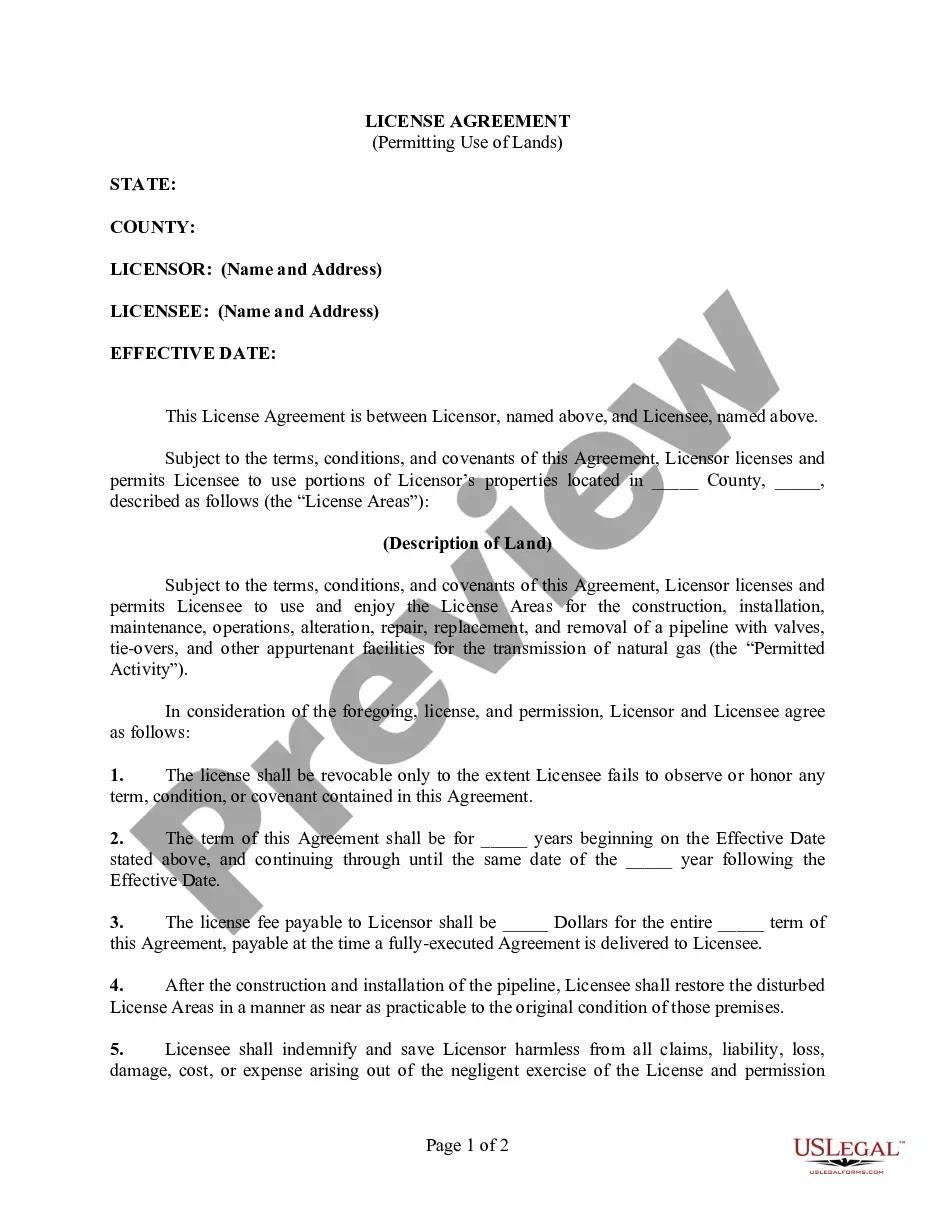
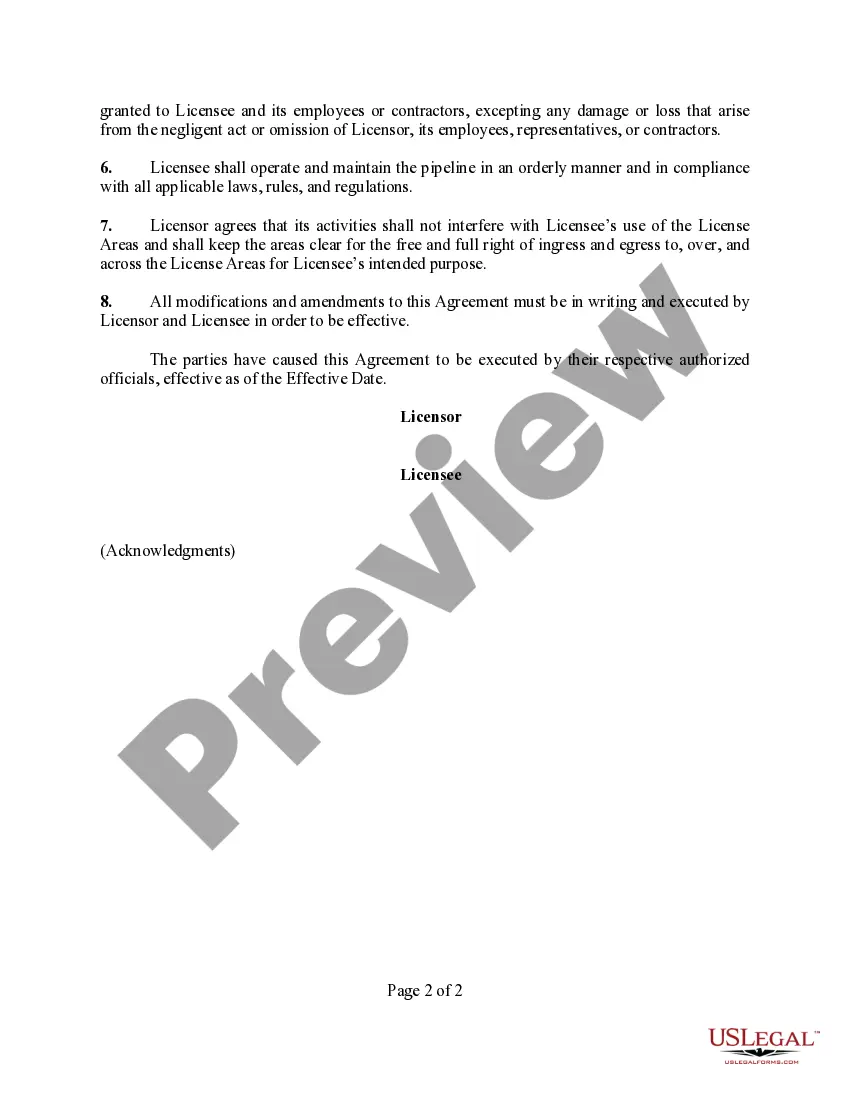
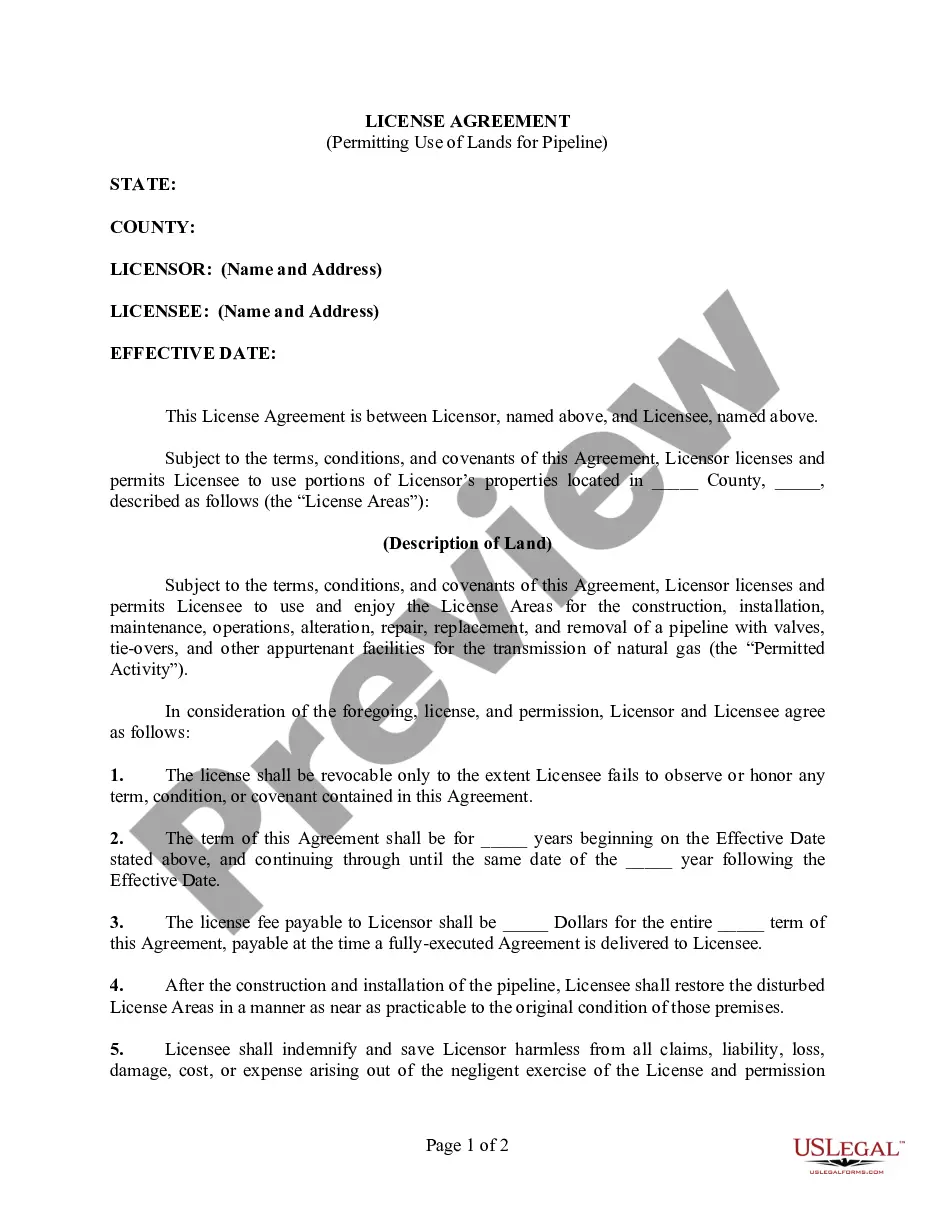
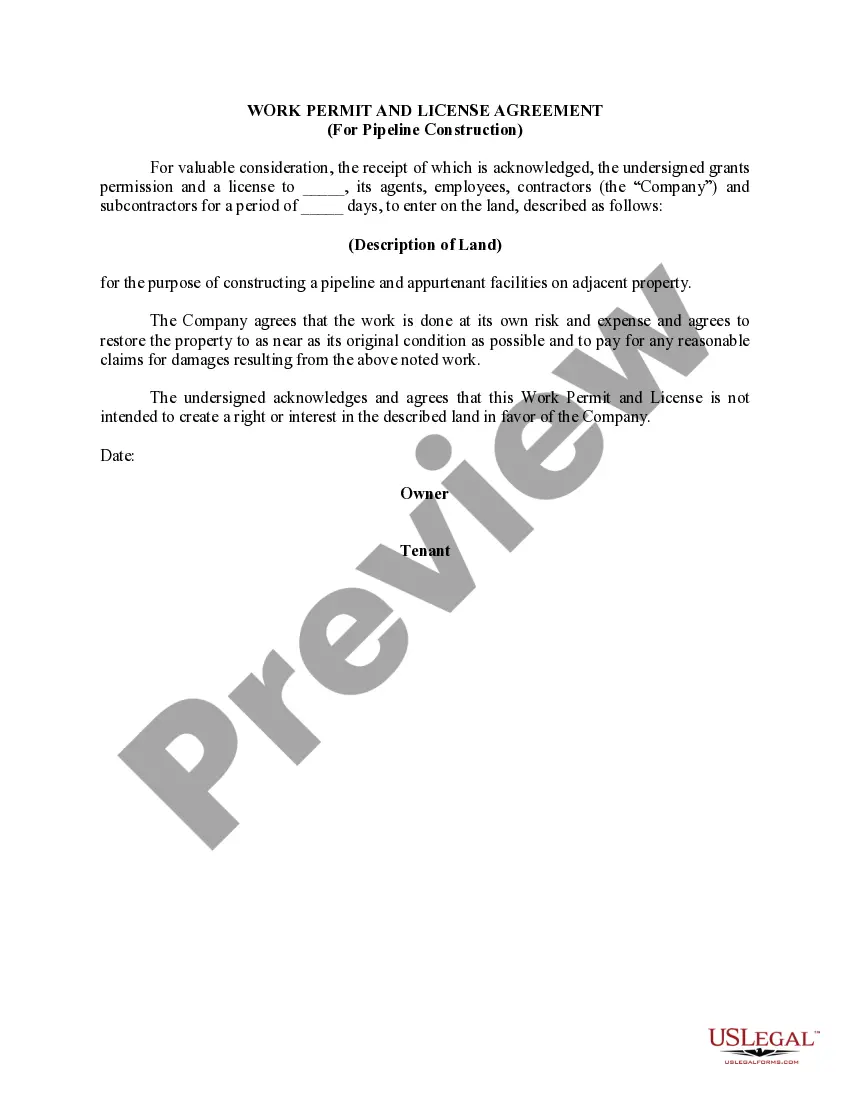
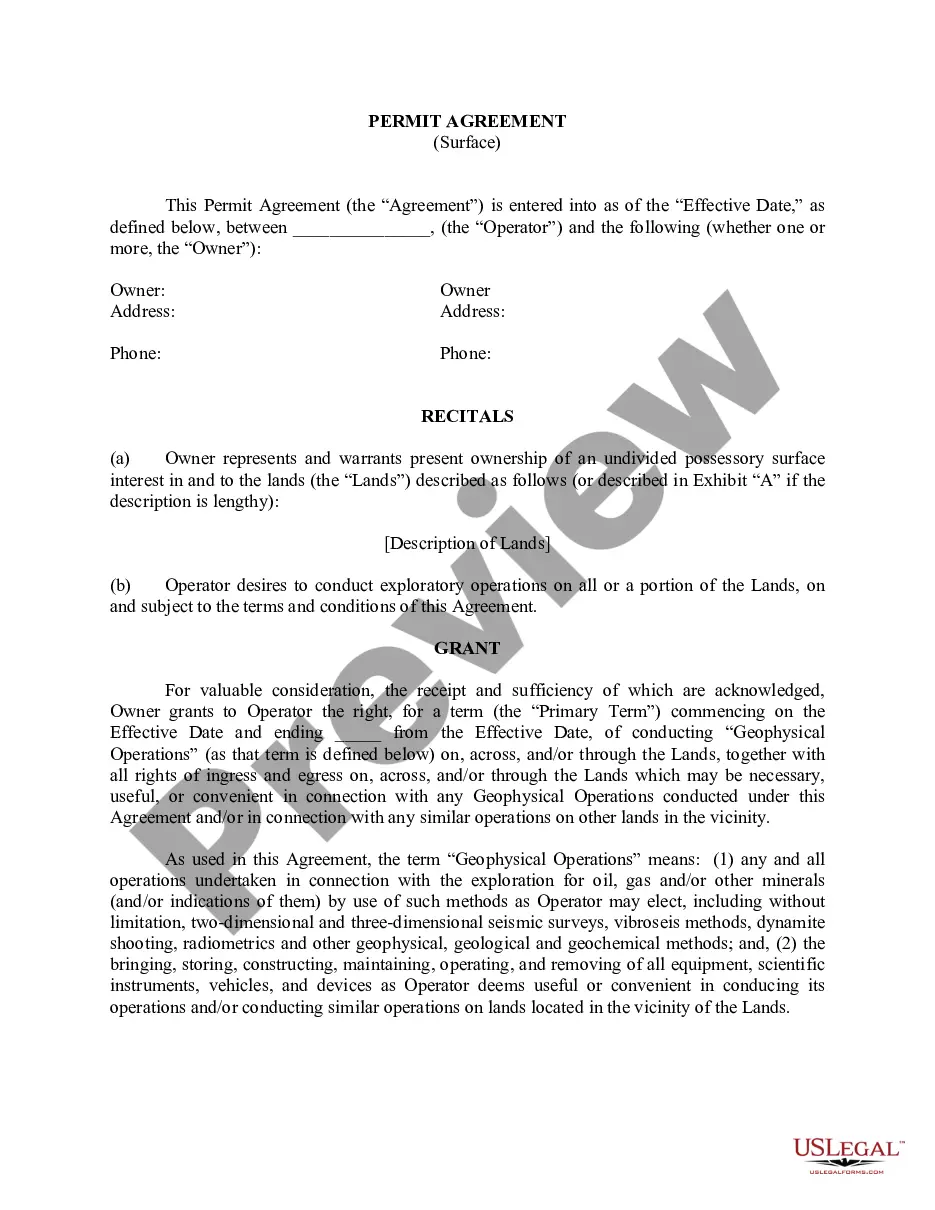
Pennsylvania License Agreement (Permitting Use of Lands)
Description
Get your form ready online
Our built-in tools help you complete, sign, share, and store your documents in one place.
Make edits, fill in missing information, and update formatting in US Legal Forms—just like you would in MS Word.
Download a copy, print it, send it by email, or mail it via USPS—whatever works best for your next step.
Sign and collect signatures with our SignNow integration. Send to multiple recipients, set reminders, and more. Go Premium to unlock E-Sign.
If this form requires notarization, complete it online through a secure video call—no need to meet a notary in person or wait for an appointment.
We protect your documents and personal data by following strict security and privacy standards.

Make edits, fill in missing information, and update formatting in US Legal Forms—just like you would in MS Word.

Download a copy, print it, send it by email, or mail it via USPS—whatever works best for your next step.

Sign and collect signatures with our SignNow integration. Send to multiple recipients, set reminders, and more. Go Premium to unlock E-Sign.

If this form requires notarization, complete it online through a secure video call—no need to meet a notary in person or wait for an appointment.

We protect your documents and personal data by following strict security and privacy standards.
Looking for another form?
How to fill out License Agreement (Permitting Use Of Lands)?
If you need to total, obtain, or produce authorized document themes, use US Legal Forms, the most important collection of authorized varieties, that can be found online. Use the site`s simple and hassle-free search to get the paperwork you will need. Various themes for company and person reasons are categorized by types and states, or keywords and phrases. Use US Legal Forms to get the Pennsylvania License Agreement (Permitting Use of Lands) in just a handful of mouse clicks.
Should you be previously a US Legal Forms consumer, log in to your account and then click the Download switch to have the Pennsylvania License Agreement (Permitting Use of Lands). You may also accessibility varieties you formerly saved within the My Forms tab of your own account.
If you are using US Legal Forms for the first time, follow the instructions listed below:
- Step 1. Ensure you have chosen the form to the proper city/region.
- Step 2. Utilize the Review choice to examine the form`s articles. Never overlook to read through the outline.
- Step 3. Should you be not satisfied with the form, take advantage of the Lookup industry towards the top of the display to find other versions of your authorized form web template.
- Step 4. Once you have identified the form you will need, click the Buy now switch. Choose the pricing program you prefer and include your accreditations to register to have an account.
- Step 5. Method the financial transaction. You may use your charge card or PayPal account to complete the financial transaction.
- Step 6. Pick the structure of your authorized form and obtain it on the product.
- Step 7. Comprehensive, revise and produce or indication the Pennsylvania License Agreement (Permitting Use of Lands).
Every single authorized document web template you purchase is your own property eternally. You may have acces to each and every form you saved within your acccount. Click the My Forms section and choose a form to produce or obtain yet again.
Compete and obtain, and produce the Pennsylvania License Agreement (Permitting Use of Lands) with US Legal Forms. There are millions of professional and status-particular varieties you can use for your personal company or person requirements.
Form popularity
FAQ
This rule provides that the owner of a higher land is not liable for damages caused by water that naturally flows down into the lower land.
Who owns public waters? The title to the beds of public waters is held in trust by the Commonwealth of Pennsylvania for the benefit of the public. In case of rivers and streams, the Commonwealth's ownership extends to ordinary low water mark, and the adjacent riparian landowner owns above the low water mark.
Many activities in Pennsylvania streams, water bodies such as lakes or ponds, or wetlands require an authorization or permit from the Pennsylvania Department of Environmental Protection (DEP) to protect public health, safety and the environment.
The riparian right is a right to make use of the water flowing in a stream upon or next to riparian land. Pennsylvania courts have adopted what is known as the "reasonable use" doctrine, also called the "American Rule.".
A dam permit is required if the proposed dam will be built across a stream and it meets one of the following criteria: a. The contributory drainage area exceeds 100 acres. The drainage area is the land area that, during a storm event, contributes water runoff to the impounding area.
A. Under Section 10 of the Rivers and Harbors Act of 1899 (33 U.S.C. 403) and Section 404 of the Clean Water Act (CWA) (33 U.S.C. 1344), PASPGP-6 authorizes regulated activities in waters of the United States, including wetlands and navigable waters, within the Commonwealth of Pennsylvania.
Pennsylvania's groundwater law is based on the so-called ?American Rule.? Under this rule, landowners may withdraw percolating groundwater from beneath their property for any ?natural and ordinary? use without regard for neighboring users.