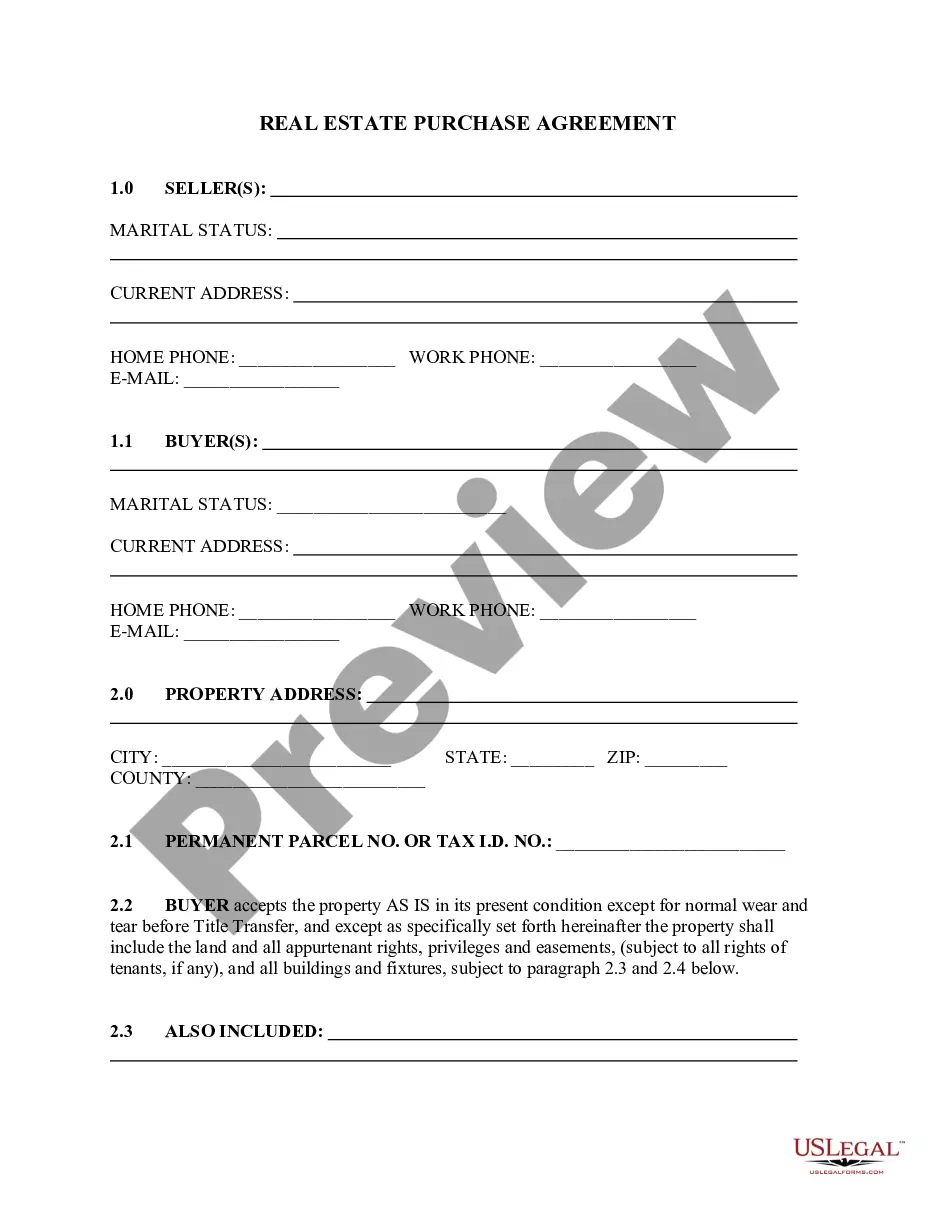
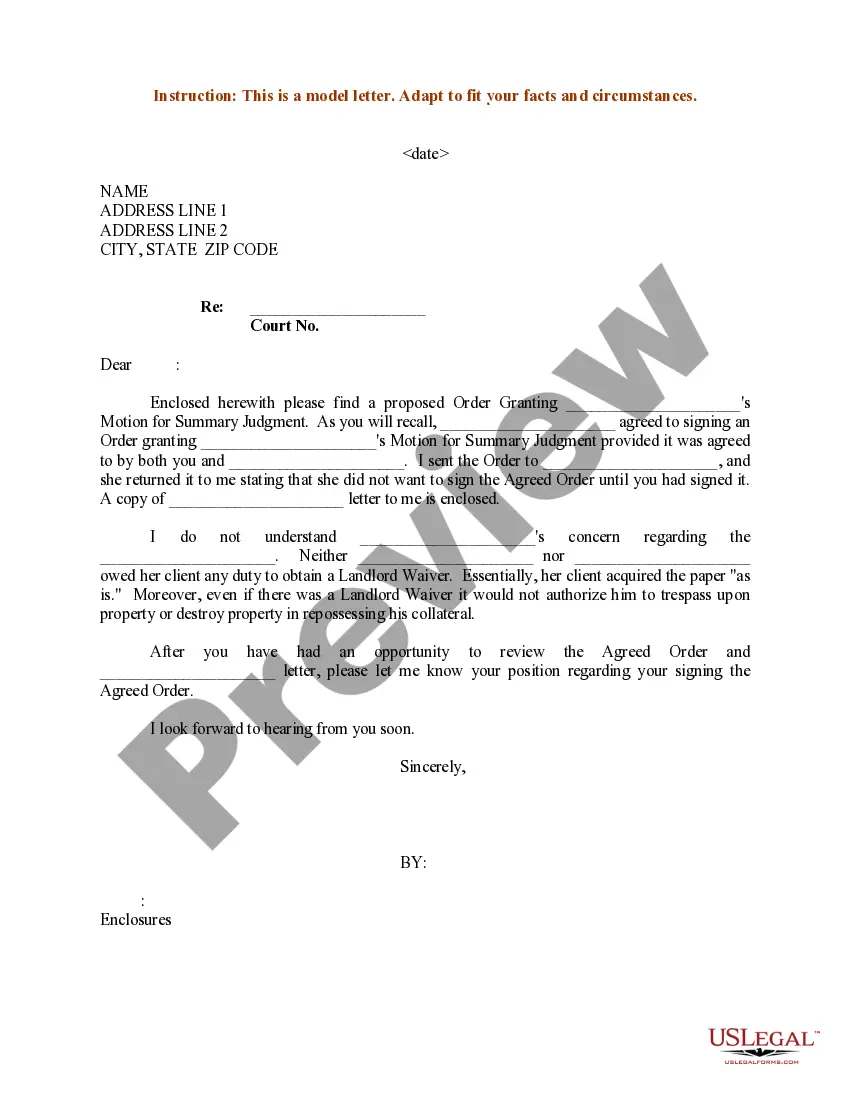
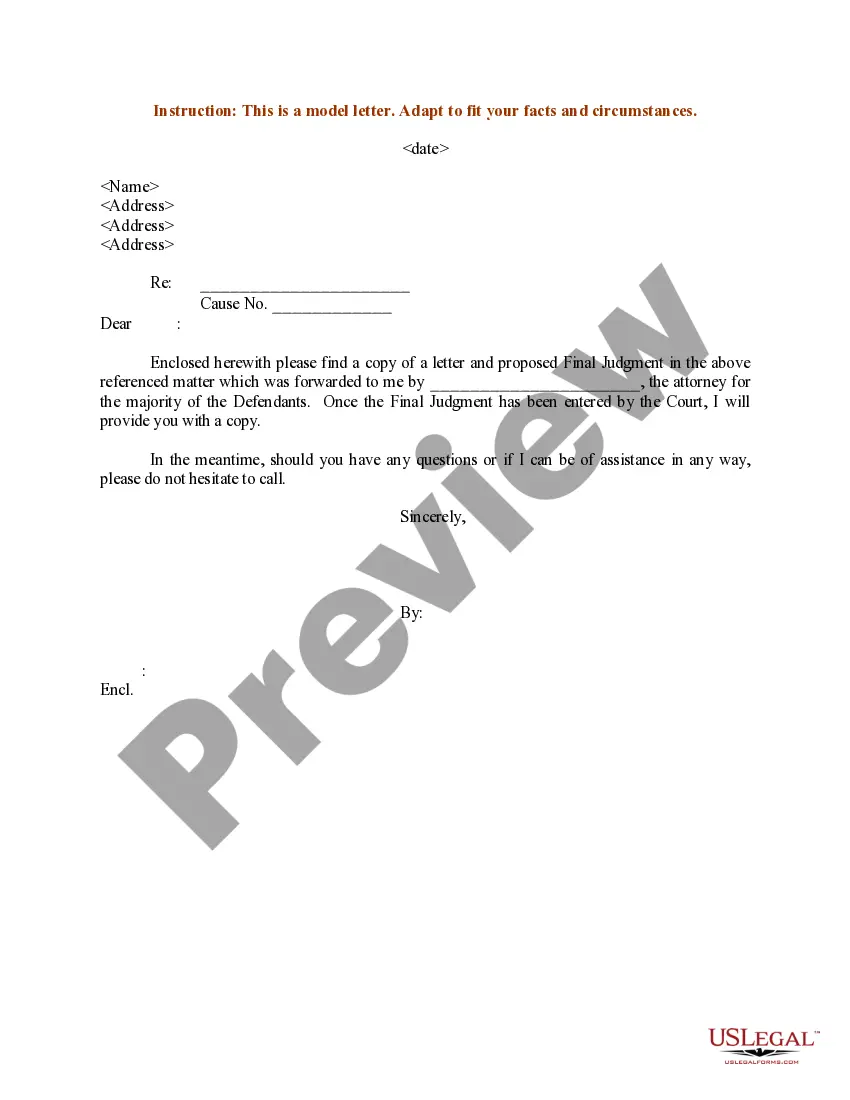
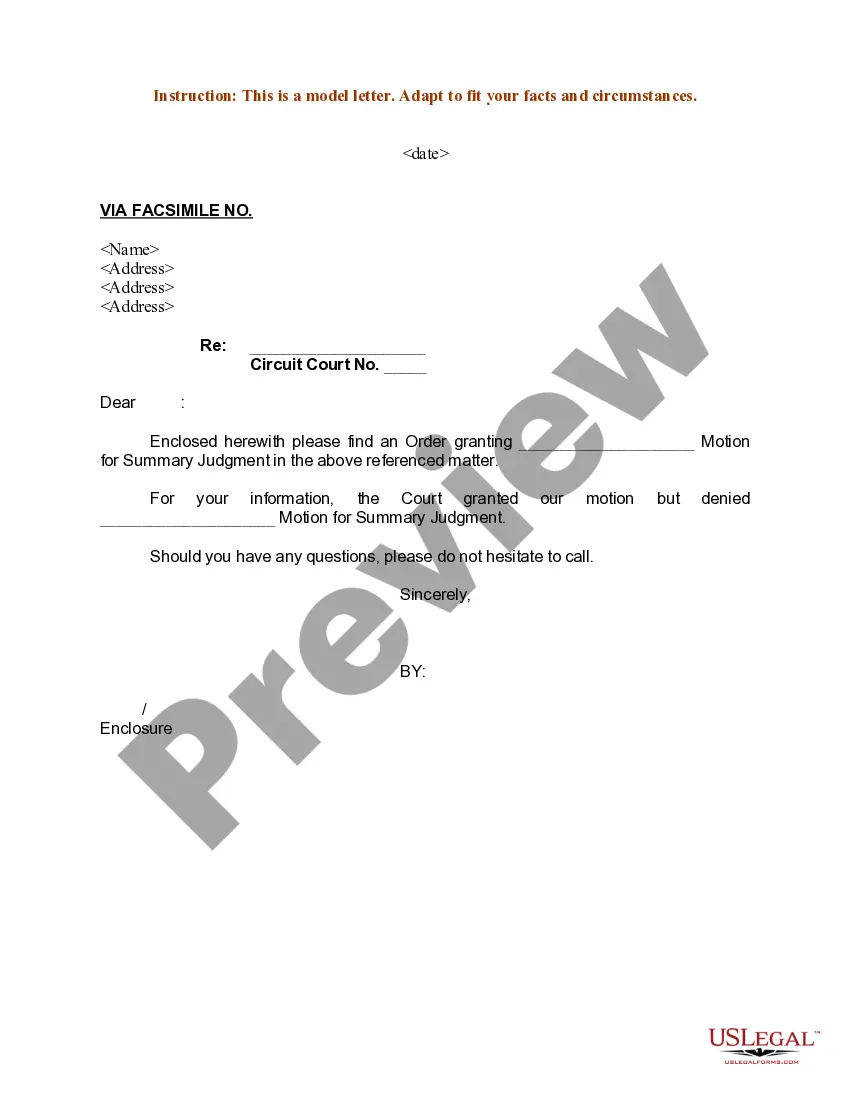
Puerto Rico Sample Letter for Proposed Order Granting Summary Judgment
Description
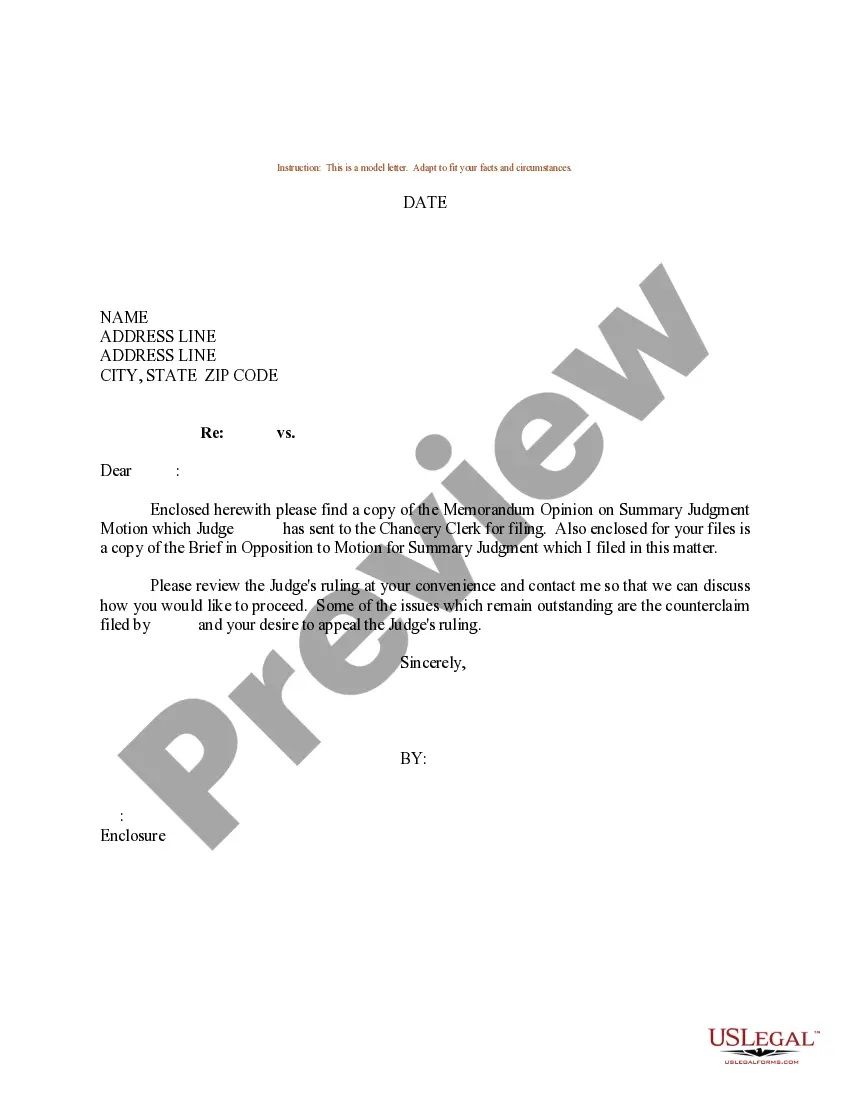
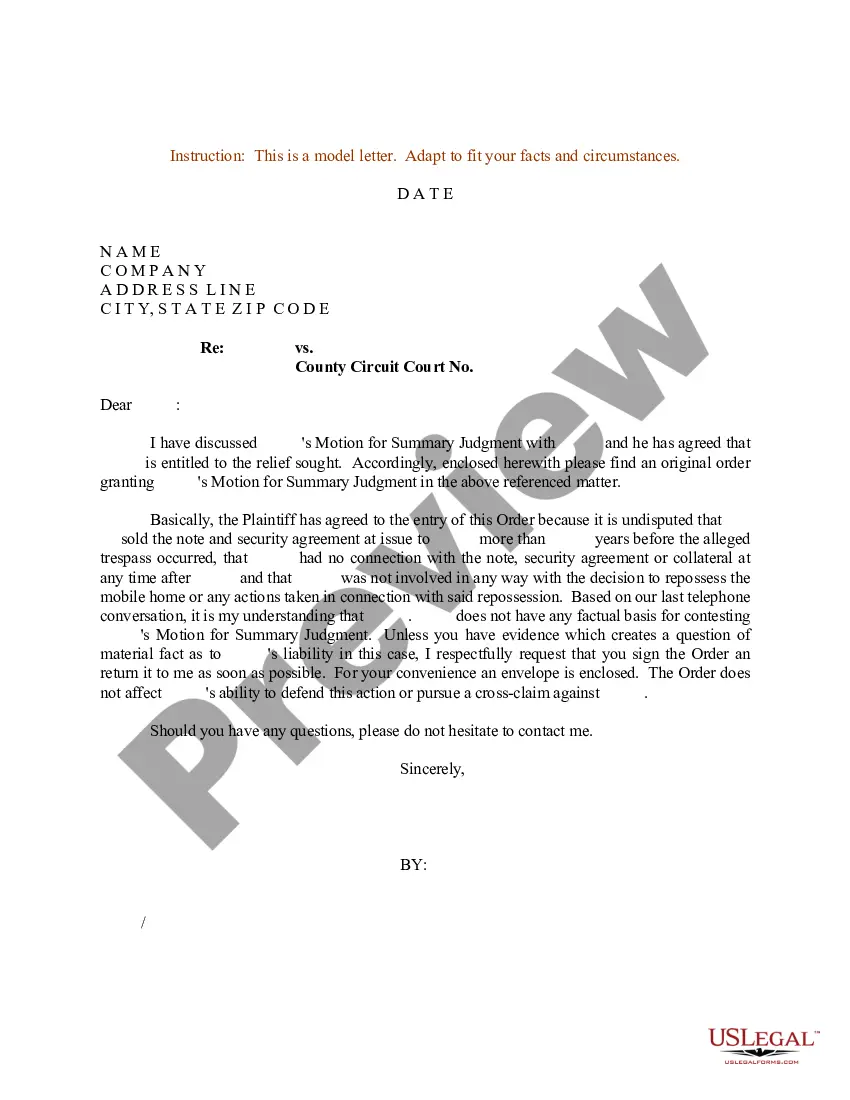
How to fill out Sample Letter For Proposed Order Granting Summary Judgment?
Have you ever been in a situation where you required paperwork for either business or specific purposes almost all the time? There are numerous legal document templates accessible online, but locating ones you can trust isn’t simple. US Legal Forms provides a plethora of form templates, such as the Puerto Rico Sample Letter for Proposed Order Granting Summary Judgment, that are designed to comply with state and federal regulations.
If you are already familiar with the US Legal Forms website and have an account, simply Log In. After that, you can download the Puerto Rico Sample Letter for Proposed Order Granting Summary Judgment template.
If you do not have an account and wish to start using US Legal Forms, follow these steps: Obtain the form you need and make sure it is for the correct area/state. Use the Review button to examine the form. Check the description to confirm that you have selected the right form. If the form isn’t what you’re looking for, utilize the Search field to find the form that fits your needs. Once you find the appropriate form, click Purchase now. Choose the pricing plan you prefer, fill in the required information to create your account, and pay for your order using your PayPal or credit card. Select a convenient document format and download your copy. Access all the document templates you have purchased in the My documents section. You can obtain another copy of the Puerto Rico Sample Letter for Proposed Order Granting Summary Judgment at any time if needed. Just select the necessary form to download or print the document template.
- Utilize US Legal Forms, the most extensive collection of legal forms, to save time and avoid mistakes.
- The service offers well-crafted legal document templates that you can use for various purposes.
- Create an account on US Legal Forms and start simplifying your life.
Form popularity
FAQ
Consider the following five approaches: Show that the motion fails to list the specific facts and law supporting summary judgment. ... Show that a dispute exists on a material fact. ... Show that the law does not support judgment on the undisputed facts.
DEPOSITIONS UPON WRITTEN. QUESTIONS. (a) Use of Written Questions: A party may make an application to the Court to take a deposition, otherwise au- thorized under Rule 81, 82, or 83, upon written questions rather than oral examination.
Where there is n genuine issue of material fact, the court will Page 2 Appendix 5 grant summary judgment in favor of one of the parties. For example, if all the evidence shows that the light was green, the court does not need to hold a trial to determine whether the light was red or green.
Rule 83, which has not been amended since the Federal Rules were promulgated in 1938, permits each district to adopt local rules not inconsistent with the Federal Rules by a majority of the judges. The only other requirement is that copies be furnished to the Supreme Court.
See Local Rule 83.9(b) (?All litigants proceeding pro se shall be bound by and comply with all local rules of this Court, and the Federal Rules of Civil and Criminal Procedure, unless otherwise excused from operation of the rules by court order.?); Loren v. Sasser, 309 F. 3d 1296, 1304 (11th Cir.
Local rules refer to a particular set of rules for each court governing matters not determined by the Federal Rules of Procedure. Local rules reflect the courts' traditional authority to manage their own affairs so as to achieve the orderly and expeditious disposition of cases.
The court shall grant summary judgment if the movant shows that there is no genuine dispute as to any material fact and the movant is entitled to judgment as a matter of law. The court shall state on the record the reasons for granting or denying the motion.
Local Court Rules. United States district courts and courts of appeals often prescribe local rules governing practice and procedure. Such rules must be consistent with both Acts of Congress and the Federal Rules of Practice and Procedure, and may only be prescribed after notice and an opportunity for public comment.