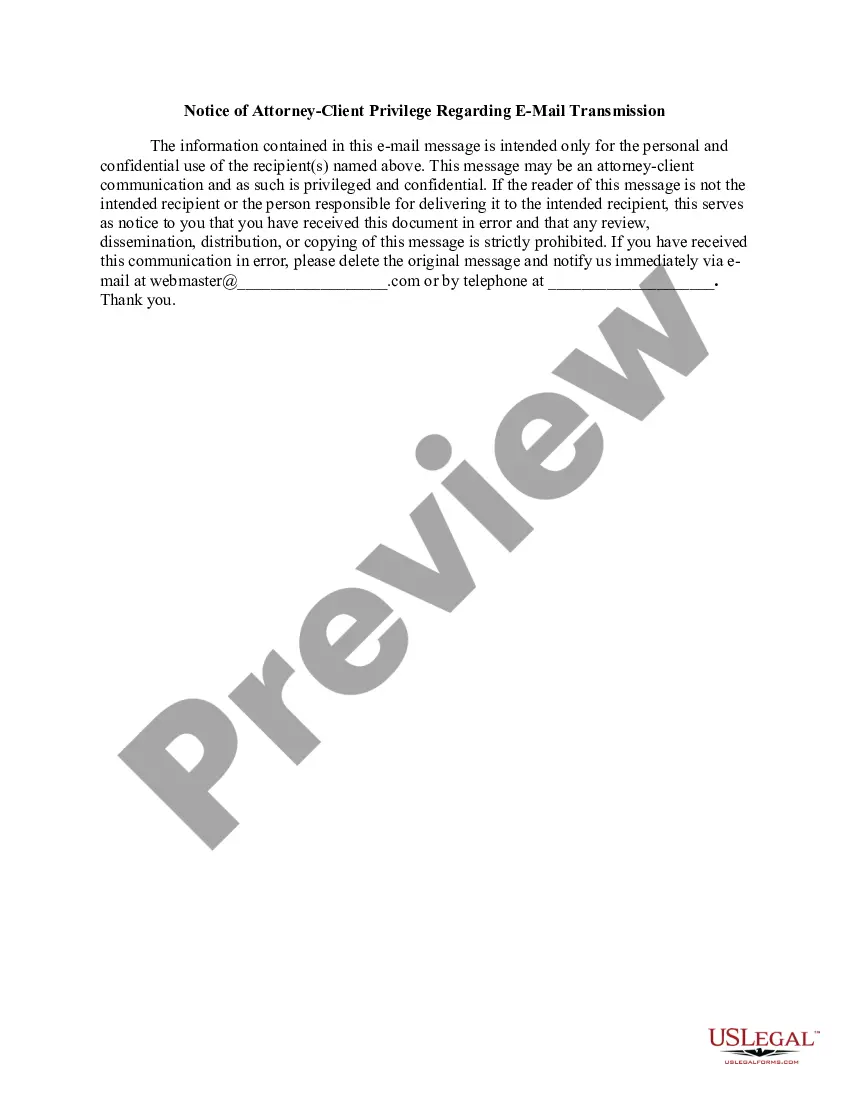
Rhode Island Notice of Attorney-Client Privilege Regarding E-Mail Transmission
Description
Get your form ready online
Our built-in tools help you complete, sign, share, and store your documents in one place.
Make edits, fill in missing information, and update formatting in US Legal Forms—just like you would in MS Word.
Download a copy, print it, send it by email, or mail it via USPS—whatever works best for your next step.
Sign and collect signatures with our SignNow integration. Send to multiple recipients, set reminders, and more. Go Premium to unlock E-Sign.
If this form requires notarization, complete it online through a secure video call—no need to meet a notary in person or wait for an appointment.
We protect your documents and personal data by following strict security and privacy standards.

Make edits, fill in missing information, and update formatting in US Legal Forms—just like you would in MS Word.

Download a copy, print it, send it by email, or mail it via USPS—whatever works best for your next step.

Sign and collect signatures with our SignNow integration. Send to multiple recipients, set reminders, and more. Go Premium to unlock E-Sign.

If this form requires notarization, complete it online through a secure video call—no need to meet a notary in person or wait for an appointment.

We protect your documents and personal data by following strict security and privacy standards.
Looking for another form?
How to fill out Notice Of Attorney-Client Privilege Regarding E-Mail Transmission?
It is feasible to spend hours online trying to find the proper legal document template that meets the state and federal requirements you need.
US Legal Forms offers thousands of legal templates that are reviewed by experts.
You can conveniently download or print the Rhode Island Notice of Attorney-Client Privilege Regarding E-Mail Transmission from our service.
If available, use the Preview button to browse through the document template as well.
- If you already possess a US Legal Forms account, you can Log In and click on the Acquire button.
- Then, you can complete, edit, print, or sign the Rhode Island Notice of Attorney-Client Privilege Regarding E-Mail Transmission.
- Every legal document template you purchase is yours permanently.
- To obtain another copy of any purchased form, visit the My documents tab and click on the corresponding button.
- If you are using the US Legal Forms website for the first time, follow the simple instructions below.
- First, ensure that you have selected the correct document template for the region/town you choose.
- Review the form description to make sure you have selected the appropriate template.
Form popularity
FAQ
In this rule: (1) "Attorney-client privilege" means the protection that applicable law provides for confidential attorney-client communications; (2) "Work-product protection" means the protection that applicable law provides for tangible material (or its intangible equivalent) prepared in anticipation of litigation or ...
Are Emails Admissible in Court? Emails are admissible in court. The key is laying the foundation to admit the emails into evidence at trial. So emails can be admissible in a trial as evidence, subject to certain requirements and procedures.
Understand the limits of the attorney-client privilege Emails between you and your attorney are presumed to be confidential under most circumstances. However, the presence of a third party on your email makes your perceived confidentiality less definite.
Attorney-client privilege is a legal principle that protects communications between attorneys and their clients. The principle is based on the belief that attorneys need to be able to freely communicate with their clients in order to provide effective legal representation.
Understand the limits of the attorney-client privilege Emails between you and your attorney are presumed to be confidential under most circumstances. However, the presence of a third party on your email makes your perceived confidentiality less definite.
What is the Lawyer-Client Privilege? When you consult with an attorney, particularly when you're accused of a crime, your communication with that attorney is protected by law. It cannot be used against you in court?even if you admit to your attorney that you committed the crime.