South Carolina HARBORING A FUGITIVE
Overview of this form
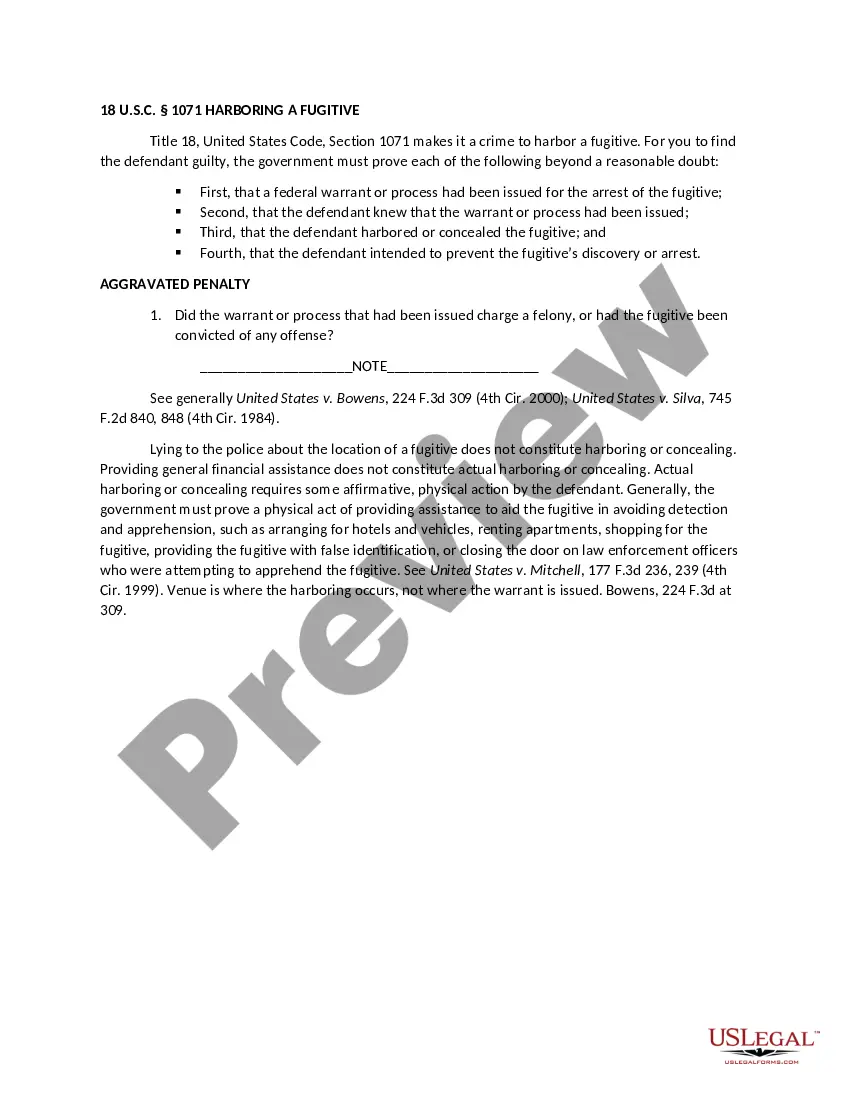
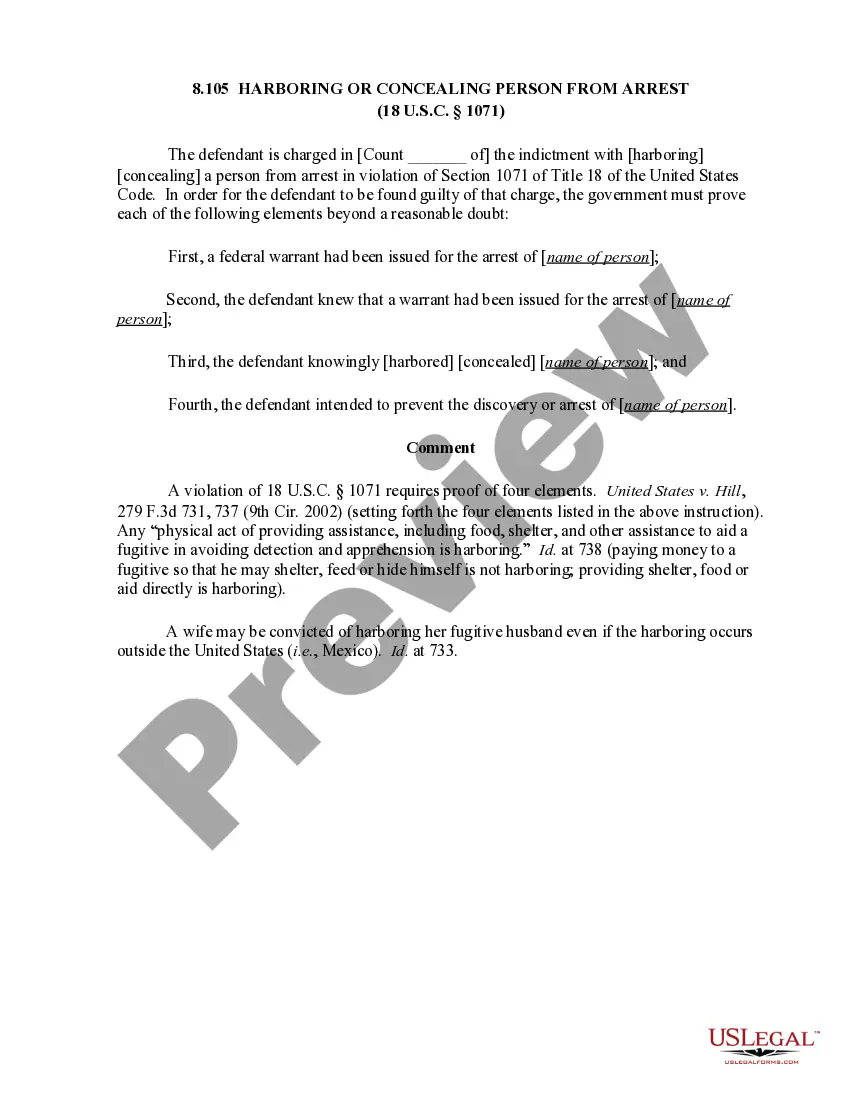
The form titled "Harboring a Fugitive" is a legal document used in federal criminal cases in the District Court of South Carolina. It outlines the specific criteria that the government must prove to convict someone of the crime of harboring or concealing a fugitive. This form serves as a guideline for jury instructions and differs from other criminal instructions by focusing specifically on the offense of harboring a fugitive as defined under Title 18, United States Code, Section 1071.
Form components explained
- Definition of harboring a fugitive and its legal implications.
- Criteria that must be met for conviction, including the issuance of a federal warrant.
- Clarification on the defendantâs knowledge of the fugitiveâs status.
- Details on actions that constitute actual harboring or concealment.
- Discussion on venue being where the harboring occurs.
Common use cases
This form is used in situations where an individual is charged with harboring a fugitive. It becomes relevant during jury trials to guide jurors on how to appropriately assess the evidence presented regarding the actions of the defendant in relation to the fugitive. Particularly, it is useful when determining the intent and actions of the defendant that contributed to the concealment of an individual sought by law enforcement.
Who can use this document
- Jurors involved in federal criminal trials for harboring a fugitive.
- Attorneys presenting cases related to fugitive harboring in federal courts.
- Legal professionals involved in criminal defense work.
- Individuals studying or teaching criminal law, particularly related to federal offenses.
How to prepare this document
- Read the legal instructions carefully to understand the criteria for harboring a fugitive.
- Gather evidence relevant to the case, including the issuance of any arrest warrants.
- Identify the actions taken by the defendant to harbor or conceal the fugitive.
- Document the knowledge the defendant had regarding the federal warrant.
- Clarify the intent behind the actions to prevent the fugitive's detection.
Does this form need to be notarized?
This form does not typically require notarization unless specified by local law. Ensure to check any additional state regulations that might apply to the harboring of a fugitive.
Get your form ready online
Our built-in tools help you complete, sign, share, and store your documents in one place.
Make edits, fill in missing information, and update formatting in US Legal Forms—just like you would in MS Word.
Download a copy, print it, send it by email, or mail it via USPS—whatever works best for your next step.
Sign and collect signatures with our SignNow integration. Send to multiple recipients, set reminders, and more. Go Premium to unlock E-Sign.
If this form requires notarization, complete it online through a secure video call—no need to meet a notary in person or wait for an appointment.
We protect your documents and personal data by following strict security and privacy standards.

Make edits, fill in missing information, and update formatting in US Legal Forms—just like you would in MS Word.

Download a copy, print it, send it by email, or mail it via USPS—whatever works best for your next step.

Sign and collect signatures with our SignNow integration. Send to multiple recipients, set reminders, and more. Go Premium to unlock E-Sign.

If this form requires notarization, complete it online through a secure video call—no need to meet a notary in person or wait for an appointment.

We protect your documents and personal data by following strict security and privacy standards.
Mistakes to watch out for
- Assuming that lying to the police constitutes harboring, when it typically does not.
- Providing financial assistance without understanding the physical acts required for harboring.
- Misunderstanding the criteria for intent, especially in assessing the defendant's actions.
- Confusing the venue of the crime, which is based on where the harboring occurred.
Why use this form online
- Convenient access to the legal form in easily downloadable Word format.
- Editability allows for customization based on the case specifics.
- Reliability assured through templates vetted by licensed attorneys.
Legal use & context
- This form provides essential instructions for the jury but is not a standalone legal document for defense or prosecution.
- Understanding the charges of harboring a fugitive requires an awareness of both federal and state laws.
- Citing relevant case law can strengthen arguments related to what constitutes harboring.
Quick recap
- The Harboring a Fugitive form clarifies legal standards for prosecution in South Carolina.
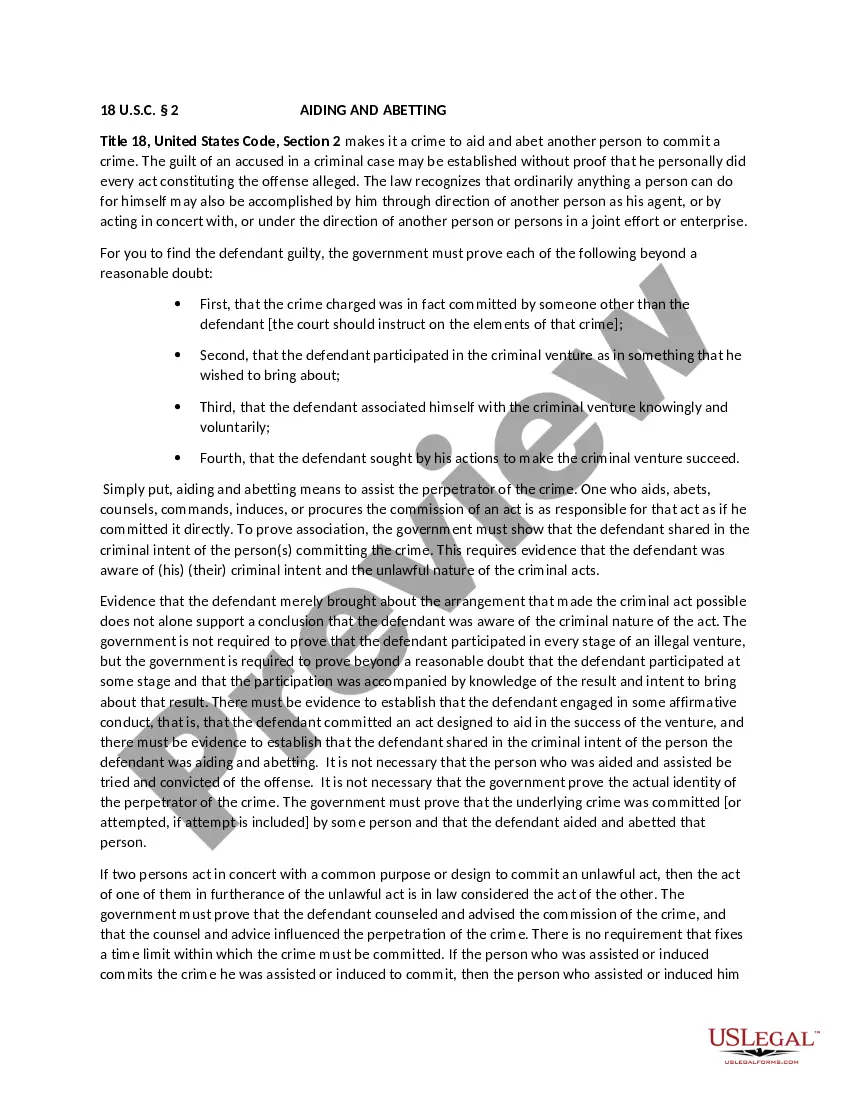
- Four key elements must be proven for a conviction, emphasizing intent and action.
- Use this form to guide legal processes in cases involving fugitive harboring.
Looking for another form?
Form popularity
FAQ
(A) It is unlawful for a person knowingly and wilfully to oppose or resist a law enforcement officer in serving, executing, or attempting to serve or execute a legal writ or process or to resist an arrest being made by one whom the person knows or reasonably should know is a law enforcement officer, whether under
As laid out in South Carolina General Code Section 16-13-240, it is a crime to obtain a signature, money, or property from someone under false pretenses or misrepresentation of a fact with ?intent to cheat and defraud a person of that property.? Simply put, if you obtain money, property, or the title to property from
SECTION 16-9-340. Intimidation of court officials, jurors or witnesses. (2) destroy, impede, or attempt to obstruct or impede the administration of justice in any court.
Under South Carolina Code § 16-13-110, shoplifting is criminal charge where the defendant is accused of trying to defraud a business or merchant not paying the retail price for their items.
(A) It is unlawful for a person knowingly and wilfully to oppose or resist a law enforcement officer in serving, executing, or attempting to serve or execute a legal writ or process or to resist an arrest being made by one whom the person knows or reasonably should know is a law enforcement officer, whether under
Obstruction of justice: SC Code § 16-9-340 makes it a felony punishable by up to ten years in prison to 1) ?intimidate or impede a judge, magistrate, juror, witness, or potential juror or witness? by force or 2) ?destroy, impede, or attempt to obstruct or impede the administration of justice in any court.?
It is unlawful for any person to assist, instruct, aid or abet, or attempt to assist, instruct, aid or abet any other person in obtaining any cable television service without payment of the lawful charge therefor. HISTORY: 1984 Act No. 407. Disclaimer: These codes may not be the most recent version.
Ing to South Carolina Code of Laws §16-3-910, a person may face criminal charges of kidnapping if they unlawfully abduct, confine, or carry away any person, unless that person is a minor and the alleged kidnapper is that minor's lawful parent or guardian.