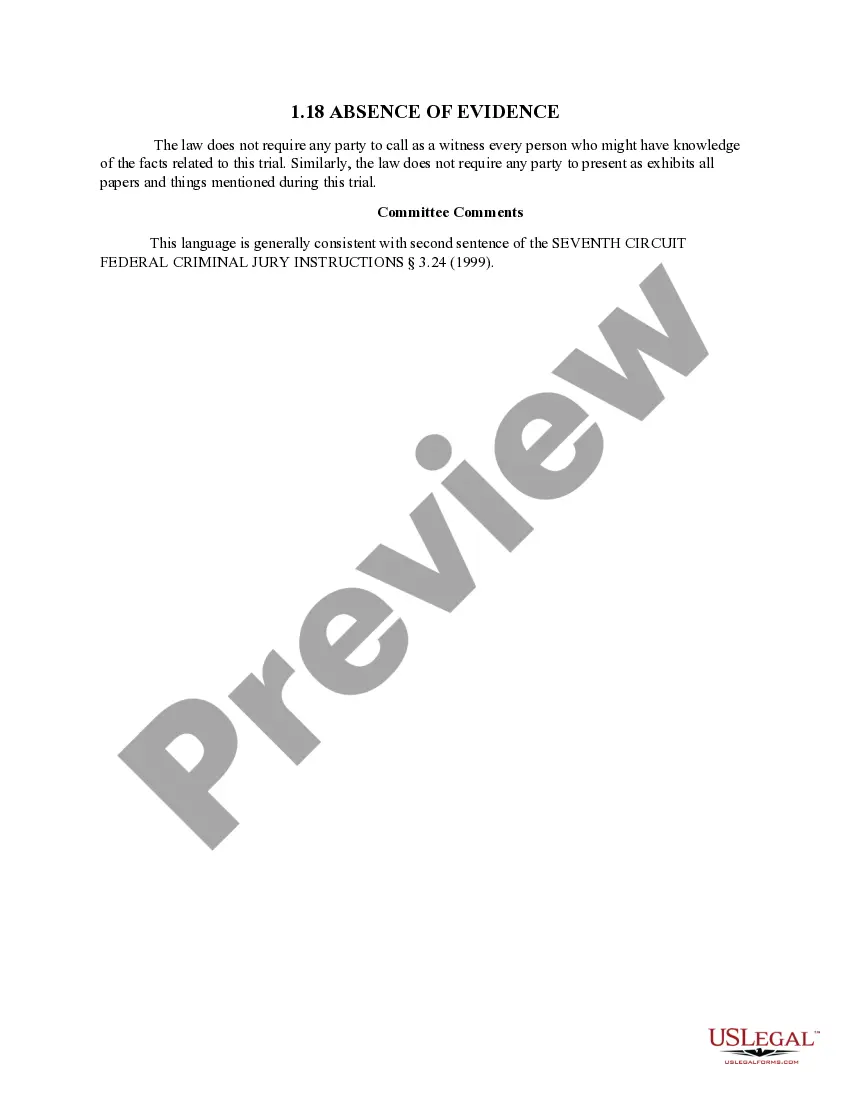
South Carolina Lack of Evidence
Description



How to fill out Lack Of Evidence?
US Legal Forms - one of the largest collections of legal documents in the United States - provides an extensive selection of legal template documents that you can download or print. On the website, you can access thousands of forms for both business and personal purposes, organized by categories, states, or keywords. You can find the latest versions of forms such as the South Carolina Lack of Evidence in just a few minutes.
If you have a subscription, Log In and download South Carolina Lack of Evidence from your US Legal Forms library. The Download button will appear on each form you view. You have access to all previously downloaded forms in the My documents section of your account.
To use US Legal Forms for the first time, here are simple instructions to help you get started: Ensure you have selected the correct form for your city/state. Click on the Review button to check the content of the form. Review the form summary to confirm that you have selected the right form. If the form does not meet your requirements, use the Search field at the top of the page to find the one that does. If you are satisfied with the form, confirm your choice by clicking the Purchase now button. Then, choose the payment plan you prefer and provide your information to register for an account. Process the payment. Use your credit card or PayPal account to complete the transaction. Select the format and download the form to your device. Edit. Complete, modify, and print and sign the downloaded South Carolina Lack of Evidence. Every template you add to your account has no expiration date and is yours indefinitely. So, if you wish to download or print another copy, simply visit the My documents section and click on the form you need.
- Access the South Carolina Lack of Evidence through US Legal Forms, one of the most extensive collections of legal document templates.
- Utilize thousands of professional and state-specific templates that meet your business or personal needs and requirements.
Form popularity
FAQ
"Relevant evidence" means evidence having any tendency to make the existence of any fact that is of consequence to the determination of the action more probable or less probable than it would be without the evidence. Note: This rule is identical to the federal rule and is consistent with South Carolina law.
Reverse 404(b) evidence is the name courts have given to a less common use of Federal Rule of Evidence 404(b), wherein a defendant attempts to introduce the "other bad acts" of a third party, usually to prove that this third party committed the crime of which the defendant is accused or that the third party coerced the ...
Evidence of other crimes, wrongs, or acts is not admissible to prove the character of a person in order to show action in conformity therewith. It may, however, be admissible to show motive, identity, the existence of a common scheme or plan, the absence of mistake or accident, or intent.
Rule 901. Requirement of authentication or identification. (a) General provision. ? The requirement of authentication or identification as a condition precedent to admissibility is satisfied by evidence sufficient to support a finding that the matter in question is what its proponent claims.
Section 404(b)(2) permits the court to exclude evidence of a crime, wrong, or other act that is offered for a proper purpose (e.g., to prove motive, opportunity, intent, preparation, plan, knowledge, identity, absence of mistake, or lack of accident) if the risk of unfair prejudice simply outweighs the probative value ...
"Relevant evidence" means evidence having any tendency to make the existence of any fact that is of consequence to the determination of the action more probable or less probable than it would be without the evidence. Note: This rule is identical to the federal rule and is consistent with South Carolina law.
(a) General rule. - For the purpose of attacking the credibility of a witness, evidence that the witness has been convicted of a felony, or of a Class A1, Class 1, or Class 2 misdemeanor, shall be admitted if elicited from the witness or established by public record during cross-examination or thereafter.
Character Evidence; Crimes or Other Acts (a) Character Evidence. (1) Prohibited Uses. Evidence of a person's character or character trait is not admissible to prove that on a particular occasion the person acted in ance with the character or trait.