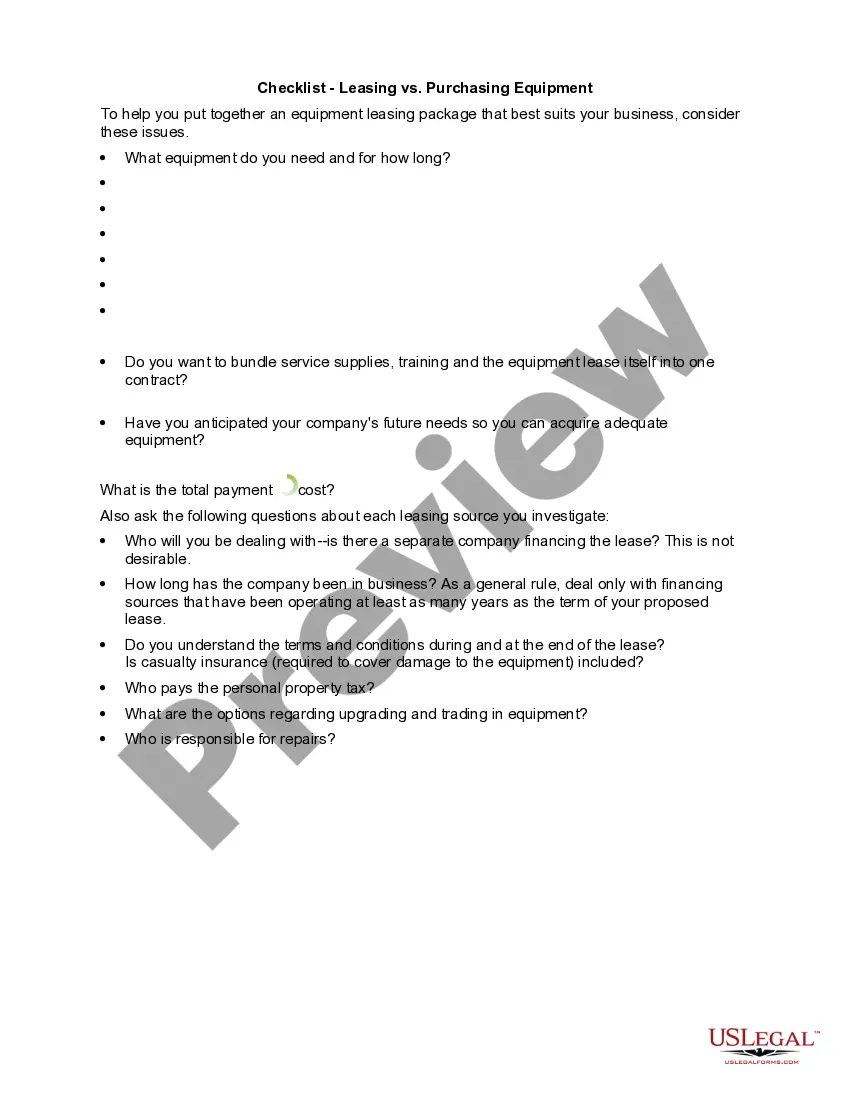
Leasing equipment can help your business stay up-to-date with the latest technology. Other benefits of leasing include making lower monthly payments than you would have with a loan, getting a fixed financing rate instead of a floating rate, benefiting from tax advantages, and conserving working capital by avoiding cash-devouring down payments. Leasing also has its downside, however: You may pay a higher price over the long term. You are also committed to retaining a piece of equipment for a certain time period, which can be problematic if your business is in flux.
Every lease decision is unique so it's important to study the lease agreement carefully. When deciding to obtain equipment, you need to determine whether it is better to lease or purchase the equipment. You might use this checklist to compare the costs for each option.
South Carolina Checklist - Leasing vs. Purchasing Equipment
Category:
State:
Multi-State
Control #:
US-03082BG
Format:
Word;
Rich Text
Instant download
Description
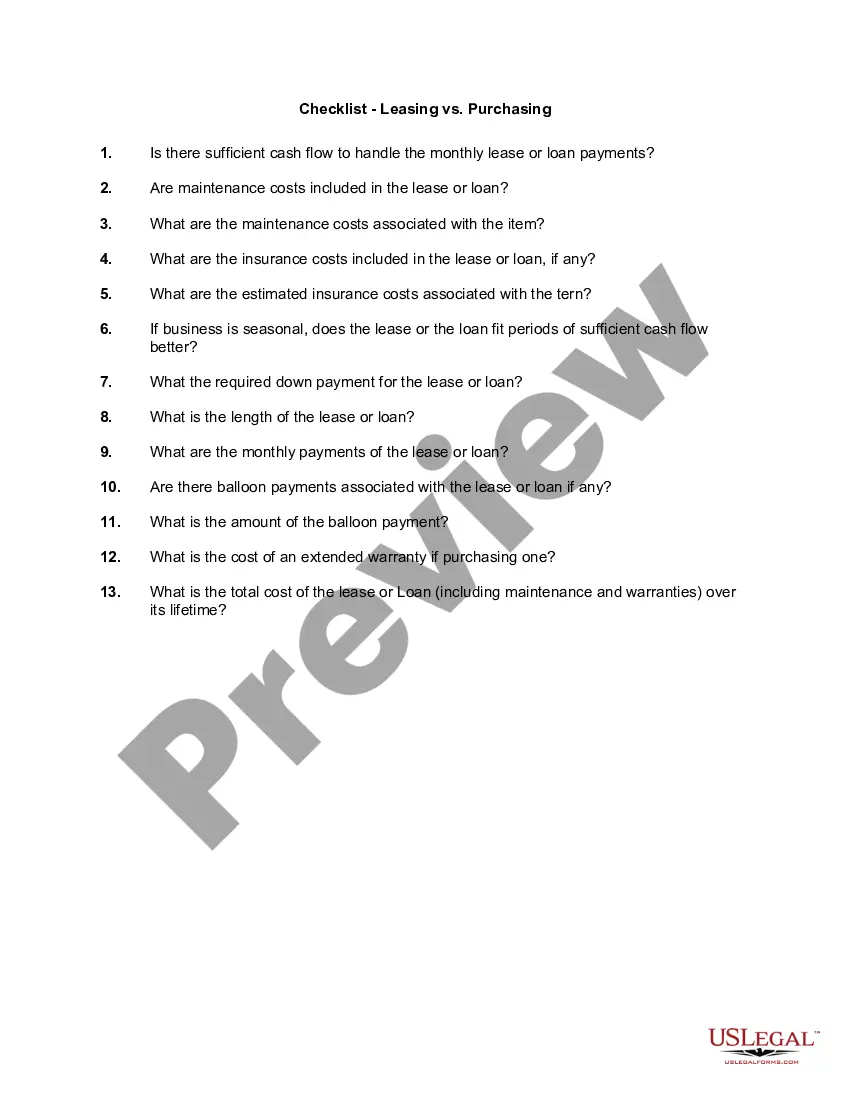



How to fill out Checklist - Leasing Vs. Purchasing Equipment?
Finding the correct legal document template can be quite challenging.
Of course, there are numerous templates available online, but how do you locate the legal form you need.
Utilize the US Legal Forms website.
First, ensure you have selected the correct form for your city/region. You can check the form using the Review button and read the form description to confirm it is suitable for you.
- The service offers thousands of templates, including the South Carolina Checklist - Leasing vs. Purchasing Equipment, suitable for both business and personal use.
- All templates are reviewed by professionals and adhere to federal and state requirements.
- If you are already registered, Log In to your account and click the Acquire button to download the South Carolina Checklist - Leasing vs. Purchasing Equipment.
- Use your account to browse the legal forms you have previously purchased.
- Visit the My documents section of your account to retrieve another copy of the document you need.
- If you are a new user of US Legal Forms, here are some simple steps to follow.
Form popularity
FAQ
One significant advantage of leasing an asset is the flexibility it offers in terms of upgrading equipment. Leasing allows you to use current technology while avoiding the risk of obsolescence associated with ownership. This key point is highlighted in the South Carolina Checklist - Leasing vs. Purchasing Equipment.
Leasing equipment often provides tax advantages that can benefit your financial strategy. Lease payments can sometimes be deducted as business expenses, reducing your taxable income. For comprehensive insights into tax implications, consult the South Carolina Checklist - Leasing vs. Purchasing Equipment.
An equipment lease is generally considered a liability for the lessee, as it represents an obligation to make future payments. However, the leased equipment itself may be viewed as an asset on the lessor’s books. Utilizing the South Carolina Checklist - Leasing vs. Purchasing Equipment can clarify how leasing affects financial statements.
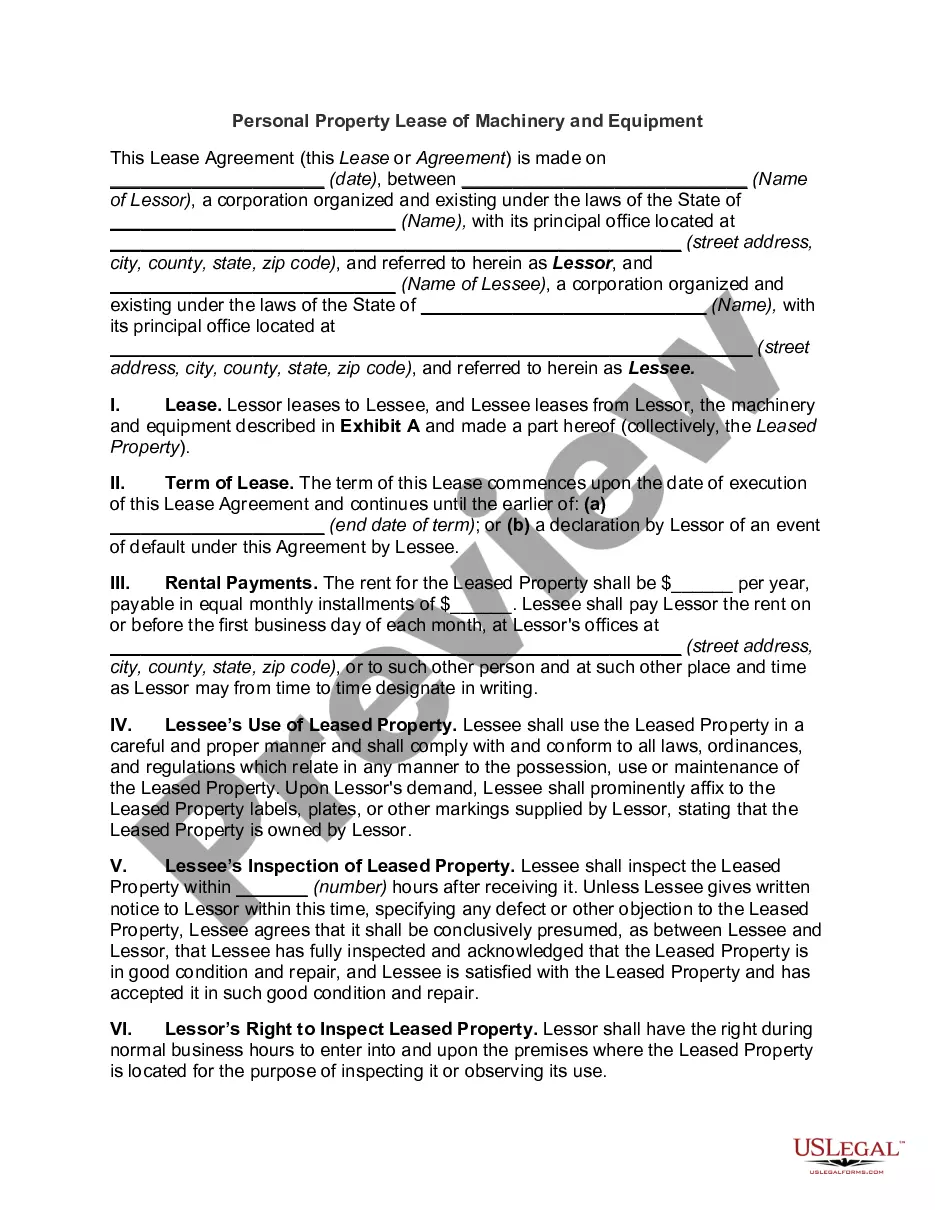
An equipment lease is a contract between a lessor and a lessee, allowing the lessee to use the equipment in exchange for payments over time. This arrangement helps businesses access essential tools without substantial upfront costs. Leveraging the South Carolina Checklist - Leasing vs. Purchasing Equipment can simplify your understanding of equipment leasing.
A lease agreement for equipment typically involves a leasing company providing machinery for a set period in exchange for regular payments. This agreement outlines terms such as payment amounts, duration, and end-of-lease options. Understanding the leasing process is crucial, and the South Carolina Checklist - Leasing vs. Purchasing Equipment can assist in making informed decisions.
Equipment on operating leases is leased for a short to medium term, allowing businesses to use the equipment without assuming ownership responsibilities. Operating leases do not appear on the balance sheet, offering a financial advantage. The South Carolina Checklist - Leasing vs. Purchasing Equipment helps clarify the implications of different lease types.
Deciding whether to buy or lease a machine depends on your specific business needs and financial situation. Leasing often offers flexibility and lower initial expenses, while purchasing can provide long-term ownership benefits. Use the South Carolina Checklist - Leasing vs. Purchasing Equipment to weigh the pros and cons for your unique circumstances.
Equipment held for lease refers to machinery or tools owned by a leasing company and made available for rent to businesses. This arrangement allows companies to access the latest equipment without the upfront costs of purchasing. By utilizing the South Carolina Checklist - Leasing vs. Purchasing Equipment, you can better understand the advantages of leasing versus buying.
Filing for adverse possession in South Carolina involves a legal process where you must demonstrate continuous and exclusive possession of the property for a specific period. Documenting your use of the property is essential to support your claim. Due to its complexity, consulting legal resources or professionals is advisable. For thorough information regarding this and related matters, refer to the South Carolina Checklist - Leasing vs. Purchasing Equipment.
Typically, businesses that have tax obligations in South Carolina need to file a PT-100. This includes corporations and limited liability companies operating within the state. Ensuring compliance with this requirement is vital to avoid penalties. For a comprehensive understanding, refer to the South Carolina Checklist - Leasing vs. Purchasing Equipment.