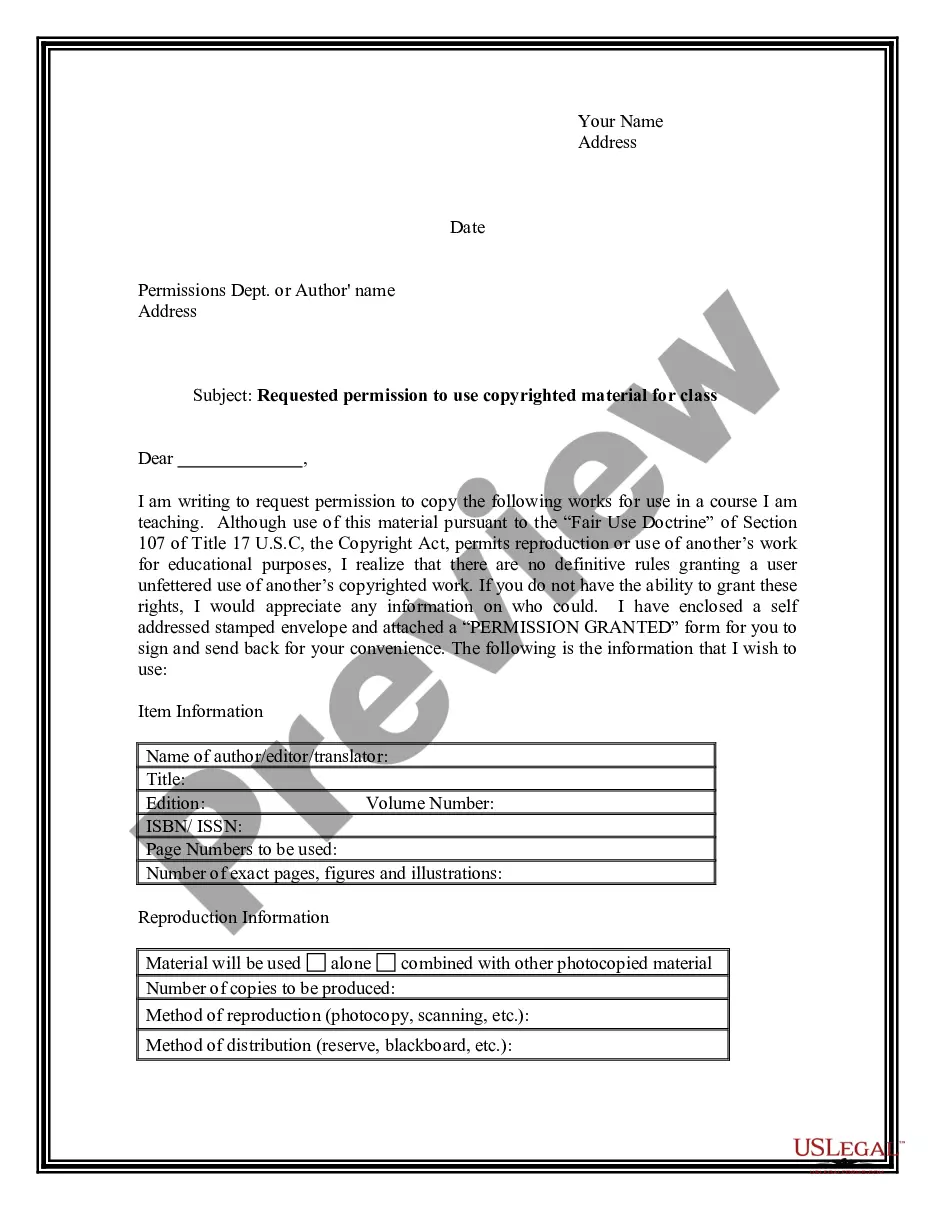
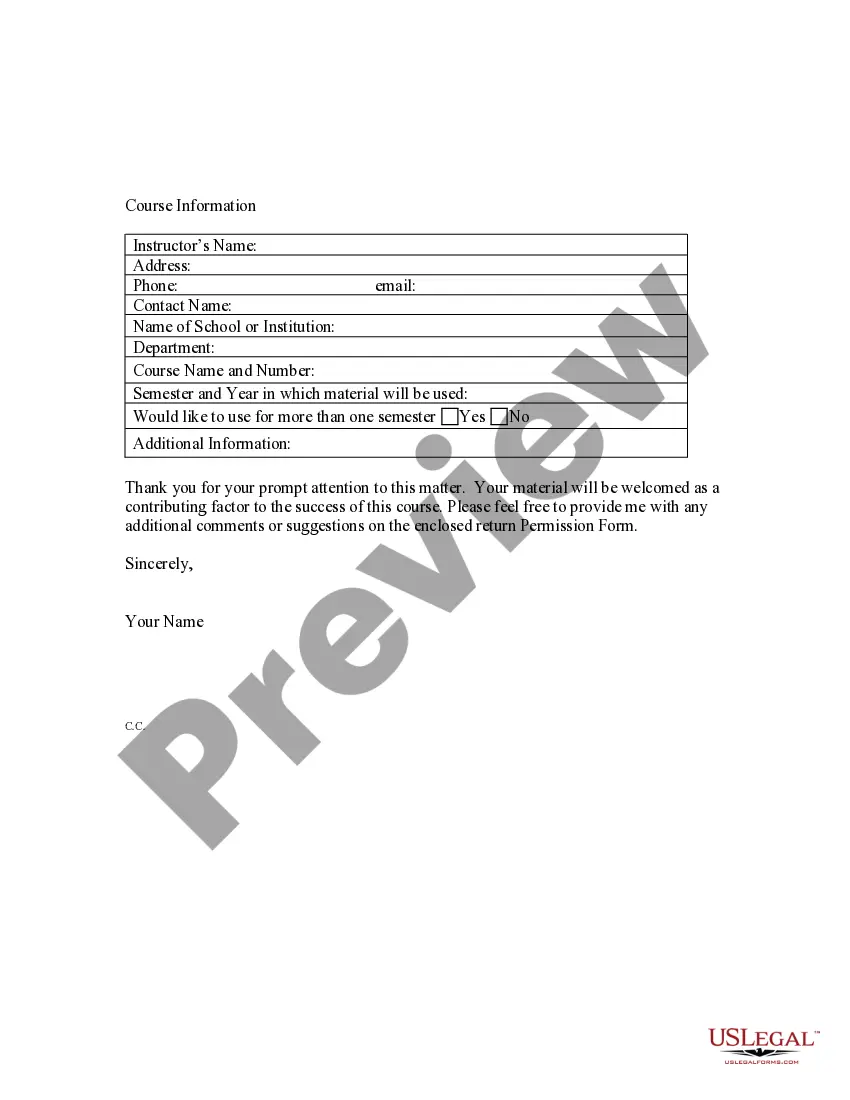
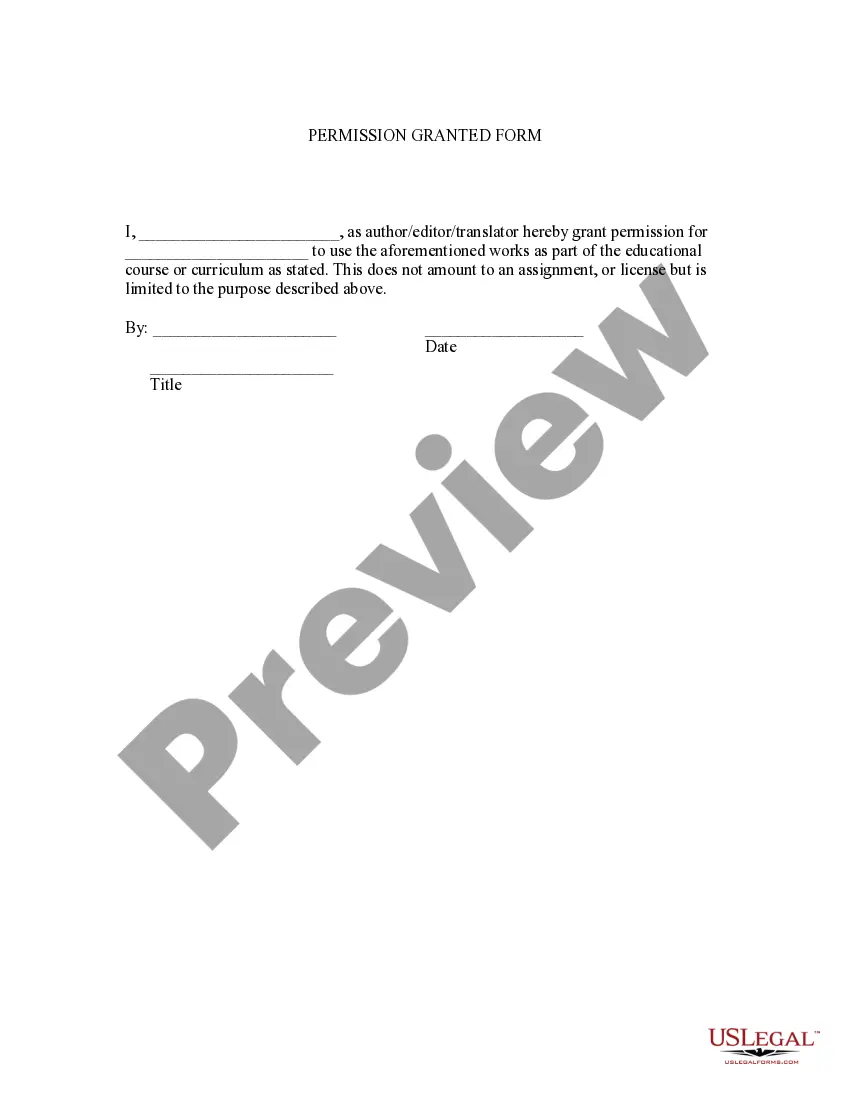
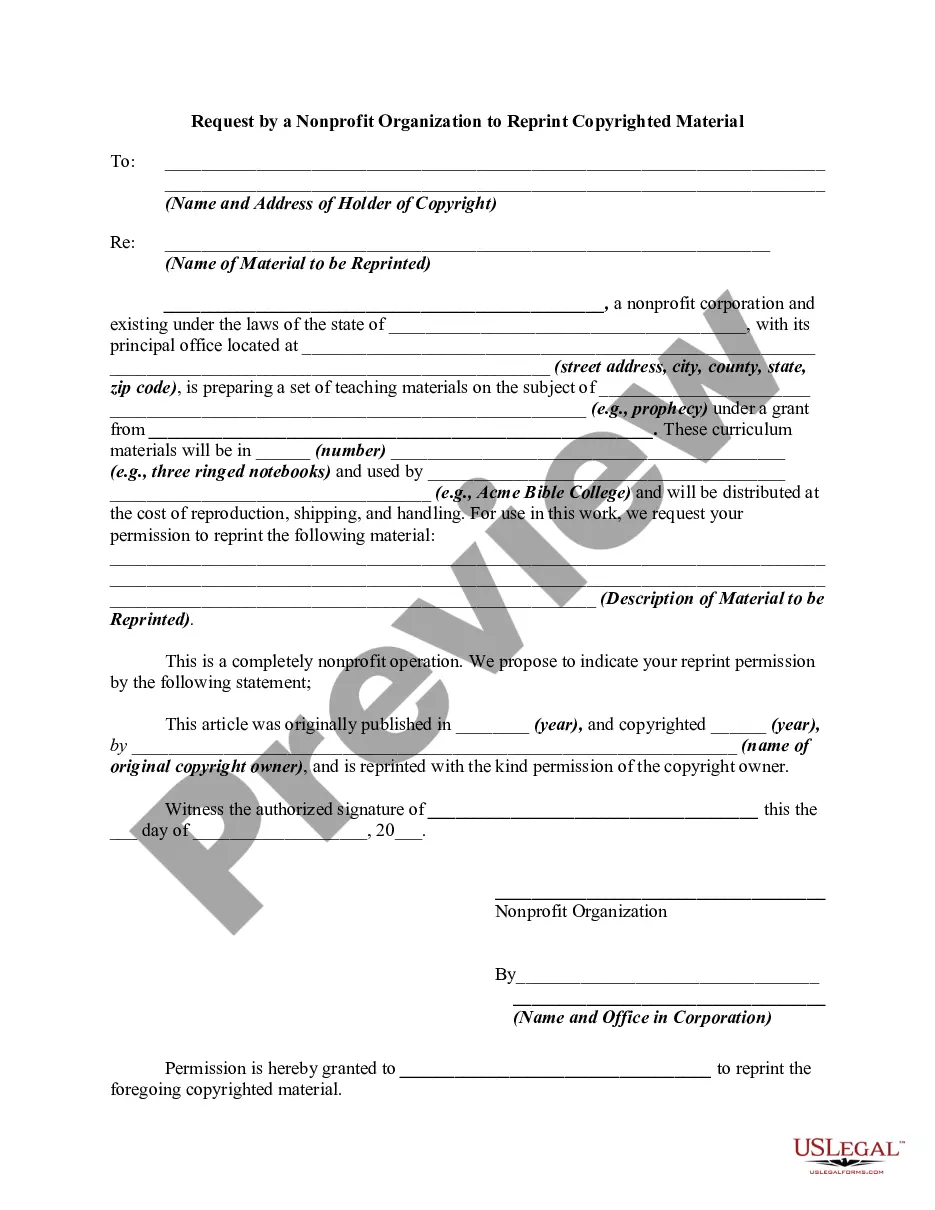
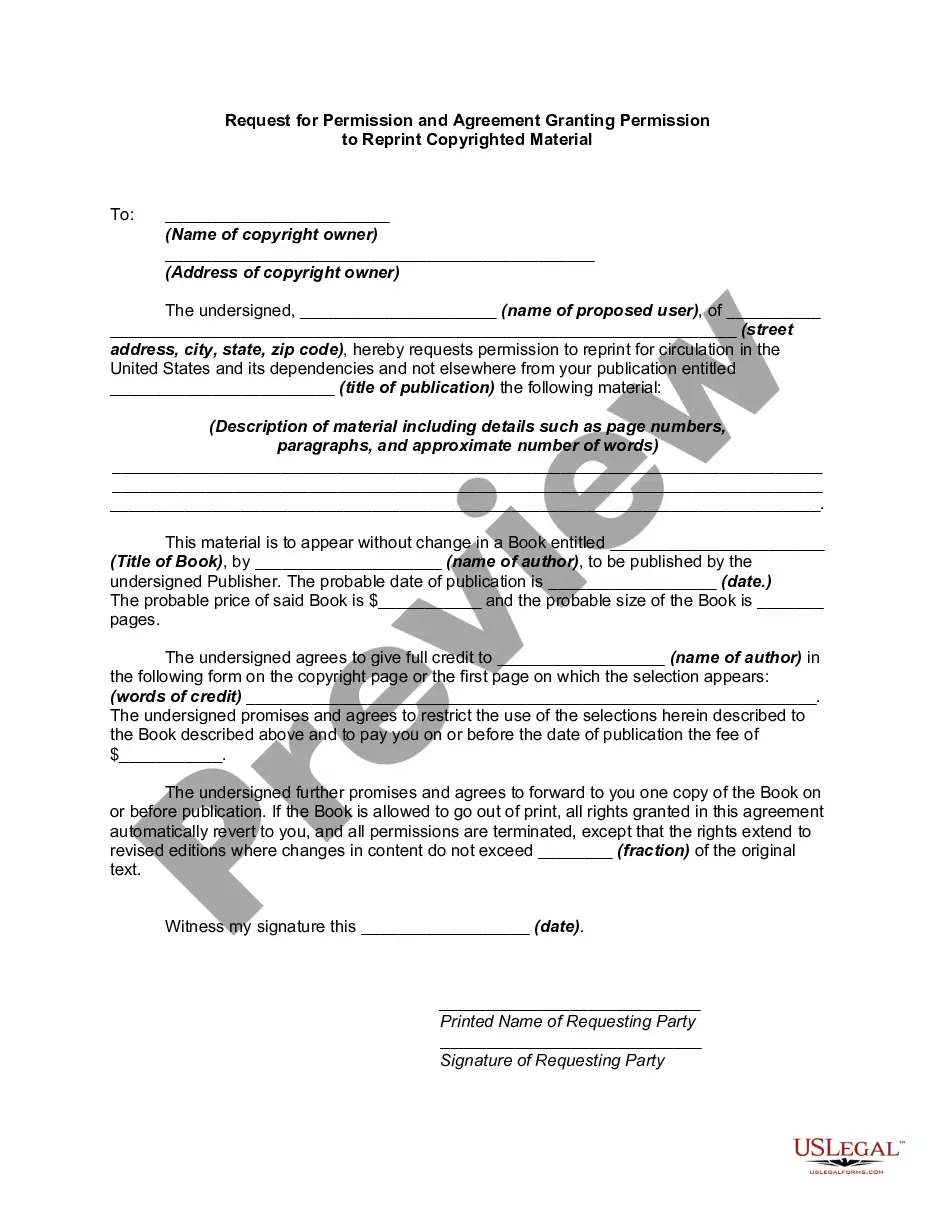
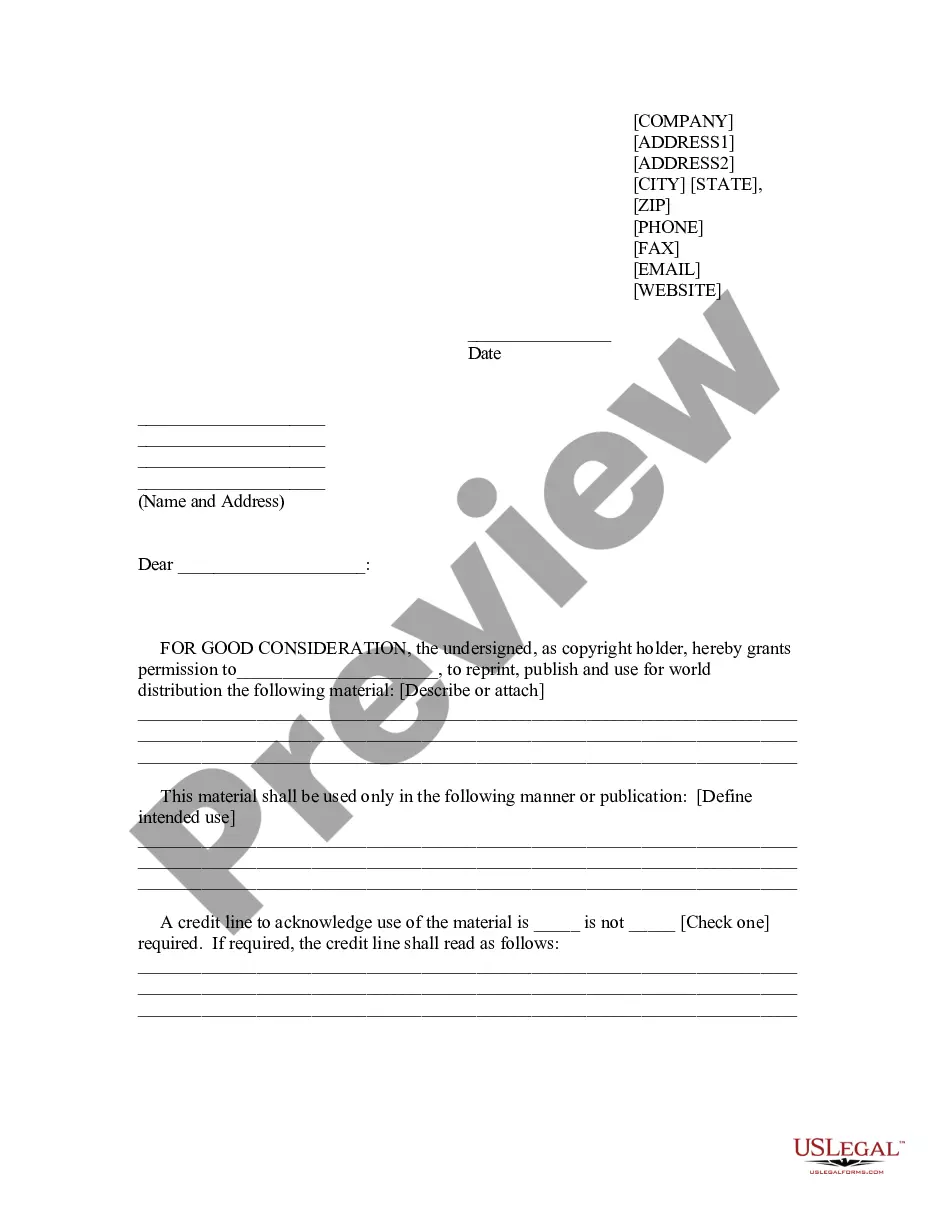
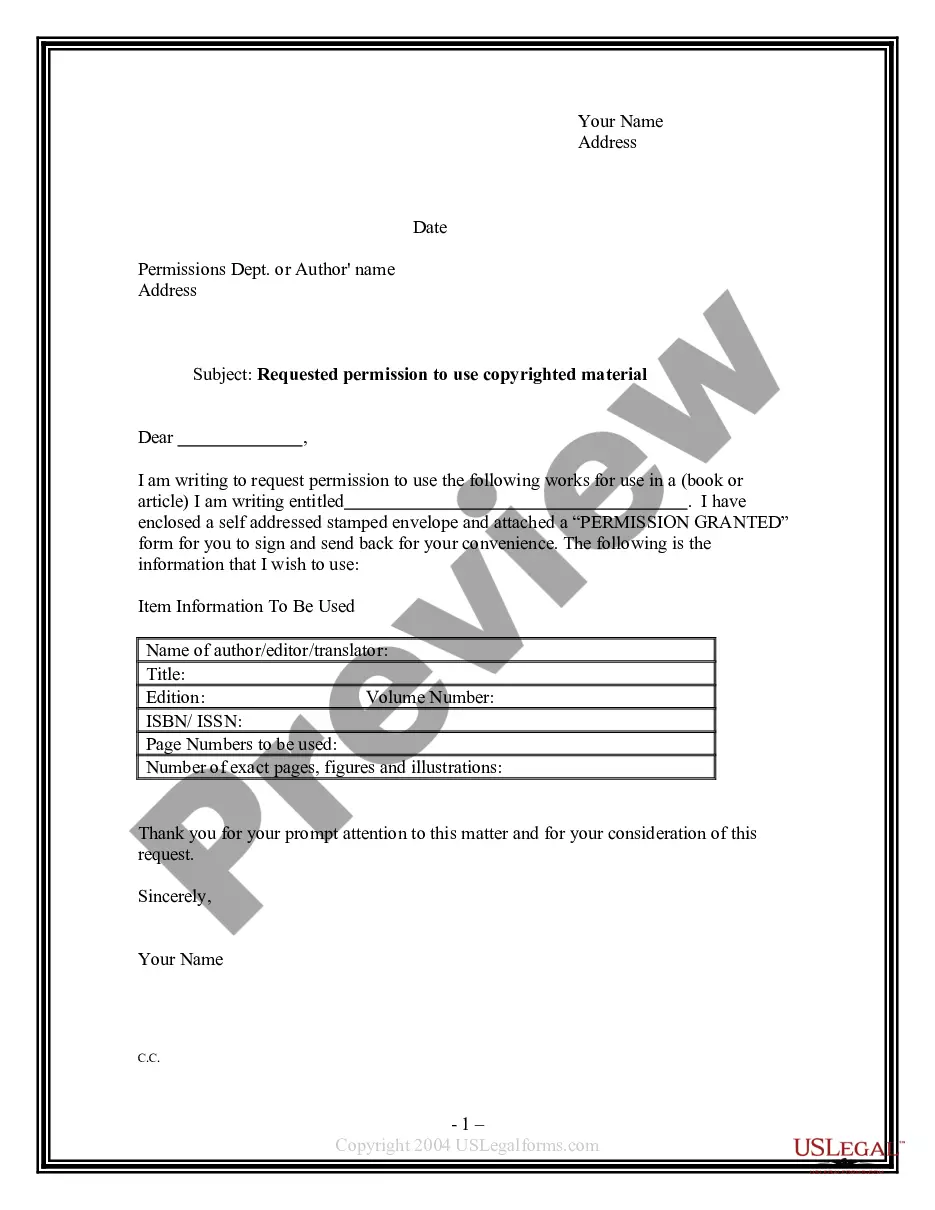
This is a permission request made by a teacher or professor requesting the right to use an author's material for a class or as part of a school curriculum. This form also includes an addendum for the author or editor to sign and send back to the teacher granting permission.
South Carolina Permission Request to Use Copyrighted Material For Class
State:
Multi-State
Control #:
US-PRM-04
Format:
Word;
Rich Text
Instant download
Description
Free preview

How to fill out Permission Request To Use Copyrighted Material For Class?
If you need to compile, obtain, or print legal document templates, utilize US Legal Forms, the largest collection of legal forms available online. Take advantage of the site's straightforward and user-friendly search to find the documents you require. A range of templates for business and personal purposes are categorized by type and jurisdiction, or keywords. Use US Legal Forms to locate the South Carolina Permission Request to Use Copyrighted Material for Class in just a few clicks.
If you are already a US Legal Forms user, Log In to your account and click the Download button to obtain the South Carolina Permission Request to Use Copyrighted Material for Class. You can also access forms you have previously downloaded from the My documents section of your account.
If you are using US Legal Forms for the first time, refer to the instructions below: Step 1. Ensure you have selected the form for the correct city/state. Step 2. Use the Preview feature to review the form's content. Don’t forget to read the description. Step 3. If you are not satisfied with the form, utilize the Search box at the top of the screen to find other versions of the legal form template. Step 4. Once you have found the form you need, select the Buy now option. Choose your preferred pricing plan and enter your details to create an account. Step 5. Complete the transaction. You can use your Visa or Mastercard or PayPal account to finalize the purchase. Step 6. Choose the format of the legal form and download it to your device. Step 7. Fill out, edit, and print or sign the South Carolina Permission Request to Use Copyrighted Material for Class.
Avoid altering or removing any HTML tags. Only synonymize plain text outside of the HTML tags.
- Every legal document template you purchase is yours permanently.
- You have access to every form you downloaded in your account.
- Click on the My documents section and select a form to print or download again.
- Compete and obtain, and print the South Carolina Permission Request to Use Copyrighted Material for Class with US Legal Forms.
- There are thousands of professional and state-specific forms available for your business or personal needs.
- Find the right legal documents easily and efficiently.
- Secure your legal documents with US Legal Forms.
Form popularity
FAQ
To write a letter requesting permission to use copyrighted material, begin by clearly stating your intent and the specific material you wish to use. Include details about your class, the purpose of the usage, and how the material will be incorporated. It's essential to be polite and respectful, as this increases the chances of receiving a positive response. For assistance, consider using US Legal Forms, which offers templates that guide you through the South Carolina Permission Request to Use Copyrighted Material For Class process effectively.
To legally use copyrighted material in a school project, you should either obtain permission from the copyright owner or ensure your use qualifies as fair use. You may need to submit a South Carolina Permission Request to Use Copyrighted Material For Class to make sure you're following the correct procedures. Additionally, using resources like USLegalForms can help you navigate the legal aspects involved in your project.
Students can use copyrighted materials for school purposes under certain conditions, such as fair use. However, it is essential to understand that fair use has limitations and does not cover all types of usage. If you are unsure, consider submitting a South Carolina Permission Request to Use Copyrighted Material For Class to clarify permissions. This approach protects you and fosters respect for copyright laws.
To request permission to use copyrighted material, you need to identify the copyright owner and reach out to them directly. Clearly state your intention for using their material and provide details about your project. Utilizing the South Carolina Permission Request to Use Copyrighted Material For Class can guide you through this process, ensuring you include all necessary information. Consider using platforms like USLegalForms to streamline your request and ensure compliance.
Fair Use in the ClassroomFair use allows copying of copyrighted material in an educational setting, such as a teacher or a student using images in the classroom. Fair use is flexible concept and can be open to interpretation in certain cases.
If you are using copyrighted materials for a class-related assignment (e.g. powerpoint, video, essay) that stays within the confines of your classroom, and the assignment is not shared beyond your professor and fellow students, then yes, it is considered fair use.
Under § 110(1), faculty and students may only perform or display but not reproduce or distribute any copyrighted work in the course of face-to-face teaching activities in a classroom, without seeking permission.
The Fair Use Doctrine (Section 107 of the Copyright Act) provides for limited use of copyrighted materials for educational and research purposes without obtaining the permission of the copyright owner.
The Copyright Office cannot grant permission to use copyrighted works. In many situations, securing permission is the most certain way to ensure an intended use is not an infringement of the copyright owner's rights.