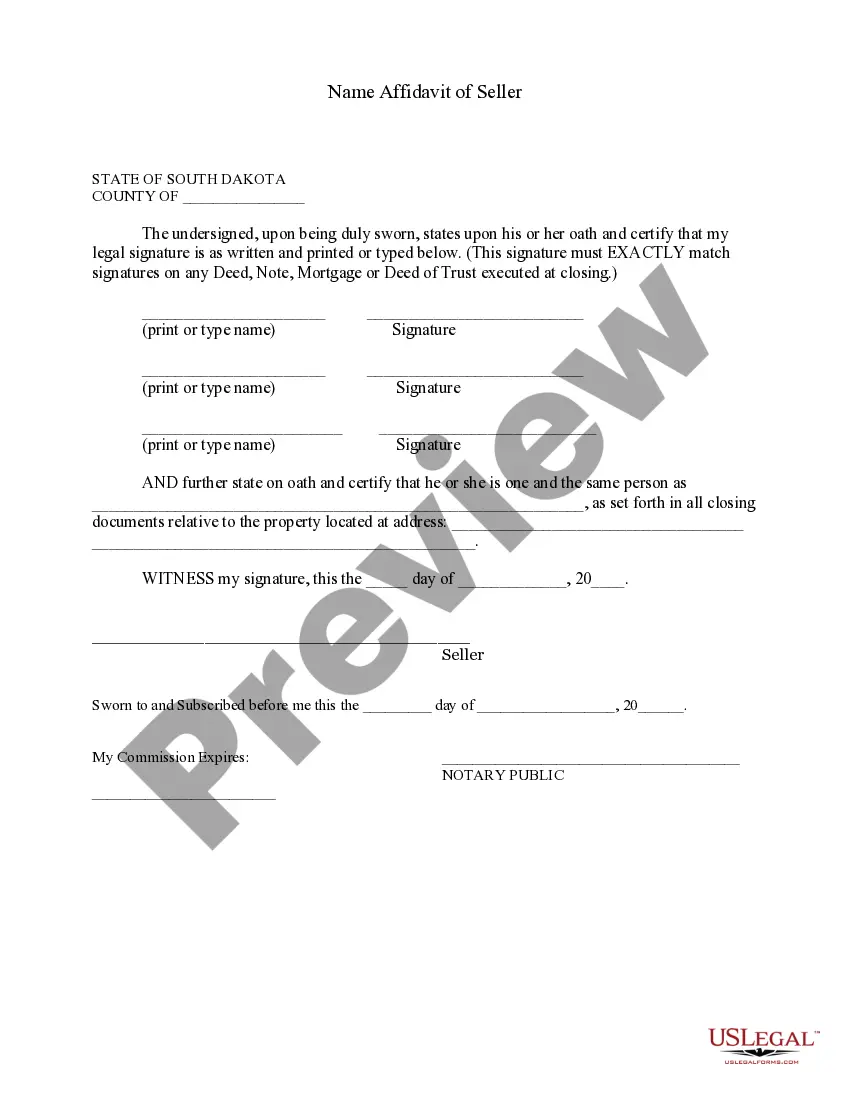
South Dakota Name Affidavit of Seller
Understanding this form
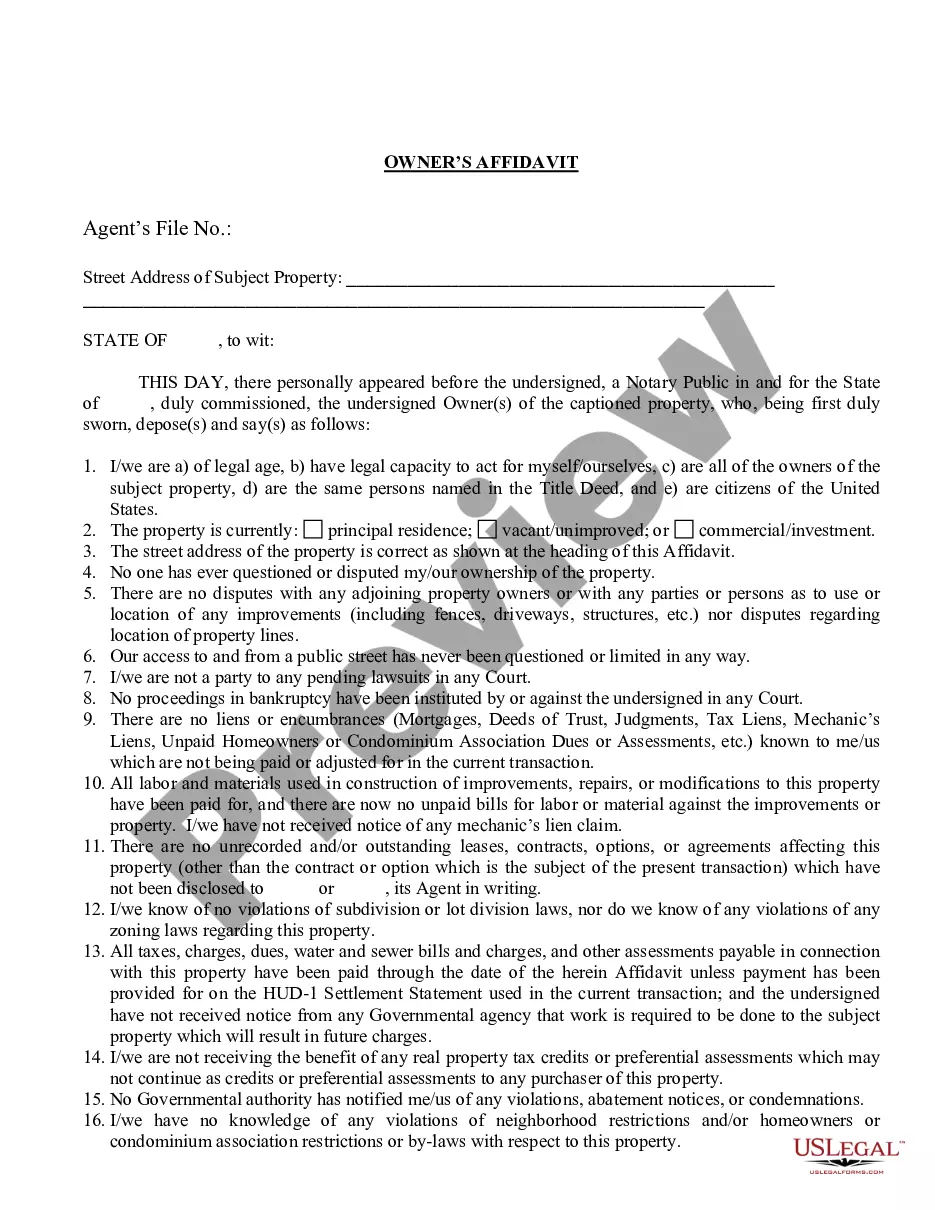
The Name Affidavit of Seller is a legal document that allows a seller to affirm their legal name, provide their signature, and disclose any additional names they may be known by. This form is essential when discrepancies exist in how a name may appear on various documents, ensuring that all signatures represent the same individual. It serves as a clarification tool, distinguishing between different variations of a name used in real estate transactions or contracts.
Main sections of this form
- Affidavit statement confirming legal name and signatures.
- Declaration of other names known by the seller, if applicable.
- Space for the sellerâs printed name and signature.
- Details regarding the property related to the transaction.
- Notary section for attesting the sellerâs signature.

Situations where this form applies
This form is typically used during real estate transactions to ensure that all parties recognize the sellerâs identity. If a seller has used different name variations in official documents, such as deeds or loans, this affidavit helps clarify that they are the same person. Additionally, it may be required for others to verify the sellerâs identity and legal authority in closing documents.
Intended users of this form
- Real estate sellers involved in property transactions.
- Individuals with multiple legal name variations.
- Anyone required to verify their identity for legal documents.
How to prepare this document
- Enter the county and state where the affidavit is being executed.
- Clearly print or type your legal name exactly as it appears on relevant documents.
- Sign the affidavit, making sure your signature matches any signatures on associated documents.
- Include any other names you have previously used for clarification.
- Provide the address of the property related to the transaction.
- Have the affidavit notarized to affirm your identity officially.
Notarization guidance
This form must be notarized to be legally valid. US Legal Forms provides secure online notarization powered by Notarize, allowing you to complete the process through a verified video call.
Get your form ready online
Our built-in tools help you complete, sign, share, and store your documents in one place.
Make edits, fill in missing information, and update formatting in US Legal Forms—just like you would in MS Word.
Download a copy, print it, send it by email, or mail it via USPS—whatever works best for your next step.
Sign and collect signatures with our SignNow integration. Send to multiple recipients, set reminders, and more. Go Premium to unlock E-Sign.
If this form requires notarization, complete it online through a secure video call—no need to meet a notary in person or wait for an appointment.
We protect your documents and personal data by following strict security and privacy standards.
Make edits, fill in missing information, and update formatting in US Legal Forms—just like you would in MS Word.
Download a copy, print it, send it by email, or mail it via USPS—whatever works best for your next step.
Sign and collect signatures with our SignNow integration. Send to multiple recipients, set reminders, and more. Go Premium to unlock E-Sign.

If this form requires notarization, complete it online through a secure video call—no need to meet a notary in person or wait for an appointment.
We protect your documents and personal data by following strict security and privacy standards.
Common mistakes
- Failing to match the signature exactly to previous documents.
- Not including all known names without clarification.
- Leaving out critical information such as property address.
- Neglecting to have the document notarized, if required.
Benefits of completing this form online
- Immediate access to a legally vetted template drafted by licensed attorneys.
- Convenience of downloading and completing the form at your own pace.
- Ability to customize the document to fit your specific situation.
- Secure storage and easy revision as necessary.
Summary of main points
- The Name Affidavit of Seller clarifies legal identity and signature variations.
- It is an essential document for real estate transactions in South Dakota.
- Proper completion and notarization of the form are critical for legal validity.
Looking for another form?

Form popularity
FAQ
You will need your original out of state titles, a copy of your state driver license, social security number, and a Motor Vehicle and Boat Title & Registration Application. Take this paperwork to your local county treasurer's office to complete registration process.
Vehicles owners may obtain a duplicate title by completing a Duplicate Title Application along with submitting a $10 fee. Submit the form and payment to the local county treasurer's office.
Identification. Proof of ownership certificate. A settlement letter. Notification of Change of Ownership. Vehicle Registration Certificate. Proof of sale. RWC (Roadworthy Certificate) Service history and receipts.
Motor vehicle titling and registration is handled through your local county treasurer's office. An Motor Vehicle or Boat Title & Registration Application must be signed by the record owner(s) or by an authorized agent for the record owner(s).
A seller can obtain a seller's permit online at SD.cars.org or at the seller's local county treasurer's office. A seller's permit cannot be issued for a boat or a snowmobile.
The following line says Signature of buyer. The buyer should sign on this line. Next to that, the buyer should print their name. Note that if two people are taking ownership of the car, both people must fit their names on the same lines. The next line says Name of seller. The seller should print their name there.
When selling a car to a private buyer in South Dakota, you have to fill out a Seller's Report of Sale (Form MV2200). Once done, make sure that you submit it to your local SD county treasurer.
First, the seller has to release ownership of the car by signing the title. The buyer then takes the signed title to the DMV, and the state issues a new registration and title. Some states might require additional paperwork to complete the process, such as a bill of sale or a transfer of ownership form.
A title-holding state is one where the lienholder (your lender) keeps the title until you've paid off the auto loan.The nine non-title holding states are: Michigan, Minnesota, New York, Arizona, Kentucky, Oklahoma, Wisconsin, Maryland, and South Dakota.