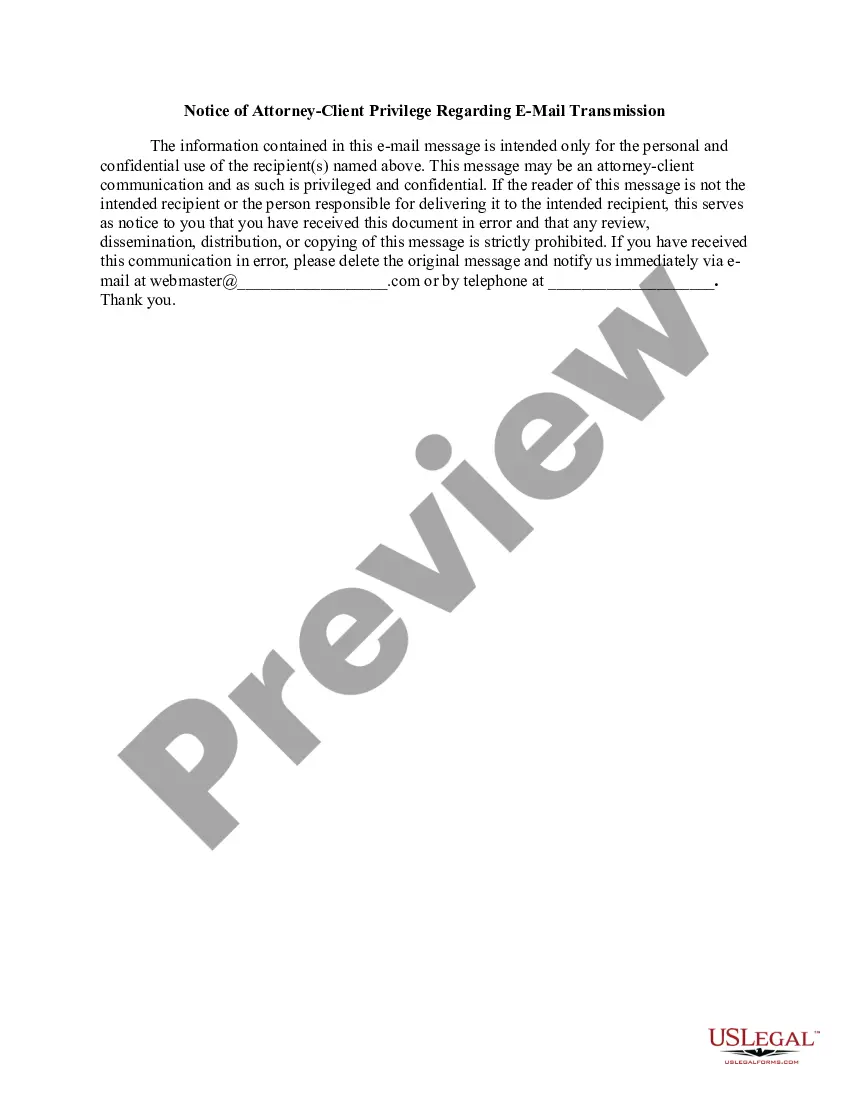
South Dakota Notice of Attorney-Client Privilege Regarding E-Mail Transmission
Description
Get your form ready online
Our built-in tools help you complete, sign, share, and store your documents in one place.
Make edits, fill in missing information, and update formatting in US Legal Forms—just like you would in MS Word.
Download a copy, print it, send it by email, or mail it via USPS—whatever works best for your next step.
Sign and collect signatures with our SignNow integration. Send to multiple recipients, set reminders, and more. Go Premium to unlock E-Sign.
If this form requires notarization, complete it online through a secure video call—no need to meet a notary in person or wait for an appointment.
We protect your documents and personal data by following strict security and privacy standards.

Make edits, fill in missing information, and update formatting in US Legal Forms—just like you would in MS Word.

Download a copy, print it, send it by email, or mail it via USPS—whatever works best for your next step.

Sign and collect signatures with our SignNow integration. Send to multiple recipients, set reminders, and more. Go Premium to unlock E-Sign.

If this form requires notarization, complete it online through a secure video call—no need to meet a notary in person or wait for an appointment.

We protect your documents and personal data by following strict security and privacy standards.
Looking for another form?
How to fill out Notice Of Attorney-Client Privilege Regarding E-Mail Transmission?
If you want to complete, download, or create authorized document templates, utilize US Legal Forms, the largest selection of legal forms available online. Take advantage of the site’s easy and user-friendly search feature to locate the documents you need. Many templates for business and personal purposes are categorized by types and keywords. Use US Legal Forms to quickly find the South Dakota Notice of Attorney-Client Privilege Regarding E-Mail Transmission with just a few clicks.
If you are already a US Legal Forms customer, Log In to your account and then click the Obtain button to access the South Dakota Notice of Attorney-Client Privilege Regarding E-Mail Transmission. You can also retrieve forms you have previously acquired from the My documents section of your account.
If you are using US Legal Forms for the first time, follow the steps outlined below: Step 1. Ensure you have selected the form for your relevant city/region. Step 2. Use the Review option to examine the form's content. Don’t forget to read the description. Step 3. If you are not satisfied with the form, use the Search field at the top of the screen to find other versions of the legal form template. Step 4. Once you have found the form you need, click the Get now button. Choose the payment plan you prefer and input your details to register for an account. Step 5. Complete the transaction. You can use your credit card or PayPal account to finalize the payment. Step 6. Select the format of the legal form and download it to your device. Step 7. Complete, edit, and print or sign the South Dakota Notice of Attorney-Client Privilege Regarding E-Mail Transmission.
Each legal document template you buy is yours permanently. You have access to all forms you have acquired in your account. Click on the My documents area and select a form to print or download again.
Stay competitive and download, and print the South Dakota Notice of Attorney-Client Privilege Regarding E-Mail Transmission with US Legal Forms. There are numerous professional and state-specific forms that you can utilize for your business or personal requirements.
- Every legal document template you purchase is yours indefinitely.
- You have access to every form you acquired in your account.
- Click on the My documents section and select a form to print or download again.
- Stay competitive and download, and print the South Dakota Notice of Attorney-Client Privilege Regarding E-Mail Transmission with US Legal Forms.
- There are thousands of professional and state-specific forms available for your business or personal needs.
Form popularity
FAQ
A client has a privilege to refuse to disclose and to prevent any other person from disclosing confidential communications made for the purpose of facilitating the rendition of professional legal services to the client: (1) Between himself or his representative and his lawyer or his lawyer's representative; (2) Between ...
The confidentiality rule, for example, applies not only to matters communicated in confidence by the client but also to all information relating to the representation, whatever its source. A lawyer may not disclose such information except as authorized or required by the Rules of Professional Conduct or other law.
The attorney-client privilege is a type of privileged communication that is recognized by law and protects certain confidential communications between a lawyer and a client from being included in a discovery process.
Rule 5.5 - Unauthorized Practice of Law; Multijurisdictional Practice of Law (a) A lawyer shall not practice law in a jurisdiction in violation of the regulation of the legal profession in that jurisdiction, or assist another in doing so.
Confidentiality refers to the professional norm that information offered by or pertaining to clients will not be shared with third parties. Privilege refers to the disclosure of confidential information in court or during other legal proceedings.
With respect to confidentiality and privileged communication: confidentiality is primarily an ethical issue, and privileged communication is primarily a legal issue.
Confidentiality is a responsibility to protect someone else's choices about disclosure, and. Privilege is a legal rule prohibiting the disclosure of private information against someone's will.
Privileged and confidential communication is the interaction between two parties having a legally protected, private relationship. Law cannot force such parties to disclose the content of communication made between them.