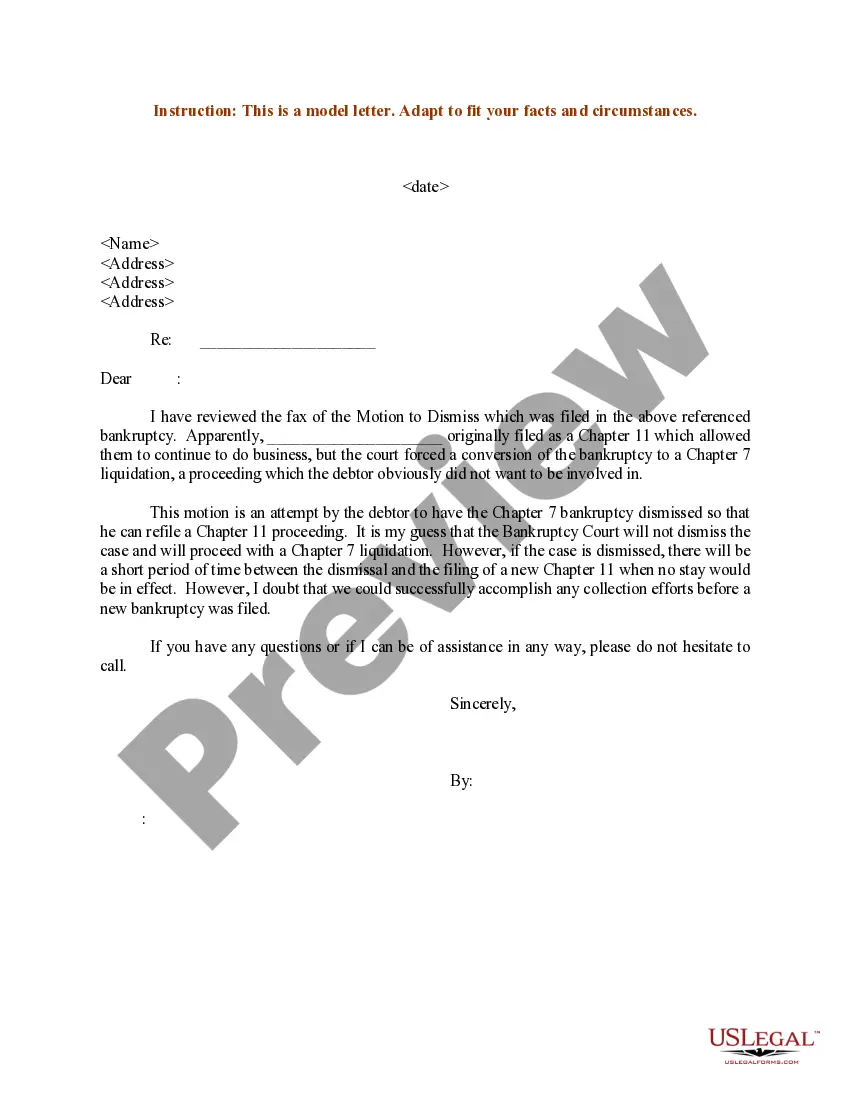
Tennessee Sample Letter for Motion to Dismiss in Referenced Bankruptcy
Description
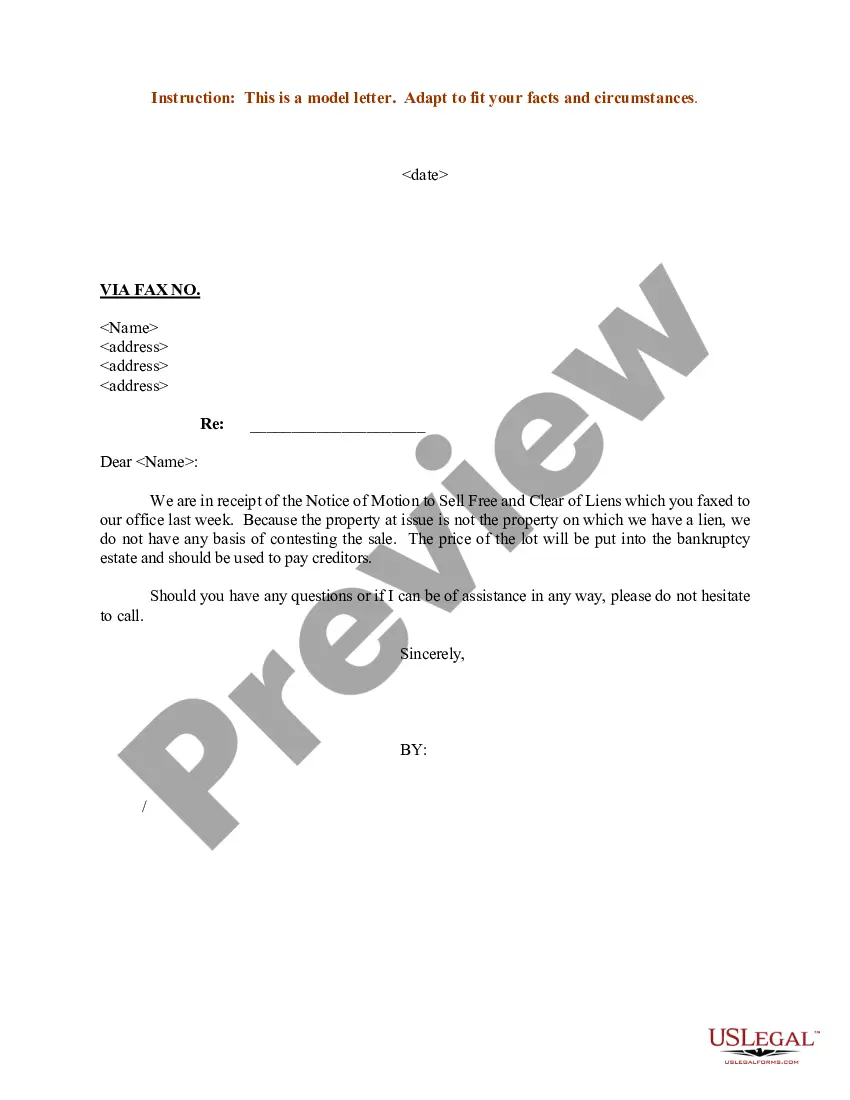


How to fill out Sample Letter For Motion To Dismiss In Referenced Bankruptcy?
If you need to compile, obtain, or print legal document templates, use US Legal Forms, the best collection of legal forms available online.
Utilize the site’s straightforward and convenient search to find the documents you need.
Various templates for business and personal purposes are sorted by categories and states, or keywords.
Once you have located the form you need, click the Purchase now option. Choose the pricing plan you prefer and enter your credentials to register for an account.
Process the transaction. You can use your Visa or Mastercard or PayPal account to complete the transaction. Step 6. Select the format of your legal form and download it onto your device. Step 7. Fill out, edit, and print or sign the Tennessee Sample Letter for Motion to Dismiss in Referenced Bankruptcy. Every legal document template you acquire is yours indefinitely. You have access to every form you downloaded in your account. Click the My documents section and select a form to print or download again. Stay competitive and obtain and print the Tennessee Sample Letter for Motion to Dismiss in Referenced Bankruptcy with US Legal Forms. There are millions of professional and state-specific forms you can utilize for your business or personal needs.
- Employ US Legal Forms to acquire the Tennessee Sample Letter for Motion to Dismiss in Referenced Bankruptcy in just a few clicks.
- If you are already a US Legal Forms customer, Log In to your account and click the Download option to access the Tennessee Sample Letter for Motion to Dismiss in Referenced Bankruptcy.
- You can also access forms you previously downloaded in the My documents tab of your account.
- If you are using US Legal Forms for the first time, follow the instructions below.
- Ensure you have selected the form for the appropriate city/state.
- Use the Preview mode to review the form’s content. Don’t forget to read the description.
- If you are dissatisfied with the form, utilize the Search area at the top of the screen to find other types of your legal form template.
Form popularity
FAQ
Once you legally file for bankruptcy, your creditors should no longer phone you or sue you and any existing garnishees are lifted. An appointed Licensed Insolvency Trustee will distribute money to your creditors from your non-exempt assets and surplus income.
However, there are certain restrictions and limitations on what you can and cannot do after filing for Chapter 7 bankruptcy. Avoid Spending Outside Your Income Levels. ... You Cannot Neglect Your Alimony & Child Support Obligations After Chapter 7. ... You Cannot Ignore Student Loans. ... You Cannot Eliminate Most Tax Debt.
The simplest answer is that a bankruptcy eliminates most, if not all, of what are known as 'unsecured' debts. These include credit card debt, lines of credit, bank loans, payday loans and income tax debt. When you file for bankruptcy, you will no longer have to worry about repaying these debts.
A Chapter 7 bankruptcy takes approximately four to six months after the initial filing to be completed and your debts discharged. After that, you can apply for a credit card. A Chapter 13 bankruptcy, however, can take between three to five years as it's a restructuring of your debt that you pay off over time.
Save all paperwork from your bankruptcy case. Though it may not seem like a critical step, save all paperwork from your bankruptcy case. ... Start saving money. ... Build a budget. ... Reestablish good credit. ... Regularly monitor your credit reports. ... Maintain your job and home. ... Make an emergency fund. ... Set financial goals.
After your bankruptcy filing falls off your credit report, your FICO score calculation could show a 30-to-100-point increase depending on the other information on your report.
Effects of discharge After discharge, the NPII will be updated to show that the bankrupt has been discharged. Credit reporting bodies are permitted under privacy legislation to keep a record of bankruptcies for up to five years from the date of bankruptcy or two years from the date of discharge, whichever is longer.
On discharge from your bankruptcy, you are released from most of the debts included in your bankruptcy and you don't have to pay any more of the outstanding amount owed to the creditors included in your bankruptcy.