Texas General Warranty Deed from a Limited Liability Company to a Municipal Corporation
Overview of this form
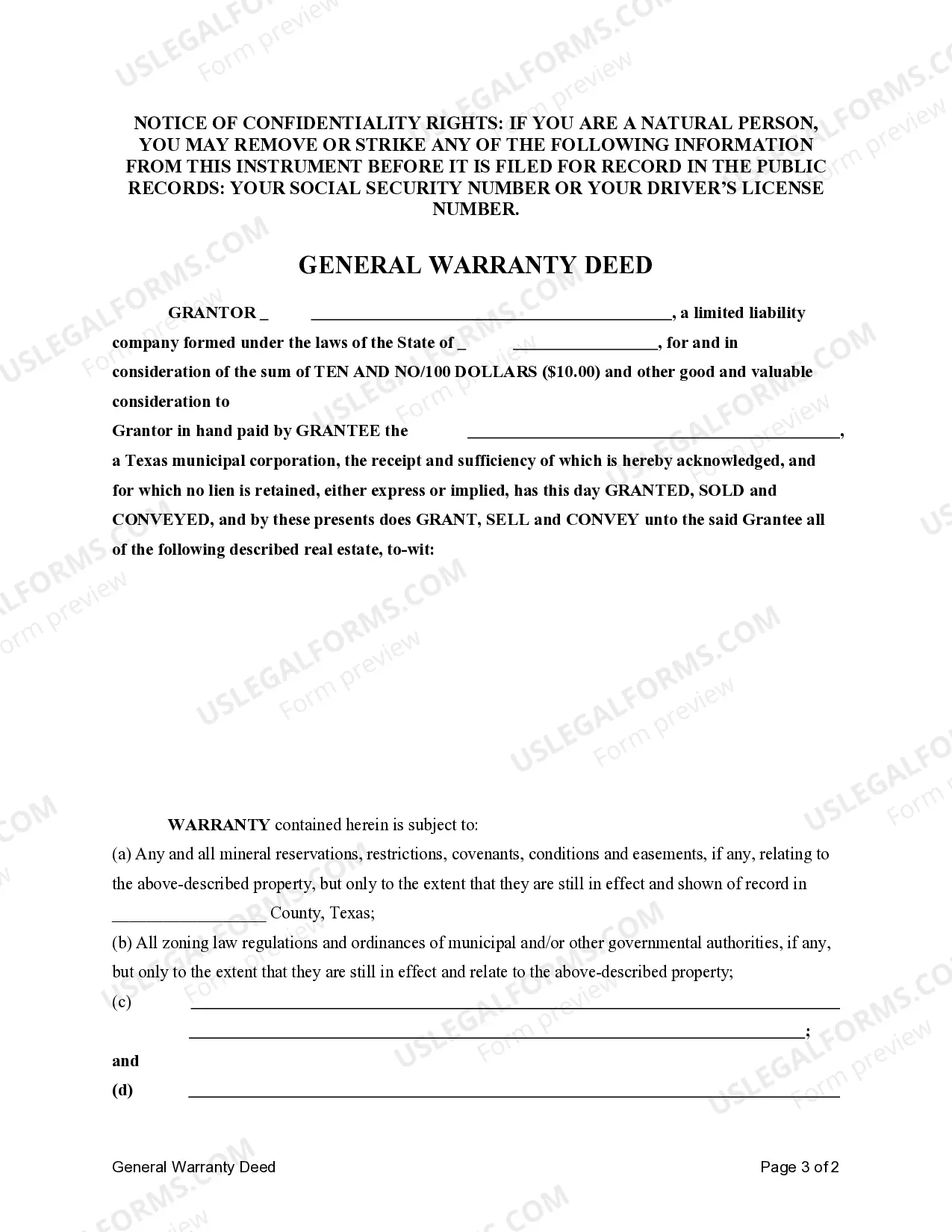
The General Warranty Deed from a Limited Liability Company to a Municipal Corporation is a legal document that transfers property ownership from a limited liability company (LLC) to a municipal corporation. This deed offers a warranty, meaning the grantor assures the grantee that the property is free from any claims or encumbrances. Unlike other types of deeds, a General Warranty Deed provides the highest level of protection for the grantee, making it suitable for formal property transactions involving government entities.
What’s included in this form
- Identification of the grantor (LLC) and grantee (municipal corporation).
- Description of the property being transferred, including legal boundaries.
- Warranties and covenants made by the grantor regarding the property.
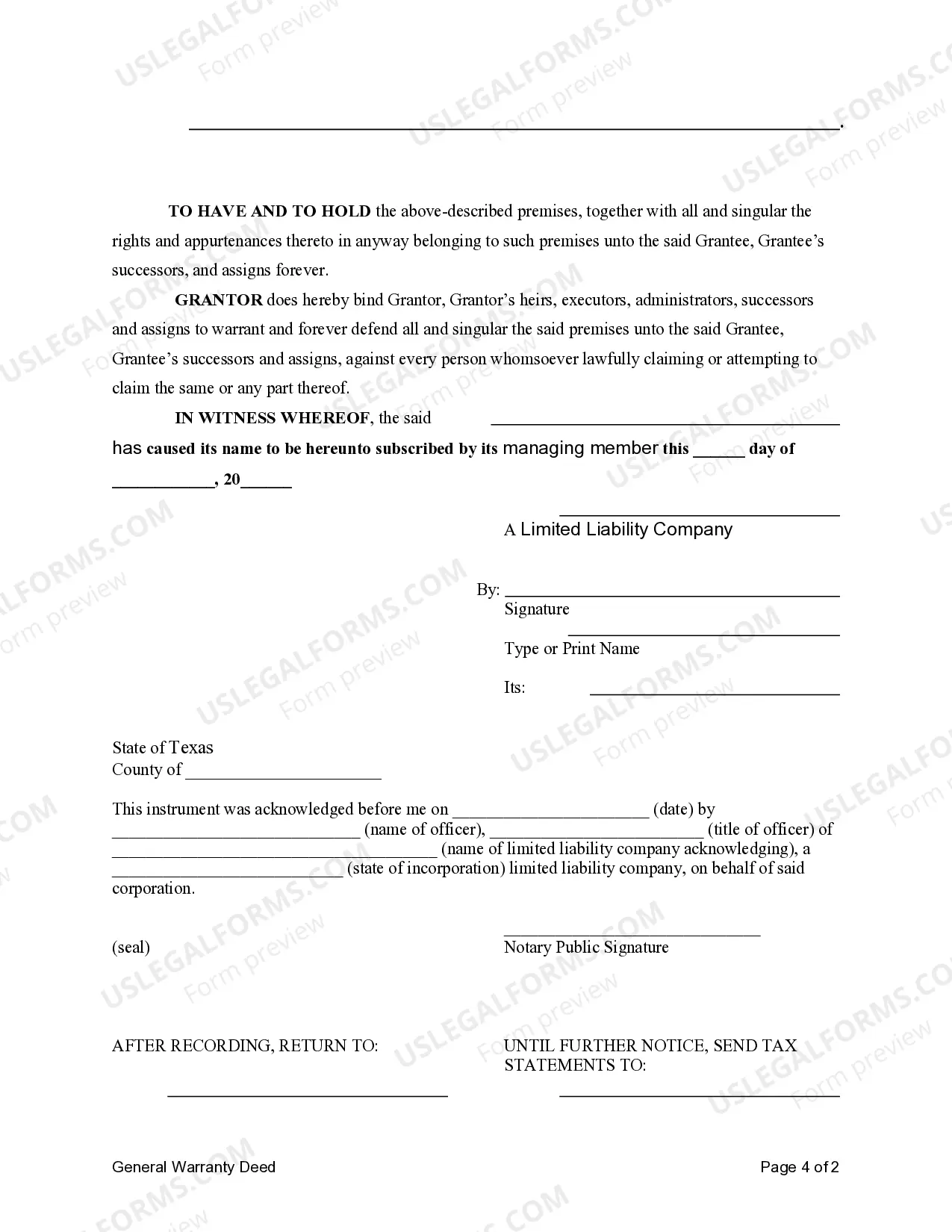
- Signatures of the grantor and any required witnesses.
- Notarization to validate the deed in certain jurisdictions.



Common use cases
This form should be used in situations where an LLC is transferring ownership of property to a municipal corporation. Common scenarios include the sale of land for public use, such as parks or infrastructure projects, where the LLC wishes to ensure the municipality has full ownership and rights over the property without any disputes in the future.
Who needs this form
- Limited liability companies transferring property ownership.
- Municipal corporations acquiring property for civic use.
- Individuals representing either party in a property transaction.
Instructions for completing this form
- Identify the parties: Clearly state the names of the LLC (grantor) and the municipal corporation (grantee).
- Specify the property: Describe the property in detail, including its legal description and address.
- Enter warranty details: Include the specific warranties being provided by the grantor regarding the property.
- Gather signatures: Ensure the grantor signs the deed and any witnesses, if required, also sign.
- Notarize the document: Depending on jurisdiction requirements, have the form notarized to validate it legally.
Does this form need to be notarized?
This form does not typically require notarization unless specified by local law. However, notarization may enhance the legal standing and enforceability of the deed in certain jurisdictions, so check local requirements.
Get your form ready online
Our built-in tools help you complete, sign, share, and store your documents in one place.
Make edits, fill in missing information, and update formatting in US Legal Forms—just like you would in MS Word.
Download a copy, print it, send it by email, or mail it via USPS—whatever works best for your next step.
Sign and collect signatures with our SignNow integration. Send to multiple recipients, set reminders, and more. Go Premium to unlock E-Sign.
If this form requires notarization, complete it online through a secure video call—no need to meet a notary in person or wait for an appointment.
We protect your documents and personal data by following strict security and privacy standards.
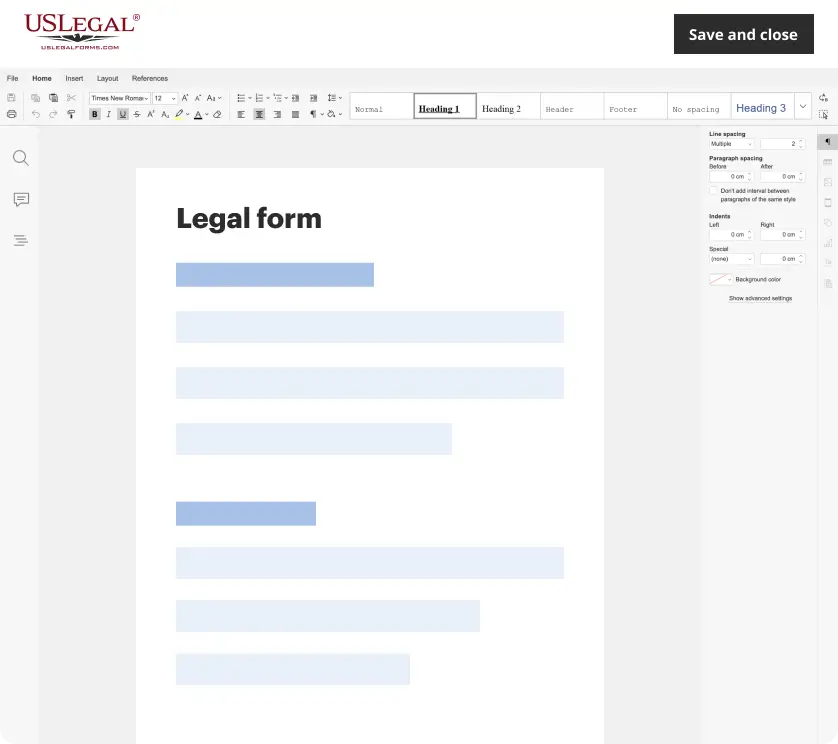
Make edits, fill in missing information, and update formatting in US Legal Forms—just like you would in MS Word.
Download a copy, print it, send it by email, or mail it via USPS—whatever works best for your next step.
Sign and collect signatures with our SignNow integration. Send to multiple recipients, set reminders, and more. Go Premium to unlock E-Sign.

If this form requires notarization, complete it online through a secure video call—no need to meet a notary in person or wait for an appointment.
We protect your documents and personal data by following strict security and privacy standards.
Typical mistakes to avoid
- Failing to include a complete legal description of the property.
- Not properly signing or witnessing the document.
- Omitting to check local laws regarding any additional requirements.
- Neglecting to provide necessary warranties or covenants.
Why use this form online
- Convenience of completing the form from anywhere with internet access.
- Editability allows for corrections and updates before finalizing.
- Instant access to a legally vetted form created by licensed attorneys.
Key takeaways
- This General Warranty Deed transfers property ownership from an LLC to a municipal corporation.
- It provides assurances against claims, protecting the granteeâs rights.
- Proper completion and understanding of the formâs requirements are essential for legal compliance and effectiveness.
Looking for another form?
Form popularity
FAQ
Be in writing. make clear on its face that it is intended to be a deed by the person making it or the parties to it. be validly executed as a deed by the person making it or one or more of the parties to it (section 1 of the Law of Property (Miscellaneous Provisions) Act 1989)
1The name and address of the seller (called the grantor)2The name and address of the buyer (called the grantee)3A legal description of the property (found on the previous deed)4A statement that the grantor is transferring the property to the grantee.How to Use a General Warranty Deed .com\nwww..com >> How to Use a General Warranty Deed
There's no way to actually transfer a real estate license from another state to Texas, but there are ways to fast-track getting a Texas real estate license if you're moving. And if you're a licensed agent or broker with a client that wants to buy in Texas you can still earn a commission through portability.
There are several different essentials to a valid deed: 1. It must be in writing; 2. The parties must be properly described; 3. The parties must be competent to convey and capable of receiving the grant of the property; 4.
1Find the most recent deed to the property. It is best to begin with a copy of the most recent deed to the property (the deed that transferred the property to the current grantor).2Create a new deed.3Sign and notarize the deed.4File the documents in the county land records.
They are (1) covenant for seisin; (2) covenant of the right to convey; (3) covenant against encumbrances; (4) covenant for QUIET ENJOYMENT; (5) covenant of general WARRANTY; and (6) covenant for further assurances.
Contrary to normal expectations, the Deed DOES NOT have to be recorded to be effective or to show delivery, and because of that, the Deed DOES NOT have to be signed in front of a Notary Public. However, if you plan to record it, then it does have to be notarized as that is a County Recorder requirement.
Yes, you are not required to be a Texas resident to obtain a Texas real estate license.This includes completing the 180-hour pre-license course, submit a license application, get fingerprinted, and take and pass the state exam.
No. Texas does not have reciprocity with any state. To become licensed, you must satisfy all current Texas licensing requirements.