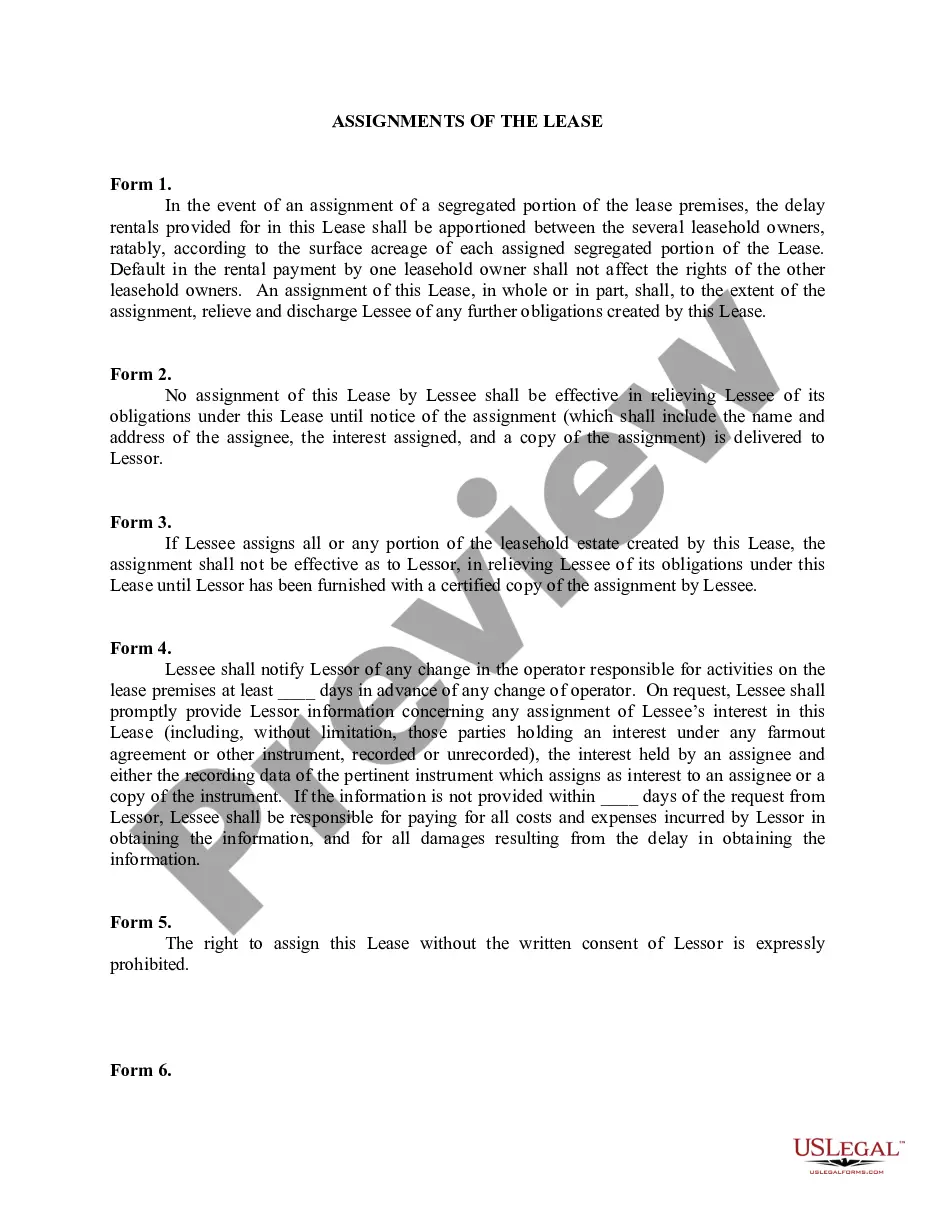
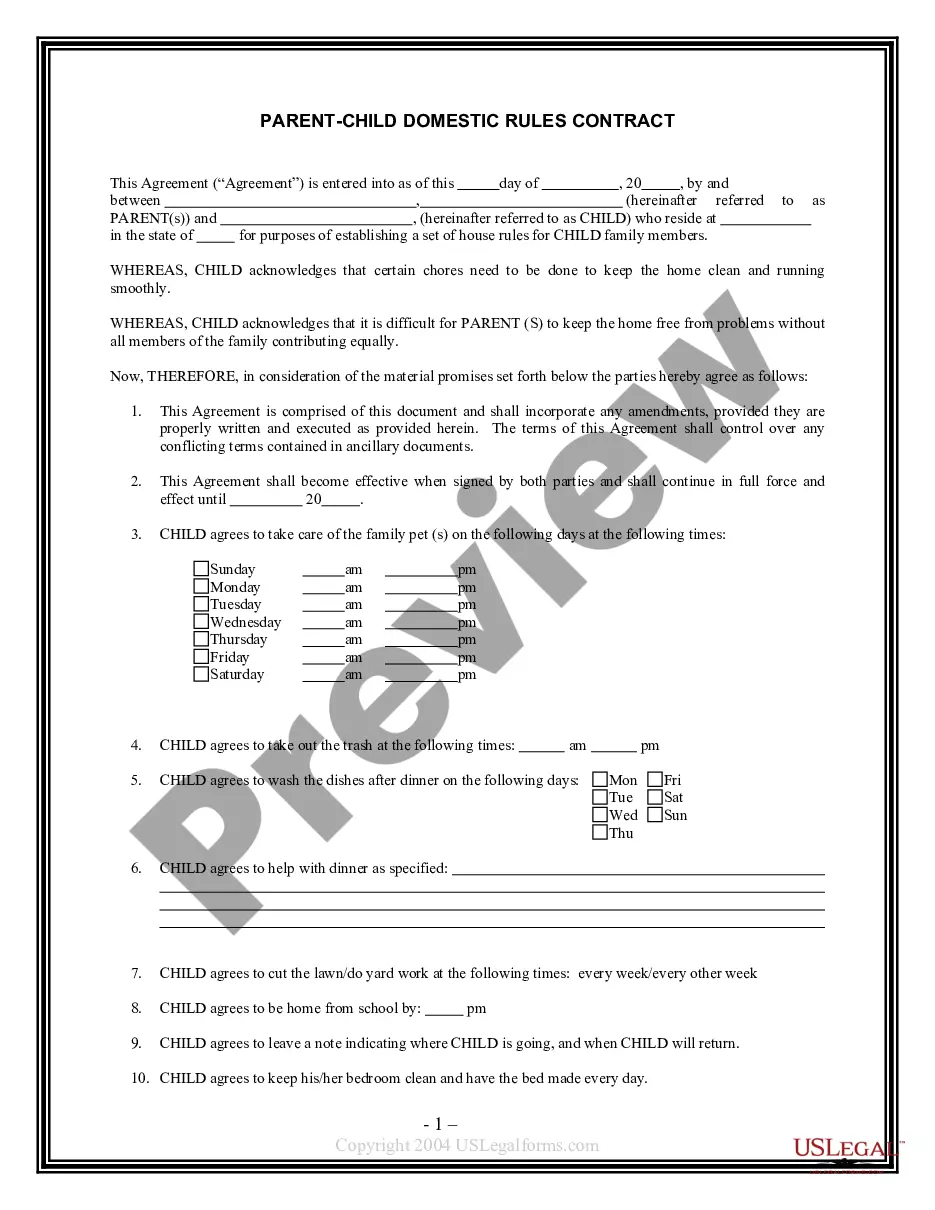
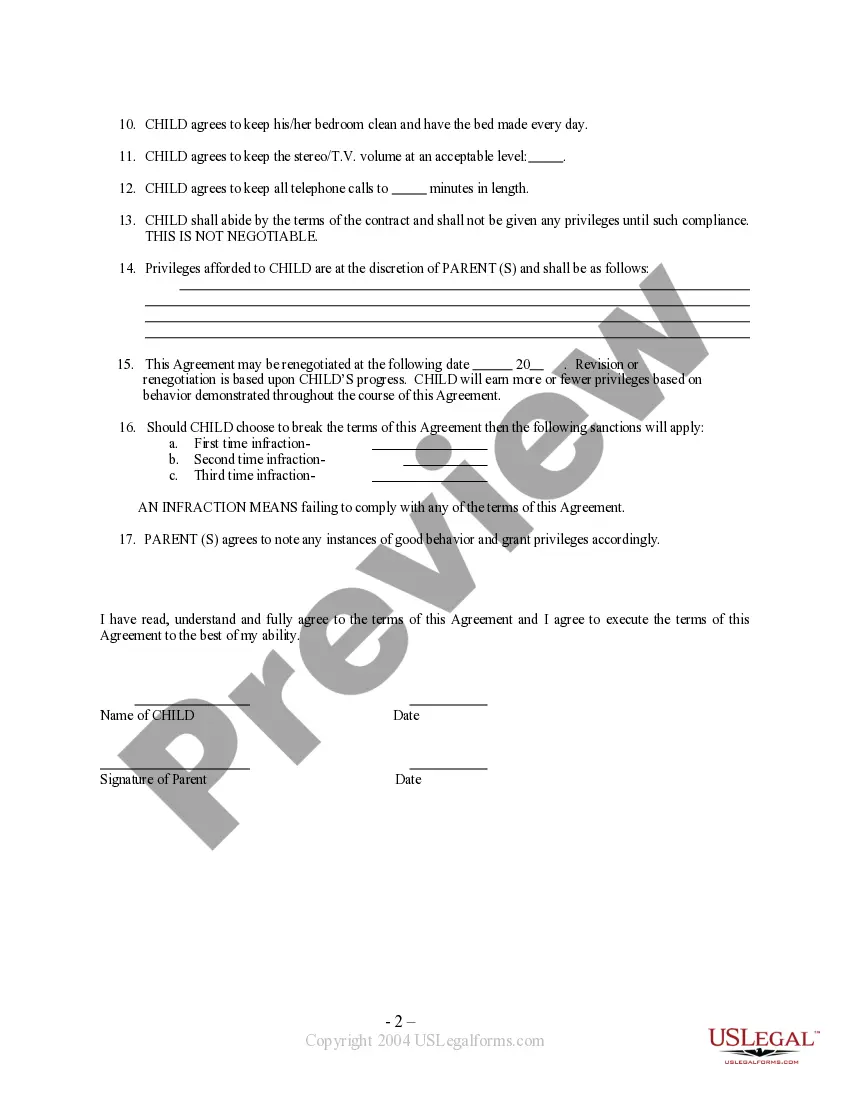
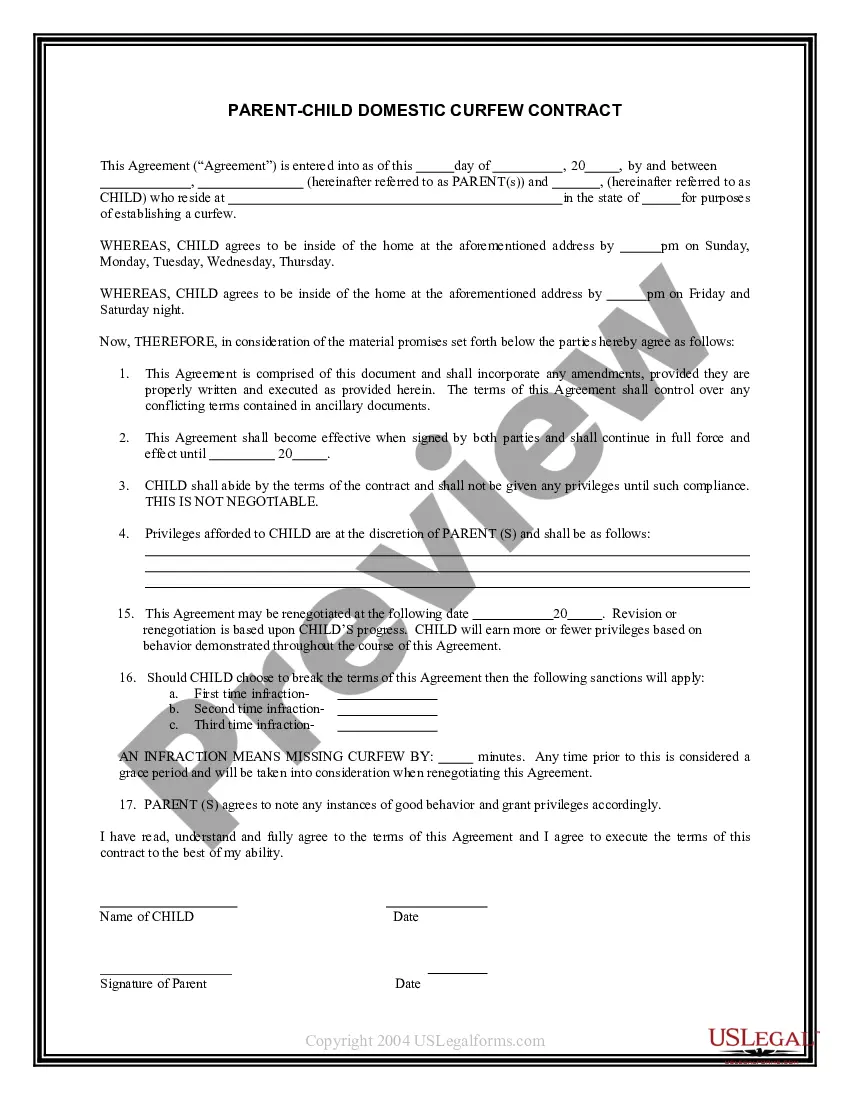
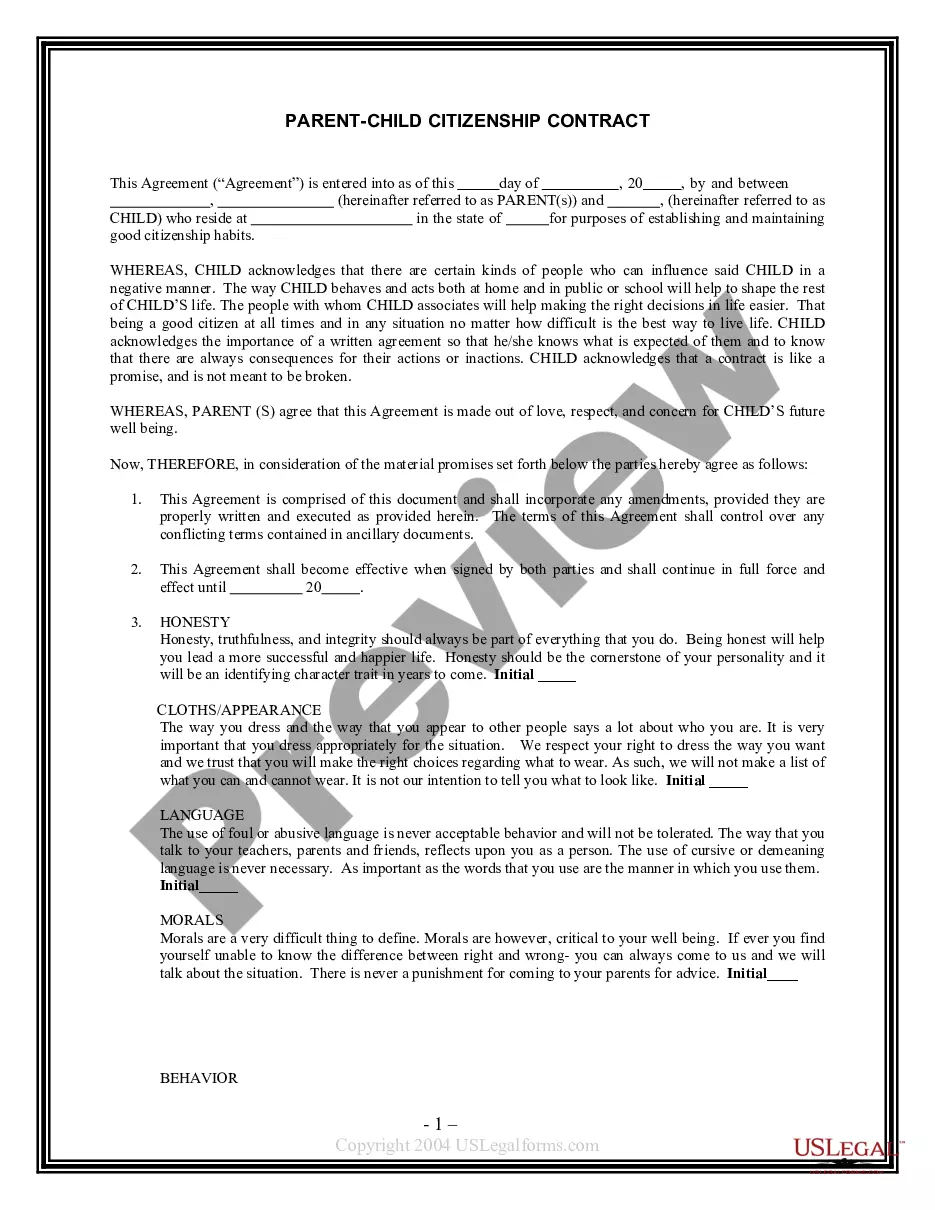
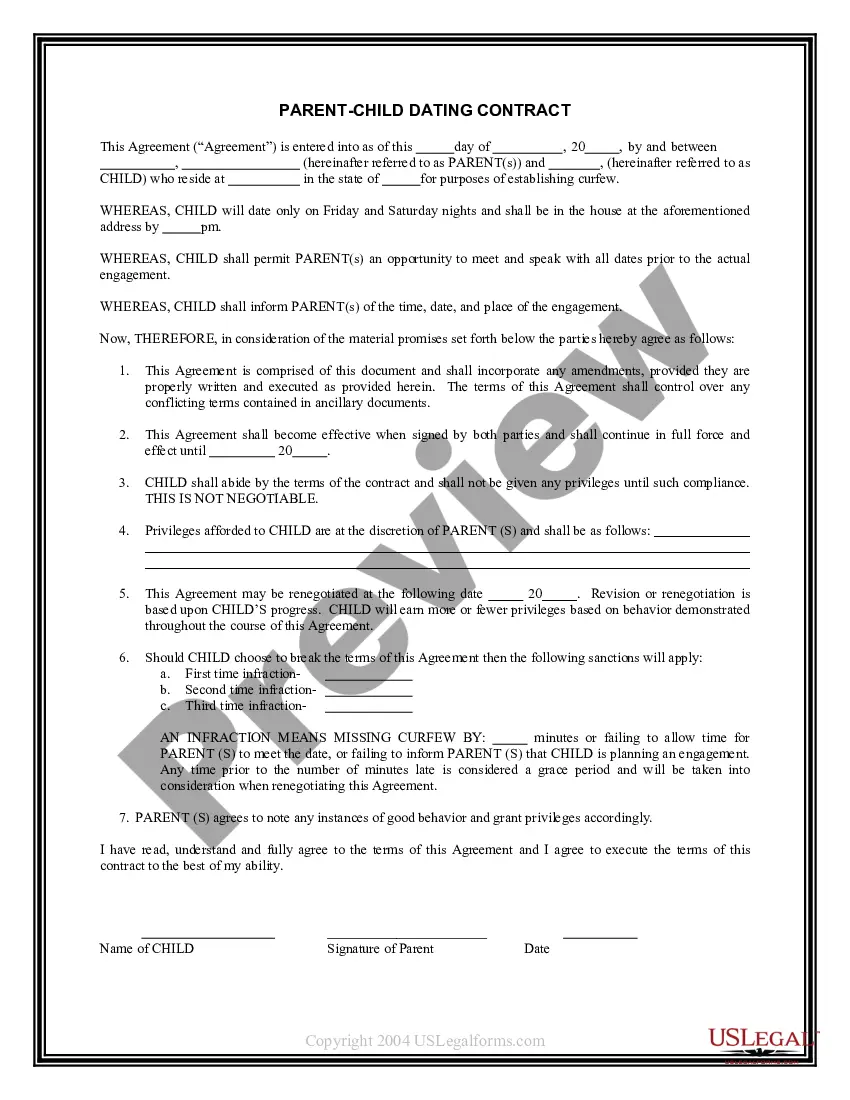
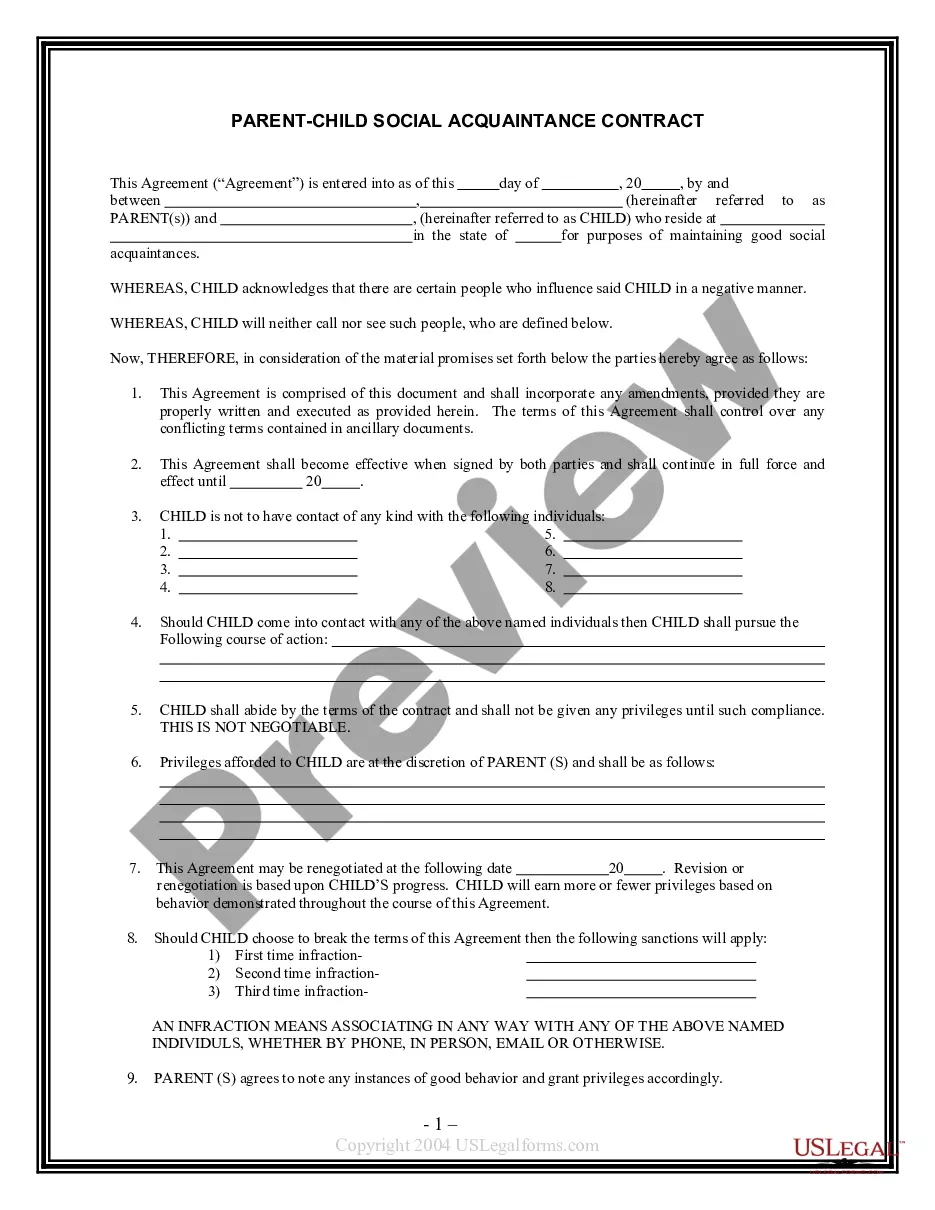
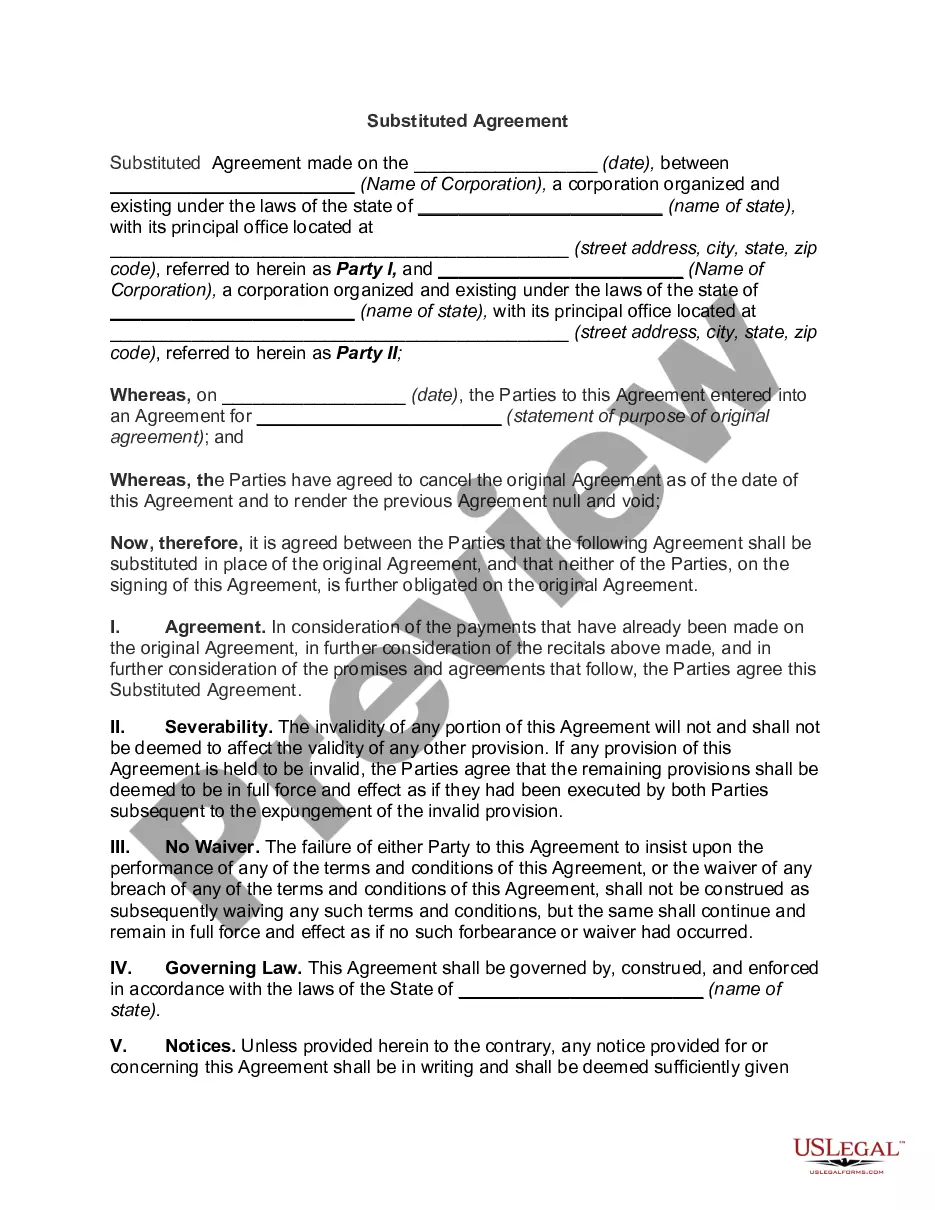
This is a contract between parent(s) and child indicating what chores are expected of child, and on what days and times child is expected to complete the chores. This contract also lists what privileges will be extended for abiding by the contract and what repercussions will follow for breaking the contract.
Texas Parent - Child Domestic Rules Contract
Category:
State:
Multi-State
Control #:
US-PC08
Format:
Word;
Rich Text
Instant download
Description
Free preview
How to fill out Parent - Child Domestic Rules Contract?
Have you found yourself in a scenario where you require papers for both business or personal purposes nearly every day.
There are numerous legitimate document templates accessible online, but finding ones you can trust is challenging.
US Legal Forms provides thousands of form templates, including the Texas Parent - Child Domestic Rules Agreement, which can be tailored to meet state and federal regulations.
Once you find the right form, click Purchase now.
Select the pricing plan you prefer, fill in the necessary information to create your account, and pay for your order using PayPal or credit card. Choose a convenient file format and download your copy. Access all the document templates you have purchased in the My documents menu. You can obtain an additional copy of the Texas Parent - Child Domestic Rules Agreement at any time, if needed. Just click on the required form to download or print the document template. Use US Legal Forms, the most extensive collection of legal forms, to save time and prevent errors. The service offers professionally crafted legal document templates that you can use for various purposes. Create an account on US Legal Forms and start simplifying your life.
- If you are already acquainted with the US Legal Forms website and possess an account, simply Log In.
- Then, you can download the Texas Parent - Child Domestic Rules Agreement template.
- If you do not have an account and wish to start using US Legal Forms, follow these steps.
- Find the form you need and ensure it is for your specific city/county.
- Utilize the Preview button to review the form.
- Read the description to confirm you have selected the correct form.
- If the form is not what you are searching for, use the Search field to locate the form that meets your needs and requirements.
Form popularity
FAQ
One of the biggest mistakes in a custody battle is failing to communicate effectively with the other parent. Poor communication can lead to misunderstandings and conflict, which ultimately affects the children. It's essential to be open and respectful while discussing terms, such as those outlined in a Texas Parent - Child Domestic Rules Contract. By prioritizing collaboration and utilizing legal resources, you can avoid common pitfalls and focus on your children's best interests.
You can obtain a custody agreement without going to court in Texas by using a Texas Parent - Child Domestic Rules Contract. This contract allows parents to establish custody terms that work for both parties while avoiding the court's involvement. By utilizing resources from platforms like US Legal Forms, you can easily access templates and guidance tailored to your situation. This approach fosters cooperation and can lead to a smoother co-parenting experience.
To create a custody agreement without going to court, you can utilize a Texas Parent - Child Domestic Rules Contract. This contract allows both parents to outline their terms regarding custody arrangements in a clear and concise manner. You can draft this agreement collaboratively, ensuring it meets the needs of both parties and prioritizes the child's best interests. Using platforms like US Legal Forms can simplify this process, providing templates and resources to help you effectively create a legally binding document.
One frequently-used option is the 4-3 schedule, where the child spends four days a week with one parent and three days with the other. The 2-2-5-5 schedule is also used by many families. The child spends two days with each parent, then five days with each parent.
The Standard Possession Order says that if the parents don't agree, the noncustodial parent has the right to possession of the child at the times provided for in Texas Family Code 153.3171 if the parents live within 50 miles of one another (starting with cases filed on or after September 1, 2021).
In the state of Texas, a child's decision cannot be the sole factor in determining which parent the child lives with. When the child reaches the age of 12, upon motion, the court can consider the child's wishes when it comes to who they will live with.
Removal of Parental ResponsibilityParental responsibility lasts until a child reaches the age of 18 or marries between the ages of 16 and 18. In reality, it gives parents the responsibility to make important decisions about the child.
The most common joint custody arrangements include the 2-2-3 plan and the 2-2-5 plan. Both involve spending alternate sets of days with either parent. Also common is the alternate week plan, where the child spends one week with a parent and the next week with the other.
In Texas, there is no age under 18 that allows for a child to refuse visitation. Visitation is the right of the parent, and it cannot be taken away by the custodial parent or child. The only option would be for the custodial parent to request a modification of orders.
We are often contacted by parents asking at what age children can decide for themselves where they will live after a divorce or separation. There are lots of articles on the internet about this, and a good number suggest that at a certain age e.g. 10, 12 or 16, a child can make their own decision. This is not the case.